Many magazines will tell you that they don't look more favourably on your submissions if you subscribe. I do know that when Ailsa Cox, John Ashbrook and I published the short story mag Metropolitan we used to join in the magazine-publishers' collective sigh that if only everyone who submitted subscribed we'd be well away, but we made a point of never converting that into a prejudice against submissions from non-subscribers. You do wonder, though, if people are sometimes tempted, but then maybe I'm just an old cynic. Anyway, before it was more generally known that Elizabeth Baines is a writing name, at least I could be sure that that wasn't happening when my stories were accepted by mags, since it's a different name which appears on my cheques and thus usually on mag subscriber lists.
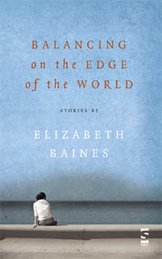
One magazine which reassures us that they are never thus swayed (which reassurance only serves to suggest that they do indeed suspect that some mags are!) is Mslexia, the magazine for women who write. One excellent service they do provide for their subscribers, however, is that they list their latest publications. I've subscribed to Mslexia since its beginning, but since I did so under my non-writing name, and it seemed too fussy to explain, I wasn't able to take advantage of that when Balancing on the the Edge of the World came out. This time, though, I decided to write and explain, and the latest issue has just popped through the door, with Too Many Magpies listed - and they've even included a picture of the cover! Thank you, MsLexia! This issue carries an interview with novelist Kamila Shamsie and the winning stories of the latest Mslexia short story competition.
The problems of having more than one name, though...!
Wednesday, April 07, 2010


Sunday, April 04, 2010
Nightjar Press Chapbooks

I wasn't feeling so good last week, wiped out and pretty much ground to a halt. Nothing I had planned to do in the way of writing got done. I was flopping my way down the stairs one afternoon, fit for nothing but a sit by the fire, and a white envelope dropped through the letterbox in the hall below me, which turned out to contain two of these lovely single-story chapbooks from Nick Royle. They are the latest in his Nightjar Press series, 'Black Country' by Joel Lane and 'When the Door Closed, It Was Dark' by Alison Moore who was shortlisted for the inaugural Manchester Fiction Prize. (I already had Tom Fletcher's 'The Safe Children'.) So just the ticket!
I'm all for the idea of chapbooks containing single stories: it's a mode of production that respects the fact that a good short story exists in its in own right and pays most dividends if given the kind of singular, focussed attention which many people don't give to the stories in collections and anthologies, reading the books too much as they read novels.
I don't know whether all of the books in the series are intended to be thus*, but all of these three are different takes on the horror genre, and while the three writers have distinctive voices they nevertheless share a certain objective spareness of narration, and which indeed characterises Royle's own horror/alternative-reality stories. (Perhaps this last is a typical characteristic of horror writing - I guess I don't read enough to know.) Alison Moore's story is the most psychological of the three - it's a story of sexual and social power - Tom Fletcher's is a Brave-New-World-type story (and pretty shocking), while Joel Lane's is another of his spooky takes on the nature of reality.
So if you like horror/spooky/alternative these are just great for a sit by the fire. And they're cheap - only £3.00 (Chapbook: originally a small pamphlet sold by a chapman, a pedlar of inexpensive, ie cheap goods.)
* I guess the name may imply as much.
Saturday, April 03, 2010
Clare Dudman reviews Too Many Magpies
Clare Dudman has written a very nice review of Too Many Magpies on her ever-interesting blog, Keeper of the Snails. She says:
A great Easter present for me - especially as I can't eat chocolate at the moment!
Just as I admired Elizabeth's anthology of short stories 'Balancing on the Edge [of the World]' I am delighted to say that I admire this novella just as much. She really does have a wistful, compelling style that keeps me turning the pages. I think in all good writing, no matter what sort, there is a recognition of truth, and it is certainly here again in this story... The terseness of the short stories is still there, but so too is a sustained menace which reminded me a little of some of Alice Hoffman's writing.
A great Easter present for me - especially as I can't eat chocolate at the moment!
Friday, April 02, 2010
New Wikio Top UK Culture Blog rankings
Well, after my negative comment yesterday on Fictonbitch about prizes and rankings, I blush today to bring you a preview of Wikio's new Top UK Culture Blog ranking which will go live on Monday, and in which, it turns out, this blog features. Really, I'm very flattered and humbled - position in the ranking depends on the number and weight of incoming links from other blogs, so thank you to all of my readers who have thus linked to me. I'm thrilled to be there with the great blogs around me on the list, and of course the mighty and wonderful Dovegreyreader, who tops it.
Ranking by Wikio Rankings will be updated on a monthly basis, and here's what else Wikio say: 'Only links found in the RSS feed are included and blogrolls are not taken into account. The weight of any given link increases according to how recently it was published'. If you would like to submit your own blog you can do so here. |
Wednesday, March 31, 2010
Files and proofs: producing the new edition of The Birth Machine

In the last three weeks or so I've been working on the reissue of The Birth Machine.http://www.amazon.co.uk/Birth-Machine-Salt-Modern-Fiction/dp/1907773029/ref=ntt_at_ep_dpi_3 First, I had to retrieve the file from the old computer on which I typeset the second edition which I published myself. It's amazing to switch it on now, that computer: it takes about five minutes to come on, groaning as if in agony, and you hold your breath thinking it's just not going to make it but die instead. And when it finally gets going, it's so slow you just want to tear your hair out, and every so often it does that groany thing again and you wait with your heart in your mouth... And it doesn't read CDs any more and sometimes gets a bit confused about floppies. Needless to say I don't use it now, but it sits on the landing next to the even older one on which I did the typesetting and, with Ben, the design for the short-story mag Metropolitan. Every so often John has tried to encourage me to get rid of them. But something made me cling on to them, and I'm so glad now that I did. Although everything on those computers had been backed up, the media on which they were backed up are simply not compatible with our modern laptops, and when Salt said three weeks ago that it was all speed ahead with the reissue of The Birth Machine, I would have been quite unable to present them with a file without typing the whole book out again - or having it OCR'd, I guess - if I hadn't had that groany old friend to turn to, to churn me up my Pagemaker file and allow me turn it (admittedly painstakingly) into a transmittable RTF word file which would go into my Macbook.

It's an interesting lesson in the speed with which our technology changes, and the ease with which archive material can thus become lost - an issue with which I understand the Welsh Academy is concerning itself, warning its members to constantly back up their files.
The computer on the right is the one I'm talking about. The one on the left I really probably should get rid of: it's not possible even to turn it on, as the On button has fallen in! But, you know, I'm sure a simple mechanical thing like a button can be fixed, and, can you see, on that computer there's a Syquest drive!! A Syquest drive, you ask? What the hell is that? Children, babies, let me tell you: a Syquest disc was the most marvellous invention in its day, the mid-nineties! It meant that we could save a WHOLE ISSUE all in one place! Before that we had to save the zipped file across several floppies - the graphics on separate discs! And what does it mean, the fact that I have a computer with a Syquest drive? It means that (if I could get the button mended) those Syquest discs in the attic carrying the later issues of Metropolitan could be brought back to life. Must say I can't think at the moment why I might need them, but then you just never know...
Anyway, once I got the file emailed off to Salt, the speed with which they came back with proofs was amazing (sometimes I think those guys aren't human!), and before I knew it Chris had emailed me a proof cover - a stunning cover which really makes you sit up - conjured up as if out of nowhere! He's tweaking it at the moment, and as soon as it's done of course I'll put it up here.
All of this in a matter of three weeks or so. Pretty good, eh?
Monday, March 22, 2010
Reading Group: The Kindness of Women by JG Ballard
This book is billed as the sequel to JG Ballard's 'semi-autobiographical' novel Empire of the Sun which was based on his experiences as a boy in a civilian prison camp near Shanghai in the second world war. The events of this book follow the details of its biographical note: boyhood imprisonment, return to England in 1946, two years at Cambridge reading medicine, work as a copywriter and a stint in Canada with the RAF, before employment as an assistant editor of a scientific journal and a writing career. It is also well known that the wife of the real-life Jim Ballard died young and that famously, through the sixties and seventies, he then brought up his three children alone in the suburb of Shepperton while pursuing his writing career, just as happens to the Jim of the novel. Thus this novel too is self-avowedly autobiographical, but as with all autobiographical fiction, precisely how autobiographical is unclear, and much of our discussion kept stumbling up against this issue.
The book follows Jim's struggle with the lifelong psychic damage which the war perpetrated on him as a child in Shanghai and on our collective consciousness.
Introducing the book, Trevor said that he had expected to like the book more than he discovered he did. He thought there was a lot about it to admire, but had found it rather repetitive - not just in the way that the first section covers the same ground as Empire of the Sun, but that having read several Ballard books he was now realizing that there were repetitions across the books as a whole (indeed, a later section in this novel covers the same ground as Crash, which we discussed previously). In addition, he found the prose repetitive: Ballard keeps repeating phrases throughout. He noted that narrator Jim just has to have sex in the end with every woman who comes into his life - even if for most of their relationship the fact that sex is off the agenda has been the essence of it, as with his Shangai au pair Olga and Peggy, his sister/mother substitute in the camp. While Trevor is famous in our group for liking sex in books, he said that on this occasion it made him 'squeamish' - most particularly the fact that Jim has sex with his wife's sister the moment he gets back to England after her death abroad. To his great surprise, Trevor had come away from this book feeling that Jim/JG Ballard wasn't a very pleasant person.
I laughed and said yes, it was as though all the women in the book are there on earth just to make Jim better through sex. Others laughed too, and Jo said with grim irony and some force that she found it totally ridiculous that he and his wife had sex in the moments after she had given birth - he wishes, she said: total male fantasy! It was generally agreed at this moment that the amount and tenor of the sex in the book was basically male fantasy. But then someone (it may have been me) said, Well, some men do behave like that, or did in those days, the sixties, when there was an ideology that sex was the answer to everything, and women did go along with it. It did seem conceivable to me as a pattern of behaviour at that time, whatever you may think of it, and anyway wasn't it a very autobiographical novel?
Ann then said that she had got very interested in this question of the book's autobiographical nature, and she had looked up some of the details, and found that in reality Ballard's wife died of pneumonia, and not as the result of a fall, as happens in the book - a fact which I now remembered I had previously known. Later, too, someone pointed out that the prison camp details differ between the two books: in Empire of the Sun narrator Jim is imprisoned with his parents - which seems to be the implication of the biographical note here - whereas in this book he and his parents are separated, in different camps. Also, someone said, his fellow prisoner Peggy Gardner, a key figure in the camp episode of this book, doesn't even appear in Empire of the Sun, and Ann suggested that she was possibly a fictional construct, taking the place of the parents. The conclusion, therefore, is that the book is not all that autobiographical.
Trevor, getting back to his introduction, said that he felt that this blend of autobiography and fiction was very good - one of the good things about the book - because by making the book fiction Ballard was able to include episodes which otherwise you would be likely to find unbelievable, for instance those which chime with the novel Crash, where Jim's old friend David Hunter plays erotic games of dicing with death in cars. I didn't quite understand what Trevor was saying here about the nature of autobiography and fiction and how we read them, but in any case, Jo cried: But there is so much in the book that isn't believable - that thing about the sex just after the birth, for instance! But Jenny, who had been quite quiet up to now, said that some people do do that.
The book follows Jim's struggle with the lifelong psychic damage which the war perpetrated on him as a child in Shanghai and on our collective consciousness.
Introducing the book, Trevor said that he had expected to like the book more than he discovered he did. He thought there was a lot about it to admire, but had found it rather repetitive - not just in the way that the first section covers the same ground as Empire of the Sun, but that having read several Ballard books he was now realizing that there were repetitions across the books as a whole (indeed, a later section in this novel covers the same ground as Crash, which we discussed previously). In addition, he found the prose repetitive: Ballard keeps repeating phrases throughout. He noted that narrator Jim just has to have sex in the end with every woman who comes into his life - even if for most of their relationship the fact that sex is off the agenda has been the essence of it, as with his Shangai au pair Olga and Peggy, his sister/mother substitute in the camp. While Trevor is famous in our group for liking sex in books, he said that on this occasion it made him 'squeamish' - most particularly the fact that Jim has sex with his wife's sister the moment he gets back to England after her death abroad. To his great surprise, Trevor had come away from this book feeling that Jim/JG Ballard wasn't a very pleasant person.
I laughed and said yes, it was as though all the women in the book are there on earth just to make Jim better through sex. Others laughed too, and Jo said with grim irony and some force that she found it totally ridiculous that he and his wife had sex in the moments after she had given birth - he wishes, she said: total male fantasy! It was generally agreed at this moment that the amount and tenor of the sex in the book was basically male fantasy. But then someone (it may have been me) said, Well, some men do behave like that, or did in those days, the sixties, when there was an ideology that sex was the answer to everything, and women did go along with it. It did seem conceivable to me as a pattern of behaviour at that time, whatever you may think of it, and anyway wasn't it a very autobiographical novel?
Ann then said that she had got very interested in this question of the book's autobiographical nature, and she had looked up some of the details, and found that in reality Ballard's wife died of pneumonia, and not as the result of a fall, as happens in the book - a fact which I now remembered I had previously known. Later, too, someone pointed out that the prison camp details differ between the two books: in Empire of the Sun narrator Jim is imprisoned with his parents - which seems to be the implication of the biographical note here - whereas in this book he and his parents are separated, in different camps. Also, someone said, his fellow prisoner Peggy Gardner, a key figure in the camp episode of this book, doesn't even appear in Empire of the Sun, and Ann suggested that she was possibly a fictional construct, taking the place of the parents. The conclusion, therefore, is that the book is not all that autobiographical.
Trevor, getting back to his introduction, said that he felt that this blend of autobiography and fiction was very good - one of the good things about the book - because by making the book fiction Ballard was able to include episodes which otherwise you would be likely to find unbelievable, for instance those which chime with the novel Crash, where Jim's old friend David Hunter plays erotic games of dicing with death in cars. I didn't quite understand what Trevor was saying here about the nature of autobiography and fiction and how we read them, but in any case, Jo cried: But there is so much in the book that isn't believable - that thing about the sex just after the birth, for instance! But Jenny, who had been quite quiet up to now, said that some people do do that.
Ann got back to the question of Jim's character and said that the way she had taken Jim was, above all, as damaged. Most of us agreed, and Clare, who is a counsellor, seemed most insistent on understanding rather than condemning him. I said that one thing I still found unacceptable (however understandable) about Jim, however, was the fact that he seemed completely to discount the possibility of his children's grief at the death of their mother and their own lasting damage: in his eyes these small children - the girls, at any rate - got over it very quickly, they were 'sensible' (unlike him), and, even on the journey home from the funeral, had, like all the women in his life, set about the task of looking after him and healing him in some way. Later he states that his children brought him up rather than the other way round. This, I have to say - male abdication of the adult and caring roles to women and girl children, and colonisation of the role of central player/victim - is a classic sexist position, and while I understand it in the light of the social ethos of the time, I still consider it an abdication of the responsibility of parenthood. Clare commented significantly that I clearly felt very strongly about this (which I do in principle) and I think that from this point on I was cast in the discussion as over-emotional in my response to the book (although in fact, as I kept saying, the book failed to provoke strong emotions in me) and as Jim's biggest detractor, which I think rather weakened anything else I tried to say. I mentioned the scene in which Jim, unseen by his children, comes upon them trying on their dead mother's wedding clothes which they have found secreted away, and which they then secrete away neatly again afterwards. Just as Jim concludes that a lover who nearly drowns but is saved by him does so to allow him to exorcise the fact that he couldn't save his wife, his conclusion here is that by being able to try on the wedding clothes and then put them away and out of their minds, his children have demonstrated that they have got over their grief. The possibility that their action is both a trying-out of their unacknowledged grief and a subsequent reinforcement of its repression does not occur to him. Jenny pooh-poohed this last, and concurred with Jim's interpretation. Clare said that she had read an account by one of Ballard's daughters of being brought up by him in Shepperton, and that it had been a representation of a very happy childhood, unclouded by grief.
Jenny then said that she felt quite differently about Jim/Ballard from the rest of us: she had found him a really pleasant and attractive character, and if she had known him in life she was sure she would have been attracted to him.
I said that my main thoughts about the book were the same as I'd had about Crash. I was enthralled by Ballard's themes: the idea that our reality is now filtered and displaced by film etc and confused with dream, our erotic relationship with machines and our resulting loss of affect. I felt he was onto great truths there about our contemporary world. But I wasn't convinced by the way he tackled it, ie by the writing. As in Crash, there is a lot of lush and vivid writing which I do really admire: Ballard can conjure up vivid pictures and the atmosphere of place in a way that few writers can achieve, but there is also something sadly lacking for me. I never feel that his books take me, on any emotional level, through the psychological journeys of his protagonists that will prove his ideas - and this is surely the main function of fiction. In fact, when it comes to the psychological journeys of his protagonists, Ballard tends to make the amateur writer's mistake of telling not showing - which is why I was able to be detached emotionally and consider a different interpretation of the wedding-dress scene from Jim's. Jim tells you outright, for instance, that he is erotically wedded to the bombers he flies, he constantly tells us that we are living as if on a film set - and the constant telling results in the repetitiveness Trevor noted - but we are never made to share in any deeply emotional way that feeling of erotic marriage or of displacement, and I was often left with the sense of things having been glossed over and of being cheated of the emotional substance. At this point John, Doug and Mark put in that they had found the book most unengaging, boring even, and John said that although he had read it only a few weeks ago he couldn't remember much about it, which was why he wasn't taking part in the conversation.
In other words, I said, as I found with Crash, the prose colludes with the lack of affect about which Ballard is writing and thus is in no position to anatomize it. I thought a good example was the early section where seven-year-old Jim is caught up in the first bomb released on Shanghai. The description of the aftermath - the bodies and detached limbs lying around - is so matter-of-fact and indeed perfunctory as to be almost overlooked in the reading, and I almost decided at this point not to go on reading as the book seemed so unengaging. Later of course I realized - one could hardly miss it with Jim's explicit assertions - that what was supposed to be being conveyed here was Jim's own emotional disengagement through shock, which would reverberate through the rest of his life. However, there was nothing in the writing of the scene - no image, no diction or sentence construction - that prefigured those devastating psychological reverberations, and to my mind there was chiefly a sense of the author's (continuing) lack of emotional engagement with the scene. Needless to say I was less articulate than I can be here in retrospect, and I think I failed to make people understand what I was saying. Clare and Jenny simply objected that that lack of engagement was what seven-year-old Jim would be feeling at the time, and after I tried to explain again Clare said that surely the later scene where thirteen-year-old Jim has to watch a Chinese man being murdered by Japanese soldiers without showing any emotion is full of the right sort of tension (and I agreed: it was better handled).
Someone referred to the section in which Jim attends medical school and dissects a body which happens to be that of a female doctor (the first, as he implies at the outset, of a long line of helpful women with the role of healing him) (and several of us agreed that we had found this bit vivid and fascinating). This process, he tells us, helps him to come psychologically to terms with the dead bodies he had seen in Shanghai. I said we have to take that last on trust, though: I never really understood on an emotional level how that healing happened (the woman's body may be anatomized, but this process inside Jim's head and emotions isn't). Jenny objected: but she doesn't heal him, because he goes on being damaged, and needs to run off to the RAF and yearns to be a bomber etc. I said Well, the narrator explicitly states that she does:
...the woman doctor on her glass table had identified herself with all the victims of the war in China, and with the young Chinese clerk I had seen murdered against the telegraph pole. By dissecting her, exploring her body from within, I felt that I was drawing closer to some warped truth ... it was that dead young woman doctor who had set me free.
This was precisely the problem I was trying to get at: the fact that the narrator states things but fails to demonstrate them on an emotional enough level to make us convinced (and indeed in this instance goes on to demonstrate the opposite). It's interesting to note that it's the dead woman who is made to be the active agent in parts of the piece quoted here: she did it to him, rather than he finding his own salvation through her (as indeed in the episode with the near-drowned lover) - a passivity on Jim's part which perhaps links to the lack of authority I find in the book as a whole.
I said that all of this was partly a function, too, of the autobiographical nature of the book. If it were purely fiction there would be a far greater onus on the author to convince emotionally, because we read autobiography and fiction differently. Jenny said, No you don't! Why do you? Mark said it was to do with the assumptions you bring to them. I said that the premise of autobiography is that what is being conveyed is factual truth, so there may seem less of a need to convince than in fiction. On the other hand, I went on, with autobiography you are paradoxically free to consider taking it with a pinch of salt, simply because the issue of the factual truth of the contents has been raised. Doug said yes, when someone is writing an autobiography one usually assumes in fact that they are putting forward a manipulated image of themselves. What we were implying is that with fiction this fraught question of whether it really happened is beside the point (and one can focus on the deeper truths). Trevor clearly inferred this and was nodding vigorously, and seemed to feel that we were corroborating his earlier statement that Ballard's fictionalisation had solved the problem of believability. But the trouble with confessedly autobiographical fiction is that, since the issue of the factual nature of the contents is raised the issue of believability is not beside the point, yet because of the fiction element one is of course even less clear than in straight autobiography about how far to take any of the individual contents as facts. However, Jenny insisted that she didn't read autobiography and fiction in different ways.
I said - to Clare's surprise - that I didn't even think the prose was always good on a working sentence level. Too many paragraphs were hampered by amateurish repetitions of constructions and rhythms, as here:
Warning Henry to stay in the car, I ran into the water... Wading out, I jumped chest high...
Trevor said, well, he does that on purpose - with which I don't agree: it looks more like carelessness to me - but I said even if it is on purpose it doesn't work, it deadens the prose, and Trevor I think agreed. There is frequent amateurish (and coy) anthropomorphism as this in the same section:
The foam seethed at her feet, delighted to greet this beautiful and deranged young woman
There's a cliched and even bourgeois coyness in the depictions of Jim's social relations: Sally took to [Dick] instantly, and Dick could see that she was everything I needed. I said I had found the dialogue - especially between Jim and the women - clunky and twee, the latter stoking my sense of the book's psychological inauthenticity.
John said bluntly that the prose was just flat, and Doug agreed and said that as a result he had found the episodic nature of the book - which jumps across time - very disengaging, giving him a sense of things being glossed over and the whole being superficial.
In fact, the episodic nature of the book was one of the things I had liked about it - with its poignant sense of time passing while Jim remained damaged. Clare and I also found that we had had quite different senses of Ballard's depiction of suburban Shepperton. Clare, who had once lived there herself, felt that he had depicted it as grey and dull, just as she remembered it, whereas for me he had rendered it exotic. Someone pointed out to me that after Jim's LSD high, in which he sees the place as ultra-exotic, he sees its dull reality, and that's true, but that reality is an aberration to him, as for most of his life it is a 'paradise of the ordinary' and a place, as someone in the book says, 'where a city dreams'.
I also said that the one really moving moment for me was near the end of the book when Jim witnesses a passing stranger saving a young girl's life by giving her the kiss of life and then picks up his bag and walks on. What I found most moving was that Jim wants to call out and ask him who he his, but then realizes that, to all intents and purposes and through the man's actions, he knows who he is. Everyone agreed that this was moving (although John has since said to me that he found it significant that when all the women in the book make efforts to save Jim it's taken for granted and so isn't particularly moving, but when a man saves someone it's considered really something and is made moving!).
After all our criticisms, Mark asked: so why then is Ballard considered by many our greatest twentieth-century writer? I shrugged rhetorically, but I do think that perhaps there's a very good answer: that whatever his failings, Ballard was really onto something about the nature of our twentieth-century psyche, and, in the final analysis, the fact that his failings may be symptoms of that psyche just renders it all the more vivid.
* Edited in: I should have mentioned that when several people said they'd found the book boring, Jenny said that she had found it really engrossing: she really looked forward to picking it up again each time, which is an experience she rarely gets with books nowadays, and longs for.
Our archived discussions can be found here, and a list of all the books we have discussed here.
Friday, March 19, 2010
The history of The Birth Machine
I'm very pleased indeed that in October my first novel, The Birth Machine, will be reissued by Salt.
The Birth Machine has a complicated, even scandalous, publishing history. When it was first published, it sold out of its 3,000 first print run and ended up being studied on university courses and dramatised for radio, but it was not reprinted, and in fact, it nearly didn't get published in the first place - all because the publishers decided that they had maybe made a mistake in agreeing to publish, as I - yes, little old me! - was too scandalous, indeed wicked, a person!
But let me go back a bit (all will become clear) and tell you about the book. Anyone who knows my work will know that one of my main concerns is the manipulation of power - both personal and political - and with telling the stories that tend to get submerged as a result, the stories and viewpoints of the less powerful and the silenced. The Birth Machine concerns a woman about to give birth who finds herself silenced (and her subjective experience discounted) by not just the system and apparatus of the medical profession, but above all by its language and logic - which indeed to some extent she has internalized. For me above all it's a novel about language, and scientific logic and the competing power of dreams and myth and intuition. The protagonist Zelda also has a buried secret, and the novel is also about the silencing power of repression.
I knew of course that it was a 'feminist' novel, but I have to say I was a bit shocked when my lovely first, male agent sent it off in all confidence to mainstream publishers only to be told that the novel was really 'too strange' - dealing with a subject not considered fit for fiction at the time. In the end, it was The Women's Press who took it up - with alacrity - as a groundbreaking book which dealt with a subject previously unexplored in fiction.
Well, of course I was ecstatic. It was a matter of only days later that I got a call from the publisher sounding grave. A scandal was occurring in the Women's Movement: a story published in an anthology by another feminist press had turned out to be written by a man. Maybe nowadays it's hard to understand why that would be a scandal, and the deep sense of violation that that feminist press felt at the time, but among feminists then there was a very strong sense of the need to carve a space for women away from the domination of men, and, I think, looking back, a sense of vulnerablity. Anyway, here was the thing: that man, they had discovered, was John, the man with whom I had recently begun a relationship! So how, they asked, could they know that I hadn't colluded in helping him to send in that story incognito? (I didn't.) How did they know he hadn't written The Birth Machine for me?
Well, at this point one could laugh - for the question can be asked: if a man can write so convincingly from the viewpoint of a woman as to cause a feminist press to fail to guess his gender, then is he after all quite the enemy from whom they need to be protected? But I'm afraid at that time no one was laughing. The feminist publishers of the anthology felt violated and betrayed, John was staggered and dismayed by the effects of his well-intentioned experiment, and my own publishers were no longer sure that they could publish me, someone who had so potentially 'alienated their market'. (Here's another laugh: the anthology publishers didn't believe me that I hadn't colluded and held me, and not John, responsible.)
Well, in the end, my publisher went ahead, but only after I had issued an 'apology' in the underground feminist press - this really went against the grain, but my main priority was not having The Birth Machine silenced. (My agent had said I should write to the newspapers, but I decided I couldn't do that to the feminist publishers who had explicitly stated to me that if it got out then everything they had ever worked for would be ruined). But things were never easy between The Women's Press and me. The rumour of my collusion didn't die: every so often I would receive what I can only call poison-pen letters from anonymous 'feminists', and the Women's Press and I finally parted company (and I withdrew my next novel from them), when someone 'reported' untruths about me to them, and they gravely and worriedly asked me to account for myself.
And as for The Birth Machine itself: well, when it was revealed during the furore that they had a market I could alienate I was dismayed. I hadn't written The Birth Machine solely for women (and certainly not just for the small London-based sector of women who would know about the scandal); indeed, it seems to me that if you have a point to make about oppression the people you need to reach and convince are the oppressors: you need to make them see and feel the effects of their oppression, and thus potentially change their minds. I would go so far as to say (a heresy, of course, to those women) that it was more important to me that men read the book than women (who didn't need to be convinced). For this reason I had started the novel with the male Professor of Obstetrics out in the world giving a lecture, the idea being to circle in slowly from there, luring the reader in, to the subjective experience of the confined woman.
However, the Women's Press, whose target market turned out to be solely women, and whose mission turned out to be more political than literary, ie that of validating women's experience, wanted the novel edited so that it began with the woman, allowing women readers to identify. In the aftermath of the scandal - and with the Women's Press having already shown themselves prepared to ditch the project - I felt in no position to argue.
But I was never happy with the version they published; in my view it made of it a different novel from the one I had written. Later I published a short run of my own - The Author's Cut - with my original structure restored and including a note on the political-literary implications of the changes, but I never had the time or resources to market it in any big way.
And then last October, out of the blue, Salt suggested reissuing this second/original version, and it will be published in October. I'm sure you can guess how thrilled I am. If I thought before that Salt were my heroes, I kind of feel now that they're actually my saviours...
The Birth Machine has a complicated, even scandalous, publishing history. When it was first published, it sold out of its 3,000 first print run and ended up being studied on university courses and dramatised for radio, but it was not reprinted, and in fact, it nearly didn't get published in the first place - all because the publishers decided that they had maybe made a mistake in agreeing to publish, as I - yes, little old me! - was too scandalous, indeed wicked, a person!
But let me go back a bit (all will become clear) and tell you about the book. Anyone who knows my work will know that one of my main concerns is the manipulation of power - both personal and political - and with telling the stories that tend to get submerged as a result, the stories and viewpoints of the less powerful and the silenced. The Birth Machine concerns a woman about to give birth who finds herself silenced (and her subjective experience discounted) by not just the system and apparatus of the medical profession, but above all by its language and logic - which indeed to some extent she has internalized. For me above all it's a novel about language, and scientific logic and the competing power of dreams and myth and intuition. The protagonist Zelda also has a buried secret, and the novel is also about the silencing power of repression.
I knew of course that it was a 'feminist' novel, but I have to say I was a bit shocked when my lovely first, male agent sent it off in all confidence to mainstream publishers only to be told that the novel was really 'too strange' - dealing with a subject not considered fit for fiction at the time. In the end, it was The Women's Press who took it up - with alacrity - as a groundbreaking book which dealt with a subject previously unexplored in fiction.
Well, of course I was ecstatic. It was a matter of only days later that I got a call from the publisher sounding grave. A scandal was occurring in the Women's Movement: a story published in an anthology by another feminist press had turned out to be written by a man. Maybe nowadays it's hard to understand why that would be a scandal, and the deep sense of violation that that feminist press felt at the time, but among feminists then there was a very strong sense of the need to carve a space for women away from the domination of men, and, I think, looking back, a sense of vulnerablity. Anyway, here was the thing: that man, they had discovered, was John, the man with whom I had recently begun a relationship! So how, they asked, could they know that I hadn't colluded in helping him to send in that story incognito? (I didn't.) How did they know he hadn't written The Birth Machine for me?
Well, at this point one could laugh - for the question can be asked: if a man can write so convincingly from the viewpoint of a woman as to cause a feminist press to fail to guess his gender, then is he after all quite the enemy from whom they need to be protected? But I'm afraid at that time no one was laughing. The feminist publishers of the anthology felt violated and betrayed, John was staggered and dismayed by the effects of his well-intentioned experiment, and my own publishers were no longer sure that they could publish me, someone who had so potentially 'alienated their market'. (Here's another laugh: the anthology publishers didn't believe me that I hadn't colluded and held me, and not John, responsible.)
Well, in the end, my publisher went ahead, but only after I had issued an 'apology' in the underground feminist press - this really went against the grain, but my main priority was not having The Birth Machine silenced. (My agent had said I should write to the newspapers, but I decided I couldn't do that to the feminist publishers who had explicitly stated to me that if it got out then everything they had ever worked for would be ruined). But things were never easy between The Women's Press and me. The rumour of my collusion didn't die: every so often I would receive what I can only call poison-pen letters from anonymous 'feminists', and the Women's Press and I finally parted company (and I withdrew my next novel from them), when someone 'reported' untruths about me to them, and they gravely and worriedly asked me to account for myself.
And as for The Birth Machine itself: well, when it was revealed during the furore that they had a market I could alienate I was dismayed. I hadn't written The Birth Machine solely for women (and certainly not just for the small London-based sector of women who would know about the scandal); indeed, it seems to me that if you have a point to make about oppression the people you need to reach and convince are the oppressors: you need to make them see and feel the effects of their oppression, and thus potentially change their minds. I would go so far as to say (a heresy, of course, to those women) that it was more important to me that men read the book than women (who didn't need to be convinced). For this reason I had started the novel with the male Professor of Obstetrics out in the world giving a lecture, the idea being to circle in slowly from there, luring the reader in, to the subjective experience of the confined woman.
However, the Women's Press, whose target market turned out to be solely women, and whose mission turned out to be more political than literary, ie that of validating women's experience, wanted the novel edited so that it began with the woman, allowing women readers to identify. In the aftermath of the scandal - and with the Women's Press having already shown themselves prepared to ditch the project - I felt in no position to argue.
But I was never happy with the version they published; in my view it made of it a different novel from the one I had written. Later I published a short run of my own - The Author's Cut - with my original structure restored and including a note on the political-literary implications of the changes, but I never had the time or resources to market it in any big way.
And then last October, out of the blue, Salt suggested reissuing this second/original version, and it will be published in October. I'm sure you can guess how thrilled I am. If I thought before that Salt were my heroes, I kind of feel now that they're actually my saviours...
Monday, March 15, 2010
An unconventional review of Too Many Magpies
Jim Murdoch writes an unconventional review of Too Many Magpies on his blog The Truth About Lies. Instead of using the conventional approach, he chose to write a kind of diary of the reading process as he read the book, and the result is interesting - to me, anyway, as the writer. When you write, you are constantly thinking about the effect on your readers - what will they think here? Will this rack the tension up nicely, or just confuse? Will they remember it when they need to later? etc etc., so it's very interesting to hear this in such detail from a reader, and most unusual: conventional reviews are written with hindsight which glosses over such reading experiences.
He begins reading late at night, and in the early hours records his impressions of the book's non-linear beginning, which it seems he did have some problems with (damn!), and then, sitting down to write again at lunchtime next day writes this: Thinking back the overall feeling I've got from this book is of a story coming into focus - exactly the impression I was aiming to achieve (hooray!), since the book is about looking at the complexities of things and meanings which are often missed. He shares his feelings at the cliff-hangers: Now, what the hell does that mean? and then when he takes the book up again: Ah, so that is what she means!
Well, I'm not so sure that in the end he's overboard about the book's glancing nature - he seems a man who likes the concrete: he has a problem with the female narrator's 'restlessness' as he puts it, and the character he really warms to is the baby, who stands in the novel for the sensually simple which the narrator yearns for but knows is not the whole story. However he calls the book 'beautifully written' and recommends it, I'm very pleased to say. And I appreciate greatly the trouble and thought Jim puts into his reviews - linking even to web examples of the scientific definitions (eg 'Hormones' and 'Cholesterol') which the narrator feels can be used to gloss over the complex truths.
He begins reading late at night, and in the early hours records his impressions of the book's non-linear beginning, which it seems he did have some problems with (damn!), and then, sitting down to write again at lunchtime next day writes this: Thinking back the overall feeling I've got from this book is of a story coming into focus - exactly the impression I was aiming to achieve (hooray!), since the book is about looking at the complexities of things and meanings which are often missed. He shares his feelings at the cliff-hangers: Now, what the hell does that mean? and then when he takes the book up again: Ah, so that is what she means!
Well, I'm not so sure that in the end he's overboard about the book's glancing nature - he seems a man who likes the concrete: he has a problem with the female narrator's 'restlessness' as he puts it, and the character he really warms to is the baby, who stands in the novel for the sensually simple which the narrator yearns for but knows is not the whole story. However he calls the book 'beautifully written' and recommends it, I'm very pleased to say. And I appreciate greatly the trouble and thought Jim puts into his reviews - linking even to web examples of the scientific definitions (eg 'Hormones' and 'Cholesterol') which the narrator feels can be used to gloss over the complex truths.
Monday, March 08, 2010
Author Blog Awards
 I've been asked to let you know about the Author Blog Awards being run by CompletelyNovel in association with Quartet, Allison and Busby, Simon and Schuster and BookBrunch. Here's what they say they're all about:
There are over 10,000 published and unpublished authors blogging to readers, writers and industry professionals. Despite huge loyal followings and a remarkable wealth of new content, many readers remain unaware of these blogs.The Author Blog Awards aim to honour the best blogs by both published and unpublished writers. They will recognise the writers who use their blogs to connect with readers in the most imaginative, engaging and inspiring ways. At the same time we hope to attract new audiences to these blogs and help readers find out more about the authors they love…and new authors too.
You can nominate your favourite author blog to win an award and will also have the chance to win something from a selection of prizes including free eReaders, new books, free eBooks, and book tokens. There are three categories: Best Published Author Blog, Best Unpublished Author Blog, and Best Author Microblog. The winners will be announced in April.
Go to the site here.
Crossposted with FictionBitch.
Thursday, March 04, 2010
Bookshops I Love: Palas Print, Caernarfon.

One of my favourite independent bookshops is Palas Print in Caernarfon. For years whenever we went up into the mountain in Wales, we were shutting ourselves off from access to books, and we always had to take a box of them (one year it was just about a tea-chest, as I was a judge for the Portico Prize). But then one year we went down into Caernarfon and discovered that the loveliest tiny bookshop had opened there, with the most artistic and inventive themed window displays: Palas Print. After a year or two, they expanded and moved to larger premises across the road. Last summer when I was there the window display was of children's books amongst a stunning theatrical sailing-ship scene and billowing waves.
And I was delighted to discover recently that Too Many Magpies is listed on their web page.
Friday, February 26, 2010
Salt sale, hard times and doing it for yourself
My publishers, Salt, are having an amazing sale, and anyone interested in poetry would be advised to get on over there quick, while stocks last. Salt make beautiful books and some are going for as little as £1 !
There's a serious side to this, though, of course. The reason Salt are running this sale is that they need an emergency injection of cash if they are to keep going. The Just One Book campaign started last summer continues, and as a Salt author I am asking you once more to do that: buy just one Salt book - and brighten up your life into the bargain! If you want prose, you could buy one of my own Salt books: Balancing on the Edge of the World, a story collection that lifts the lid on some of the untold stories in our everyday lives, or my novel Too Many Magpies, on the surface a spooky tale of adultery but on the deeper level a study of our present sense of the precariousness of the world, and of the ways in which we think. (If you've got them already, why not buy one for a relative or friend - Too Many Magpies, since motherhood is one of its themes, would make a great Mothers' Day present!) Or you could buy a book by one of the great short story writers I feel privileged to be published alongside: Carys Davies, Matthew Licht, Paul Magrs, Tania Hershman, Vanessa Gebbie, Nuala Ni Chonchuir, Chrissie Gittins, Padrika Tarrant, and on... Or you could buy Salt's guide to the art of the short story, Short Circuit.
Times are hard, the publishing industry has changed, and all but the most commercial sectors of publishing are suffering. Last night I attended a meeting of north-west women writers, convened by the novelist Sherry Ashworth and others with a view to setting up a press to publish fiction by women in the north west, in response to these changes. The reality of those changes was illustrated by the fact that there were several writers present, both prize-winning and mass-market, who were now facing difficulties in publishing their latest books or had moved to small presses. Basically the feeling is now that writers must do it for themselves.
A propos this, my fellow Salt author Nuala Ni Chonchuir writes an interesting post on the subject of self-promotion by authors. I have come across criticisms on the web of authors who ceaselessly promote their own books, and I have to say that, although I try to do it conscientiously, it still goes against the grain for me, but the fact is that it's now an absolute necessity - most of all for authors with small presses, but also it seems now for most authors with big publishers. I'm sure that Vanessa Gebbie won't mind me replicating here her comment on Nuala's post:
Cross-posted to Fictionbitch.
There's a serious side to this, though, of course. The reason Salt are running this sale is that they need an emergency injection of cash if they are to keep going. The Just One Book campaign started last summer continues, and as a Salt author I am asking you once more to do that: buy just one Salt book - and brighten up your life into the bargain! If you want prose, you could buy one of my own Salt books: Balancing on the Edge of the World, a story collection that lifts the lid on some of the untold stories in our everyday lives, or my novel Too Many Magpies, on the surface a spooky tale of adultery but on the deeper level a study of our present sense of the precariousness of the world, and of the ways in which we think. (If you've got them already, why not buy one for a relative or friend - Too Many Magpies, since motherhood is one of its themes, would make a great Mothers' Day present!) Or you could buy a book by one of the great short story writers I feel privileged to be published alongside: Carys Davies, Matthew Licht, Paul Magrs, Tania Hershman, Vanessa Gebbie, Nuala Ni Chonchuir, Chrissie Gittins, Padrika Tarrant, and on... Or you could buy Salt's guide to the art of the short story, Short Circuit.
Times are hard, the publishing industry has changed, and all but the most commercial sectors of publishing are suffering. Last night I attended a meeting of north-west women writers, convened by the novelist Sherry Ashworth and others with a view to setting up a press to publish fiction by women in the north west, in response to these changes. The reality of those changes was illustrated by the fact that there were several writers present, both prize-winning and mass-market, who were now facing difficulties in publishing their latest books or had moved to small presses. Basically the feeling is now that writers must do it for themselves.
A propos this, my fellow Salt author Nuala Ni Chonchuir writes an interesting post on the subject of self-promotion by authors. I have come across criticisms on the web of authors who ceaselessly promote their own books, and I have to say that, although I try to do it conscientiously, it still goes against the grain for me, but the fact is that it's now an absolute necessity - most of all for authors with small presses, but also it seems now for most authors with big publishers. I'm sure that Vanessa Gebbie won't mind me replicating here her comment on Nuala's post:
I was at a large writer's convention last weekend, with talks from some senior figures in the publishing world - (Get Writing 2010 - and a speaker in question was the MD of Hachette) - it was a wake-up call for anyone in the audience who thought that all you had to do was get a book accepted and then sit back!
Cross-posted to Fictionbitch.
Sunday, February 21, 2010
New series: Bookshops I Love: Simply Books, Bramhall, Cheshire

As I said yesterday, I thought I'd start profiling the bookshops as well as the libraries stocking my books.
I had heard about Simply Books from colleagues - what a wonderful bookshop it was: what fantastic, judiciously chosen stock, how helpful the staff, Andrew Cant and Sue (not sure if they are married), are, how exciting they make things with reader events. And then I read in a Times article that, in an era when independent bookshops are closing at a rate of knots, they had won the Independent Bookseller of the Year award for 2009.
On Saturday afternoon I drove over to check it out, and to ask if they might be interested in stocking my books. As soon as John (who was with me) and I entered, I could see Andrew at the till, and noticed him look up straight away to see who had entered - he's obviously completely on the ball and alert to his customers. As for the stock on display: the first thing that hit my eye, rather than the latest blockbusters, was a face-out copy of a Jonathan Safran Foer novel, and another of a John McGregor novel. The shop is also a colourful haven for child readers, and all over the window were posters advertising author events. As soon as he had finished at the counter, Andrew was straight over to ask if he could help me, and to my great delight he said he would order both my volume of stories, Balancing on the Edge of the World, and the novel Too Many Magpies. And he put me on the spot by asking that question I should have expected, because you're always told you'll be asked it, but which so few book buyers do, since (I guess) they don't often bother trying to sell things to customers: 'What do I say to customers when I'm trying to sell them this book?'
Saturday, February 20, 2010
New series: Libraries I Love: Liverpool Central Library

Thought I'd start a new occasional series, or two: profiling libraries and bookshops in which I come across my books being stocked and which needless, to say, I fall instantly in love with (if I'm not already). Last week of course I wrote about Walkden Library, where I had a really great time giving a reading, though I didn't provide a picture of its plush yet airy reading room, and will now:
 Of course I've written previously about Manchester Central Library, where I've read twice in the stunningly wood-panelled committee room (and which is due to close for three years for redesign and refurbishment.) Yesterday I took a trip to Liverpool, specifically to the Central Library for a networking day for librarians and writers in the North West, organised by Jane Mathieson, the Regional Reader Development Co-ordinator. Jane explained to us that the Reader Development initiative is an attempt to redress the balance after the push towards IT shifted the focus of libraries, and to reassert the prime role of libraries in developing people's relationships with books. Inviting writers into libraries is part of the initiative.
I had never before set foot in Liverpool Central Library, built in 1860, and it is the most magnificent building: rather imposingly Neo-Classical on the outside as can be seen above, but beautiful on the inside with a mezzanine gallery in the circular original reading room I passed through, accessed by a spiral staircase worked in decorative ironwork.

There are later additions to the building, and here, in the fiction section near the more modern entrance I found my story collection, Balancing on the Edge of the World, on a shelf:

Tuesday, February 16, 2010
Some author visit experiences are great

On Saturday I had one of my best experiences ever doing a reading. I had been invited to Walkden library for a morning session. For those of you who don't know, Walkden is just south of Bolton, one of those little Lancashire towns that are now part of the Greater Manchester conurbation, and part of Salford local authority. It wasn't very likely that anyone who didn't live there would come to the reading, so for once there seemed no point in my spending time and energy promoting it myself. So, frankly, I wasn't expecting an awful lot in the way of an audience.
I could not have been more surprised. Walkden library turned out to be newly rehoused in a large glass building, Gateway House (which even Google doesn't know: to begin with, I went with my Google map to the little old brick building, now abandoned, a bit further out of town), and it shares this building with the NHS, which creates a real community hub. And it's an absolutely beautiful library, wonderfully equipped with extra rooms filled with light, and because the library service shares the reception staff with the NHS, the library staff are freerer than is traditional to concentrate on the more creative side of their job. Library Manager Chris Carson, it turned out, is busy establishing several reading groups, and it turned out that two of these had read both my Salt books. I arrived to discover that as a result, and also because he had designed beautiful leaflets and posters and promoted the reading, I had an audience of thirty, in a small town, in the middle of a Saturday morning! And not only that - a lovely, interested audience with deep questions to ask me about my work.
Thank you so much to that audience, and to Chris, and also to Sarah Coyne, the Reader Development Officer, who invited me in the first place. And thank you to Chris for the photo above, and the one below which shows the posters he made.

Saturday, February 13, 2010
Reading group: The Turn of the Screw by Henry James
John suggested this classic novella which he had read in the summer and found fascinating. It presents the story of an unnamed young governess employed by the uncle and guardian of two orphans - a young sister and brother whom he has established in an ancestral country house - with the specific and somewhat strange instruction that she is to take complete charge and not trouble him in his London home. Initially overwhelmed, indeed frightened by the task ahead of her, the governess is then exhilarated by finding the children 'perfect', but very soon comes to 'realize' that they are being haunted by the ghosts of two dead and reputedly evil servants, who have 'come for them'.
John said he had found the book fascinating as what seemed to him a repudiation of the certainties of Victorian realist fiction and a presentation of the ambiguities of perception. He pointed out that the governess's story itself is shrouded by layers of displacement. Most obviously it is framed: the novel begins with a narrator recounting a typical Victorian Christmastide ghost-story telling session in just such a country house in which the governess's story will take place - a comparison the narrator indirectly but explicitly draws. While the novel begins, The story had held us, round the fire, sufficiently breathless, it becomes clear - though not immediately - that the story referred to here is not the one with which the novel will be concerned. Meanwhile, there is comment on the part of the house guests on the quality of each others' ghost tales. All of this serves to set the governess's story right away in a context of comparison and evaluation, while much is made of the delight that the female house guests take in being frightened, in other words of their complicit gullibilty. The governess's story is offered by the guest Douglas, who promises that it will top all the others for 'dreadfulness'. Rather than tell the story himself he says he will read them the governess's own written first-person account. Now while this may seem on the surface to be a proof of its authenticity, the story is at this point rendered peculiarly remote by the fact that, as Douglas reports, although it was once told to him in person by the governess, it had happened many years before that telling, and was written down years after that telling, and the written version was handed on to Douglas only on the death of its author, which is now twenty years past. Not only that, it is physically remote, and indeed locked away in a drawer, and Douglas must send off for it, with a key to have the drawer unlocked, and the company must wait a full two days for its arrival. Meanwhile Douglas provides the background to the story - the facts of the governess's provenance as the daughter of a clergyman, and the circumstances of her employment - which results in a temporal narrative distancing for the reader of the novel. Douglas makes much in his account of vouching for the governess's 'niceness' and 'cleverness', but the validity of his view is somewhat held in suspense by the fact that the ladies present detect in this very speech indications that - in spite of his protestations that she had been ten years older than he - Douglas had been at least a little in love with her and thus biased.
John said that, as a child psychologist himself, he was very taken with what he believed was James's questioning of the concepts of good and evil and what he saw as James's overturning of the simplistic pretty=good and ugly=bad associations one finds in novelists like Dickens. At the start of her employment, the governess sees the pretty children as utterly pure, but right from the beginning we have to question her view as unreliable: they have been orphaned, they have been more or less abandoned by their guardian, and the boy, it turns out, has just been expelled from school, yet she expresses the judgement that they have been untouched by unhappiness. This is only thrown into an ironic light when she later comes to see them as communing with the 'ghosts' and indeed, deceitful and touched by evil themselves. Everyone agreed with John that as the story progresses the governess's perceptions become less and less reliable, culminating perhaps in the moment when she reports to Mrs Grose the housekeeper that the 'ghost' of the dead governess Miss Jessel spoke to her, completely contradicting the earlier blow-by-blow account in her narration of the encounter with the ghost. Her perceptions are extreme, unsubtle, wildly reversed and, with a close reading of the text, unsubstantiated, often because of unfinished sentences when she interrupts, or fails to challenge when others - chiefly Mrs Grose or Miles the boy - break off speaking, seemingly eager to jump to her own conclusions. Finally she tips into a kind of illogical madness: all appearances of innocence must be fraudulent and therefore indicate the presence of evil.
Many critics have pointed to the ambiguity of the figure of the governess in Victorian fiction, caught between upstairs and downstairs, and John said he thought that this was pretty central to the ambiguities of this novel, and pushed here to a particular limit. With what seemed to him something of a plot manipulation (the governess not allowed to contact her employer), James forces her into extreme isolation, a situation in which she has no employer to talk to but cannot talk freely to the servants, not even the housekeeper Mrs Grose of whom she longs to make a friend but from whom she must keep a certain professional distance, resulting in a deeply ambiguous relationship. (We hear in passing that she is also isolated from her family by the fact that they are suffering their own troubles, to which she will not add in correspondence.) John pointed out that James often names his characters symbolically (Miss Jessell, was, it seems, a Jezebel, as someone else in the group pointed out; one meaning of the name Miles is 'uncertainty') and John wondered about the apparent negative connotations of the name Mrs Grose, as well as its possible meaning of 'big'. Could it be that the housekeeper is a more significant element in this story than many interpretations have allowed for? It seemed to John that the housekeeper who appears so homely and dependable in the (unreliable) governess's eyes would in reality resent her arrival in the household, having previously been left to run it herself, and having been very close to the little girl Flora who must now remove her affections to the governess. It is interesting that at the end, when Flora turns against the governess and becomes frightened of her, Mrs Grose 'reclaims' her, even to sleep in her room, and then flees with her, albeit it with the governess's 'blessing'. Mrs Grose might well, in terms of social and psychological reality, want the governess out of the way. Could it be that the whole 'haunting' is a setup engineered by Mrs Grose to achieve that very thing?
At this point the room erupted, and everyone said that it seemed that John had been reading a different novel from the rest of us. Everyone else had read the novel aware only of two main conventional and opposing interpretations: either that the ghosts were indeed real (as early critics of the novel assumed) or that they were a figment of the neurotic imagination of the (thus dangerous) governess, the Freudian reading established by the critic Edmund Wilson. There was now some discussion in which people spoke up for either interpretation, but on the whole people were unable to decide, though Trevor said that he reckoned there were definitely two ghosts in this book.
I said that, having read the novel previously, this time I had read it very carefully, trying to see which of those two interpretations held water, but that I had found that neither did, and the places where it all came unstuck were in the conversations with Mrs Grose which were unfathomable in their ambiguity. It was often impossible, I found, to know exactly how to assess Mrs Grose: when she was being sincere in her sympathies, or when she was perhaps humouring the governess over her belief in the ghosts. The extent of the unreliability of the governess-narrator was not always clear. Others in the group nodded in agreement. I said that on the whole I came down on the side of the psychological interpretation (James was a psychological novelist, after all), but that there was one particular scene where that simply doesn't hold water at all. After the governess sees the 'ghost' of Quint looking in through the dining-room window, she describes his very distinctive appearance - red hair, strange little whiskers - in great detail to Mrs Grose, who immediately recognises the description (with apparent horror) as that of Quint, the master's previous valet. At this precise point the governess has never even heard of Quint and has yet to be told that he is dead. This would seem to indicate that in the objective terms of the novel, the ghost does indeed exist as an objective reality. It had seemed to me that the only conclusion to draw was that a novelist as conscious as James and unlikely to make a mere mistake, must thus, as some critics have concluded, be deliberately creating an ambiguity of possibilities. However, I now wondered if John could be right, and we all reconsidered the novel in the light of his suggestion.
John drew our attention to something in that dining-room window scene which had indeed struck me as very strange and the meaning of which I'd been unable to fathom. At the end of her description, the governess says of the ghost: "He gives me a sort of sense of looking like an actor." Mrs Grose responds: "An actor!" and the governess-narrator comments: It was impossible to resemble one less, at least, than Mrs Grose at that moment. Does this mean that Mrs Grose is so shocked by the governess's unwitting touching on the truth (ie that someone is indeed posing/acting as the ghost) that she momentarily has no need to go on acting herself? (EDITED IN: It now seems significant that Douglas, in commenting on the ghost story which he says has parallels with the one he will read out, refers to its 'ghost - or whatever it was.') There is a passage very soon after the governess's arrival which I couldn't make much sense of, but which in the light of John's interpretation seems to be the governess-narrator's (and the author's?) implication, or indeed statement, that in retrospect (ie from the years-later perspective when she is writing the account) she should have been suspicious of Mrs Grose. Having persuaded herself at the time that Mrs Grose is an ally, the governess then wonders:
And what about the fact that, when things reach a crisis, and the decision is made to write after all to the uncle, the supposedly illiterate Mrs Grose says that she'll write to him? The governess questions her: how could she write? and Mrs Grose quickly says that she communicates with the master through the bailiff. Has this been a slipup on the part of Mrs Grose, who found it useful to go along with the governess's assumption of her illiteracy - which in fact has never been substantiated? In fact, in social reality Victorian housekeepers needed to be literate - particularly those left for extended periods in sole charge of a household, as Mrs Grose has been - which the naive governess overlooks. Was Mrs Grose indeed acting her illiteracy when she refused to look at the letter from the school announcing Miles' expulsion? Could this very strange unexplanatory (and indeed thus unlikely ) letter be part of some plot which is linked with the deaths of the former servants? Do the circumstances around those deaths need to be covered up? And if so, is that the reason little Miles must be kept from school, to stop him blabbing - saying things, as he later puts it to the governess. And the bailiff who Mrs Grose says writes for her? Where did he pop up from? He has never previously been mentioned. And what's this 'communicating', apparently in the continuous present? Have they already contacted the master behind the governess's back? Could it be that Mrs Grose and the bailiff are in league in some way - could the bailiff, indeed, be the 'actor'? - and capitalising on the very young governess's nervousness, suggestibility and overactive imagination based in sexual repression and fear (what, indeed, in her years-later narration she calls her 'obsession')? Is Quint so named by James - the name means 'fifth' - because he is the fifth player in an intrigue concerning the housekeeper, the bailiff, the hoodwinked governess and the two dead servants? It's an interpretation that seems to gather credibility in light of the fact that, with his brother William, James was involved in attempts to make scientific studies of paranormal phenomena, many of which were of course uncovered as frauds. (At this point one sees parallels with Affinity by Sarah Waters.) Is the message of the novel that an over-readiness to believe in ghosts, indulged in by the houseguests at the beginning of the book, can actually get you into serious, indeed deadly trouble (and open you up to manipulation)?
John said that he thought that this possible interpretation had been overlooked by critics out of middle-class prejudice: that as a female servant Mrs Grose and her role have been invisible to them. Everyone agreed that Mrs Grose is indeed a major character in the book - she is so often present and constantly referred back to - yet critics so often treat her as minor player, or a mere foil. Some of us said that we now wanted to read the novel again in the light of this interpretation but others groaned, Doug the loudest, and said No way, they had had real difficulties with James' convoluted prose, and when I said that it did actually suit the governess's convoluted oxymoronic mentality, they retorted that all James's prose was like that. Hans read out the very worst sentence, which others of us had noted, and in which the young governess persuades herself with Jamesian pomposity that the house is a benign place: But there was everything, for our apprehension, in the lucky fact that no discomfortable legend, no perturbation of scullions, had ever, within anyone's memory, attached to the kind old place. Jo, however, a real lover of James, jumped to the defence of the prose.
We then discussed the sexual undertones or indeed overtones of the novel. Clare said she totally went along with the interpretation of the film some years ago now, which presented the whole thing as a portrayal of child sexual abuse - ie in which the children had indeed once been sexually abused by the now dead servants. There is something about this interpretation that rings true, but the question remains: how much of it is intended as factual reality, and how much the governess's imaginings? As subscribers to Freudian interpretations have pointed out, a close reading shows that the sexual interpretations stem from the governess herself: Mrs Grose's confession about the licentious relationship of the two dead servants is, as we have seen above, prompted by the governess's own decision that Quint is 'infamous'; it is the governess who first interprets in homoerotic terms the fact that Miles spent time alone with Quint (and Mrs Grose picks up on it and 'elaborates'). We never hear the foul language which Flora is meant eventually to speak: it is only ever reported by Mrs Grose, and at a time when, in John's interpretation, Mrs Grose is far gone into manipulating the governess and taking advantage of her psychology and assumptions. It is to be remembered that, in love/lust with the absent master (a point which Douglas makes much of in his opening introduction), the governess is in a heightened state of (repressed) sexual frustration, and the fact that the sexual spin on things stems from her psychology seems proven in one of the most unsettling statements of her narrative that when she and Miles were finally left alone in the house together, she compared the two of them to some 'young couple' 'on their wedding journey' (and there is an earlier conversation between the two in the churchyard which has unsettling sexual undertones). To the governess the abuse is 'out there' (with the ghosts) but ultimately, she is the abuser, clasping the children too tightly out of her own need for affection, flirting with the child Miles, and finally, through her own sexual fears, frightening Flora to the extent that she won't come near her and frightening or suffocating Miles to death. Nevertheless, there are hints of the sexualization of the children, or at least of Miles: he appears to flirt back at the governess and there is the very strange conversation in which he confesses that the reason for his expulsion is that he has been 'saying things' to boys he liked, and that they in turn have passed them on to boys they 'liked'. Is this the author's portrayal of the cycle of corruption set in motion by corrupting adults? And if so, how many of the adults are involved? Are the two ex-servants really dead, or have they been dispatched as the result of a scandal? Mrs Grose is certainly evasive when the governess, with rare straightforwardness, questions her about the circumstances of their deaths, and when Mrs Grose eventually recounts those of Quint's they bear suspicious similarities to Rochester's fall in Jane Eyre. Could it be that this is Mrs Grose's derivative made-up tale and that Quint is in fact still around, and, rather than the 'bailiff', is performing his own 'haunting'? Does the quintet of abusers include the master (rather than the conjured-up bailiff) who, although he so strangely never comes to house now was clearly once there, attended by his valet Quint? (EDITED IN: No bailiff appears in the list which Douglas gives in his introductory account of the persons associated with the household, a list so oddly precise and inclusive that it includes 'an old donkey'). Could Mrs Grose's shock at the governess's sexual interpretation of the ghosts' motives be indeed genuine, but a reaction to the governess's once more stumbling (unwittingly) on the truth? At any rate, this seems a remarkable tale of a convoluted series of abuses: the neglect, or more, practised by the master, the shadowy but certainly dubious doings of the two past servants, the manipulation of the governess by the housekeeper, and the unwitting abuse of the children by the governess.
Towards the end of the evening I remembered that for years I had carried with me the very idea about this book that John had suggested: that the housekeeper dunnit; but in the intervening years had forgotten.
We mentioned the glances in the book towards other classic ghost/country house stories, the reference to the Mysteries of Udolpho and the echoes of Jane Eyre (another governess isolated in a lonely country house), and the fact that the novel thus operates as a comment on the convention. We discussed the fact that the frame breaks at the end of the novel: the narrative does not return to Douglas or the narrator, but finishes with the end of the governess's account and the dramatic denouement of her tale. Mark said that to return to the frame would have clearly watered things: the dramatic moment obviously makes the best end. In retrospect, it seems to me that James's intention is more subtly to indicate the power of the unconscious to break through (and break down) the kind of civilised structures that the opening frame represented.
Anyway, time for another close reading, in my opinion, whatever the rest of the group may think.
Our archived discussions can be found here, and a list of all the books we have discussed here.
John said he had found the book fascinating as what seemed to him a repudiation of the certainties of Victorian realist fiction and a presentation of the ambiguities of perception. He pointed out that the governess's story itself is shrouded by layers of displacement. Most obviously it is framed: the novel begins with a narrator recounting a typical Victorian Christmastide ghost-story telling session in just such a country house in which the governess's story will take place - a comparison the narrator indirectly but explicitly draws. While the novel begins, The story had held us, round the fire, sufficiently breathless, it becomes clear - though not immediately - that the story referred to here is not the one with which the novel will be concerned. Meanwhile, there is comment on the part of the house guests on the quality of each others' ghost tales. All of this serves to set the governess's story right away in a context of comparison and evaluation, while much is made of the delight that the female house guests take in being frightened, in other words of their complicit gullibilty. The governess's story is offered by the guest Douglas, who promises that it will top all the others for 'dreadfulness'. Rather than tell the story himself he says he will read them the governess's own written first-person account. Now while this may seem on the surface to be a proof of its authenticity, the story is at this point rendered peculiarly remote by the fact that, as Douglas reports, although it was once told to him in person by the governess, it had happened many years before that telling, and was written down years after that telling, and the written version was handed on to Douglas only on the death of its author, which is now twenty years past. Not only that, it is physically remote, and indeed locked away in a drawer, and Douglas must send off for it, with a key to have the drawer unlocked, and the company must wait a full two days for its arrival. Meanwhile Douglas provides the background to the story - the facts of the governess's provenance as the daughter of a clergyman, and the circumstances of her employment - which results in a temporal narrative distancing for the reader of the novel. Douglas makes much in his account of vouching for the governess's 'niceness' and 'cleverness', but the validity of his view is somewhat held in suspense by the fact that the ladies present detect in this very speech indications that - in spite of his protestations that she had been ten years older than he - Douglas had been at least a little in love with her and thus biased.
John said that, as a child psychologist himself, he was very taken with what he believed was James's questioning of the concepts of good and evil and what he saw as James's overturning of the simplistic pretty=good and ugly=bad associations one finds in novelists like Dickens. At the start of her employment, the governess sees the pretty children as utterly pure, but right from the beginning we have to question her view as unreliable: they have been orphaned, they have been more or less abandoned by their guardian, and the boy, it turns out, has just been expelled from school, yet she expresses the judgement that they have been untouched by unhappiness. This is only thrown into an ironic light when she later comes to see them as communing with the 'ghosts' and indeed, deceitful and touched by evil themselves. Everyone agreed with John that as the story progresses the governess's perceptions become less and less reliable, culminating perhaps in the moment when she reports to Mrs Grose the housekeeper that the 'ghost' of the dead governess Miss Jessel spoke to her, completely contradicting the earlier blow-by-blow account in her narration of the encounter with the ghost. Her perceptions are extreme, unsubtle, wildly reversed and, with a close reading of the text, unsubstantiated, often because of unfinished sentences when she interrupts, or fails to challenge when others - chiefly Mrs Grose or Miles the boy - break off speaking, seemingly eager to jump to her own conclusions. Finally she tips into a kind of illogical madness: all appearances of innocence must be fraudulent and therefore indicate the presence of evil.
Many critics have pointed to the ambiguity of the figure of the governess in Victorian fiction, caught between upstairs and downstairs, and John said he thought that this was pretty central to the ambiguities of this novel, and pushed here to a particular limit. With what seemed to him something of a plot manipulation (the governess not allowed to contact her employer), James forces her into extreme isolation, a situation in which she has no employer to talk to but cannot talk freely to the servants, not even the housekeeper Mrs Grose of whom she longs to make a friend but from whom she must keep a certain professional distance, resulting in a deeply ambiguous relationship. (We hear in passing that she is also isolated from her family by the fact that they are suffering their own troubles, to which she will not add in correspondence.) John pointed out that James often names his characters symbolically (Miss Jessell, was, it seems, a Jezebel, as someone else in the group pointed out; one meaning of the name Miles is 'uncertainty') and John wondered about the apparent negative connotations of the name Mrs Grose, as well as its possible meaning of 'big'. Could it be that the housekeeper is a more significant element in this story than many interpretations have allowed for? It seemed to John that the housekeeper who appears so homely and dependable in the (unreliable) governess's eyes would in reality resent her arrival in the household, having previously been left to run it herself, and having been very close to the little girl Flora who must now remove her affections to the governess. It is interesting that at the end, when Flora turns against the governess and becomes frightened of her, Mrs Grose 'reclaims' her, even to sleep in her room, and then flees with her, albeit it with the governess's 'blessing'. Mrs Grose might well, in terms of social and psychological reality, want the governess out of the way. Could it be that the whole 'haunting' is a setup engineered by Mrs Grose to achieve that very thing?
At this point the room erupted, and everyone said that it seemed that John had been reading a different novel from the rest of us. Everyone else had read the novel aware only of two main conventional and opposing interpretations: either that the ghosts were indeed real (as early critics of the novel assumed) or that they were a figment of the neurotic imagination of the (thus dangerous) governess, the Freudian reading established by the critic Edmund Wilson. There was now some discussion in which people spoke up for either interpretation, but on the whole people were unable to decide, though Trevor said that he reckoned there were definitely two ghosts in this book.
I said that, having read the novel previously, this time I had read it very carefully, trying to see which of those two interpretations held water, but that I had found that neither did, and the places where it all came unstuck were in the conversations with Mrs Grose which were unfathomable in their ambiguity. It was often impossible, I found, to know exactly how to assess Mrs Grose: when she was being sincere in her sympathies, or when she was perhaps humouring the governess over her belief in the ghosts. The extent of the unreliability of the governess-narrator was not always clear. Others in the group nodded in agreement. I said that on the whole I came down on the side of the psychological interpretation (James was a psychological novelist, after all), but that there was one particular scene where that simply doesn't hold water at all. After the governess sees the 'ghost' of Quint looking in through the dining-room window, she describes his very distinctive appearance - red hair, strange little whiskers - in great detail to Mrs Grose, who immediately recognises the description (with apparent horror) as that of Quint, the master's previous valet. At this precise point the governess has never even heard of Quint and has yet to be told that he is dead. This would seem to indicate that in the objective terms of the novel, the ghost does indeed exist as an objective reality. It had seemed to me that the only conclusion to draw was that a novelist as conscious as James and unlikely to make a mere mistake, must thus, as some critics have concluded, be deliberately creating an ambiguity of possibilities. However, I now wondered if John could be right, and we all reconsidered the novel in the light of his suggestion.
John drew our attention to something in that dining-room window scene which had indeed struck me as very strange and the meaning of which I'd been unable to fathom. At the end of her description, the governess says of the ghost: "He gives me a sort of sense of looking like an actor." Mrs Grose responds: "An actor!" and the governess-narrator comments: It was impossible to resemble one less, at least, than Mrs Grose at that moment. Does this mean that Mrs Grose is so shocked by the governess's unwitting touching on the truth (ie that someone is indeed posing/acting as the ghost) that she momentarily has no need to go on acting herself? (EDITED IN: It now seems significant that Douglas, in commenting on the ghost story which he says has parallels with the one he will read out, refers to its 'ghost - or whatever it was.') There is a passage very soon after the governess's arrival which I couldn't make much sense of, but which in the light of John's interpretation seems to be the governess-narrator's (and the author's?) implication, or indeed statement, that in retrospect (ie from the years-later perspective when she is writing the account) she should have been suspicious of Mrs Grose. Having persuaded herself at the time that Mrs Grose is an ally, the governess then wonders:
The one appearance indeed that in this early outlook might have made me shrink again was that of her being so inordinately glad to see me. I felt within half an hour that she was glad - stout simple plain clean wholesome woman - as to be positively on her guard against showing it too much. I wondered even then a little why she should wish not to show it, and that, with reflexion, with suspicion, might of course have made me uneasy.In other words, she noted at the time that Mrs Grose was dissembling, and comments now, while writing it all down, that it should have made her uneasy (and the housekeeper was dissembling in a different way from the one which the governess at the time assumed). What we have in this novel is not so much an unreliable narrator, as a narrator reviewing with hindsight a situation she couldn't fathom at the time and indeed misinterpreted. There are many subsequent instances in the unfolding story when the young governess sees Mrs Grose apparently reining in her own emotions and 'holding herself in', and she spends much of her time with the woman assessing her and trying to work out her reactions, but failing to question her and rashly jumping to conclusions. Some of the passages which I earlier felt portrayed Mrs Grose as possibly humouring the governess and indeed suspicious of her (though I wasn't sure), can, in the light of John's interpretation, be read without trouble as portraying Mrs Grose as genuinely shocked by the extent to which the governess has run with the idea of the haunting, but then cleverly deciding to use it. In the scene where the governess reports her first sighting of Miss Jessel's ghost, Mrs Grose is at first shocked, but then turns away to the window (in thought, and to hide the fact that she is thinking?) and then: After a little while she turned round... She slowly came back to me. 'Miss Jessel was infamous [this in fact has been the governess's suggestion].' She once more took my hand in both her own, holding it as tight as if to fortify me against the increase of alarm I might draw from this disclosure. 'They were both infamous,' she finally said - the 'slowly' and 'finally' indicating calculation rather than growing conviction as to the reality of the ghost as I had previously considered and which the governess assumes. The young governess is unreliable in her perceptions, but not just in the matter of the ghosts and the children: she is misreading Mrs Grose.
And what about the fact that, when things reach a crisis, and the decision is made to write after all to the uncle, the supposedly illiterate Mrs Grose says that she'll write to him? The governess questions her: how could she write? and Mrs Grose quickly says that she communicates with the master through the bailiff. Has this been a slipup on the part of Mrs Grose, who found it useful to go along with the governess's assumption of her illiteracy - which in fact has never been substantiated? In fact, in social reality Victorian housekeepers needed to be literate - particularly those left for extended periods in sole charge of a household, as Mrs Grose has been - which the naive governess overlooks. Was Mrs Grose indeed acting her illiteracy when she refused to look at the letter from the school announcing Miles' expulsion? Could this very strange unexplanatory (and indeed thus unlikely ) letter be part of some plot which is linked with the deaths of the former servants? Do the circumstances around those deaths need to be covered up? And if so, is that the reason little Miles must be kept from school, to stop him blabbing - saying things, as he later puts it to the governess. And the bailiff who Mrs Grose says writes for her? Where did he pop up from? He has never previously been mentioned. And what's this 'communicating', apparently in the continuous present? Have they already contacted the master behind the governess's back? Could it be that Mrs Grose and the bailiff are in league in some way - could the bailiff, indeed, be the 'actor'? - and capitalising on the very young governess's nervousness, suggestibility and overactive imagination based in sexual repression and fear (what, indeed, in her years-later narration she calls her 'obsession')? Is Quint so named by James - the name means 'fifth' - because he is the fifth player in an intrigue concerning the housekeeper, the bailiff, the hoodwinked governess and the two dead servants? It's an interpretation that seems to gather credibility in light of the fact that, with his brother William, James was involved in attempts to make scientific studies of paranormal phenomena, many of which were of course uncovered as frauds. (At this point one sees parallels with Affinity by Sarah Waters.) Is the message of the novel that an over-readiness to believe in ghosts, indulged in by the houseguests at the beginning of the book, can actually get you into serious, indeed deadly trouble (and open you up to manipulation)?
John said that he thought that this possible interpretation had been overlooked by critics out of middle-class prejudice: that as a female servant Mrs Grose and her role have been invisible to them. Everyone agreed that Mrs Grose is indeed a major character in the book - she is so often present and constantly referred back to - yet critics so often treat her as minor player, or a mere foil. Some of us said that we now wanted to read the novel again in the light of this interpretation but others groaned, Doug the loudest, and said No way, they had had real difficulties with James' convoluted prose, and when I said that it did actually suit the governess's convoluted oxymoronic mentality, they retorted that all James's prose was like that. Hans read out the very worst sentence, which others of us had noted, and in which the young governess persuades herself with Jamesian pomposity that the house is a benign place: But there was everything, for our apprehension, in the lucky fact that no discomfortable legend, no perturbation of scullions, had ever, within anyone's memory, attached to the kind old place. Jo, however, a real lover of James, jumped to the defence of the prose.
We then discussed the sexual undertones or indeed overtones of the novel. Clare said she totally went along with the interpretation of the film some years ago now, which presented the whole thing as a portrayal of child sexual abuse - ie in which the children had indeed once been sexually abused by the now dead servants. There is something about this interpretation that rings true, but the question remains: how much of it is intended as factual reality, and how much the governess's imaginings? As subscribers to Freudian interpretations have pointed out, a close reading shows that the sexual interpretations stem from the governess herself: Mrs Grose's confession about the licentious relationship of the two dead servants is, as we have seen above, prompted by the governess's own decision that Quint is 'infamous'; it is the governess who first interprets in homoerotic terms the fact that Miles spent time alone with Quint (and Mrs Grose picks up on it and 'elaborates'). We never hear the foul language which Flora is meant eventually to speak: it is only ever reported by Mrs Grose, and at a time when, in John's interpretation, Mrs Grose is far gone into manipulating the governess and taking advantage of her psychology and assumptions. It is to be remembered that, in love/lust with the absent master (a point which Douglas makes much of in his opening introduction), the governess is in a heightened state of (repressed) sexual frustration, and the fact that the sexual spin on things stems from her psychology seems proven in one of the most unsettling statements of her narrative that when she and Miles were finally left alone in the house together, she compared the two of them to some 'young couple' 'on their wedding journey' (and there is an earlier conversation between the two in the churchyard which has unsettling sexual undertones). To the governess the abuse is 'out there' (with the ghosts) but ultimately, she is the abuser, clasping the children too tightly out of her own need for affection, flirting with the child Miles, and finally, through her own sexual fears, frightening Flora to the extent that she won't come near her and frightening or suffocating Miles to death. Nevertheless, there are hints of the sexualization of the children, or at least of Miles: he appears to flirt back at the governess and there is the very strange conversation in which he confesses that the reason for his expulsion is that he has been 'saying things' to boys he liked, and that they in turn have passed them on to boys they 'liked'. Is this the author's portrayal of the cycle of corruption set in motion by corrupting adults? And if so, how many of the adults are involved? Are the two ex-servants really dead, or have they been dispatched as the result of a scandal? Mrs Grose is certainly evasive when the governess, with rare straightforwardness, questions her about the circumstances of their deaths, and when Mrs Grose eventually recounts those of Quint's they bear suspicious similarities to Rochester's fall in Jane Eyre. Could it be that this is Mrs Grose's derivative made-up tale and that Quint is in fact still around, and, rather than the 'bailiff', is performing his own 'haunting'? Does the quintet of abusers include the master (rather than the conjured-up bailiff) who, although he so strangely never comes to house now was clearly once there, attended by his valet Quint? (EDITED IN: No bailiff appears in the list which Douglas gives in his introductory account of the persons associated with the household, a list so oddly precise and inclusive that it includes 'an old donkey'). Could Mrs Grose's shock at the governess's sexual interpretation of the ghosts' motives be indeed genuine, but a reaction to the governess's once more stumbling (unwittingly) on the truth? At any rate, this seems a remarkable tale of a convoluted series of abuses: the neglect, or more, practised by the master, the shadowy but certainly dubious doings of the two past servants, the manipulation of the governess by the housekeeper, and the unwitting abuse of the children by the governess.
Towards the end of the evening I remembered that for years I had carried with me the very idea about this book that John had suggested: that the housekeeper dunnit; but in the intervening years had forgotten.
We mentioned the glances in the book towards other classic ghost/country house stories, the reference to the Mysteries of Udolpho and the echoes of Jane Eyre (another governess isolated in a lonely country house), and the fact that the novel thus operates as a comment on the convention. We discussed the fact that the frame breaks at the end of the novel: the narrative does not return to Douglas or the narrator, but finishes with the end of the governess's account and the dramatic denouement of her tale. Mark said that to return to the frame would have clearly watered things: the dramatic moment obviously makes the best end. In retrospect, it seems to me that James's intention is more subtly to indicate the power of the unconscious to break through (and break down) the kind of civilised structures that the opening frame represented.
Anyway, time for another close reading, in my opinion, whatever the rest of the group may think.
Our archived discussions can be found here, and a list of all the books we have discussed here.
Friday, February 12, 2010
Character in fiction and life
Character. Ah.
Everyone said my dad was a wonderful character. And he was. But what did those other people mean? When he was young (and even when he wasn't) they meant he was glamorous (he was tremendously good-looking; he told great jokes; he had a colourful past which he played on shamelessly; he was brilliant at making friends, at picking up languages and so making contacts all over the world). My dad cheered people up and made them feel good. What they didn't know was that he suffered from depression: only we in the family ever knew it.
So when I say that my dad was a great character, I mean something quite different: I mean he was complex, that his identity was fluid, he was a different man in the outside world from the one he was inside his home - or no, he was both, or all, of those characters, because we too were graced by his charm and his wit, and we looked at him through a kind of double or multiple exposure.
And then there's this other thing: when I was young I was apparently a pain in the neck. I argued with my father, usually when he was in his darker phases, and caused a load of tension in the household. But I'm really not like that now (I guess I eventually I learned my lesson), and I think many people would characterise me as some kind of amenable diplomatic type (though maybe Fictionbitch betrays me). But you know, whenever I go back home that old personality gets there before me, and I can sense everyone getting tense in case I start being too outspoken and causing arguments and trouble. Basically (because I have been away for so long), my family believe I am other than I am nowadays, and if you asked my sister to write a story about me I bet many people wouldn't recognize that character as me.
So as a writer I'm really very suspicious of the concept of 'character'. I know writers go on about characters taking them over and talking to them, and I do know that experience, and it is very exciting when it seems to happen. But you know, the truth is that all our fiction characters are products of our own psyches and ways of looking at people and the world. Any 'character' is just one aspect of this: an individual writer's idiosyncratic viewpoint.
Everyone said my dad was a wonderful character. And he was. But what did those other people mean? When he was young (and even when he wasn't) they meant he was glamorous (he was tremendously good-looking; he told great jokes; he had a colourful past which he played on shamelessly; he was brilliant at making friends, at picking up languages and so making contacts all over the world). My dad cheered people up and made them feel good. What they didn't know was that he suffered from depression: only we in the family ever knew it.
So when I say that my dad was a great character, I mean something quite different: I mean he was complex, that his identity was fluid, he was a different man in the outside world from the one he was inside his home - or no, he was both, or all, of those characters, because we too were graced by his charm and his wit, and we looked at him through a kind of double or multiple exposure.
And then there's this other thing: when I was young I was apparently a pain in the neck. I argued with my father, usually when he was in his darker phases, and caused a load of tension in the household. But I'm really not like that now (I guess I eventually I learned my lesson), and I think many people would characterise me as some kind of amenable diplomatic type (though maybe Fictionbitch betrays me). But you know, whenever I go back home that old personality gets there before me, and I can sense everyone getting tense in case I start being too outspoken and causing arguments and trouble. Basically (because I have been away for so long), my family believe I am other than I am nowadays, and if you asked my sister to write a story about me I bet many people wouldn't recognize that character as me.
So as a writer I'm really very suspicious of the concept of 'character'. I know writers go on about characters taking them over and talking to them, and I do know that experience, and it is very exciting when it seems to happen. But you know, the truth is that all our fiction characters are products of our own psyches and ways of looking at people and the world. Any 'character' is just one aspect of this: an individual writer's idiosyncratic viewpoint.
Thursday, February 11, 2010
Prague

Sorry not to have blogged for so long: I've been tremendously busy and elsewhere. I was in Prague for almost a week, invited to read on the Monday at the great anglophone bookshop and cafe, The Globe, for Alchemy Prague, a series of literary and musical events run by Ken Nash for the Anglo-American literary society there. It was a good event, very full, and here's a pic John took with some of the audience reflected in the mirror:

After I read, there was an open mic session revealing some real talent which I also witnessed on the Thursday at a new poetry reading series (set up by some of the people who had read on the Monday). Quite made me want to move to Prague! We stayed in a lovely flat in Nove Mesto which we'd been lent for the duration, arriving quite romantically at midnight (our plane had been delayed by the weather) in a snowfall. One of the people at the Monday reading was Zuzana Hronkova, the Anglo-American University librarian, and she invited us to look around the very peaceful and cosy university library next day (and took copies of my books for the library).
Then we had a good few days tramping around the city. It was very cold and in the sidestreets the ice was packed hard - I slipped and fell on the way to the reading on the Monday! The most compelling thing for me, though, was a visit we made to Terezin, (Theresienstadt), Jewish ghetto, an hour's bus ride north of Prague. Really, words fail me so far to express the impact of this experience, and in the meantime I guess I can do no better than refer you to WG Sebald's wonderful, searing novel Austerlitz. And here's my photo of the railway track which brought the Jews into the town:

Subscribe to:
Posts (Atom)