Showing posts with label writers and publishing. Show all posts
Showing posts with label writers and publishing. Show all posts
Tuesday, December 21, 2010
Guest post at The Spectator
Here's a link to a guest post I was kindly invited to write by The Spectator's book blog editor David Blackburn, on the publishing history of The Birth Machine and the way it illustrates that it's not just literary talent that can make or break books and writers.


Monday, December 06, 2010
Guest on Nicola Morgan's soapbox: 'Talent will Out'?
Today I'm delighted to be over at Nicola Morgan's great blog Help! I Need a Publisher! as a guest on her soapbox. I'm talking about how the notion that 'talent will out' always gets me steamed up, and how the history of the publication of The Birth Machine confirmed me in my attitude.
Thursday, October 01, 2009
Publication day for Too Many Magpies

Today is official publication day. It's an understatement to say I'm chuffed. These things are always a little fuzzed nowadays - advance copies have been available on the Salt website since it came back from the printer nearly a fortnight ago, and our lovely Didsbury bookshop, Morten's, immediately stocked it to sell at our Didsbury Arts Festival reading last Friday. So it's kind of 'out there' already, but there is of course something special about official publication day. Maybe I'll have a little glass of champagne tonight, even if it will be on my own, since John decided to stop drinking four days ago, and I wouldn't like to spoil his resolution!
It's been an amazing process, getting this book published - so quick, and seamless, even taking into account the nail-biting period in late May, I think it was, when it looked as though Salt would have to fold and the novel wouldn't go ahead after all. It was only late last November that I wrote to Jen and asked her if she'd like to look at it, and by Christmas she had said she would like to publish it (the best Christmas present I've ever had), and in the autumn. I never really got upset about the scare in the summer - guess I'm too used to the knocks of the writer's life by now, and have learnt to accept such things as the norm and to see the successes as wonderful miracles. Also somehow I so believed in Jen and Chris's ingenuity and commitment that an opposite part of me didn't think Salt could really fail - and of course there was so much immediate support for the Just One Book campaign, and I made myself too busy with that to allow myself to think negatively.
As soon as Salt had drawn back from the brink Jen set to typesetting TMM. It's beautifully typeset and I'm so grateful to her - most especially as the stress of the scare had left her feeling unwell at the time. The cover just happened, out of the blue - almost literally out of the blue. I had been taking photos of magpies myself, just in case they were needed, to have one ready the moment the subject of the cover was broached, but quite frankly, they weren't much cop. Magpies are really quite hard to photograph: being pied they don't show up against any kind of cluttered background. They kept settling in the leafy tree outside my workroom window, but it was hopeless - though interesting: when I blew up one photo a little goldfinch was revealed sitting companionably beside the magpie, undetectable before then. Then one evening walking home I saw magpies perched very high up in the tree in reading-group Trevor's garden - an ash, still not properly in leaf in June, so the birds were silhouetted against the sky (and luckily I had my camera on me). That sky was a bright cloudless blue, though, and I sent the photo over to Jen and Chris with great doubts: it was far too peaceful and complacent, none of the haunting atmosphere we needed for the novel. But Chris took one look at it, and knew he could do something haunting with it, and the amazing spookily distressed design on the cover of the book is the result.
And now, all in ten months, here is the book - complete, concrete, a thing existing in its own right, separate from us who worked on it, and from me out of whose head it came in the first place, and ready, I hope, to become something else, whatever is made of it in the minds of others...
Thursday, August 21, 2008
The story behind the story: Condensed Metaphysics
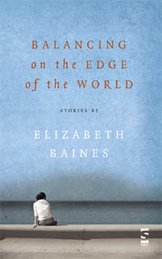
Last summer I contributed to a series on John Baker's blog in which writers discussed the questions of 'inspiration' and the creation of texts. In doing so, I concentrated on the story 'Compass and Torch' which is included in my collection, Balancing on the Edge of the World.
That was then something of an exception for me, as I've always thought the focus should be on the words on the page, rather than all this meta-stuff which tends to feed into the current obsession with the author as part of the fiction package. Also I'm dead against the current tendency for biographical readings of fiction, and I've always thought that pointing to any real-life triggers for fiction - even if it's only to point out the differences between the life and the fiction - is to reinforce the obsession.
But then I'm writing a blog, after all, and I've written here about some of my writing processes even if, so far, I haven't really related them at the time to specific pieces. And after the publication of the collection I did get into one or two brief discussions on here about specific stories in the book which did touch on issues of creation/production, and now find myself drawn to continue these discussions and talk occasionally about issues of creation surrounding some of the stories in the book.
So here goes, with 'Condensed Metaphysics', the first story in the book.
This is the story of a group of people out on the town who end up in a pizza parlour where a comic drunken conversation with the other customers punctures a few preconceptions and leads to some pretty serious realizations. It begins like this:
That wiped the smile off, I can tell you. Fact? My carefully wrought and imagined story, with all those made-up conversations and characters, that product of my imagination, not a replication or account, but an artifice of images and a hammock of words swinging rhythmically, a constructed vehicle for my own individual vision and themes? Wasn't it obvious from the shape, the patterning, that it was a made up thing?
I don't mind admitting I had a moment's doubt about the story, and in order to explain I do need to admit here that it was indeed based - based - on a real-life incident, more closely perhaps than most of my stories. I considered the fact that I had included real-life place names in the story, something I usually consciously don't do since what I'm aiming for usually is something a bit less realist - more universal, or mythic, if that's not too pretentious. Had this given it a kind of cod 'authenticity', especially since Alan (if he remembered) wasn't accustomed to reading that kind of thing in my work? Or was it something deeper? I had certainly written this story very quickly, it had come to me the moment I had woken up the morning after the real-life incident, and I had polished it off that day, and it was indeed steeped in the atmosphere of the real-life event. And the prose rhythms of the story were also tied up with the real-life experience; they did seem to have emerged from the particular hilarity of that real-life evening.
But of course it was fiction, (those rhythms were my own after all, and the characters and their stories were my fabrication), and so important was it to me to have it acknowledged as such, that I was quite prepared to wait for a lengthy period before publication. I wrote back to Alan Ross and jokingly told him that he was right in guessing that it had been based on a real-life incident but there was no doubt that the piece was fiction.
Well, now, maybe I was too cryptic, maybe Alan Ross was so busy he missed the point of my letter: imagine my dismay when the story appeared in the very next issue as reportage, indeed as a kind of travel piece, under the umbrella title Chinatown.
Why Chinatown? Because, presumably, the chap with the begging cup at the beginning of the story is asked by the revellers where he sleeps at night; he replies that he sleeps in an alley in Chinatown and before they can say any more he embarks comically on a lecture about popular misconceptions about the dangers of Chinatown. But we never find out if his version of Chinatown is the right one, partly because the revellers quickly forget all about him and Chinatown as they go on into the takeway place to order their pizzas. Any Chinatown of the story is not the specific place which a travel piece must reduce it to, but a Chinatown of the mind. This is a story not about a specific place or any specific places (in spite of my naming) but about viewpoint and the isolation of everyone from each other's experience and stories. It's a story about stories rather than reality, indeed it's about the difficulty of ever really pinning down reality - hence its ironic title 'Condensed Metaphysics'.
Best not even to get involved in discussions about the real-life sources for fiction, I say.
That was then something of an exception for me, as I've always thought the focus should be on the words on the page, rather than all this meta-stuff which tends to feed into the current obsession with the author as part of the fiction package. Also I'm dead against the current tendency for biographical readings of fiction, and I've always thought that pointing to any real-life triggers for fiction - even if it's only to point out the differences between the life and the fiction - is to reinforce the obsession.
But then I'm writing a blog, after all, and I've written here about some of my writing processes even if, so far, I haven't really related them at the time to specific pieces. And after the publication of the collection I did get into one or two brief discussions on here about specific stories in the book which did touch on issues of creation/production, and now find myself drawn to continue these discussions and talk occasionally about issues of creation surrounding some of the stories in the book.
So here goes, with 'Condensed Metaphysics', the first story in the book.
This is the story of a group of people out on the town who end up in a pizza parlour where a comic drunken conversation with the other customers punctures a few preconceptions and leads to some pretty serious realizations. It begins like this:
We're all drunk and Ellie's drunkest. She runs up to a guy with a begging cup outside the Babylon and asks him to lend us some money, we're hungry and want a pizza and none of us has got any cash.In fact (as I've indicated before), the publishing history of this story neatly sums up the pitfalls of being drawn to talk about the 'real-life' elements of fiction (which, paradoxically, makes it hard to discuss its publishing history without doing so!). As soon as I had written this story I sent it off to London Magazine, which was edited at the time by the now sadly deceased Alan Ross. This is perhaps an indication of my pig-headedness: I had sent occasional stories to Alan in the past, but although he usually bothered to be complimentary, he had never agreed to publish any, and though I had long come to the conclusion that my stories just weren't his kind of thing - well, let's just say my granny was pretty stubborn too. So I was delighted when he wrote back very quickly and said he had found the story very funny and wanted to publish it. And then he asked me was it fiction or fact, because if it was fiction then I would have a long wait for it to appear in the magazine, but if it was fact then he'd be able to put it in the reportage section at the back of the mag next issue.
That wiped the smile off, I can tell you. Fact? My carefully wrought and imagined story, with all those made-up conversations and characters, that product of my imagination, not a replication or account, but an artifice of images and a hammock of words swinging rhythmically, a constructed vehicle for my own individual vision and themes? Wasn't it obvious from the shape, the patterning, that it was a made up thing?
I don't mind admitting I had a moment's doubt about the story, and in order to explain I do need to admit here that it was indeed based - based - on a real-life incident, more closely perhaps than most of my stories. I considered the fact that I had included real-life place names in the story, something I usually consciously don't do since what I'm aiming for usually is something a bit less realist - more universal, or mythic, if that's not too pretentious. Had this given it a kind of cod 'authenticity', especially since Alan (if he remembered) wasn't accustomed to reading that kind of thing in my work? Or was it something deeper? I had certainly written this story very quickly, it had come to me the moment I had woken up the morning after the real-life incident, and I had polished it off that day, and it was indeed steeped in the atmosphere of the real-life event. And the prose rhythms of the story were also tied up with the real-life experience; they did seem to have emerged from the particular hilarity of that real-life evening.
But of course it was fiction, (those rhythms were my own after all, and the characters and their stories were my fabrication), and so important was it to me to have it acknowledged as such, that I was quite prepared to wait for a lengthy period before publication. I wrote back to Alan Ross and jokingly told him that he was right in guessing that it had been based on a real-life incident but there was no doubt that the piece was fiction.
Well, now, maybe I was too cryptic, maybe Alan Ross was so busy he missed the point of my letter: imagine my dismay when the story appeared in the very next issue as reportage, indeed as a kind of travel piece, under the umbrella title Chinatown.
Why Chinatown? Because, presumably, the chap with the begging cup at the beginning of the story is asked by the revellers where he sleeps at night; he replies that he sleeps in an alley in Chinatown and before they can say any more he embarks comically on a lecture about popular misconceptions about the dangers of Chinatown. But we never find out if his version of Chinatown is the right one, partly because the revellers quickly forget all about him and Chinatown as they go on into the takeway place to order their pizzas. Any Chinatown of the story is not the specific place which a travel piece must reduce it to, but a Chinatown of the mind. This is a story not about a specific place or any specific places (in spite of my naming) but about viewpoint and the isolation of everyone from each other's experience and stories. It's a story about stories rather than reality, indeed it's about the difficulty of ever really pinning down reality - hence its ironic title 'Condensed Metaphysics'.
Best not even to get involved in discussions about the real-life sources for fiction, I say.
Tuesday, March 06, 2007
Who is the judge?
In my last post I described the experience of publishing The Birth Machine with changes imposed by the publisher which ran strongly counter to my authorial/aesthetic intentions, and the way I then felt about the published work. In today's Guardian, Mark Ravenhill discusses similar issues, focusing this time on a writer's own 'mistakes' which he or she sees only after a work has gone out into the public domain. I touched on the fact that academics, in writing about the first edition of The Birth Machine, had written about a work which in fact I did not want to own, and Ravenhill develops an implication of this:
Ravenhill's statement that writers can always ever after see improvements they could have made to their work is very true. He argues, however, that writers should never let this lead them to suppress their work (as Deep Purple have, with Live at the Birmingham NEC 1993):
Whether a reader likes the play or not, it will look to them like an authoritative stream of text, a definitive statement. What I see is great black holes of missed opportunities. This is not false modesty. This is quite honestly what it feels like to open a book with my name on the cover. I'm amazed that academics haven't grasped this. Whenever an academic talks to me about my work, there's still an assumption that here is a definitive, confident text that is at my bidding.
Ravenhill's statement that writers can always ever after see improvements they could have made to their work is very true. He argues, however, that writers should never let this lead them to suppress their work (as Deep Purple have, with Live at the Birmingham NEC 1993):
Artists aren't always the best judges as to which of their works should make it into the public domain. If his family had followed his instructions, all of Kafka's manuscripts would have been burnt and we would have lost some of the 20th century's most important literature.
Saturday, March 03, 2007
Whose novel is it?
Notwithstanding The Death of the Author, first comes Zadie Smith arguing that a work of literature is above all the expression of an author's personality, and now here's Milan Kundera advising that an author's work is his own property to destroy, suppress or alter as he pleases, in a new book due from Fabers and extracted in today's Guardian Review.
Maybe I should have had Milan Kundera with me when my novel The Birth Machine was first published.
Like much of my work, The Birth Machine is about knowledge and power, about the different kinds of knowledge, empirical and intuitive, the knowledge of science and the knowledge of myths and dreams, and the question of where, between them all, the truth, and the power, lie. Well, this is what it's about as far as I'm concerned. It's also, for me, a novel about viewpoint, about objectivity and subjectivity, and in this, to me, the structure is all-important: I began with an objective, scientific (medical) viewpoint and slowly circled inwards to the subjective viewpoint of the 'object' patient, and through into memory and even further into dream.
But, after we'd done the deal, after the publisher had said how much she absolutely loved my novel, she told me: 'We really need you to change the beginning. We need to begin with the viewpoint of the woman patient in order to appeal to our market, ie women, and allow them to identify.'
Well, this was a feminist publisher, and I wasn't so naive that I hadn't realised that she might see my book more narrowly in terms of male power and the condition of women (or indeed that the context of a feminist publishing house might push it towards this narrower interpretation), but I was pretty shocked by this indication that the book would only be marketed to women, and deeply shocked that my structural stratagems must be discarded and with them any chance of my thematic intentions being realised. (And they must: the publisher did not feel she could go ahead unless I made the change.)
 Well, I made the change. I was a new, scared writer after all, and my agent had already tried to sell the book to mainstream publishers, but the very thing which had attracted The Women's Press, the central situation of a high-tech birth, had put those other publishers off, and, insecure as I was, I didn't think anyone else would publish it. Apart from which, The Women's Press had already threatened not to go ahead with the book as I'd turned out in real life to be Not a Good Feminist in the eyes of their 'market' (which was thus diminishing before my eyes to 'Angry Feminists in the Know'). I was already on a last warning, and to get this book published, a satire about a woman making the mistake of being a Good Girl according to others' rules, I had to be a good girl according my feminist publishers' rules. And the novel was made more 'accessible', 'identifiable-with' - in post-structuralist terms less writerly and more readerly - and the political/aesthetic challenge I had intended was dissipated.
Aesthetically I felt ruined, and in some ways I didn't even want to own the novel as it was published. For as Kundera says in his new book: the beauty of a novel is inseparable from its architecture; I say "beauty" because the composition is not merely a technical skill; it carries within it an author's originality of style. Whenever I thought about 'The Birth Machine' it was the original version I thought about, and whenever I read from the book to audiences, I always read the original first chapter which had been relegated to later in the published version. So when the book went out of print and the rights reverted to me, I published a revised edition, subtitled 'The Author's Cut', with the original structure reinstated.
 But by then, to many people, including academics who had written about it, 'The Birth Machine' was indeed the first published version - and many had written to me to tell me how much it had meant to them. What did this mean? In the Author's Note to the revised edition I say this:
But I think I was still running scared. After all, I had grabbed the first chance to reinstate the original version. And what do I think now? Well, that 'The Author's Cut' is the real version.
Maybe I should have had Milan Kundera with me when my novel The Birth Machine was first published.
Like much of my work, The Birth Machine is about knowledge and power, about the different kinds of knowledge, empirical and intuitive, the knowledge of science and the knowledge of myths and dreams, and the question of where, between them all, the truth, and the power, lie. Well, this is what it's about as far as I'm concerned. It's also, for me, a novel about viewpoint, about objectivity and subjectivity, and in this, to me, the structure is all-important: I began with an objective, scientific (medical) viewpoint and slowly circled inwards to the subjective viewpoint of the 'object' patient, and through into memory and even further into dream.
But, after we'd done the deal, after the publisher had said how much she absolutely loved my novel, she told me: 'We really need you to change the beginning. We need to begin with the viewpoint of the woman patient in order to appeal to our market, ie women, and allow them to identify.'
Well, this was a feminist publisher, and I wasn't so naive that I hadn't realised that she might see my book more narrowly in terms of male power and the condition of women (or indeed that the context of a feminist publishing house might push it towards this narrower interpretation), but I was pretty shocked by this indication that the book would only be marketed to women, and deeply shocked that my structural stratagems must be discarded and with them any chance of my thematic intentions being realised. (And they must: the publisher did not feel she could go ahead unless I made the change.)
 Well, I made the change. I was a new, scared writer after all, and my agent had already tried to sell the book to mainstream publishers, but the very thing which had attracted The Women's Press, the central situation of a high-tech birth, had put those other publishers off, and, insecure as I was, I didn't think anyone else would publish it. Apart from which, The Women's Press had already threatened not to go ahead with the book as I'd turned out in real life to be Not a Good Feminist in the eyes of their 'market' (which was thus diminishing before my eyes to 'Angry Feminists in the Know'). I was already on a last warning, and to get this book published, a satire about a woman making the mistake of being a Good Girl according to others' rules, I had to be a good girl according my feminist publishers' rules. And the novel was made more 'accessible', 'identifiable-with' - in post-structuralist terms less writerly and more readerly - and the political/aesthetic challenge I had intended was dissipated.
Aesthetically I felt ruined, and in some ways I didn't even want to own the novel as it was published. For as Kundera says in his new book: the beauty of a novel is inseparable from its architecture; I say "beauty" because the composition is not merely a technical skill; it carries within it an author's originality of style. Whenever I thought about 'The Birth Machine' it was the original version I thought about, and whenever I read from the book to audiences, I always read the original first chapter which had been relegated to later in the published version. So when the book went out of print and the rights reverted to me, I published a revised edition, subtitled 'The Author's Cut', with the original structure reinstated.
 But by then, to many people, including academics who had written about it, 'The Birth Machine' was indeed the first published version - and many had written to me to tell me how much it had meant to them. What did this mean? In the Author's Note to the revised edition I say this:
 Of course in the end it's not for me, as the writer, to say which version is better, or whether either version fulfils completely the authorial/editorial intention behind its creation, and whether indeed it matters if it doesn't - all this has to be up to readers.
But I think I was still running scared. After all, I had grabbed the first chance to reinstate the original version. And what do I think now? Well, that 'The Author's Cut' is the real version.
Subscribe to:
Posts (Atom)