It was because I had recently raved about it (see my review) that John chose this book, the story of Oscar de Leon, a New Jersey ghetto nerd struggling with the curse imposed by his family's history of entanglement with the repressive Dominican regime.
I had met Trevor in the street a few days before the meeting and he had raved too: definitely worth the money, he said (we usually read books in paperback, and this was an exception), absolutely flipping brilliant, wonderful the way the story (told in the main by street-wise Yunior who befriends Oscar at the request of his own girlfriend, Oscar's elder sister, Elizabeth) is developed in a non-linear way - it makes it all so real, and exciting the way certain information only comes out later, and Trevor had only one criticism which was that he was so hooked he felt he was reading it too quickly and was missing stuff - a point with which I agreed.
So I was a bit surprised when John reported that he was never really engaged by the book in this way. I had noticed that he read it in a piecemeal way, being very busy with other things, so it's possible that he didn't give it appropriate attention, but in any case I was very interested to hear what everyone else thought.
On the whole people thought the same as Trevor and me. They had been gripped, and most people, like me, were particularly bowled over by the narrative voice of the novel and suspected that Yunior's voice was very close to that of the author, since there are frequent footnotes explaining the history of the Dominican Republic, and indeed of the composition of the novel itself, which are delivered in the same voice. As a result, Clare said that she had been hooked by these footnotes, unlike those in Kiss of the Spiderwoman, which had bored her silly: these seemed, unlike those, an integral part of the novel, essential to its structure. Jenny agreed, but she said she had a slight problem in that as a result she wasn't sure how how factual were their historical details. Trevor said that he felt that Junot Diaz had set out particularly to educate people about the DR with this novel, and so we could take them as truly historical, and people then agreed, and Clare, Jenny and Ann said what an amazing experience it had been to discover from it this history which is generally unknown and unacknowledged. I said that I really loved the way that the footnotes and the novel itself (which is in fact dedicated to Elizabeth de Leon) played with the ideas of fact and fiction in a way that was searingly appropriate, thematically, for the slippery realities created by the political situation described - at which John drew attention to the amazing symbol in the novel of the faceless person, and people chorused accord.
Clare said that she loved the way the different stories of the characters were woven together in a non-linear, indeed backwards way: the way that you get the stories of the children and then the story of the mother, and after that the story of the grandfather, and in the telling of each the previous stories take on new meanings and contours. Jenny strongly agreed. She said that when she read the daughter's story she thought the mother was a bitch, but then when she read the mother's tragic story her eyes were opened, and it was great to have these changing perspectives.
The big surprise for me was Doug's reaction. He had been pretty quiet up to now, but now he said that he agreed with us about much of this, in particular he thought like John that the women were brilliantly done and that the story of Oscar's mother was especially moving. But unlike us, he had found Yunior's voice - which we had found so authentic - fake, affected and modish in its streetwise nature. What? We stared at him open-mouthed. But what about the fact that we felt it was pretty close to the voice of the author (especially as I had said that it was also like the overall voice of Diaz's short stories in Drown)? Doug said, Well, in any case he didn't find the character of Oscar at all convincing. What? Our mouths dropped open further. He was a caricature of a nerd, Doug said, and come to that, so was Yunior, a caricature of a streetwise guy, picking up the girls, talking like he did... And he found the story of Oscar's bullying at school and university so parochial compared to the extreme stories of his mother and grandfather.
We were staggered. First, we pointed out that the whole point is that Oscar's plight draws him back tragically into that political situation. As for the portrayal of those two characters, we had no answer except to say that we had found them both utterly convincing, and Oscar's plight as a bullied nerd as moving as Doug had found it unmoving. Doug said, Well what about when that Goth girl befriends Oscar, that was totally unconvincing, how would a Goth want to be seen dead with Oscar? Clare said, because he was safe, because she could have the kinds of discussions with him she couldn't have with her Goth friends or her boyfriend, but Doug said that his friend had a daughter who was a Goth and she wouldn't be seen dead with anyone outside her own Goth circle. I said, Well, there are Goths and there are Goths and Trevor and Jenny said that people can dress up as Goths for all sorts of reasons, sometimes only because they want to dress like that. But this was getting away from the book and onto life and Clare pulled the discussion back by saying that she felt you could identify with Oscar, surely, if you had ever experienced some kind of bullying or even at least thought you had. And she didn't think that Yunior was a caricature because he did precisely that, identified with Oscar at moments which the rest of us agreed were very moving.
Then Trevor said that he had a hunch that Diaz himself was probably both characters, that he had split himself in two - the wiseguy and the nerd - to tell this story, a point which we all found astute. This seemed for a moment to prove Doug's point, but the fact remained that everyone beside Doug found the depiction of these two characters nevertheless convincing and moving.
After which, we had an impassioned discussion about bullying...
Our archived discussions can be found here, and a list of all the books we have discussed here.
Sunday, September 21, 2008


Friday, September 19, 2008
Out of my head and into the air
So I listened to my story, The Way to Behave, on the radio this afternoon - often a strange experience, since it's so rarely the same as it is in your head, but Lesley Sharp had it almost the way I hear it myself! Of course, it had been cut to fit the slot - the 'frilly' bits had gone (I couldn't help thinking that that was how they must have thought of them): the descriptions of the room and the autumn, with their hints of witchcraft and physical violence; I suppose you could say it was (appropriately) turned into more of a drama. But it definitely got the spirit of it, and Lesley Sharp really was the character as I'd envisaged her: what a pro! Thank you, Lesley, thank you producer Jill Waters, and thank you Jen at Salt.
The story can be heard online for the next 7 days here.
The story can be heard online for the next 7 days here.
Tuesday, September 16, 2008
When it comes from a talented short story writer...
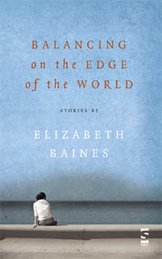
I have just been paid the ultimate compliment for a short-story writer, praise from a most talented writer of his own exciting, unique short stories. Rob Shearman, whose collection Tiny Deaths (Comma Press) was longlisted for the Frank O'Connor Award, shortlisted for the Edge Hill Prize and is also shortlisted for the World Fantasy Awards, has given Balancing this lovely Amazon Review:
It's all too easy for short stories to read as something very slight - either as tales which don't have a strong enough backbone to support a bigger plot, or as bits of poetry in prose form which delight in the rhythm of words over meaning or point. What makes Elizabeth Baines' collection so brilliant - and why, no doubt, it was deservedly nominated recently for an international award - is that she perfectly plays with both the page-turning quality of novel's fiction, and a crafted beauty you usually only associate with verse. These are stories concerned with 'power', in all its forms - whether it be the hilarious tale of a naive screenwriter and the way her fledgeling script is abused by a film course, or the magical superhuman powers of a young child ignored by the numbing reality of parents getting divorced. They're funny, and moving, and thoughtful - but above all, they're short stories which celebrate how beguiling short stories can be. Read and be enchanted.
Monday, September 15, 2008
Horizon Review goes live
The first issue of Horizon, edited by poet Jane Holland has just gone live. It's packed with fabulous stuff - most of which I've only managed to glance at yet - including poetry by George Szirtes and Katy-Evans Bush and fiction by Nuala Ní Chonchúir and me.
Here it is: a new place on the web for exciting and serious literature to flourish! Read, submit, spread the word!
Here it is: a new place on the web for exciting and serious literature to flourish! Read, submit, spread the word!
Sunday, September 14, 2008
The Way to Behave on Radio 4, 3.30, Friday.
 Looked at the radio listings in the Observer this morning and found that it's Friday of this week that my Balancing story 'The Way to Behave' is being broadcast on Radio 4 (3.30 pm). It's a fabulous series to be in, intended to highlight collections of stories in print and easily available, and titled In Bookshops Now. The series kicks off tomorrow with (appropriately) 'Monday Diary' from another Salt collection, the wonderful Some New Ambush by my friend Carys Davies (she's my friend because we met through both being published by Salt and precisely because I so love and admire her writing). It's a real mark of Salt's marketing nous that they should feature so prominently in such a series.
I'm particularly chuffed as my story is being read by actress Lesley Sharp (above) of Clocking Off fame and numerous northern TV dramas - what an honour, and she's just perfect I think for the ironic tone of the narrator. My story slot is critic Stephanie Billen's Radio Choice for Friday and she has this to say:
Radio 4 continues its valuable championing of the short story by highlighting fiction from widely available collections. Concluding the week is 'The Way to Behave', a clever tale by Elizabeth Baines, in which a social worker takes a slow revenge on her husband's far too nice mistress. Reader Lesley Sharp invests her character with just the right amount of venom as she recalls her fateful first discovery of a blonde hair: 'a gold worm, hooked and wriggling...'
I should mention that The Way to Behave was first published in (and commissioned for) the Bitch Lit anthology which is also available, direct from Crocus Books (get them both if you can afford it!)
Saturday, September 13, 2008
Getting one's writing head on
I've had a very disrupted year, writing-wise. I'm speaking in terms of the academic year, here: those academic-year rhythms are so deeply ingrained that like Emma Darwin I always think of this time of the year as a new beginning. The leaves beginning to fall, the darkening evenings and the earlier twinkling of the lights in the windows fill me with an excited sense of adventures to come. Consequently, it's a time too for reassessment.
This time last year I was busy on the blog story, which though I enjoyed immensely and found a welcome change from the isolation of the normal writing mode, was of course time out from my own writing. It was immediately followed up by the activities involved in the launch of Balancing - those promotional activities for which I at any rate need a different mentality from that which I need for writing. As far as I'm concerned, it's a bit of a Jekyll and Hyde situation: for the promotional work one must trip the switch and shrug off the dreamy, receptive personality who does the writing, and become outgoing and hard-headed. (In fact the blog story required a strange fusing of those two personae, which was perhaps why I found it so all-encompassing.) After Christmas I got time to myself at last and managed, once my head had settled, to begin on a new series of short stories. But it was indeed a question of waiting for my head to settle. A week or so ago I read Jeanette Winterson's novel Lighthousekeeping: in the Postscript to my paperback edition Winterson describes well the necessity to wait for fiction to happen to you, the fact that it simply can't be forced, one needs to be emotionally and creatively ready. (In fact, appropriately, Stevenson's Jekyll and Hyde features in Lighthousekeeping.)
Well, by the end of January I was ready, but I had written only three stories or so when family illness struck with a vengeance: both John and my brother became seriously ill, and while the danger is now passed for both of them and I did begin writing again in May, I have to say that my creative focus has been intermittent.
But then yesterday things felt different. I had washed all the dirty laundry we had brought back from Wales, the summer was over and packed away. There was that soft, fizzing, typically Manc autumnal rain falling. Suddenly I experienced that old familiar combination of peacefulness and excitement. I went to my desk and in a flash I saw the way to write the story I conceived in Wales but of which I'd only so far managed a sentence, and the wrong one at that.
Here's hoping, anyway...
This time last year I was busy on the blog story, which though I enjoyed immensely and found a welcome change from the isolation of the normal writing mode, was of course time out from my own writing. It was immediately followed up by the activities involved in the launch of Balancing - those promotional activities for which I at any rate need a different mentality from that which I need for writing. As far as I'm concerned, it's a bit of a Jekyll and Hyde situation: for the promotional work one must trip the switch and shrug off the dreamy, receptive personality who does the writing, and become outgoing and hard-headed. (In fact the blog story required a strange fusing of those two personae, which was perhaps why I found it so all-encompassing.) After Christmas I got time to myself at last and managed, once my head had settled, to begin on a new series of short stories. But it was indeed a question of waiting for my head to settle. A week or so ago I read Jeanette Winterson's novel Lighthousekeeping: in the Postscript to my paperback edition Winterson describes well the necessity to wait for fiction to happen to you, the fact that it simply can't be forced, one needs to be emotionally and creatively ready. (In fact, appropriately, Stevenson's Jekyll and Hyde features in Lighthousekeeping.)
Well, by the end of January I was ready, but I had written only three stories or so when family illness struck with a vengeance: both John and my brother became seriously ill, and while the danger is now passed for both of them and I did begin writing again in May, I have to say that my creative focus has been intermittent.
But then yesterday things felt different. I had washed all the dirty laundry we had brought back from Wales, the summer was over and packed away. There was that soft, fizzing, typically Manc autumnal rain falling. Suddenly I experienced that old familiar combination of peacefulness and excitement. I went to my desk and in a flash I saw the way to write the story I conceived in Wales but of which I'd only so far managed a sentence, and the wrong one at that.
Here's hoping, anyway...
Friday, September 12, 2008
Satisfaction or your money back
Yesterday The Guardian tried to elicit tales of stage rage from writers and performers who had been annoyed by audiences, but in several cases it was the audience who turned out to have been most enraged, and the performers forbearing or even timid.
Anyway, it reminded me of the time we took the Bitch Lit tour to Ilkley....
Anyway, it reminded me of the time we took the Bitch Lit tour to Ilkley....
Tuesday, September 09, 2008
Words lost in the flood

Ah, the city! And I always thought I was a country lass at heart. Here's what we had to wade through to get from the house to the car, the stream which is normally three feet beneath the track. Though you can't see it, it's waterfalling down each side of that tree on the left. Well, we had our wellies, of course, but the feeling of being cut off on a mountain in a changing climate was a bit insistent, especially when the wind got howling and the rain hit the windows like breakers (and came in through the gaps in the mortar!).
We spent the fortnight fighting the elements with lime plaster and paint and, in this place where in the past I have gratefully written most intensively, I wrote a single sentence only, I didn't read much after all, and the internet - of course - was dodgy. By the time we were due to come back I had regressed to such a non-verbal state I was almost scared to...
Thursday, September 04, 2008
Raymond Carver winners published online
The winning stories in the Raymond Carver Competition, including my own third prizewinning 'Used to Be', are now published online in the Fall issue of Carve Magazine.
Tuesday, September 02, 2008
It's how you read em, I guess
Email today from Matthew Limpede, editor of Carve Magazine. The Fall issue is slightly delayed, but should appear on Wednesday or Thursday with the winning stories of the Raymond Carver competition, including my own, 'Used to Be'.
It's interesting to think about this story in the light of Dovegreyreader's comments about Balancing on the Edge of the World. It's something of a breathtaking whirl, deliberately eschewing or at least questioning all the traditional tropes of the short story - character, symbolism etc - and I would say it most definitely doesn't fit her description:
Actually, while I'm thrilled that Dgr's review is so positive, I don't think of the stories in Balancing in this way, either, or maybe I'm just frightened stiff of the kind of reaction expressed today by Elaine of Random Jottings on Vulpes Libris:
In fact, folks, I see my stories as punchy, ironic and huge in the themes they tackle - but then I guess it's up to others to decide...
It's interesting to think about this story in the light of Dovegreyreader's comments about Balancing on the Edge of the World. It's something of a breathtaking whirl, deliberately eschewing or at least questioning all the traditional tropes of the short story - character, symbolism etc - and I would say it most definitely doesn't fit her description:
I envisage Elizabeth Baines hunched over a magnifying glass, the finest, most delicate of brushes in her hand, painting exquisite little miniatures, and there you have the essence of her short story collection... It is the microscopic quality of Elizabeth Baines’ eye that make each and every one of these stories so special.
Actually, while I'm thrilled that Dgr's review is so positive, I don't think of the stories in Balancing in this way, either, or maybe I'm just frightened stiff of the kind of reaction expressed today by Elaine of Random Jottings on Vulpes Libris:
...when I pick up a collection of short stories and find they are described as ‘exquisite vignettes’ (and yes this has happened), my main reaction is to run screaming from the room.
In fact, folks, I see my stories as punchy, ironic and huge in the themes they tackle - but then I guess it's up to others to decide...
Monday, September 01, 2008
Ah, September, and the cloud has cleared and I can see the ridge all patched in purple heather, and what's more I can get the internet, and here I am at the laptop, splattered in paint but having a break, and I have just been given a huge boost by discovering that Dovegreyreader has chosen Balancing on the Edge of the World for a roundup of favourite story collections, conducted by Vulpes Libris' Leena. Thank you, Dgr!
There's an interesting selection of story collections and favourite all-time single stories, should you head on over, a fair weighting towards the traditional, I think, with Katherine Mansfield coming out well, but also Clare Wigfall's recent wonderful The Loudest Sound and Nothing having made a big impact.
Interestingly, Leena says that she turned to other bloggers as she had come up against something of a blank with her vulpine fellows: '..many of them pleaded ignorance of the genre'.
Hmm.
Still, the other bloggers came up trumps.
And I also discovered that Barbara has bought Balancing and received it in the post today...
Internet, brilliant innit?
There's an interesting selection of story collections and favourite all-time single stories, should you head on over, a fair weighting towards the traditional, I think, with Katherine Mansfield coming out well, but also Clare Wigfall's recent wonderful The Loudest Sound and Nothing having made a big impact.
Interestingly, Leena says that she turned to other bloggers as she had come up against something of a blank with her vulpine fellows: '..many of them pleaded ignorance of the genre'.
Hmm.
Still, the other bloggers came up trumps.
And I also discovered that Barbara has bought Balancing and received it in the post today...
Internet, brilliant innit?
Thursday, August 28, 2008
Into the clouds again
Back in Wales, and I don't think the cloud has gone the whole time we've been away. The tub of logs near the front door was full to the brim with rainwater and the logs were sprouting huge fungi...
I've got the internet this morning though (after several tries), and I'll blog when I can during the next 10 days or so.
And it's September on Monday, and you know, September is traditionally better weather in these hills than August. Well, we'll see...
And never mind about the times I can't hook up, I've got walls to whitewash and woodwork to paint and a novel I want to write to think about, and several stories jostling to be written and a bagful of books I want to read...
I've got the internet this morning though (after several tries), and I'll blog when I can during the next 10 days or so.
And it's September on Monday, and you know, September is traditionally better weather in these hills than August. Well, we'll see...
And never mind about the times I can't hook up, I've got walls to whitewash and woodwork to paint and a novel I want to write to think about, and several stories jostling to be written and a bagful of books I want to read...
Friday, August 22, 2008
TV really does take over your life
So they're taking down the scaffolding, and the vans and cameras and actors and all the seemingly hundreds of personnel surrounding them have moved on to the next location.
And last night Rowan the location manager comes and says goodbye. 'Thanks for the lunch,' says John (yesterday we were invited to the TV canteen vans to have lunch with everyone else, something John says he hasn't done since he was a teenager, when he and his mates did it regularly - hanging around film sets so long that they got given lunch in the end - and his moped ended up in a famous, iconic scene).
'You're welcome,' says Rowan. 'Come again next time.'
'Next time?' We look at each other.
'Oh, yes,' says Rowan blithely. 'It's a character's house, after all. There are other episodes waiting to be written. We'll be back again before Christmas.'
Hm.
And last night Rowan the location manager comes and says goodbye. 'Thanks for the lunch,' says John (yesterday we were invited to the TV canteen vans to have lunch with everyone else, something John says he hasn't done since he was a teenager, when he and his mates did it regularly - hanging around film sets so long that they got given lunch in the end - and his moped ended up in a famous, iconic scene).
'You're welcome,' says Rowan. 'Come again next time.'
'Next time?' We look at each other.
'Oh, yes,' says Rowan blithely. 'It's a character's house, after all. There are other episodes waiting to be written. We'll be back again before Christmas.'
Hm.
Thursday, August 21, 2008
The story behind the story: Condensed Metaphysics
Last summer I contributed to a series on John Baker's blog in which writers discussed the questions of 'inspiration' and the creation of texts. In doing so, I concentrated on the story 'Compass and Torch' which is included in my collection, Balancing on the Edge of the World.
That was then something of an exception for me, as I've always thought the focus should be on the words on the page, rather than all this meta-stuff which tends to feed into the current obsession with the author as part of the fiction package. Also I'm dead against the current tendency for biographical readings of fiction, and I've always thought that pointing to any real-life triggers for fiction - even if it's only to point out the differences between the life and the fiction - is to reinforce the obsession.
But then I'm writing a blog, after all, and I've written here about some of my writing processes even if, so far, I haven't really related them at the time to specific pieces. And after the publication of the collection I did get into one or two brief discussions on here about specific stories in the book which did touch on issues of creation/production, and now find myself drawn to continue these discussions and talk occasionally about issues of creation surrounding some of the stories in the book.
So here goes, with 'Condensed Metaphysics', the first story in the book.
This is the story of a group of people out on the town who end up in a pizza parlour where a comic drunken conversation with the other customers punctures a few preconceptions and leads to some pretty serious realizations. It begins like this:
That wiped the smile off, I can tell you. Fact? My carefully wrought and imagined story, with all those made-up conversations and characters, that product of my imagination, not a replication or account, but an artifice of images and a hammock of words swinging rhythmically, a constructed vehicle for my own individual vision and themes? Wasn't it obvious from the shape, the patterning, that it was a made up thing?
I don't mind admitting I had a moment's doubt about the story, and in order to explain I do need to admit here that it was indeed based - based - on a real-life incident, more closely perhaps than most of my stories. I considered the fact that I had included real-life place names in the story, something I usually consciously don't do since what I'm aiming for usually is something a bit less realist - more universal, or mythic, if that's not too pretentious. Had this given it a kind of cod 'authenticity', especially since Alan (if he remembered) wasn't accustomed to reading that kind of thing in my work? Or was it something deeper? I had certainly written this story very quickly, it had come to me the moment I had woken up the morning after the real-life incident, and I had polished it off that day, and it was indeed steeped in the atmosphere of the real-life event. And the prose rhythms of the story were also tied up with the real-life experience; they did seem to have emerged from the particular hilarity of that real-life evening.
But of course it was fiction, (those rhythms were my own after all, and the characters and their stories were my fabrication), and so important was it to me to have it acknowledged as such, that I was quite prepared to wait for a lengthy period before publication. I wrote back to Alan Ross and jokingly told him that he was right in guessing that it had been based on a real-life incident but there was no doubt that the piece was fiction.
Well, now, maybe I was too cryptic, maybe Alan Ross was so busy he missed the point of my letter: imagine my dismay when the story appeared in the very next issue as reportage, indeed as a kind of travel piece, under the umbrella title Chinatown.
Why Chinatown? Because, presumably, the chap with the begging cup at the beginning of the story is asked by the revellers where he sleeps at night; he replies that he sleeps in an alley in Chinatown and before they can say any more he embarks comically on a lecture about popular misconceptions about the dangers of Chinatown. But we never find out if his version of Chinatown is the right one, partly because the revellers quickly forget all about him and Chinatown as they go on into the takeway place to order their pizzas. Any Chinatown of the story is not the specific place which a travel piece must reduce it to, but a Chinatown of the mind. This is a story not about a specific place or any specific places (in spite of my naming) but about viewpoint and the isolation of everyone from each other's experience and stories. It's a story about stories rather than reality, indeed it's about the difficulty of ever really pinning down reality - hence its ironic title 'Condensed Metaphysics'.
Best not even to get involved in discussions about the real-life sources for fiction, I say.
That was then something of an exception for me, as I've always thought the focus should be on the words on the page, rather than all this meta-stuff which tends to feed into the current obsession with the author as part of the fiction package. Also I'm dead against the current tendency for biographical readings of fiction, and I've always thought that pointing to any real-life triggers for fiction - even if it's only to point out the differences between the life and the fiction - is to reinforce the obsession.
But then I'm writing a blog, after all, and I've written here about some of my writing processes even if, so far, I haven't really related them at the time to specific pieces. And after the publication of the collection I did get into one or two brief discussions on here about specific stories in the book which did touch on issues of creation/production, and now find myself drawn to continue these discussions and talk occasionally about issues of creation surrounding some of the stories in the book.
So here goes, with 'Condensed Metaphysics', the first story in the book.
This is the story of a group of people out on the town who end up in a pizza parlour where a comic drunken conversation with the other customers punctures a few preconceptions and leads to some pretty serious realizations. It begins like this:
We're all drunk and Ellie's drunkest. She runs up to a guy with a begging cup outside the Babylon and asks him to lend us some money, we're hungry and want a pizza and none of us has got any cash.In fact (as I've indicated before), the publishing history of this story neatly sums up the pitfalls of being drawn to talk about the 'real-life' elements of fiction (which, paradoxically, makes it hard to discuss its publishing history without doing so!). As soon as I had written this story I sent it off to London Magazine, which was edited at the time by the now sadly deceased Alan Ross. This is perhaps an indication of my pig-headedness: I had sent occasional stories to Alan in the past, but although he usually bothered to be complimentary, he had never agreed to publish any, and though I had long come to the conclusion that my stories just weren't his kind of thing - well, let's just say my granny was pretty stubborn too. So I was delighted when he wrote back very quickly and said he had found the story very funny and wanted to publish it. And then he asked me was it fiction or fact, because if it was fiction then I would have a long wait for it to appear in the magazine, but if it was fact then he'd be able to put it in the reportage section at the back of the mag next issue.
That wiped the smile off, I can tell you. Fact? My carefully wrought and imagined story, with all those made-up conversations and characters, that product of my imagination, not a replication or account, but an artifice of images and a hammock of words swinging rhythmically, a constructed vehicle for my own individual vision and themes? Wasn't it obvious from the shape, the patterning, that it was a made up thing?
I don't mind admitting I had a moment's doubt about the story, and in order to explain I do need to admit here that it was indeed based - based - on a real-life incident, more closely perhaps than most of my stories. I considered the fact that I had included real-life place names in the story, something I usually consciously don't do since what I'm aiming for usually is something a bit less realist - more universal, or mythic, if that's not too pretentious. Had this given it a kind of cod 'authenticity', especially since Alan (if he remembered) wasn't accustomed to reading that kind of thing in my work? Or was it something deeper? I had certainly written this story very quickly, it had come to me the moment I had woken up the morning after the real-life incident, and I had polished it off that day, and it was indeed steeped in the atmosphere of the real-life event. And the prose rhythms of the story were also tied up with the real-life experience; they did seem to have emerged from the particular hilarity of that real-life evening.
But of course it was fiction, (those rhythms were my own after all, and the characters and their stories were my fabrication), and so important was it to me to have it acknowledged as such, that I was quite prepared to wait for a lengthy period before publication. I wrote back to Alan Ross and jokingly told him that he was right in guessing that it had been based on a real-life incident but there was no doubt that the piece was fiction.
Well, now, maybe I was too cryptic, maybe Alan Ross was so busy he missed the point of my letter: imagine my dismay when the story appeared in the very next issue as reportage, indeed as a kind of travel piece, under the umbrella title Chinatown.
Why Chinatown? Because, presumably, the chap with the begging cup at the beginning of the story is asked by the revellers where he sleeps at night; he replies that he sleeps in an alley in Chinatown and before they can say any more he embarks comically on a lecture about popular misconceptions about the dangers of Chinatown. But we never find out if his version of Chinatown is the right one, partly because the revellers quickly forget all about him and Chinatown as they go on into the takeway place to order their pizzas. Any Chinatown of the story is not the specific place which a travel piece must reduce it to, but a Chinatown of the mind. This is a story not about a specific place or any specific places (in spite of my naming) but about viewpoint and the isolation of everyone from each other's experience and stories. It's a story about stories rather than reality, indeed it's about the difficulty of ever really pinning down reality - hence its ironic title 'Condensed Metaphysics'.
Best not even to get involved in discussions about the real-life sources for fiction, I say.

Wednesday, August 20, 2008
Filming at Breakfast
OK, so now the film crew want to use our front door for the next-door-neighbour character to come out of (what is it that tells me that this is what they were intending to do all along?). And we are coming down to breakfast and the director is in the front doorway and asking, Do we mind if they just put a camera there in the doorway? And of course that means that the actor needs to come right in, along with the lighting crew, and the next thing you know there are arc lights in the hall and cables snaking to the power points in the living room...
But before that, it's the rehearsal, and I'm coming into the hallway and who is stepping in through the front door but John McArdle who played the main character in my radio series The Circle, and, it turns out, is playing the next-door neighbour today! This is when I find out that the series being filmed, The Choir Project, has been written by Debbie Horsfield, whose Making Out was perhaps of the best drama series I've ever seen on telly...
But before that, it's the rehearsal, and I'm coming into the hallway and who is stepping in through the front door but John McArdle who played the main character in my radio series The Circle, and, it turns out, is playing the next-door neighbour today! This is when I find out that the series being filmed, The Choir Project, has been written by Debbie Horsfield, whose Making Out was perhaps of the best drama series I've ever seen on telly...
Tuesday, August 19, 2008
Reading group: The Reluctant Fundamentalist by Mohsin Hamid
At the end of the last reading group meeting we were all a bit drunk, I think, and we cooked up the idea of having this month's meeting in the house in Wales where John and I would be spending most of August. We must have been mad: not only is the house still very much gutted, it's also pretty small, and most people would have had to camp in the field outside, and with these August winds howling and the stream that runs through the field swelling one night and flooding, it was clearly not on. We chickened out, and came back to Manc and held the meeting at our house here instead. In any case, the book suggested by Jenny for discussion, Mohsin Hamid's The Reluctant Fundamentalist, was probably best discussed in a less abandoned and celebratory mood.
It was a sombre evening, dark already when people turned up at eight huddled and drenched from the walk around the corner, an evening well suited to the grave theme and formal tone of this book, a novella-length dramatic monologue delivered in a Lahore marketplace cafe by Changez, the Pakistani-born, Princeton-educated ex high-flying New York financial analyst, and addressed to an American stranger.
Jenny said she chose the book because of its subject matter and because it had been Booker shortlisted (which last would no doubt have drawn wry comment from the anti-hype, anti-prize Mark had he not been absent from the group for some time now because of his studies). She briefly recapped the story which Changez tells the stranger: of his meteoric success at university and in the financial company he joins thereafter, of his relationship with the young and beautiful New Yorker Erica who however is blighted by past sadness, the death of her first, childhood love, and of the way that both areas of Changez's life take a downward turn after 9/11. Erica becomes strangely sadder and indeed psychotically obsessed with the dead Chris, finally withdrawing from Changez altogether; Changez's social status is threatened by the growing American suspicion of all Muslims, and at the same time he comes to realize that he has been a willing dupe in the West's usurpation of his own people who, as he points out to the stranger, although now suffering poverty, built sophisticated cities and conducted a sophisticated civilization when westerners were still barbarians.
Meanwhile, this being a dramatic monologue, as this story is unfolding so is another, on the level of dramatic action: the relationship between Changez and the stranger is tense and highly ambiguous. Changez buttonholes the stranger, who appears immediately afraid, especially of the burly waiter. During the course of the meal which Changez 'invites' the stranger to share - in fact appearing rather to impose it on him, as he does his story - we learn that this louring and intent-seeming waiter has been a freedom fighter in Afghanistan. Yet who is this American stranger in this city without tourism? He must be a businessman, Changez concludes (and the stranger fails to confirm or deny this); yet why does his hand continually move towards his inside pocket? And what is that glint of metal there? Is it a cigarette case or a gun? Who is trapping or hounding down whom? Jenny said she concluded that the stranger had been sent by the Americans to take out Changez, the new if reluctant fundamentalist. Doug however said that since Changez took such pains to engage the stranger he had concluded it was the other way around, that the American stranger was being trapped by Changez and his new fundamentalist confederates. In the end, though, we all agreed that you couldn't really conclude either: indeed both were possible (in the best spy thriller tradition) and, more importantly, the book was deliberately ambiguous (it's an ambiguity that holds right up to and including the dramatic end), sending the important message that it in our current political situation friendship and enmity become muddied, and it's not possible to pinpoint goodies and baddies (as the traditional spy thriller ultimately does).
Jenny said that she found the book a little puzzling, a bit thin maybe. She thought that Erica's sudden emotional descent and its link with 9/11 wasn't really explained and that Changez's political turnaround was perfunctory and possibly unconvincing (and people murmured agreement). She said that pondering this she had wondered what made someone a fundamentalist, and had decided it was probably when something goes wrong in their personal life and they need something to fill a gap. Taking this back to the book, she thought that maybe the point was that if Changez's relationship with Erica had worked out, then he wouldn't have become a fundamentalist.
I said that I didn't think that we were meant to give the book that kind of psychological reading, and that rather it was an allegory, as indicated by the symbolic naming. Erica stands for the Am-erica which after 9/11 is lost, like her, in nostalgia for past glory and invulnerability - a point which Changez (and the author) makes explicitly (and indeed rather over-explicitly). Chris, her dead boyfriend, stands for the death of any vibrancy or integrity in Western Christian civilization, Western Christianity being now reduced to its own version of fundamentalism. There's another kind of fundamentalism in the West too, it's implied, that of the cult of materialism and finance - the mantra of the finance company for which Changez worked is 'focus on the fundamentals' - and it is indeed this fundamentalism about which Changez becomes reluctant as his views change. John added that Changez was also of course symbolically named, as he both changes and becomes perhaps an agent for change.
People agreed that the book made more sense read in this way, but nevertheless, and perhaps because of this, they still found it thin. I asked them what they thought of the voice - Changez's voice in which the whole book is of course couched. It's a very formal voice, suited to the formal cultural mores of Changez's Pakistani background and the kind of English he would have learned there: 'Excuse me, sir, but may I be of assistance?' Jenny said she really liked the voice: it was one of the reasons she picked out the book; she likes books in which the voice is calm and measured yet there is something tense or sinister about what is being conveyed. I agreed about this, yet I wasn't sure that the voice in this book rang true: wouldn't someone as bright as Changez pick up the slicker lingo of American business and finance - and how could he be so successful without doing so? Doug, who works in finance too, agreed, now that he thought about it. Jenny said, But the Americans absolutely love that old-fashioned formal kind of English, they have a real snobbery about it, which seemed a valid point, but then wasn't the point about Changez that he had excelled at fitting in and hiding his outsider status?
Trevor said there was something else about the book which bothered him, which had made him wonder whether it really worked in the psychological and temporal terms set up by its dramatic monologue form. It had continually occurred to him as he read to wonder if Changez would really have been able to detain such a reluctant stranger for so long, and was it psychologically realistic that he would in those circumstances have told, or been indulged in the telling of, such an intimate tale, including the intimate details of a sexual relationship? And most of all, could he really possibly have told a tale of such length in the space of a single meal? And everyone else said that the very same thoughts had also troubled them.
All in all, the consensus was that the book was interesting but perhaps rather little: Jenny said she didn't think it had the weight to make it worthy of its Booker shortlisting, and Doug said that he felt that it benefited from its timeliness, but that in 50 years people would be unlikely to find it so important as a work of literature.
Our archived discussions can be found here, and a list of all the books we have discussed here.
It was a sombre evening, dark already when people turned up at eight huddled and drenched from the walk around the corner, an evening well suited to the grave theme and formal tone of this book, a novella-length dramatic monologue delivered in a Lahore marketplace cafe by Changez, the Pakistani-born, Princeton-educated ex high-flying New York financial analyst, and addressed to an American stranger.
Jenny said she chose the book because of its subject matter and because it had been Booker shortlisted (which last would no doubt have drawn wry comment from the anti-hype, anti-prize Mark had he not been absent from the group for some time now because of his studies). She briefly recapped the story which Changez tells the stranger: of his meteoric success at university and in the financial company he joins thereafter, of his relationship with the young and beautiful New Yorker Erica who however is blighted by past sadness, the death of her first, childhood love, and of the way that both areas of Changez's life take a downward turn after 9/11. Erica becomes strangely sadder and indeed psychotically obsessed with the dead Chris, finally withdrawing from Changez altogether; Changez's social status is threatened by the growing American suspicion of all Muslims, and at the same time he comes to realize that he has been a willing dupe in the West's usurpation of his own people who, as he points out to the stranger, although now suffering poverty, built sophisticated cities and conducted a sophisticated civilization when westerners were still barbarians.
Meanwhile, this being a dramatic monologue, as this story is unfolding so is another, on the level of dramatic action: the relationship between Changez and the stranger is tense and highly ambiguous. Changez buttonholes the stranger, who appears immediately afraid, especially of the burly waiter. During the course of the meal which Changez 'invites' the stranger to share - in fact appearing rather to impose it on him, as he does his story - we learn that this louring and intent-seeming waiter has been a freedom fighter in Afghanistan. Yet who is this American stranger in this city without tourism? He must be a businessman, Changez concludes (and the stranger fails to confirm or deny this); yet why does his hand continually move towards his inside pocket? And what is that glint of metal there? Is it a cigarette case or a gun? Who is trapping or hounding down whom? Jenny said she concluded that the stranger had been sent by the Americans to take out Changez, the new if reluctant fundamentalist. Doug however said that since Changez took such pains to engage the stranger he had concluded it was the other way around, that the American stranger was being trapped by Changez and his new fundamentalist confederates. In the end, though, we all agreed that you couldn't really conclude either: indeed both were possible (in the best spy thriller tradition) and, more importantly, the book was deliberately ambiguous (it's an ambiguity that holds right up to and including the dramatic end), sending the important message that it in our current political situation friendship and enmity become muddied, and it's not possible to pinpoint goodies and baddies (as the traditional spy thriller ultimately does).
Jenny said that she found the book a little puzzling, a bit thin maybe. She thought that Erica's sudden emotional descent and its link with 9/11 wasn't really explained and that Changez's political turnaround was perfunctory and possibly unconvincing (and people murmured agreement). She said that pondering this she had wondered what made someone a fundamentalist, and had decided it was probably when something goes wrong in their personal life and they need something to fill a gap. Taking this back to the book, she thought that maybe the point was that if Changez's relationship with Erica had worked out, then he wouldn't have become a fundamentalist.
I said that I didn't think that we were meant to give the book that kind of psychological reading, and that rather it was an allegory, as indicated by the symbolic naming. Erica stands for the Am-erica which after 9/11 is lost, like her, in nostalgia for past glory and invulnerability - a point which Changez (and the author) makes explicitly (and indeed rather over-explicitly). Chris, her dead boyfriend, stands for the death of any vibrancy or integrity in Western Christian civilization, Western Christianity being now reduced to its own version of fundamentalism. There's another kind of fundamentalism in the West too, it's implied, that of the cult of materialism and finance - the mantra of the finance company for which Changez worked is 'focus on the fundamentals' - and it is indeed this fundamentalism about which Changez becomes reluctant as his views change. John added that Changez was also of course symbolically named, as he both changes and becomes perhaps an agent for change.
People agreed that the book made more sense read in this way, but nevertheless, and perhaps because of this, they still found it thin. I asked them what they thought of the voice - Changez's voice in which the whole book is of course couched. It's a very formal voice, suited to the formal cultural mores of Changez's Pakistani background and the kind of English he would have learned there: 'Excuse me, sir, but may I be of assistance?' Jenny said she really liked the voice: it was one of the reasons she picked out the book; she likes books in which the voice is calm and measured yet there is something tense or sinister about what is being conveyed. I agreed about this, yet I wasn't sure that the voice in this book rang true: wouldn't someone as bright as Changez pick up the slicker lingo of American business and finance - and how could he be so successful without doing so? Doug, who works in finance too, agreed, now that he thought about it. Jenny said, But the Americans absolutely love that old-fashioned formal kind of English, they have a real snobbery about it, which seemed a valid point, but then wasn't the point about Changez that he had excelled at fitting in and hiding his outsider status?
Trevor said there was something else about the book which bothered him, which had made him wonder whether it really worked in the psychological and temporal terms set up by its dramatic monologue form. It had continually occurred to him as he read to wonder if Changez would really have been able to detain such a reluctant stranger for so long, and was it psychologically realistic that he would in those circumstances have told, or been indulged in the telling of, such an intimate tale, including the intimate details of a sexual relationship? And most of all, could he really possibly have told a tale of such length in the space of a single meal? And everyone else said that the very same thoughts had also troubled them.
All in all, the consensus was that the book was interesting but perhaps rather little: Jenny said she didn't think it had the weight to make it worthy of its Booker shortlisting, and Doug said that he felt that it benefited from its timeliness, but that in 50 years people would be unlikely to find it so important as a work of literature.
Our archived discussions can be found here, and a list of all the books we have discussed here.
Monday, August 18, 2008
TV takes over your life
OK, so I'm back in Manc and back to my home broadband. But can I write? Can I heck. There's a TV crew setting up scaffolding in the back garden! This area we live in, Didsbury, is always being used for TV drama locations - for years a house in our street was one of the locations for Cold Feet. A few years back John and I were stupid enough to agree to our house being used for a one-off film. Never again. We had just decorated the hall, landing and stairs with great effort: as I've said before, the house needed a lot doing to it when we moved in, including major repairs - and still does, I'm afraid. The hall, landing and stairs was indeed the only part we had sorted out then, and by the time the TV crew left after two days' filming there were knocks in all the new paintwork, and chatting to star Robert Lyndsey on the landing, nice as he turned out to be, did NOT, NOT make up for the experience!
So when the Beeb's location manager came round the other week looking for something for a new drama series we said N.O. And anyway, it turned out the director had different ideas about the kind of home Sarah Lancashire's single-parent ex-university-wife character would be living in, and went for our next-door-neighbour's much smarter house instead. So we thought we'd escaped. Phew.
But then of course it turns out they need to put lights up in our garden to shine into next door's kitchen. And then there's the little matter of the character's scruffier neighbour who needs to be filmed walking down our suitably overgrown garden. And then there are our window frames which, while not exactly pristine, are too un-scruffy even for that character and need to be painted to look shabbier. And while they're at it, can they put some blinds up in our windows? And I come downstairs to make a cup of tea and there's a crew member moving everything off the windowsills ready....
I can think of one way to salvage the situation. I'll get a story out of it if it kills me.
Edited in later:
I was thinking what a contrast, this media-soaked place, to the one I've just left, cut off from everything in the hills, and then I remembered: one summer there was filming there, as well! They used the outside of the house and its little field for a short Welsh-language film, an adaptation of a short story, Mynedd Grug (Heather Mountain), by the Welsh writer Kate Roberts, who was born in nearby Rhosgadfan.
And you can go into the pub in Tremadoch and quite often there'll be a film crew or a reccy party relaxing at the end of the day... How long before even our countryside becomes, like the real New York, veiled by the one planted in our minds by film?
So when the Beeb's location manager came round the other week looking for something for a new drama series we said N.O. And anyway, it turned out the director had different ideas about the kind of home Sarah Lancashire's single-parent ex-university-wife character would be living in, and went for our next-door-neighbour's much smarter house instead. So we thought we'd escaped. Phew.
But then of course it turns out they need to put lights up in our garden to shine into next door's kitchen. And then there's the little matter of the character's scruffier neighbour who needs to be filmed walking down our suitably overgrown garden. And then there are our window frames which, while not exactly pristine, are too un-scruffy even for that character and need to be painted to look shabbier. And while they're at it, can they put some blinds up in our windows? And I come downstairs to make a cup of tea and there's a crew member moving everything off the windowsills ready....
I can think of one way to salvage the situation. I'll get a story out of it if it kills me.
Edited in later:
I was thinking what a contrast, this media-soaked place, to the one I've just left, cut off from everything in the hills, and then I remembered: one summer there was filming there, as well! They used the outside of the house and its little field for a short Welsh-language film, an adaptation of a short story, Mynedd Grug (Heather Mountain), by the Welsh writer Kate Roberts, who was born in nearby Rhosgadfan.
And you can go into the pub in Tremadoch and quite often there'll be a film crew or a reccy party relaxing at the end of the day... How long before even our countryside becomes, like the real New York, veiled by the one planted in our minds by film?
Sunday, August 17, 2008
The State of Me by Nasim Marie Jafry
 It's a particular experience, reading a book by someone you know - I always feel so personally involved, which is why I always write about those books on this blog rather than my other, more detached, critical blog. Quite often I've been party to the joys and struggles of the book's creation and/or publishing history and often I can't read the book without hearing the author's own real-life voice and envisaging the gestures which usually accompany it.
Nasim Marie Jafry's debut novel The State of Me, a revelatory depiction of life with ME, is an especially pertinent case since, for one thing, it is an avowedly autobiographical novel. Thus if you know what Nasim looks like it is just about impossible to read it without projecting her appearance onto that of the protagonist, and indeed the witty, wry, angry yet philosophical voice of that narrator-protagonist is the voice I know from emails and internet forums. In fact, many people will know Nasim as well as and better than I do, since it is also the voice of her successful and touching blog. This novel's publishing history is an interesting one: an agent persuaded a very reluctant Nasim that in a world where memoirs are the big sellers the book would be more easily marketable if sold as 'fictionalized memoir'. However the agent's first attempts to sell the novel quickly failed, since as an autobiographical novel it failed to meet publishers' expected parameters for memoir. The agent promptly dropped the book, leaving the author to tout it herself, but without the energy to do so, debilitated as she was by the condition which forms the very subject of the book. Instead, Nasim posted extracts on her blog and Clare Christian of The Friday Project came along like a fairy godmother and snapped it up, and now at last the book is published. Thus the author's real-life experience of having the book published after a long ME-troubled struggle becomes a kind of meta-ending for the novel's story, and in this respect the story of the novel and real life bleed into each other in a very particular way. This, and the identification which many must have with Nasim through her blog, may be why some commentators have judged that the novel should after all have been published as 'fictionalized memoir', which, in spite of the highly positive nature of the reviews, must be a dismaying thing for Nasim to hear.
In fact, it's nonsense. OK, so we may be able to see for ourselves, and Nasim's blog has told us, the things in the novel which relate to the real-life Nasim. But Nasim has also told us that there are things in the novel which don't relate to reality, and in my view, as in hers, that makes it fiction full stop. Come on, folks, there's no such thing as 'fictionalized memoir' (only insofar as no memoir can ever be truly objective - but that's not what we're talking about here.) You start making things up, you change the tenor of everything, you're making an artifice, which is what artists, including novelists, do.
So let's look at this book as an artifice, as a novel, as Nasim would want us to do. It's the story, beginning in the eighties, of Helen Fleet, a popular, lively university student of French who is struck down during her year abroad by a mystery illness which leaves her debilitated, cutting short her studies and forcing her withdrawal from life. Later tests reveal that her initial illness was caused by the coxsackie virus, and much later, physical tests prove that her muscles are no longer capable of producing enough energy. Initially, however - at a time before ME has been named, leave alone generally acknowledged by the medical profession - Helen encounters medical disbelief in her symptoms, and even after it has become acknowledged and her originally projected five years of the condition turns into six, seven, and finally, by the end of the novel thirteen, she comes up against both medical and lay resistance.
The novel is the story of Helen's rearguard psychic battle against the condition itself and her forced retirement, against such disbelief, and against the consequences for her relationship: the bond between Helen and her boyfriend, though ultimately strong, is stretched to breaking point as he sets off on the youthful adventures on which she can no longer accompany him. And her weapons in this battle are her wit, her verbal inventiveness and precision, her vivid eye on the kaleidoscopic world which is going on around and without her, her acute observations of character and physical detail, and above all her anger, which is the motivating, energizing force of this novel.
The amazing feat of this novel is to give one a physical sense of the pain and frustration of this condition, and yet to be bouncing with life, the inner life and the irrepressible psyche of Helen. For long stretches of time not a lot happens - which of course is the nature of the condition and the point of Helen's tragedy - and this may be why some commentators have insisted that it's 'not a novel'. Wrong again. Look at the word novel: the novel is called the novel because it has the capacity to constantly reinvent itself anew. It doesn't have to conform to conventional expections - the best ones in my view don't; it doesn't have to be action-filled or action-based, as long as it works, by which I mean it involves you emotionally, makes you want to keep reading, and this novel certainly did that for me. The story of this novel is an inner, psychological one; it's the story of Helen's fight to retain the sense of who she is while in outward ways the condition changes the kind of person she is or can hope to be, and of her psychological maturing in the process.
The ways in which the effects of this novel are created are highly literary (and novelistic), with precisely honed, sometimes lyrical prose and with highly stylistic devices. Helen uses the conceit of Play-School type windows through which her situation can be viewed via different viewpoints; intermittently she brings in an imagined conversation with a stranger who begins by expressing disbelief in her condition and must be educated into its reality and with whom she reviews her own progress.
The ending is inconclusive, which again seems to have led people to a reading of the book as memoir, but once again I'd say that formally this is the perfect novelistic end, replicating both Helen's uncertain future and the unfinished story of ME's acceptance by the medical profession. And, come to that, fitting that feeling of wishing a book hadn't ended...
Sunday, August 10, 2008
Clouds in the hills and a story on the radio, maybe
Oh dear, this is turning into a blog about the ruddy internet. So OK, I got a better mobile broadband, and yes, it does work from the house here, but not when the weather is bad! And has the weather been bad up here in the hills! Here from the upstairs window where I sit at my laptop I should see a blue ridge of hills but all I can see most days is the cloud we’re sitting in the middle of, and the very nearby ash trees flinging themselves around with the kind of anguish I feel every time I try to connect up.
However, sometimes it happens and I find myself thinking what a miracle the internet is, instead of taking it for granted as we’ve all learnt to do in the past few years. Still, it can take several minutes – now and then 10! - to navigate between web pages, so I may not be very good on links, I’m afraid.
So anyway, I got an email through to my publisher Jen at Salt to tell her about my Raymond Carver win, and the next time I managed to hook up there was a reply from her telling me that my story ‘The Way to Behave’ is to be broadcast on Radio 4’s afternoon slot sometime in the autumn, probably in September – that is, if she received my answer giving the go-ahead: too many of my emails have been bouncing back! ‘The Way to Behave’ is one of the stories collected in Balancing, and it was originally commissioned for the Bitch Lit anthology (Crocus) with which we had great fun doing a series of readings dressed in character, since most of the stories, TWTB included, were dramatic monologues. TWTB is the story of a wronged wife, the narrator, who finds an unusual way of taking revenge, and is one of my naughty swipes at the abuses of feminism by so-called feminists. (My Aunty Phyllis read Balancing recently and pronounced TWTB her favourite in the whole book, so maybe I should be worried: but no, Phyllis was a WAAF in the war, and she’s pretty switched on about female power.) To read my character for the Bitch Lit tour, I dressed up, as she does in the story, as a vamp: red high heels, red nails, bright lipstick and dark wig, and when my mother and sister came to the reading we did at Sheffield, they sat there as the reading started wondering where I had got to, and didn’t realize I was me until I began reading! TWTB is one of the more conventional stories in Balancing, and so I suppose well suited to radio.
I haven’t been feeling very literary, though. Writing’s on hold as I’ve been too busy helping out with the work on this old family house, which was started two years ago, but is only ever done in people’s spare time, mostly in the summer. And do I really want to start writing a blog about lime plastering and woodworm?
Although, actually, a damned enticing story came to me the other night in the pub down by the straits…
However, sometimes it happens and I find myself thinking what a miracle the internet is, instead of taking it for granted as we’ve all learnt to do in the past few years. Still, it can take several minutes – now and then 10! - to navigate between web pages, so I may not be very good on links, I’m afraid.
So anyway, I got an email through to my publisher Jen at Salt to tell her about my Raymond Carver win, and the next time I managed to hook up there was a reply from her telling me that my story ‘The Way to Behave’ is to be broadcast on Radio 4’s afternoon slot sometime in the autumn, probably in September – that is, if she received my answer giving the go-ahead: too many of my emails have been bouncing back! ‘The Way to Behave’ is one of the stories collected in Balancing, and it was originally commissioned for the Bitch Lit anthology (Crocus) with which we had great fun doing a series of readings dressed in character, since most of the stories, TWTB included, were dramatic monologues. TWTB is the story of a wronged wife, the narrator, who finds an unusual way of taking revenge, and is one of my naughty swipes at the abuses of feminism by so-called feminists. (My Aunty Phyllis read Balancing recently and pronounced TWTB her favourite in the whole book, so maybe I should be worried: but no, Phyllis was a WAAF in the war, and she’s pretty switched on about female power.) To read my character for the Bitch Lit tour, I dressed up, as she does in the story, as a vamp: red high heels, red nails, bright lipstick and dark wig, and when my mother and sister came to the reading we did at Sheffield, they sat there as the reading started wondering where I had got to, and didn’t realize I was me until I began reading! TWTB is one of the more conventional stories in Balancing, and so I suppose well suited to radio.
I haven’t been feeling very literary, though. Writing’s on hold as I’ve been too busy helping out with the work on this old family house, which was started two years ago, but is only ever done in people’s spare time, mostly in the summer. And do I really want to start writing a blog about lime plastering and woodworm?
Although, actually, a damned enticing story came to me the other night in the pub down by the straits…
Thursday, August 07, 2008
Raymond Carver short story competition
So there I was with my rickety mobile broadband, having driven all the way down the mountain and into Caernarfon before I got a connection, sitting in the car in the middle of the wind- and rain-swept Castle Square, and I finally got my emails - including one telling me that my recent story 'Used to Be' has come third in the Carve Mag Raymond Carver short story competition.
So let me eat humble pie. Honestly, always going on about how conventional and conservative short story competitions are, and how (nose in the air) I'm into innovation myself, and then I go and get a prize in one of the blighters! But actually, I must say that (though I may be wrong) I consider this particular story one of my most innovative - it's specifically and explicitly about the contingency of story and the fluidity of all those old short story tropes - metaphor, character, etc - in the face of our particular contemporary uncertainty. So I'll admit it, I'm really thrilled that it's been acknowledged in this way, and feel really privileged!
And I bought a different mobile broadband (what a waste of dosh!) and so though I'm still on the mountain I'm back in blogging business sooner than I expected...
So let me eat humble pie. Honestly, always going on about how conventional and conservative short story competitions are, and how (nose in the air) I'm into innovation myself, and then I go and get a prize in one of the blighters! But actually, I must say that (though I may be wrong) I consider this particular story one of my most innovative - it's specifically and explicitly about the contingency of story and the fluidity of all those old short story tropes - metaphor, character, etc - in the face of our particular contemporary uncertainty. So I'll admit it, I'm really thrilled that it's been acknowledged in this way, and feel really privileged!
And I bought a different mobile broadband (what a waste of dosh!) and so though I'm still on the mountain I'm back in blogging business sooner than I expected...
Saturday, August 02, 2008
Hold up
OK, I give up. I bought mobile broadband, and it didn't even work on that hill - there was no connection, even though the website said there would be a rudimentary one. So sorry about the silence again. And for one reason or another I won't be blogging again for another 10 days to a fortnight, or dealing with comments I'm afraid.
Tuesday, July 29, 2008
The things you're allowed to say and who you're allowed to say them to
In an article in today's Guardian Jenni Murray notes that women's theatre has been held back by 'a fear of doing damage to the sisterhood':
Which makes me think immediately of what happened when my satirical first radio play, Rhyme or Reason, was broadcast. This was a play about a single mother taken in hand by a childless 'feminist' who sees fit to inculcate her into feminist theories including those of motherhood. All in all, she bosses her about something rotten and generally betrays, to comic effect, how little she actually knows. It was a play, as so many of my plays, about the gap we often encounter between theory and practice, and about the power that some of us wield over others, often unwittingly, in the guise of do-gooding, and I suppose, yes, it was also about certain bullying aspects I felt had emerged in the women's movement - and which were really nothing to do with the true aims of feminism, but were indeed a corruption of them - and which are now of course well documented.
Oh dear. There's me having a coffee with a mate a year or so later and she tells me that she was at this meeting, and there were women up in arms at what I had done to the women's movement with that play - especially as it had won a prize: let's face it, it had been a suck to antifeminism, and as such it had been rewarded by the antifeminist establishment.
Wow. No wonder there was that frosty reception that time I went to that feminist book launch...
And ten years later there I am in the print shop in the village and a woman I haven't seen for years, not since the time I wrote the play, comes up and explains to me, more kindly, her still-held personal opinion on the matter: There was nothing wrong with writing it, but what was wrong was doing it for national radio, for the ears of those who could use it to condemn. The only place to say such things was within the movement itself.
Hm.
You rarely saw a feminist play where the women characters were weak, bad or stupid. As the playwright April de Angelis put it in a 1997 lecture she gave at Birmingham University, female writers have worried that men might see a play about compromised and conflicted women, and say, "Well, if she's saying it, it must be true, and we were right all along to say women have no rights in society, should get back to the kitchen, have children, etc." There's a fear, De Angelis confessed, of writing an "incorrect" woman character. All of which has meant that the feminist theatre of the 80s and 90s has been long on consciousness-raising, but short on laughs.
Which makes me think immediately of what happened when my satirical first radio play, Rhyme or Reason, was broadcast. This was a play about a single mother taken in hand by a childless 'feminist' who sees fit to inculcate her into feminist theories including those of motherhood. All in all, she bosses her about something rotten and generally betrays, to comic effect, how little she actually knows. It was a play, as so many of my plays, about the gap we often encounter between theory and practice, and about the power that some of us wield over others, often unwittingly, in the guise of do-gooding, and I suppose, yes, it was also about certain bullying aspects I felt had emerged in the women's movement - and which were really nothing to do with the true aims of feminism, but were indeed a corruption of them - and which are now of course well documented.
Oh dear. There's me having a coffee with a mate a year or so later and she tells me that she was at this meeting, and there were women up in arms at what I had done to the women's movement with that play - especially as it had won a prize: let's face it, it had been a suck to antifeminism, and as such it had been rewarded by the antifeminist establishment.
Wow. No wonder there was that frosty reception that time I went to that feminist book launch...
And ten years later there I am in the print shop in the village and a woman I haven't seen for years, not since the time I wrote the play, comes up and explains to me, more kindly, her still-held personal opinion on the matter: There was nothing wrong with writing it, but what was wrong was doing it for national radio, for the ears of those who could use it to condemn. The only place to say such things was within the movement itself.
Hm.
Friday, July 25, 2008
Internet blackout and 24:7 lights-up

Sorry about the unannounced absence from my blogs: I was away in a place where I thought I could get broadband and found I couldn't - nowhere, no cafes, no pubs, nada, and I hesitate to say where in case I collude with nasty stereotypes about my beloved homeland!!!! This afternoon I'm off to buy mobile broadband for next time, though I understand that on that particular mountain there's as yet only rudimentary connection, not broadband speed.
Anyway, I came back to Manc yesterday and to 24:7 Theatre Festival already in full swing, and buzzier than ever before. Tickets are selling like hot cakes and houses are packed. Shows are starting to sell out, and I suggest booking now rather than waiting to get tickets on the door. It's really quite amazing how this festival has grown in the short time since Amanda Hennessy and Dave Slack dreamed the idea up. In the pic above Dave (in the blue shirt) is standing outside 24:7 venue Pure in the Printworks, talking with actor Nick Mason who had just appeared in Watching Stars by Kate Gilbert and directed by Wyllie Longmore.
Friday, July 18, 2008
Agony and ecstasy
Susan Hill has said again that she doesn't understand the 'agony-brigade' and if she didn't simply love writing, she just wouldn't do it. Ah, lucky Susan. She does wonder, though, if she'd go on doing it if she weren't getting paid for it - and I think that may be one crucial point. Susan makes it clear that writing is what she is meant for temperamentally, and one way in which writing can be agony is if you're compelled to do it willy nilly by your whole makeup, and yet you're not getting paid for it - worse, if you're not even getting published.
There's another kind of agony, and I've been suffering from it this week. I knew there was something in there I wanted to write, and I couldn't get to it. Or rather, I could glimpse it, but I couldn't find the way to it. All the ways I tried were wrong, or rather, they didn't produce the thing I really wanted to say. I've been suffering precisely those feelings that Susan says she suffers when she's not writing - I've felt itchy, frustrated, stopped, only half alive.
Yesterday I found the key, and wrote the whole story in two mornings, and phew, there I was on that writing high again...
There's another kind of agony, and I've been suffering from it this week. I knew there was something in there I wanted to write, and I couldn't get to it. Or rather, I could glimpse it, but I couldn't find the way to it. All the ways I tried were wrong, or rather, they didn't produce the thing I really wanted to say. I've been suffering precisely those feelings that Susan says she suffers when she's not writing - I've felt itchy, frustrated, stopped, only half alive.
Yesterday I found the key, and wrote the whole story in two mornings, and phew, there I was on that writing high again...
Thursday, July 10, 2008
Launch of Me and the Dead by Katy Evans-Bush
 Well, at the risk of reinforcing horrid northern stereotypes, I can report that I fled a freezing Manc on Tuesday and was whisked in only two hours to the comparatively balmy world of London and the urbanity of Treadwell's bookshop in Covent Garden, where fabulous Baroque in Hackney blogger Katy Evans-Bush was launching her keenly awaited Salt book of elegant, witty and moving poems.
The room downstairs was packed, and Katy was kept busy signing all night long, though she took a few minutes out to stand on a chair (the only way we could see her) and read two poems (just two - when we could have gone on listening!).
I took photos - and seemed to be the only one doing so - but most of them came out blurred, maybe because I was temporarily (I hope!) brain damaged: I had met friends in Wahacas for a meal beforehand, and coming out of the loo I stepped down a step without knowing it was a step and rattled my brain so hard inside my skull that I felt it knock and was utterly dazed for a few seconds. That's my excuse, anyway. Or, no, actually, Katy does move a lot!
Here she is reading:

And signing:


I had a great evening and was delighted to meet for the first time fellow-blogger, Little Monsters author and now Salt short-story author Charles Lambert. Here he is with Salt poet Isobel Dixon (who has her back to the camera):

And I was equally pleased to meet literary blogger Tim Love, that indefatigable reviewer of short stories.
Me and the Dead is a great book: buy it.
Sunday, July 06, 2008
Reading group: Crash by JG Ballard
This was a pretty heated meeting.
I had suggested this 1973 book since I had never read it, yet had always meant to, being fairly sure from what I knew of its subject matter that it was culturally significant and would be at the very least an interesting and probably an exciting read. It's the first-person narration of an advertising film executive, 'Ballard', who, after a car crash, becomes involved with a group of people all of whom are also crash victims and who are led by the sinister ex-scientist Vaughan into an obsession with car crashes and, more importantly, into a cult of the eroticization of violence and physical wounds. The story is told retrospectively after Vaughan's inevitable - and indeed more or less self-willed - death which opens the book.
Ballard's introduction to the French edition, published in my English edition - which I didn't read until afterwards - sets out his, to me, exciting and significant aims. The book, he says, is 'an extreme metaphor for an extreme situation'. He suggests that the car crash - 'a pandemic cataclysm institutionalized in all industrial societies that kills hundreds of thousands of people each year and injures millions' - may be a 'sinister portent of a nightmare marriage between sex and technology'. We live in an age of 'the concept of unlimited possibility' and in a world 'ruled by fictions of every kind', indeed 'inside an immense novel', and the consequent 'diseases of our psyche' - 'voyeurism, self-disgust, the infantile basis of our dreams and longings' - 'have now culminated in the most terrifying casualty of the century: the death of affect'.
He would like to think that the book is also 'the first pornographic novel based on technology', but it also has a political role, he says - and pornography is anyway 'in a sense the most political form of fiction, dealing with how we use and exploit each other, in the most urgent and ruthless way'. I'm not too sure about this definition of pornography - pornography might well reveal this about our behaviour but revealing it as a political act is not often I bet the motive of the pornographer. He states that as the author of the book he has no moral stance, since this can no longer be the role of the writer, who 'knows nothing any longer', yet Ballard's political aspirations for the book surely pull against this. Finally he states that the ultimate role of Crash is 'cautionary, a warning against that brutal, erotic and overlit realm that beckons more and more persuasively to us from the margins of the technological landscape' - and you can't get much more moral in intent than a cautionary tale.
Had I read first these apparent conflicts in authorial intention I might have guessed how disappointed I was going to be with the book, and introducing the book to the group I said so. There are brilliant descriptions of our traffic-choked world and our shifting significance within it, but they are repeated over and over in a way that becomes numbing. The increasing perversions of the characters are presented in the same numbing manner, wounds matched to car parts in a way that becomes nerdy and as infantile as the characters performing them, while the characters themselves are kept at a distance. All of this is clearly strategy to recreate their loss of affect - and Trevor jumped in here in defence of the book to point this out - but I'm afraid it simply didn't work for me: I just found the book dull and had to struggle to go on reading it. It said little more than the introduction and was as much of a thesis - indeed its thesis was repeated numbingly over and over : 'these unions of torn genitalia and sections of car body and instrument panel formed ... a new union of pain and desire' - since it gave me no real insight into the characters and their psychology. There was no real development to engage you, you knew exactly what was going to happen.
People were now bouncing in their seats to contradict me. Trevor said I couldn't complain about knowing what was going to happen because it tells you at the start: Vaughan gets killed in a car crash. I said I didn't mean plot, I meant emotional development: I wanted to know, to experience precisely how the characters moved into the psychological states which led them to their perversions and I didn't. I had really wanted to be excited or shocked by this book, but I wasn't. I was held at a distance. Trevor said that I couldn't complain about that because it was deliberate to keep the reader at a distance. I tried to say that because something is deliberate doesn't mean it works but now people were talking on all sides and I didn't get a chance. I did get to say that my biggest emotional involvement had been wondering how I would have written it: how I'd have retained a moral stance - I was going to say while allowing the reader to share the experiences of the characters, but Trevor cut me off, saying firmly that Ballard had no moral stance. I started to say, Yet he says he's telling a cautionary tale, but realized I had been deflected from my point, so stopped. Also I was afraid that people were thinking that I was being precious and pulling rank and showing off as a writer, especially as I had mentioned at the start that I had been published alongside Ballard a couple of times in mags and anthologies. Indeed Clare now asked me if I always read novels as an author and I said there was no way I couldn't, and Clare and Ann agreed (somewhat politely, I thought) that it was interesting to get an insider's viewpoint while Jenny stayed significantly silent, and I had the uncomfortable feeling that I had disqualified myself as a pure reader and invalidated entirely the point I was trying to make. Trying to get back to it, I did say that I hadn't been at all emotionally involved or found the book erotic apart from one or two moments, but Clare and Jenny said they definitely had.
People started talking about that but I said that I still had my most important thing to say about the book, and they subsided and let me. I said that I completely acknowledged that cars are sexualized in our culture, that when young lads drive cars fast it's a sexual thing and the car is an extension of their penis etc, but that commonplace fantasy precisely overlooks the matter of maiming or death: such young lads feel invulnerable. By contrast in this book pain and death become part of the erotic fantasy. (In fact, I've written a bit about this myself, in my novel Body Cuts, but I found Crash so emotionally unconvincing that I came away feeling that I didn't understand it at all.) I was about to say this, that the book didn't make it convincing, but people jumped in to explain the phenomenon to me, saying That's because it's a perversion! Jenny said, the difference is that all these characters have been involved in car crashes already, and Clare said, yes and then the pain and the wounds become eroticized.
People were now interrupting each other and complaining that they were not being allowed to speak. Eventually I asked them to let me speak again because I wanted to finish my point about psychological conviction in the narrative, which I felt I hadn't got over, but Jenny said, You've said it already and I felt told off and shut up altogether and ate some crisps instead while the discussion went on between Jenny, Clare and Trevor, the book's proponents. (Ann, who hadn't managed to get hold of a copy and so hadn't read it just listened too, as did John who had also found the book boring.) They relished the brilliance of the idea of the airport setting as a theatre for Vaughan's perversions, and the voyeurism yet exhibitionism of the narrator Ballard perched in his glassy flat overlooking the motorway flyover, at the clever paradox that the traffic was constantly static, stuck there in jams. There was a brief discussion about whether the book was erotic or pornographic. Clare did admit that she had also found the repetitious descriptions of car parts and wounds tedious, and had noticed that occasionally the prose descended into clunkiness, but she agreed when Jenny said with a grin that she had found some of the details really shocking, such as the growing semen stain around the flies of Vaughan's filthy trousers.
Because he had said nothing, Clare asked John what he thought of it. He said he had found it samey and boring but he had no real strong feelings about it either way. He did think though, that perversion is really a search for emotion, and that this is what the book was about. Then Jenny said but what's perversion? A perversion is only a perversion once you name it that, it's simply cultural, and there was some inconsequential discussion about this.
Trevor said, What about the bit when 'Ballard' and Vaughan have sex in the motorway underpass and then Vaughan tries to kill Ballard by running him down, that was dead good. I spoke up again and said that I could quite believe it can happen that men have sex and then want to kill each other afterwards, but I really didn't believe in this scene in this novel, it was narrated in too distant a manner. Trevor repeated that I couldn't complain about that because that had been intended. This time I said that I could complain about it, just because something is intended doesn't mean it works. In fact I thought this book was a brave experiment that hadn't worked.
Ann then said the discussion made her think of Hubert Selby Junior's Last Exit to Brooklyn which we discussed previously. Jenny and Clare groaned. Oh no, they had really hated that - that really had been distasteful! Jenny said that she had also liked Crash much better than Nabokov's Lolita which had so disgusted, shocked and upset her that she had been unable to finish it.
It struck me then that this was a clue to what seemed a paradoxical response in the group to Crash, for how could you find a book shocking, as they were gleefully claiming to do, while acknowledging and approving its detachment? Last Exit to Brooklyn and Lolita are books which, unlike Crash, take you right into the minds of the transgressive characters and allow you to see their humanity: what is shocking in them is that they implicate you, the reader, wholly and in my opinion are the greater novels for it. Crash, on the other hand, allows the reader a voyeuristic position, and as such is as pornographic as Ballard clearly intends: any shock is safe, second-hand and as relishable (or tedious) as a ride in a ghost train. Thus the book and the reader collude with the lack of affect it is intended as a warning against.
Not that I got to say any of this. I just drank too much wine instead.
Finally, people asked if it could have been written today. Ballard's premise, stated in the introduction, that we are characterized by optimism and a sense of limitless possibilities, no longer holds in face of the uncertainties of terrorism and global warming. Certainly Ballard could not write that introduction now, nor use this observation as a premise. Yet the book itself is a pessimistic vision, and we operate enough on doublethink to make its message still relevant today.
Our archived discussions can be found here, and a list of all the books we have discussed here.
I had suggested this 1973 book since I had never read it, yet had always meant to, being fairly sure from what I knew of its subject matter that it was culturally significant and would be at the very least an interesting and probably an exciting read. It's the first-person narration of an advertising film executive, 'Ballard', who, after a car crash, becomes involved with a group of people all of whom are also crash victims and who are led by the sinister ex-scientist Vaughan into an obsession with car crashes and, more importantly, into a cult of the eroticization of violence and physical wounds. The story is told retrospectively after Vaughan's inevitable - and indeed more or less self-willed - death which opens the book.
Ballard's introduction to the French edition, published in my English edition - which I didn't read until afterwards - sets out his, to me, exciting and significant aims. The book, he says, is 'an extreme metaphor for an extreme situation'. He suggests that the car crash - 'a pandemic cataclysm institutionalized in all industrial societies that kills hundreds of thousands of people each year and injures millions' - may be a 'sinister portent of a nightmare marriage between sex and technology'. We live in an age of 'the concept of unlimited possibility' and in a world 'ruled by fictions of every kind', indeed 'inside an immense novel', and the consequent 'diseases of our psyche' - 'voyeurism, self-disgust, the infantile basis of our dreams and longings' - 'have now culminated in the most terrifying casualty of the century: the death of affect'.
He would like to think that the book is also 'the first pornographic novel based on technology', but it also has a political role, he says - and pornography is anyway 'in a sense the most political form of fiction, dealing with how we use and exploit each other, in the most urgent and ruthless way'. I'm not too sure about this definition of pornography - pornography might well reveal this about our behaviour but revealing it as a political act is not often I bet the motive of the pornographer. He states that as the author of the book he has no moral stance, since this can no longer be the role of the writer, who 'knows nothing any longer', yet Ballard's political aspirations for the book surely pull against this. Finally he states that the ultimate role of Crash is 'cautionary, a warning against that brutal, erotic and overlit realm that beckons more and more persuasively to us from the margins of the technological landscape' - and you can't get much more moral in intent than a cautionary tale.
Had I read first these apparent conflicts in authorial intention I might have guessed how disappointed I was going to be with the book, and introducing the book to the group I said so. There are brilliant descriptions of our traffic-choked world and our shifting significance within it, but they are repeated over and over in a way that becomes numbing. The increasing perversions of the characters are presented in the same numbing manner, wounds matched to car parts in a way that becomes nerdy and as infantile as the characters performing them, while the characters themselves are kept at a distance. All of this is clearly strategy to recreate their loss of affect - and Trevor jumped in here in defence of the book to point this out - but I'm afraid it simply didn't work for me: I just found the book dull and had to struggle to go on reading it. It said little more than the introduction and was as much of a thesis - indeed its thesis was repeated numbingly over and over : 'these unions of torn genitalia and sections of car body and instrument panel formed ... a new union of pain and desire' - since it gave me no real insight into the characters and their psychology. There was no real development to engage you, you knew exactly what was going to happen.
People were now bouncing in their seats to contradict me. Trevor said I couldn't complain about knowing what was going to happen because it tells you at the start: Vaughan gets killed in a car crash. I said I didn't mean plot, I meant emotional development: I wanted to know, to experience precisely how the characters moved into the psychological states which led them to their perversions and I didn't. I had really wanted to be excited or shocked by this book, but I wasn't. I was held at a distance. Trevor said that I couldn't complain about that because it was deliberate to keep the reader at a distance. I tried to say that because something is deliberate doesn't mean it works but now people were talking on all sides and I didn't get a chance. I did get to say that my biggest emotional involvement had been wondering how I would have written it: how I'd have retained a moral stance - I was going to say while allowing the reader to share the experiences of the characters, but Trevor cut me off, saying firmly that Ballard had no moral stance. I started to say, Yet he says he's telling a cautionary tale, but realized I had been deflected from my point, so stopped. Also I was afraid that people were thinking that I was being precious and pulling rank and showing off as a writer, especially as I had mentioned at the start that I had been published alongside Ballard a couple of times in mags and anthologies. Indeed Clare now asked me if I always read novels as an author and I said there was no way I couldn't, and Clare and Ann agreed (somewhat politely, I thought) that it was interesting to get an insider's viewpoint while Jenny stayed significantly silent, and I had the uncomfortable feeling that I had disqualified myself as a pure reader and invalidated entirely the point I was trying to make. Trying to get back to it, I did say that I hadn't been at all emotionally involved or found the book erotic apart from one or two moments, but Clare and Jenny said they definitely had.
People started talking about that but I said that I still had my most important thing to say about the book, and they subsided and let me. I said that I completely acknowledged that cars are sexualized in our culture, that when young lads drive cars fast it's a sexual thing and the car is an extension of their penis etc, but that commonplace fantasy precisely overlooks the matter of maiming or death: such young lads feel invulnerable. By contrast in this book pain and death become part of the erotic fantasy. (In fact, I've written a bit about this myself, in my novel Body Cuts, but I found Crash so emotionally unconvincing that I came away feeling that I didn't understand it at all.) I was about to say this, that the book didn't make it convincing, but people jumped in to explain the phenomenon to me, saying That's because it's a perversion! Jenny said, the difference is that all these characters have been involved in car crashes already, and Clare said, yes and then the pain and the wounds become eroticized.
People were now interrupting each other and complaining that they were not being allowed to speak. Eventually I asked them to let me speak again because I wanted to finish my point about psychological conviction in the narrative, which I felt I hadn't got over, but Jenny said, You've said it already and I felt told off and shut up altogether and ate some crisps instead while the discussion went on between Jenny, Clare and Trevor, the book's proponents. (Ann, who hadn't managed to get hold of a copy and so hadn't read it just listened too, as did John who had also found the book boring.) They relished the brilliance of the idea of the airport setting as a theatre for Vaughan's perversions, and the voyeurism yet exhibitionism of the narrator Ballard perched in his glassy flat overlooking the motorway flyover, at the clever paradox that the traffic was constantly static, stuck there in jams. There was a brief discussion about whether the book was erotic or pornographic. Clare did admit that she had also found the repetitious descriptions of car parts and wounds tedious, and had noticed that occasionally the prose descended into clunkiness, but she agreed when Jenny said with a grin that she had found some of the details really shocking, such as the growing semen stain around the flies of Vaughan's filthy trousers.
Because he had said nothing, Clare asked John what he thought of it. He said he had found it samey and boring but he had no real strong feelings about it either way. He did think though, that perversion is really a search for emotion, and that this is what the book was about. Then Jenny said but what's perversion? A perversion is only a perversion once you name it that, it's simply cultural, and there was some inconsequential discussion about this.
Trevor said, What about the bit when 'Ballard' and Vaughan have sex in the motorway underpass and then Vaughan tries to kill Ballard by running him down, that was dead good. I spoke up again and said that I could quite believe it can happen that men have sex and then want to kill each other afterwards, but I really didn't believe in this scene in this novel, it was narrated in too distant a manner. Trevor repeated that I couldn't complain about that because that had been intended. This time I said that I could complain about it, just because something is intended doesn't mean it works. In fact I thought this book was a brave experiment that hadn't worked.
Ann then said the discussion made her think of Hubert Selby Junior's Last Exit to Brooklyn which we discussed previously. Jenny and Clare groaned. Oh no, they had really hated that - that really had been distasteful! Jenny said that she had also liked Crash much better than Nabokov's Lolita which had so disgusted, shocked and upset her that she had been unable to finish it.
It struck me then that this was a clue to what seemed a paradoxical response in the group to Crash, for how could you find a book shocking, as they were gleefully claiming to do, while acknowledging and approving its detachment? Last Exit to Brooklyn and Lolita are books which, unlike Crash, take you right into the minds of the transgressive characters and allow you to see their humanity: what is shocking in them is that they implicate you, the reader, wholly and in my opinion are the greater novels for it. Crash, on the other hand, allows the reader a voyeuristic position, and as such is as pornographic as Ballard clearly intends: any shock is safe, second-hand and as relishable (or tedious) as a ride in a ghost train. Thus the book and the reader collude with the lack of affect it is intended as a warning against.
Not that I got to say any of this. I just drank too much wine instead.
Finally, people asked if it could have been written today. Ballard's premise, stated in the introduction, that we are characterized by optimism and a sense of limitless possibilities, no longer holds in face of the uncertainties of terrorism and global warming. Certainly Ballard could not write that introduction now, nor use this observation as a premise. Yet the book itself is a pessimistic vision, and we operate enough on doublethink to make its message still relevant today.
Our archived discussions can be found here, and a list of all the books we have discussed here.
Friday, July 04, 2008
Claire Keegan wins Edge Hill Prize
 Yesterday afternoon John and I drove over to Liverpool and the awards ceremony for the Edge Hill Short Story Prize in the Bluecoat Gallery, where Irish writer Claire Keegan was presented with the prize for her wonderfully evocative second collection, Walk the Blue Fields. Runner-up was Simon Robson (The Separate Heart), and the Readers' Choice Prize (chosen by reading groups in the area) went to Christopher Fowler for Old Devil Moon. Aslo shortlisted were Jane Gardam (The People on Privilege Hill), and Robert Shearman, whose Tiny Deaths was the one book on the list published by a small independent, Comma Press.
Accepting her prize, Claire Keegan echoed a sentiment I've expressed elsewhere and spoke of the mistake that people make in assuming that the short story is a quick-fix read suitable for a rushed age. Stories are anything but, she said: it's no wonder they're unpopular as they require a special kind of concentration and stillness.
I was told that around thirty books had been submitted (publishers were allowed to submit two books each), that the competition had been stiff and that a consideration in choosing a shortlist had been not simply the quality of individual stories but whether or not a book made a good collection - by which I think was meant a unified collection, a somewhat contentious issue I've discussed previously here. The three judges (who I think read only the shortlist) were novelist Hilary Mantel, BBC producer Duncan Minshull and Professor Rhiannon Evans of Edge Hill.
I had a great evening: the canapes - chosen apparently by Edge Hill lecturer and prize instigator (and my metropolitan co-editor) Ailsa Cox - were probably the best I've ever tasted (goat's cheese and aubergine - wow!) and I had a good chinwag with some really interesting people.
Here I am talking to shortlister Robert Shearman:

These were John's favourite canapes, beetroot and sushi, bit blurred I'm afraid - guess he was overexcited:

Thursday, July 03, 2008
Signing for Chorlton Bookshop
Yesterday I went down to Chorlton Bookshop to sign copies of Balancing on the Edge of the World for the local authors day they are holding on Saturday (5th) for Independent Booksellers Week. Chorlton Bookshop is one of the nicest independent bookshops I know, and I'm not just saying that because as an author I've always found them fantastically supportive: there's such a buzz about it and it always looks so enticing - and they have always had the loveliest window displays. Here's a ridiculous photo of me not actually signing but pretending to because John wanted me to stand in front of one of their colourful displays:
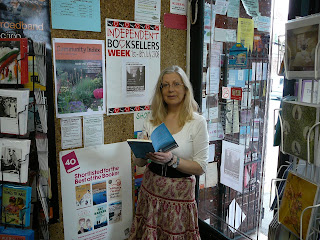
And bookseller Vicky made my afternoon by telling me that my book has done really well there and is still selling!

And bookseller Vicky made my afternoon by telling me that my book has done really well there and is still selling!
Sunday, June 29, 2008
Bo Jazz at the King's Arms
I don't go often to the King's Arms in Salford, although one summer I spent a good deal of time there, as my play O'Leary's Daughters was staged for the 24:7 Theatre Festival in their fabulous round-ceilinged upstairs room (I think it used to be a billiards room), and last year after our rehearsals for The Processing Room at Salford University, Mary-Ann Coburn and I used to call in for a drink on our way back into town. I really should go more, because this is where Studio Salford is based, and they always have exciting-sounding programmes of new plays as well as their unique occasional 'embryo' nights where writers and artists can try out new sketches or snippets of plays or short films.
Studio Salford itself seems to be dark at the moment, but on Friday and last night a new independent company formed by actors Jarrod Cooke and Ryan Barber staged the first of their own entertainments, Bo Jazz, billed as 'a new concept in live sketch shows', and directed by Helen Parry. John, Matthew and I went along. I must say the acting was brilliant. Five actors, Jarrod, Ryan, Curtis Cole, Samantha Siddall and Daniel Hayes each made lightning switches between very different characters, playing them with wonderfully accurate observation. I liked the innovation whereby between the sketches two musicians, Daniel Willis and Johnny Smith, played live music pieces they had specially composed with the sketches as inspiration. I have to say I did find the sketches a bit laddish, and I'm not sure that the pretty vicious anti-lesbian joke at the end was quite excusable as simply a condemnation of the character who made it.
A great evening, though, and when we came down for the interval who should we bump into but several old friends who just happened to be there drinking. I told you, I should go there more often....
Thursday, June 26, 2008
The Revenger's Tragedy at The Royal Exchange
Last night I went to the Royal Exchange production of The Revenger's Tragedy. I won't name names but, bloody hell, actors just can't seem to speak early modern English dialogue any more.
I must quickly make an exception for Stephen Tompkinson who played Vindice: none of his TV appearances I've seen have indicated to me the stature of his acting, but after last night I'd say he's a genius. Eileen O'Brien, who plays his mother, was also as brilliant as I've come to expect of her.
I went with my son Matthew and we sat on the banquettes, and I have to say we got sore bums and just before the interval our backs started aching but it was worth it, and John, who didn't come because of the bad reviews the production had had, really missed out. I knew the play from university but I'd never seen it, and it really was an experience. As the RX programme notes explain, the Jacobean playwrights thought of themselves as writing modern versions of Roman tragedy, but had overlooked the fact that the violence of those Roman tragedies was merely reported and not enacted on stage. It was a pretty strange experience to watch the Duke having his eyelids slit and his tongue cut out (you just couldn't help thinking about how they were doing it), and, as the interval started, to watch a stage hand pick up the 'tongue' and put it into a plastic pot ready for the next performance. The production self-consciously acknowledged this difficulty in suspending disbelief for a modern audience (for instance, during the use of the Duke's dead body in an intrigue there's a dance sequence performed to 'The Sun Has Got His Hat On'), but whether it worked - along with the modern dress: guys in suits using daggers and killing dukes without redress? - we're still heatedly discussing. There's no doubt however that it's made an impression and that the images will stay with us for good.
I must quickly make an exception for Stephen Tompkinson who played Vindice: none of his TV appearances I've seen have indicated to me the stature of his acting, but after last night I'd say he's a genius. Eileen O'Brien, who plays his mother, was also as brilliant as I've come to expect of her.
I went with my son Matthew and we sat on the banquettes, and I have to say we got sore bums and just before the interval our backs started aching but it was worth it, and John, who didn't come because of the bad reviews the production had had, really missed out. I knew the play from university but I'd never seen it, and it really was an experience. As the RX programme notes explain, the Jacobean playwrights thought of themselves as writing modern versions of Roman tragedy, but had overlooked the fact that the violence of those Roman tragedies was merely reported and not enacted on stage. It was a pretty strange experience to watch the Duke having his eyelids slit and his tongue cut out (you just couldn't help thinking about how they were doing it), and, as the interval started, to watch a stage hand pick up the 'tongue' and put it into a plastic pot ready for the next performance. The production self-consciously acknowledged this difficulty in suspending disbelief for a modern audience (for instance, during the use of the Duke's dead body in an intrigue there's a dance sequence performed to 'The Sun Has Got His Hat On'), but whether it worked - along with the modern dress: guys in suits using daggers and killing dukes without redress? - we're still heatedly discussing. There's no doubt however that it's made an impression and that the images will stay with us for good.
Wednesday, June 25, 2008
Messiness in Fiction
As I've written here before, I'm working on a series of short stories in which I'm trying something new. It's partly my response to, or maybe expression of, the situation we find ourselves in culturally and psychologically post 9/11, and partly perhaps my own rebellion against what I've done before - which you have to keep doing if you're not to go stale as an artist, right?
As I've said here, I've become increasingly impatient with concepts of fixed character, and with plot which leans towards singular meaning, and indeed with the whole conventional notion of story - I guess I always have, really, but I've been tipped over the edge recently. I keep asking myself: How like life is that, after all: the single interpretation, the one (authorial) viewpoint, the satisfying conclusion?
And yet... How to make stories which convey the messiness of life, the fact that sometimes there is no conclusion and we don't know the meaning - which increasingly it seems to me it's important to do - while yet satisfying the entirely understandable desire of readers for pattern and meaning?
It's hard. My story 'Possibility', which will appear in the first edition of the new online lit mag Horizon Review is one attempt. This kind of writing is exhilarating, challenging, but not easy. But an article by Anthony Neilson in today's Guardian has given me courage. He says that works of art which 'attempt to bring order to the unruliness of existence' are reductive, and that this is simply not the business of artists.
As I've said here, I've become increasingly impatient with concepts of fixed character, and with plot which leans towards singular meaning, and indeed with the whole conventional notion of story - I guess I always have, really, but I've been tipped over the edge recently. I keep asking myself: How like life is that, after all: the single interpretation, the one (authorial) viewpoint, the satisfying conclusion?
And yet... How to make stories which convey the messiness of life, the fact that sometimes there is no conclusion and we don't know the meaning - which increasingly it seems to me it's important to do - while yet satisfying the entirely understandable desire of readers for pattern and meaning?
It's hard. My story 'Possibility', which will appear in the first edition of the new online lit mag Horizon Review is one attempt. This kind of writing is exhilarating, challenging, but not easy. But an article by Anthony Neilson in today's Guardian has given me courage. He says that works of art which 'attempt to bring order to the unruliness of existence' are reductive, and that this is simply not the business of artists.
Sunday, June 22, 2008
Reading group: Anil's Ghost by Michael Ondaatje
Michael Ondaatje's The English Patient is one of the few books I have loved so much that I have read it three times in spite of all the other books out there waiting to be squeezed into the time and, more importantly, the headspace left over from my own writing. Once I told him so, at one of those legendary Waterstone's Deansgate readings, and I'm not sure what he thought - whether he was embarrassed or amused or believed me, but anyway I had to say it. It's the structure I find most beautiful - a structure so resonant with aching meanings - so I'm not a huge a fan of the film which alters it so radically.
So anyway, when Doug suggested this, Ondaatje's next novel, I had mixed feelings. Surely this too, would be great, but then surely no writer could ever come up with something so thrillingly resonant twice? In any case, I read it through the filter of the first.
The novel is set in the late eighties and early nineties in Sri Lanka, when government squads were hunting down and murdering antigovernment insurgents and separatist guerillas, and concerns the events which ensue when Anil, a young forensic anthropologist, born in Sri Lanka but having lived abroad for most of her adult life, returns to uncover on behalf of a human rights group the source of the organized campaigns of murder.
This book takes further Ondaatje's use of unusual structure to embody the themes, and this time the rationale is more overtly political. It is essentially episodic, moving from character to character and back and forth in time in a way which can seem baffling, but which people in the group quickly noted mimics both the processes of civil war in which people and meanings are scattered and the procedure of forensic archeology which must piece together seemingly disparate elements. Introducing the book, Doug began by saying that it is about Anil, although he said this rather uncertainly and we quickly agreed that it's not possible to talk about this book in such conventional terms, or appropriate to bring to it conventional expectations. While the beginning appears to focus on Anil - arriving in Sri Lanka, remembering a doomed love affair, and meeting Sarath, the Sri Lankan anthropolgist with whom she will work - by the end of the book the focus has shifted to Sarath. Indeed, it is significant that the first section is titled 'Sarath' and the title of the book does not refer to Anil herself but to her 'ghost'. Most people in the group took this last reference - the 'ghost' - to concern the skeleton on which Anil and Sarath work, but I thought it meant something much more significant: it is revealed some way into the novel that a 'ghost' is a Sri Lankan informer, and Anil does indeed have her 'informer' on the deepest level: someone who points out to her that she with her outsider's perspective is not only useless but potentially dangerous to those she purports to be working to help. As people noted, Anil has dropped out of the book's focus altogether by the end, and by creating such a major shift in perspective the structure of the book thus makes a deeply political statement. I had intended to ask the group why they thought certain sections of the book were in italics, notably Anil's memories of her work life, but I forgot and it wasn't discussed. I think now that it's another authorial device to distance and parenthesize Anil's perspective and illustrate its impotence.
Nearly everyone thought this was an immensely clever book, and nearly everyone seemed to agree that it was moving (although it struck me that they said it without seeming particularly moved). Doug said he had found it very vivid - both in terms of the depiction of the scenery and atmosphere and in terms of the character depiction, although there were some things he couldn't quite get to grips with, like the point of Anil's memories of her affair and of her friendship with another, female colleague with whom she has now also lost touch. Clare said she thought that the point of these last were that they illustrated that people never really made lasting connections because they never really knew each other, another instance of Anil's impotence and alienation.
All of this praise had rendered John completely silent, as he had been unable to engage with the novel at all, and I now said that in spite of everything I admired about the book, my experience had been rather similar: unlike others I hadn't been moved by the book since I hadn't found the characters ever came to emotional life. Jenny suggested that that was deliberate authorial strategy, a replication of the repression of people living under such regimes - which is probably true, but sadly means for me that the novel's devices were too successful, and deprived it of the resonance I'd found in The English Patient.
Our archived discussions can be found here, and a list of all the books we have discussed here.
So anyway, when Doug suggested this, Ondaatje's next novel, I had mixed feelings. Surely this too, would be great, but then surely no writer could ever come up with something so thrillingly resonant twice? In any case, I read it through the filter of the first.
The novel is set in the late eighties and early nineties in Sri Lanka, when government squads were hunting down and murdering antigovernment insurgents and separatist guerillas, and concerns the events which ensue when Anil, a young forensic anthropologist, born in Sri Lanka but having lived abroad for most of her adult life, returns to uncover on behalf of a human rights group the source of the organized campaigns of murder.
This book takes further Ondaatje's use of unusual structure to embody the themes, and this time the rationale is more overtly political. It is essentially episodic, moving from character to character and back and forth in time in a way which can seem baffling, but which people in the group quickly noted mimics both the processes of civil war in which people and meanings are scattered and the procedure of forensic archeology which must piece together seemingly disparate elements. Introducing the book, Doug began by saying that it is about Anil, although he said this rather uncertainly and we quickly agreed that it's not possible to talk about this book in such conventional terms, or appropriate to bring to it conventional expectations. While the beginning appears to focus on Anil - arriving in Sri Lanka, remembering a doomed love affair, and meeting Sarath, the Sri Lankan anthropolgist with whom she will work - by the end of the book the focus has shifted to Sarath. Indeed, it is significant that the first section is titled 'Sarath' and the title of the book does not refer to Anil herself but to her 'ghost'. Most people in the group took this last reference - the 'ghost' - to concern the skeleton on which Anil and Sarath work, but I thought it meant something much more significant: it is revealed some way into the novel that a 'ghost' is a Sri Lankan informer, and Anil does indeed have her 'informer' on the deepest level: someone who points out to her that she with her outsider's perspective is not only useless but potentially dangerous to those she purports to be working to help. As people noted, Anil has dropped out of the book's focus altogether by the end, and by creating such a major shift in perspective the structure of the book thus makes a deeply political statement. I had intended to ask the group why they thought certain sections of the book were in italics, notably Anil's memories of her work life, but I forgot and it wasn't discussed. I think now that it's another authorial device to distance and parenthesize Anil's perspective and illustrate its impotence.
Nearly everyone thought this was an immensely clever book, and nearly everyone seemed to agree that it was moving (although it struck me that they said it without seeming particularly moved). Doug said he had found it very vivid - both in terms of the depiction of the scenery and atmosphere and in terms of the character depiction, although there were some things he couldn't quite get to grips with, like the point of Anil's memories of her affair and of her friendship with another, female colleague with whom she has now also lost touch. Clare said she thought that the point of these last were that they illustrated that people never really made lasting connections because they never really knew each other, another instance of Anil's impotence and alienation.
All of this praise had rendered John completely silent, as he had been unable to engage with the novel at all, and I now said that in spite of everything I admired about the book, my experience had been rather similar: unlike others I hadn't been moved by the book since I hadn't found the characters ever came to emotional life. Jenny suggested that that was deliberate authorial strategy, a replication of the repression of people living under such regimes - which is probably true, but sadly means for me that the novel's devices were too successful, and deprived it of the resonance I'd found in The English Patient.
Our archived discussions can be found here, and a list of all the books we have discussed here.
Saturday, June 21, 2008
Succour launch at the Briton's Protection
 The literary magazine scene is thriving again, thanks to the web, and one mag which has achieved prominence and a good deal of acclaim is Succour. Last night the latest and seventh issue was launched in the Briton's Protection pub here in Manc, and John and I went along and met Max Dunbar, one of Succor's several UK regional editors, and Managing Editor Anthony Banks, and heard two great readings by contributors to the current issue, Animals. Nick Royle's striking story 'The Bee Eater' displayed his trademark style, whereby everyday reality is slyly shifted into the surreal and indeed shockingly weird. Aidan Clarkson's poem, 'Feathers, Families', dealing with a strange mass metamorphosis, was equally arresting and otherworldly - all the more so for its deadpan demotic tone. Great stuff: I bought the mag forthwith.
Nick and Anthony Banks also read stories of their own which had appeared in the London Magazine (which, in spite of recent Arts Council cuts, is still going strong due to the energetic efforts of the acting editor Sarah Mae Tuson and her team). John also read: his recent serious illness has somehow pushed him back into writing poetry after years away from it and writing academic texts instead, and last night he put his toe back in the reading water with a very short poem from his Peterloo collection, In the Footsteps of the Opium Eater.
It was a great evening, and great to drive home with a sense that the small magazine scene is buzzing once again.
Sunday, June 15, 2008
Inspiration again
Speaking of 'inspiration': Nick Laird follows Anne Enright in the new Guardian Author, Author slot with an endorsement of her account of the process of beginning writing a piece as fundamentally unwilled and out of the author's conscious control. (Can't find a link, I'm afraid.) However, Laird is only speaking for poetry, the conception of which he says has 'no aspect of choice':
I like this, and I also like the fact that he says that this is why you can't just go making poetry out of other people's suggestions or reported incidents, but I'm pretty uncomfortable (as I guess Anne Enright might be) with his suggestion that the same can't be said for fiction.
As far as I'm concerned, this is a pretty accurate description of the conception of fiction (as I've indicated in the piece I wrote as part of the series on author 'inspiration' for John Baker's blog) - especially short stories which I believe are closely related to poems. Laird's account of a poem's gestation: 'Not a wholly intended process', depending on Maeterlink's 'concentration, intensity of mood', is not unlike my own description of a story's gestation in my Quill magazine interview, and for me the 'clarification' of a story similarly depends (if to lesser extent) on 'sonic effect'.
And actually, when it comes to novels, it's not that different, either, as far as I'm concerned...
This is why, when my mum rings up on Sundays with the latest scandal or family crisis and the inevitable rider: 'There's a story there for you!', like Laird I can only politely murmur agreement, knowing it won't go anywhere.
The right words are little coughs from off-stage, promptings, triggers, intimations of something near and distant ... and finally connected to you, right through your skin.
I like this, and I also like the fact that he says that this is why you can't just go making poetry out of other people's suggestions or reported incidents, but I'm pretty uncomfortable (as I guess Anne Enright might be) with his suggestion that the same can't be said for fiction.
As far as I'm concerned, this is a pretty accurate description of the conception of fiction (as I've indicated in the piece I wrote as part of the series on author 'inspiration' for John Baker's blog) - especially short stories which I believe are closely related to poems. Laird's account of a poem's gestation: 'Not a wholly intended process', depending on Maeterlink's 'concentration, intensity of mood', is not unlike my own description of a story's gestation in my Quill magazine interview, and for me the 'clarification' of a story similarly depends (if to lesser extent) on 'sonic effect'.
And actually, when it comes to novels, it's not that different, either, as far as I'm concerned...
This is why, when my mum rings up on Sundays with the latest scandal or family crisis and the inevitable rider: 'There's a story there for you!', like Laird I can only politely murmur agreement, knowing it won't go anywhere.
Saturday, June 07, 2008
The Short Review reviews Balancing on the Edge of the World
Issue 8 of The Short Review is now up, and it includes a pretty fabulous review by Melissa Lee-Houghton of my story collection Balancing on the Edge of the World .
She calls it 'a stunning debut collection by a writer whose prose deliberates its characters and themes with a keen sense of literary drama'. She also says of the stories that they are:
And here's what The Short Review says about me (!):
Eeek! Now I'll have to live up to that!
This seems to be a bumper issue, with reviews of nine other great-looking collections as well, and interviews with seven authors (including yours truly).
She calls it 'a stunning debut collection by a writer whose prose deliberates its characters and themes with a keen sense of literary drama'. She also says of the stories that they are:
contemporary in the acutest sense without being limited to being fashionably modern ... Place and time are not necessarily pinned down in many of the stories, but rather swoon toward a universality which is wholly admirable ... The stories never feel forced, but prickle with a high-sensitivity to the themes which bleed through Baines’s concept of power: often nameless individuals dish out and receive humility, fear, violent threat, expectation ... Each story, though offering a heavily unreassuring perspective, feels weightless and tuned in, in the balance of the fickle order of things.
And here's what The Short Review says about me (!):
Her reputation is consistent amongst her peers and readers alike, as an innovative and committed writer of distinctly pure talent.
Eeek! Now I'll have to live up to that!
This seems to be a bumper issue, with reviews of nine other great-looking collections as well, and interviews with seven authors (including yours truly).
Wednesday, June 04, 2008
Salt's Short Story Bank
Want to get loads of contemporary short stories and a bargain to boot, including discounts and beautiful hardbacks?
Subscribe to my innovative publisher Salt's Short Story Bank.
Subscribe to my innovative publisher Salt's Short Story Bank.
Sunday, June 01, 2008
The need to be ready to write
Anne Enright writes about the difficulty of starting a novel, and the tricky conditions required for doing so, including one's own emotional relationship to the material. What comes over is an impression that the ability to get going on a piece is not ultimately under the author's conscious control or will.
I've written something similar on this blog, but after reading the Enright piece I got to thinking that actually, sometimes being forced to start writing rather than waiting around for the ripe moment or 'inspiration' is useful, and fruitful (well I hope it was for me!). All but the first two of my radio plays were written to commission and deadline, as were at least two of the stories in Balancing: 'The Way to Behave', which was commissioned for the Bitchlit anthology, and 'Into the Night' which was requested for a Welsh anthology of erotic stories (though the anthology never happened - not enough Welsh writers came up with erotic stories!) I've also written here agreeing with AL Kennedy that literary competitions which dictate subject-matter militate against innovation, but both of these short stories were responses to prescribed themes.
I guess, though, it's more a question of being lucky if the prescribed theme or the imposed deadline fits your own prior state of readiness, because unless you're in the 'zone' whatever you write will be dead in the water before it swims.
I've written something similar on this blog, but after reading the Enright piece I got to thinking that actually, sometimes being forced to start writing rather than waiting around for the ripe moment or 'inspiration' is useful, and fruitful (well I hope it was for me!). All but the first two of my radio plays were written to commission and deadline, as were at least two of the stories in Balancing: 'The Way to Behave', which was commissioned for the Bitchlit anthology, and 'Into the Night' which was requested for a Welsh anthology of erotic stories (though the anthology never happened - not enough Welsh writers came up with erotic stories!) I've also written here agreeing with AL Kennedy that literary competitions which dictate subject-matter militate against innovation, but both of these short stories were responses to prescribed themes.
I guess, though, it's more a question of being lucky if the prescribed theme or the imposed deadline fits your own prior state of readiness, because unless you're in the 'zone' whatever you write will be dead in the water before it swims.
Subscribe to:
Posts (Atom)