Tuesday, August 31, 2010
Twitter, Too Many Magpies, and a nice review
Very pleased to say that William Rycroft has given Too Many Magpies a really nice review. Interestingly, he begins the review by posing the question, Does Twitter sells books? His answer is yes, as he found out about TMM through the #dearpublisher discussion on Twitter, via which he got into a dialogue with my publisher Chris at Salt. Chris, bless his heart, recommended it when William explained the kind of book he liked. Thank you to both of them, and very glad it came up to William's expectations!


Wednesday, August 25, 2010
Alison Wells reviews Too Many Magpies
After not being to able to make a connection this morning (even though the weather was lovely - maybe it's not the weather!), I've now got 3 strokes on the 5-stroke connection gauge, and as soon as I connected up found this - a really lovely review of Too Many Magpies by writer Alison Wells. It's made my day, especially as what she says at the end is quite the best compliment one writer can pay to another:
As a reader it was the kind of book I have longed to read, as a writer, it is the kind of book I would dream of writing.I can't tell you how very happy that makes me feel. Thank you, Alison.
Sunday, August 22, 2010
Cut off
 For days this has been my view in the mornings from my writing desk here in Wales, and as a result I haven't had much internet access. In the past I've thought it was the clouds that interfered with the signals (I think they're bounced back off the ridge in front of the house, as at the back we're shielded from Caernarfon and the masts by a hump of the hill and slate tips, and the ridge attracts cloud), and at other times I've thought it must be the wind. Well, we've had both this week, and as you can see we've been right inside the former. I've lost text messages and emails I've tried to send as a result of signals cutting out half-way through sending them, and for most of the time the web has been impossible. Today though, touch wood, the weather's better and last time I tried the connection was pretty good.
I managed to put yesterday's post up only after a lot of hassle. When I sat down to write it, I couldn't access Blogger at all, so I composed it in Word and when I got a connection pasted it in, and what a palaver that turned out to be: blogger simply wouldn't accept Word HTML, and I had to go through the whole thing deleting and replacing it all. They call it 'mobile broadband', but really, it's worse than dial-up used to be on my old groany desktop computer. And then, I discovered today, my latest version of the post hadn't published at all, although I'd thought it had...
Not surprisingly, I have ended up a lot of the time not even bothering, especially when I've got my novel pressing and that's the main reason I'm here. And I must say, I'm getting plenty of that done. And I've got another 10 days or so before other family members arrive here to join us...
Saturday, August 21, 2010
Reading group: The Bell Jar by Sylvia Plath
This book was my suggestion, a book I had loved when I read it some years ago. It’s poet Sylvia Plath’s only novel, published originally under a pseudonym and confessedly and verifiably autobiographical.
It opens during the fifties summer that the Rosenbergs are executed for spying and first-person narrator Esther Greenwood, an A-grade literature student, is working out an expenses-paid job on a New York fashion magazine, the prize she has won, along with several other aspirant young women, with her writing. Acutely aware of the hollowness of the fashion world around her, disillusioned with her long-term medical student boyfriend Buddy, and sensing that her lifelong academic goals are equally hollow, Esther begins to be cut off in depression, the ‘bell jar’ of the title, eventually undergoing ECT and attempting suicide and becoming hospitalised. The book is striking for its wonderfully imagistic, witty and energetic prose, and moves at a great pace – the kind of book you really can’t put down.
I told the group how much I had loved the book previously, but said that this time I had a problem with it: I didn’t really know how to take it. The first time I read it I had entirely identified with Esther – apart from her suicidal impulses – but on this occasion I was shocked to find that I couldn’t always sympathise with her and indeed now and then I found I didn’t even like her. For instance, after the opening line, which is so striking that I had remembered it almost verbatim when I suggested the book: It was a queer, sultry summer, the summer they electrocuted the Rosenbergs… the prose moves instantly away from political engagement to a self-obsessed focus on Esther’s own emotional state: The idea of being electrocuted makes me sick. It’s not the Rosenbergs who have her attention in this paragraph so much as the idea of suffering electrocution herself, which, as Hans would point out later, is fulfilled when her own first ECT treatment goes wrong and she suffers great trauma. Indeed, she goes further in distancing herself from the Rosenberg issue and painting it rather as an unworthy and hassling trauma to herself: That’s all there was to read about in the papers – goggle-eyed headlines staring up at me on every street corner and the fusty, peanut-smelling mouth of every subway. It had nothing to do with me , but I couldn’t help wondering what it would be like, being burned all along your nerves (my bolds).
It would be possible to read this as self-ironic, were it not for the fact that we are clearly meant to take Esther’s depression and later trauma seriously, and of course should. On the other hand, there are clearly self-ironic moments: I decided I would spend the summer writing a novel./ That would fix a lot of people. There are occasions when we are clearly meant to laugh at, or at least with, Esther: at the way, for instance, she eats with unladylike greed at the Ladies’ Day banquet, and - embedded as a flashback within this scene - the way she cons her way out of taking a science course at college. But then we are not intended to laugh at the consequences and underlying currents: a traumatic food poisoning which symbolises the rot at the heart of this New York world and prefigures the deeper sickness which Esther will suffer, and the fact that, in spite of saying ‘I had to laugh when I thought about [the chemistry course]’, she admits ‘how scared and depressed’ she was about it. The drop in tone made me see the episodes retrospectively in a more serious light, which in turn, perhaps because of the (retrospectively inappropriate) levity of the earlier scenes, made me see Esther as potentially simply greedy and self-centred.
It seemed to me that my problem with knowing how to read the book had something to do with the tone, but I wasn’t sure exactly what. John put in here and said that yes, on this reading he had found the first half too flippant for the grimness of the second half. I wasn’t sure I agreed with this. I wouldn’t say that the tone was ever flippant, and there are dark ironies I really appreciated. For instance, when Esther begins contemplating suicide she thinks that if you are going to jump off a building then the higher the storey the safer, since you are more likely to kill yourself, and that a gun is dangerous only because you are most likely to bungle the attempt and end up living.
I said that I was also surprised to realize on this reading something that I hadn’t noticed the first time, and which I have never heard or read anyone noting: that this is a story of suppressed grief. Esther’s father has died when she was a child, and Esther says quite clearly, though somewhat briefly, that she began to realize she had never been happy since she was running along the beach the summer before her father died. Suicidal and living with her mother, she visits the town she grew up in and her father’s grave:
Having become aware of this theme, it seemed the real one to me, but I felt it was somewhat subsumed in (and possibly, indeed, cuts across) the more overt feminist theme. There is the depiction of the brutality of male obstetrics: I thought it was just like the sort of drug a man would invent. Here was a woman in terrible pain, obviously feeling every bit of it or she wouldn’t groan like that, and she would go straight home and start another baby because the drug would make her forget how bad the pain had been. Buddy’s mother is described as turning herself into a floor rug for others to walk on, and there is a strong implication that Esther’s depression is a reaction to the fact that in a world in which she is expected to type dictated letters she wants to ‘dictate [her] own thrilling letters’.
I wondered therefore how aware the author was of this theme of suppressed grief, and if this is the source of an uncertainty I found in the novel. At this point I had become curious to see what others had written about the themes of the novel, and had done a brief bit of Googling. I didn’t find any mention of Esther’s grief about her father but was interested to find a fair amount of disagreement in particular about the end of the novel. While Marjorie Perloff sees the book as being about Esther’s need to find herself in a world that divides women from themselves (she quotes the extensive dismemberment imagery in the novel), and the ending as Esther’s rebirth, Diane Bonds argues that in fact at the end Esther dismembers herself in order to fit into society (quoting the wedding imagery that appears there). Personally, I feel that the ending is extremely ambiguous, and also that it’s hard not to read into it the fact that Plath did commit suicide not long after the book was written, which adds to my sense of the uncertainty of the whole. Therefore, I said, I would be interested in what the others in the group thought.
I was much briefer than this in my introduction and didn’t quote chapter and verse as I have here, so I probably wasn’t very convincing. Jenny said firmly that she had really liked the book, and Trevor agreed. Trevor said, You want to take no notice of that internet stuff, and said what he thought the novel was about, but I’m really sorry to say that I can’t remember what that was. I think he disagreed that the ending was ambiguous (one or two people had agreed that it was), but I don’t remember how he interpreted it.
Some saw the book as being simply about mental illness, I think, including Hans who said, But there isn’t a feminist theme in it, is there? I said, Well, what about the fact that Esther immediately identifies Marco whom she meets at a party as one of those men who hates women, and Hans said, Well there are men who hate women – implying, I think, that Plath wasn’t making any particular feminist point about this. Someone (maybe Trevor) pointed out to me that Sylvia Plath would never even have heard of feminism, and I said that that didn’t make her message any less feminist, but I didn’t get the feeling that I convinced. Jenny said that this book was taken up as feminist during the seventies and eighties because it hit a chord, and I think she was implying that its feminist slant was over-emphasised then. There was a fair bit of discussion about mental illness and its changing treatment, and changing definitions of depression and schizophrenia, which Jenny as a one-time sociology lecturer knew a lot about.
Jenny said that when she read it in the seventies she hadn’t liked it as much as everyone else, but that this time she had liked it a lot because now she can see how it fitted in with something which I think she called Symbolic Interpretation, which she said was a theory very current at the time of the writing of the book. She said that that thing about the Rosenbergs, for instance, was a comment on the world around Esther (ie as opposed to the way I’d analysed it). No one else knew what Symbolic Interpretation was, and I asked her to explain. She said it was a way of looking at the world in terms of symbols, and although I momentarily thought I understood, I don’t in retrospect: it seems to me quite simply that all writing is symbolic interpretation, although Plath’s imagery is certainly heavily symbolic.
All these different interpretations were serving to emphasise my sense of an uncertainty at the heart of the book. I asked people what they thought of Esther’s mother, as Diane Bonds interprets her as monstrous, which I hadn’t myself. Everyone agreed with me: they thought the mother was simply inadequate and over-conventional, and some even said that at moments they could feel sorry for her. Trevor said again that I shouldn’t bother with internet stuff, but I think it’s instructive that Bonds could interpret such statements of Esther’s as ‘My mother wasn’t much help’ as indicative of monstrosity, ie that this may be symptomatic of a difficulty in getting to grips with the tone of the narration.
Ann said that she had enjoyed the book very much, but that she too had had a difficulty in knowing how to read it. Mainly she felt that it was just about impossible to read it without knowledge of Plath’s suicide very soon after writing it, and impossible to know how one would read it without that knowledge.
Jenny and Trevor said that they thought it was entirely possible to read the book without injecting that knowledge into it, and I felt that they thought it was wrong to do so.
Ann said, though, that she suspected that Plath's depression at the time of writing had actually affected the tone of the book: that the book was an attempt to rise above the situation with wit and a resolution, but it was undercut by her continuing depression, which also gives rise to the ambiguous ending. This, I think, hits the nail on the head.
Trevor, though, reiterated that you could read it without knowing about Plath’s suicide, and someone, I think Jenny, said, But it’s brilliantly written! – which, having taken it for granted, I had failed to say, and I quickly agreed, as did everyone. People then spent some time talking about the bits they’d particularly liked, especially the funny bits. Trevor loved the bit about Esther thinking her finger-bowl was soup and drinking it all up, the little flowers and all. Hans said he found it really funny when Esther was walking around with a yellow scarf tied to her neck, her first attempt at suicide, but was unable to find anything to hang it on to, and others agreed. I said, But that wasn’t meant to be funny, was it? And Hans readily agreed, as did the others, and I said, Well, this illustrates that there is a difficulty with the tone of the book.
Then Doug spoke up. He said that when he first read the book years ago he thought it was absolutely marvellous, maybe the perfect book, but that his reaction this time was far stronger than mine: he didn’t like any of the people in it. I said, But aren’t they all seen through Esther’s eyes? And he said, yes, but that’s what he didn’t like, the sneery, snobby tone of the whole thing - a quiet bombshell that more or less ended the discussion.
Our archive discussions can be found here and a list of the books we have discussed, with links to the discussions, here.
It opens during the fifties summer that the Rosenbergs are executed for spying and first-person narrator Esther Greenwood, an A-grade literature student, is working out an expenses-paid job on a New York fashion magazine, the prize she has won, along with several other aspirant young women, with her writing. Acutely aware of the hollowness of the fashion world around her, disillusioned with her long-term medical student boyfriend Buddy, and sensing that her lifelong academic goals are equally hollow, Esther begins to be cut off in depression, the ‘bell jar’ of the title, eventually undergoing ECT and attempting suicide and becoming hospitalised. The book is striking for its wonderfully imagistic, witty and energetic prose, and moves at a great pace – the kind of book you really can’t put down.
I told the group how much I had loved the book previously, but said that this time I had a problem with it: I didn’t really know how to take it. The first time I read it I had entirely identified with Esther – apart from her suicidal impulses – but on this occasion I was shocked to find that I couldn’t always sympathise with her and indeed now and then I found I didn’t even like her. For instance, after the opening line, which is so striking that I had remembered it almost verbatim when I suggested the book: It was a queer, sultry summer, the summer they electrocuted the Rosenbergs… the prose moves instantly away from political engagement to a self-obsessed focus on Esther’s own emotional state: The idea of being electrocuted makes me sick. It’s not the Rosenbergs who have her attention in this paragraph so much as the idea of suffering electrocution herself, which, as Hans would point out later, is fulfilled when her own first ECT treatment goes wrong and she suffers great trauma. Indeed, she goes further in distancing herself from the Rosenberg issue and painting it rather as an unworthy and hassling trauma to herself: That’s all there was to read about in the papers – goggle-eyed headlines staring up at me on every street corner and the fusty, peanut-smelling mouth of every subway. It had nothing to do with me , but I couldn’t help wondering what it would be like, being burned all along your nerves (my bolds).
It would be possible to read this as self-ironic, were it not for the fact that we are clearly meant to take Esther’s depression and later trauma seriously, and of course should. On the other hand, there are clearly self-ironic moments: I decided I would spend the summer writing a novel./ That would fix a lot of people. There are occasions when we are clearly meant to laugh at, or at least with, Esther: at the way, for instance, she eats with unladylike greed at the Ladies’ Day banquet, and - embedded as a flashback within this scene - the way she cons her way out of taking a science course at college. But then we are not intended to laugh at the consequences and underlying currents: a traumatic food poisoning which symbolises the rot at the heart of this New York world and prefigures the deeper sickness which Esther will suffer, and the fact that, in spite of saying ‘I had to laugh when I thought about [the chemistry course]’, she admits ‘how scared and depressed’ she was about it. The drop in tone made me see the episodes retrospectively in a more serious light, which in turn, perhaps because of the (retrospectively inappropriate) levity of the earlier scenes, made me see Esther as potentially simply greedy and self-centred.
It seemed to me that my problem with knowing how to read the book had something to do with the tone, but I wasn’t sure exactly what. John put in here and said that yes, on this reading he had found the first half too flippant for the grimness of the second half. I wasn’t sure I agreed with this. I wouldn’t say that the tone was ever flippant, and there are dark ironies I really appreciated. For instance, when Esther begins contemplating suicide she thinks that if you are going to jump off a building then the higher the storey the safer, since you are more likely to kill yourself, and that a gun is dangerous only because you are most likely to bungle the attempt and end up living.
I said that I was also surprised to realize on this reading something that I hadn’t noticed the first time, and which I have never heard or read anyone noting: that this is a story of suppressed grief. Esther’s father has died when she was a child, and Esther says quite clearly, though somewhat briefly, that she began to realize she had never been happy since she was running along the beach the summer before her father died. Suicidal and living with her mother, she visits the town she grew up in and her father’s grave:
…my legs folded under me, and I sat down in the sopping grass. I couldn’t understand why I was crying so hard.
Then I remembered that I had never cried for my father’s death.
Having become aware of this theme, it seemed the real one to me, but I felt it was somewhat subsumed in (and possibly, indeed, cuts across) the more overt feminist theme. There is the depiction of the brutality of male obstetrics: I thought it was just like the sort of drug a man would invent. Here was a woman in terrible pain, obviously feeling every bit of it or she wouldn’t groan like that, and she would go straight home and start another baby because the drug would make her forget how bad the pain had been. Buddy’s mother is described as turning herself into a floor rug for others to walk on, and there is a strong implication that Esther’s depression is a reaction to the fact that in a world in which she is expected to type dictated letters she wants to ‘dictate [her] own thrilling letters’.
I wondered therefore how aware the author was of this theme of suppressed grief, and if this is the source of an uncertainty I found in the novel. At this point I had become curious to see what others had written about the themes of the novel, and had done a brief bit of Googling. I didn’t find any mention of Esther’s grief about her father but was interested to find a fair amount of disagreement in particular about the end of the novel. While Marjorie Perloff sees the book as being about Esther’s need to find herself in a world that divides women from themselves (she quotes the extensive dismemberment imagery in the novel), and the ending as Esther’s rebirth, Diane Bonds argues that in fact at the end Esther dismembers herself in order to fit into society (quoting the wedding imagery that appears there). Personally, I feel that the ending is extremely ambiguous, and also that it’s hard not to read into it the fact that Plath did commit suicide not long after the book was written, which adds to my sense of the uncertainty of the whole. Therefore, I said, I would be interested in what the others in the group thought.
I was much briefer than this in my introduction and didn’t quote chapter and verse as I have here, so I probably wasn’t very convincing. Jenny said firmly that she had really liked the book, and Trevor agreed. Trevor said, You want to take no notice of that internet stuff, and said what he thought the novel was about, but I’m really sorry to say that I can’t remember what that was. I think he disagreed that the ending was ambiguous (one or two people had agreed that it was), but I don’t remember how he interpreted it.
Some saw the book as being simply about mental illness, I think, including Hans who said, But there isn’t a feminist theme in it, is there? I said, Well, what about the fact that Esther immediately identifies Marco whom she meets at a party as one of those men who hates women, and Hans said, Well there are men who hate women – implying, I think, that Plath wasn’t making any particular feminist point about this. Someone (maybe Trevor) pointed out to me that Sylvia Plath would never even have heard of feminism, and I said that that didn’t make her message any less feminist, but I didn’t get the feeling that I convinced. Jenny said that this book was taken up as feminist during the seventies and eighties because it hit a chord, and I think she was implying that its feminist slant was over-emphasised then. There was a fair bit of discussion about mental illness and its changing treatment, and changing definitions of depression and schizophrenia, which Jenny as a one-time sociology lecturer knew a lot about.
Jenny said that when she read it in the seventies she hadn’t liked it as much as everyone else, but that this time she had liked it a lot because now she can see how it fitted in with something which I think she called Symbolic Interpretation, which she said was a theory very current at the time of the writing of the book. She said that that thing about the Rosenbergs, for instance, was a comment on the world around Esther (ie as opposed to the way I’d analysed it). No one else knew what Symbolic Interpretation was, and I asked her to explain. She said it was a way of looking at the world in terms of symbols, and although I momentarily thought I understood, I don’t in retrospect: it seems to me quite simply that all writing is symbolic interpretation, although Plath’s imagery is certainly heavily symbolic.
All these different interpretations were serving to emphasise my sense of an uncertainty at the heart of the book. I asked people what they thought of Esther’s mother, as Diane Bonds interprets her as monstrous, which I hadn’t myself. Everyone agreed with me: they thought the mother was simply inadequate and over-conventional, and some even said that at moments they could feel sorry for her. Trevor said again that I shouldn’t bother with internet stuff, but I think it’s instructive that Bonds could interpret such statements of Esther’s as ‘My mother wasn’t much help’ as indicative of monstrosity, ie that this may be symptomatic of a difficulty in getting to grips with the tone of the narration.
Ann said that she had enjoyed the book very much, but that she too had had a difficulty in knowing how to read it. Mainly she felt that it was just about impossible to read it without knowledge of Plath’s suicide very soon after writing it, and impossible to know how one would read it without that knowledge.
Jenny and Trevor said that they thought it was entirely possible to read the book without injecting that knowledge into it, and I felt that they thought it was wrong to do so.
Ann said, though, that she suspected that Plath's depression at the time of writing had actually affected the tone of the book: that the book was an attempt to rise above the situation with wit and a resolution, but it was undercut by her continuing depression, which also gives rise to the ambiguous ending. This, I think, hits the nail on the head.
Trevor, though, reiterated that you could read it without knowing about Plath’s suicide, and someone, I think Jenny, said, But it’s brilliantly written! – which, having taken it for granted, I had failed to say, and I quickly agreed, as did everyone. People then spent some time talking about the bits they’d particularly liked, especially the funny bits. Trevor loved the bit about Esther thinking her finger-bowl was soup and drinking it all up, the little flowers and all. Hans said he found it really funny when Esther was walking around with a yellow scarf tied to her neck, her first attempt at suicide, but was unable to find anything to hang it on to, and others agreed. I said, But that wasn’t meant to be funny, was it? And Hans readily agreed, as did the others, and I said, Well, this illustrates that there is a difficulty with the tone of the book.
Then Doug spoke up. He said that when he first read the book years ago he thought it was absolutely marvellous, maybe the perfect book, but that his reaction this time was far stronger than mine: he didn’t like any of the people in it. I said, But aren’t they all seen through Esther’s eyes? And he said, yes, but that’s what he didn’t like, the sneery, snobby tone of the whole thing - a quiet bombshell that more or less ended the discussion.
Our archive discussions can be found here and a list of the books we have discussed, with links to the discussions, here.
Monday, August 16, 2010
Champion of Ben Judge's World Lit Cup!
Can you believe it, I am the champion of Benjamin Judges' World Literary Cup!!
I won the final and the quarter-final purely on random words (!) but along the way I beat Katherine Mansfield, James Joyce, Nicola Barker and Jorge Luis Borges, and not entirely according to spurious criteria but to some extent Ben's own literary judgement, and he said some very nice things about Too Many Magpies.
Thank you, Ben! And all respect to my opponents including my fellow north-west writer Jenn Ashworth who only fell on penalty shoot-outs!
I won the final and the quarter-final purely on random words (!) but along the way I beat Katherine Mansfield, James Joyce, Nicola Barker and Jorge Luis Borges, and not entirely according to spurious criteria but to some extent Ben's own literary judgement, and he said some very nice things about Too Many Magpies.
Thank you, Ben! And all respect to my opponents including my fellow north-west writer Jenn Ashworth who only fell on penalty shoot-outs!
Sunday, August 15, 2010
Reading group: The Girl with the Dragon Tattoo
Hans suggested this book because when his wife, who doesn’t normally like crime novels, had tried it, she’d found she liked it. He was interested therefore to know what the group members thought of it, and since it has been such a phenomenal best-seller, along with its two sequels, we were interested to know why, and chose it over the alternative suggestion.
It concerns Swedish investigative journalist Mikail Blomkvist, editor of the political journal Millennium, who is brought down by a capitalist he tried to expose and as a result becomes involved with Henrik Vanger, head of a business family with a shadowy past including Nazism and the disappearance in the sixties of Vanger’s sixteen-year-old niece Harriet who has never been seen again, presumed dead. Vanger engages Blomkvist, who has had to leave his editorship, ostensibly to write a history of the Vanger family but in reality to investigate Harriet’s disappearance. He is helped in this quest by an unconventional private investigator, the tough punk Lisbeth Salander, a computer hacker and previous problem child who in her twenties is still, according to the Swedish system, under state care.
It’s a long book – 538 pages - and one of the strange aspects of its success is that it seems to be generally agreed (on Twitter etc) that for the first 100 pages or so it’s pretty boring, with lots of expositionary backstory concerning the court case and the investigation which led to Blomkvist’s conviction and downfall.
Well, the gist of the meeting was that everyone thought it was pretty rubbishy but everyone liked it apart from John who found he couldn’t read it, and me, although I have to admit that for the sake of argument I was more negative in the meeting than I actually felt, as outlined on my Fictionbitch blog.
The first person to comment was Jenny, who has read all three of the books, and who said she absolutely loved the character Lisbeth Salander, and there were murmurs of agreement. In fact, I didn't find Salander entirely convincing as a character, though I didn't say this: there seemed inconsistency rather than complexity in the way she was portrayed as streetwise yet now and then naive. Everyone pretty much agreed that the book was poorly written, and that indeed for the first 100 pages or so Larsson seemed to be learning, in a very fundamental way, to write. There is far too much exposition, much telling the reader instead of showing, and Larsson will suddenly launch into a non-novelistic essay informing the reader about such things as the Swedish state care system. Not to mention the author’s relish in the tedious details of computers which may have been state-of-the art at the time of writing, but which are now outdated. Although people had said they liked Salander, they all agreed that there was no real psychological insight in the book. And everyone, even accountant Doug, agreed that the end of the book, which deals with Blomkvist’s comeback and the details of the financial scandal he finally does expose, is even more boring than the beginning.
I said that it reminded me of nothing so much as reading Enid Blyton when I was a child, especially the way the food is described in such painstaking and often inappropriate detail. I read out this passage which occurs just after Blomkvist and Salander have escaped from a torture chamber, Blomkvist himself having been tortured:
She helped him off with his clothes and propelled him to the bathroom. Then she put on water for coffee and made half a dozen thick sandwiches on rye bread with cheese and liver sausage and dill pickles (my italics)
and everyone fell about laughing.
As I said on my Fictionbitch blog, this is probably the first book we’ve read for the group that I didn’t find in any way disruptive to my own creative writing process, and everyone agreed that that was the point, it was meant merely as a diversion. Clare said it was like chocolate, just something easy to swallow, and Ann said she’d had some long train journeys recently and it had been great for that, to pass the time. I said that that was my objection, really: ultimately, I really didn’t want to read a book just to pass the time, but for something much more fruitful; to me it was a waste of time. John said I was precious, and from the reaction of the others he was speaking for them too, but it was really rich coming from him since he hadn’t even read past page 50 or so. And Ann added that she’d liked reading about the food and finding out about the things Swedes ate, and the fact that they drank so much coffee, and others agreed.
Then Ann addressed the question of why this book, above other crime thrillers, has been so very popular. She thought that certain crime series are popular because they happen to hit particular chords in the societies and times in which they are written, and there was a fair bit of discussion about other crime writers members had read. Jenny said that this book was about violence to women: indeed, the parts that the book is divided into are subtitled with quotes from Swedish statistics on violence to women, and the original Swedish title of the book was Men Who Hate Women. I said that in fact it ticked several of our current concerns to which the theme of violence towards women is somewhat subsumed: corruption in big business, the Nazi past with which we continue to be obsessed, and big-brother surveillance and computer hacking.
But I didn’t think it actually really addressed these issues, not on the psychological level I want from novels (in spite of what some critics have said about Larsson’s anatomization of the mind of a serial killer). What for instance, was Larsson saying about Nazism? (I can’t explain any further without giving the plot away.) There was a pause as people thought, and then someone said, ‘Nazis are bad.’ And I said ‘Exactly. Nothing deeper or more psychological than that.’
Tuesday, August 10, 2010
Things you sometimes see from your writing desk VI
I took a photo of the view I had most days from my window in Wales, but I must have accidentally deleted it. It showed the cloud right outside the window and the nearby trees ghostly, which was very nice in a way: I felt cosily shut in with the world of my novel, and I made good progress, although the overall progress is pretty slow, I'm finding. Like Nuala Ni Chonchuir, who visited this blog recently, I seem to be a more contemplative writer these days, and I think it's bearing fruit...
Anyway, before I went away, the view from my Manchester window was filled with shrieking swifts teaching their young to fly. They kept swooping past in gangs inches from the glass, but they were impossible to catch with the camera, I found: by the time I'd clicked, the window was empty again. This was my best shot: the very last swift about to fly out of view.

And now I'm back and the swifts have gone. They come for such a short time: they don't arrive until the first week in May and they've already gone by the end of the first week of August, and in that time they've nested and their young are fit to fly south. And their departure is so striking: right up until they go the neighbourhood rings with their screaming, and then you wake up one morning and there's silence, they've gone, and you can't help thinking of the end of summer, even though the school holidays have not long begun and the corn's not yet ripe, as we could see at close quarters when the footpath we were following one afternoon in Wales suddenly went right through a cornfield:

On the other hand, the blackbirds are still busy with their belated nest outside my Manchester window, I'm glad to say.
And here's the latest ambitious window display in Palas Print, the Caernarfon bookshop: a display of camping and travel books:

Anyway, before I went away, the view from my Manchester window was filled with shrieking swifts teaching their young to fly. They kept swooping past in gangs inches from the glass, but they were impossible to catch with the camera, I found: by the time I'd clicked, the window was empty again. This was my best shot: the very last swift about to fly out of view.

And now I'm back and the swifts have gone. They come for such a short time: they don't arrive until the first week in May and they've already gone by the end of the first week of August, and in that time they've nested and their young are fit to fly south. And their departure is so striking: right up until they go the neighbourhood rings with their screaming, and then you wake up one morning and there's silence, they've gone, and you can't help thinking of the end of summer, even though the school holidays have not long begun and the corn's not yet ripe, as we could see at close quarters when the footpath we were following one afternoon in Wales suddenly went right through a cornfield:

On the other hand, the blackbirds are still busy with their belated nest outside my Manchester window, I'm glad to say.
And here's the latest ambitious window display in Palas Print, the Caernarfon bookshop: a display of camping and travel books:

Too Many Magpies wins semi-finals of Benjamin Judge's Literary World Cup
What a hoot. Unbelievably, I have beaten Jorge Luis Borges in the semi-finals of Benjamin Judges' World Literary Cup! I really think Ben must have been a bit biased there ! (which is very nice!). Here's what he says:
I'm up against Tove Jansson, author of the Moomin books in the final. Can't imagine how that will go...
(I wrote this post in five minutes - links and all: I'm back in Manchester and back to my broadband which is such a relief: in Wales it would have taken me half and hour with the links and maybe in the end it wouldn't have loaded up at all! Now I just have to be more disciplined with myself about writing, though, what with broadband and shops and mates to see..)
reading Borges is a whole lot of fun, and yes there are interesting questions of reality and the like in our modern world but…Blimey. I don't know what to say, apart from thank you Ben!
…but when you read Too Many Magpies (and I use the future tense purposely, you are going to read it) you read it thinking yes! That’s right! That is what life is like. That is how people speak and think and act. It is real and as such it reflects reality far better than a cracked mirror or an invisible tiger ever can.
I'm up against Tove Jansson, author of the Moomin books in the final. Can't imagine how that will go...
(I wrote this post in five minutes - links and all: I'm back in Manchester and back to my broadband which is such a relief: in Wales it would have taken me half and hour with the links and maybe in the end it wouldn't have loaded up at all! Now I just have to be more disciplined with myself about writing, though, what with broadband and shops and mates to see..)
Saturday, August 07, 2010
Reading group: Cloud Street by Tim Winton
As well as failing to keep up with blogging on account of being so involved in my novel, I've also been struggling to do my scheduled reading. When the group met to discuss this book in June I hadn't managed to find time read it - and John, who had already read it, dissuaded me from bothering , as he felt it would put me off my stride: there are enough similarities with the book I'm writing, he felt, to make me feel I ought to change mine (which he didn't think I should). In fact, of course, this made me curious enough to have a sneaky peek, and I immediately felt I would love it. And now I've read it - though it took me ages! - and it's true there are things which chime with my own, but not enough I feel to matter.
Like my WIP, it's a kind of family saga. In this case it's the story of two Australian families, the Pickles and the Lambs, who live one each side of a rambling, ramshackle house in Perth, bought with a win on the horses and inherited by Sam Pickles whose own life is directed and misdirected by a compulsion for gambling and a quasi-religious belief in luck. The Lambs arrive in the wake of a tragedy - one of their sons, the previously bright Fish, has been brain-damaged through near-drowning - and in the half of the house they rent they set up a grocer's shop. For many years relations between the two families are fairly strained, particularly between the two wives, beautiful drunkard Dolly Pickles and plain, hard-working Oriel Lamb with her Protestant ethic, but inevitably the lives of them all become entangled. There's a rich, rumbustious realism to this novel: as one critic has said, it's as vivid and concrete as a soap, and the character depiction is to my mind sublime; yet there are ghosts and hauntings. There's a windowless room with a piano that rings out middle C when no one's in the room, and the shades of the pianist and original owner, a cruel woman who once ran a missionary for black girls in the house, and the sobbing black girl who died there, probably from a beating; there's a singing, talking pig, there's an unearthly aboriginal man who haunts the family, especially Fish's brother Quick, and the whole story is watched from another dimension by Fish after his death, the true drowning he has in the end (and at the beginning of the novel).
As far as I remember everyone present for the discussion liked this book, though none were quite as bowled over as I'd expected them to be after dipping into the beginning. What was clear to me then was the impressive language: the use of a vivid and energetic Australian demotic, and the most striking and apt images: 'diesels throbbing like blood', 'the water was a flat bed of sunlight', 'the sky kiting over', and when I came to read the book, for much of its length I was hooked on this language and the way it successfully combines the earthy, realist elements and the surreal.
However, some people in the group didn't find the mix so seamless: it seemed to be agreed that the aboriginal man, for instance, was 'plonked in', someone suggested as a political sop, and some hadn't found the fact that the story is narrated by an after-life Fish particularly significant or memorable. In fact, there wasn't really much discussion at all: Doug said he also very much admired the language and Clare said that the book was notable for its generosity, the lack of judgement of the characters that you so often find in English novels, with which I heartily agree. But the conversation petered out, and John noted that the book hadn't given rise to the discussion of any issues, and it was generally agreed that there weren't really any issues to discuss; it was just the story of a pair of families.
Having now read the book I'd say that this is a book in which as in a soap much happens on the level of event - as you would expect in the story of two generations of two families - but as in a soap nothing much happens in terms of development of theme. The structure of the book is circular, beginning and ending with Fish's death, and you do very much get the feeling of not having moved on in insight, rather having simply watched a vivid tableau and got to know and love a set of characters. There are themes, those of luck and autonomy, guilt and responsibility, betrayal and loyalty, and the novel proper begins with a situation in which Sam Pickles and his family are in thrall to his sense of luck (the 'shifty shadow'). But the novel shifts focus (if entertainingly and excitingly) to other characters and other story strands, and any resolution of this theme is forced and indeed sentimental: the birth of a child which banishes the malignant ghosts of the house. In fact, I found the last part of the novel disappointingly sentimental, with a telling loss of rhythm in the prose and a certain coyness or perhaps formality creeping into the previously gritty diction. And I found I agreed about the narrative device: ultimately, I couldn't see any thematic point in the use of an after-life narrator.
At the time of the discussion it seemed to me that this book was likely to be great in the most serious sense of the word, and I asked the others if they thought it was. They didn't think so, but they thought it a great read. For much of its length while I was reading it I couldn't imagine how they could be so lukewarm, but having ended up disappointed I'm afraid I have to agree.
Our archived discussions can be found here, and a list of all the books we have discussed here.
Like my WIP, it's a kind of family saga. In this case it's the story of two Australian families, the Pickles and the Lambs, who live one each side of a rambling, ramshackle house in Perth, bought with a win on the horses and inherited by Sam Pickles whose own life is directed and misdirected by a compulsion for gambling and a quasi-religious belief in luck. The Lambs arrive in the wake of a tragedy - one of their sons, the previously bright Fish, has been brain-damaged through near-drowning - and in the half of the house they rent they set up a grocer's shop. For many years relations between the two families are fairly strained, particularly between the two wives, beautiful drunkard Dolly Pickles and plain, hard-working Oriel Lamb with her Protestant ethic, but inevitably the lives of them all become entangled. There's a rich, rumbustious realism to this novel: as one critic has said, it's as vivid and concrete as a soap, and the character depiction is to my mind sublime; yet there are ghosts and hauntings. There's a windowless room with a piano that rings out middle C when no one's in the room, and the shades of the pianist and original owner, a cruel woman who once ran a missionary for black girls in the house, and the sobbing black girl who died there, probably from a beating; there's a singing, talking pig, there's an unearthly aboriginal man who haunts the family, especially Fish's brother Quick, and the whole story is watched from another dimension by Fish after his death, the true drowning he has in the end (and at the beginning of the novel).
As far as I remember everyone present for the discussion liked this book, though none were quite as bowled over as I'd expected them to be after dipping into the beginning. What was clear to me then was the impressive language: the use of a vivid and energetic Australian demotic, and the most striking and apt images: 'diesels throbbing like blood', 'the water was a flat bed of sunlight', 'the sky kiting over', and when I came to read the book, for much of its length I was hooked on this language and the way it successfully combines the earthy, realist elements and the surreal.
However, some people in the group didn't find the mix so seamless: it seemed to be agreed that the aboriginal man, for instance, was 'plonked in', someone suggested as a political sop, and some hadn't found the fact that the story is narrated by an after-life Fish particularly significant or memorable. In fact, there wasn't really much discussion at all: Doug said he also very much admired the language and Clare said that the book was notable for its generosity, the lack of judgement of the characters that you so often find in English novels, with which I heartily agree. But the conversation petered out, and John noted that the book hadn't given rise to the discussion of any issues, and it was generally agreed that there weren't really any issues to discuss; it was just the story of a pair of families.
Having now read the book I'd say that this is a book in which as in a soap much happens on the level of event - as you would expect in the story of two generations of two families - but as in a soap nothing much happens in terms of development of theme. The structure of the book is circular, beginning and ending with Fish's death, and you do very much get the feeling of not having moved on in insight, rather having simply watched a vivid tableau and got to know and love a set of characters. There are themes, those of luck and autonomy, guilt and responsibility, betrayal and loyalty, and the novel proper begins with a situation in which Sam Pickles and his family are in thrall to his sense of luck (the 'shifty shadow'). But the novel shifts focus (if entertainingly and excitingly) to other characters and other story strands, and any resolution of this theme is forced and indeed sentimental: the birth of a child which banishes the malignant ghosts of the house. In fact, I found the last part of the novel disappointingly sentimental, with a telling loss of rhythm in the prose and a certain coyness or perhaps formality creeping into the previously gritty diction. And I found I agreed about the narrative device: ultimately, I couldn't see any thematic point in the use of an after-life narrator.
At the time of the discussion it seemed to me that this book was likely to be great in the most serious sense of the word, and I asked the others if they thought it was. They didn't think so, but they thought it a great read. For much of its length while I was reading it I couldn't imagine how they could be so lukewarm, but having ended up disappointed I'm afraid I have to agree.
Our archived discussions can be found here, and a list of all the books we have discussed here.
Thursday, August 05, 2010
Wikio Top UK Culture Blogs for August
Here's a sneak preview of the new Wikio Top UK Culture blog rankings (to be published on 10th August).
I see this blog has slipped some, and no wonder: so sorry, folks, I'm totally immersed in my novel and it's taking up most of the day and I'm just not getting time for blogging! Also I'm still up the mountain and the weather hasn't been good and as a result the internet connection is dire. Anyway, here are all the great blogs I'm thrilled to be there with (if the mobile broadband sees fit to upload it):
I see this blog has slipped some, and no wonder: so sorry, folks, I'm totally immersed in my novel and it's taking up most of the day and I'm just not getting time for blogging! Also I'm still up the mountain and the weather hasn't been good and as a result the internet connection is dire. Anyway, here are all the great blogs I'm thrilled to be there with (if the mobile broadband sees fit to upload it):
Friday, July 30, 2010
Things you sometimes see from your writing desk V
Bit quiet on here, I know. I've been in Wales for a week with pretty dodgy internet and with my head deep in my novel every morning, and we've had another family member staying so have been off on long family walks for the rest of each day. Tonight, though, it's just John and me again and the rain is just bucketing out of the sky, and surprisingly, in spite of that, I have some decent internet connection for once!
As for the novel, well, maybe it'll go down in history as the most reworked novel ever - or maybe not, but then I guess it's some consolation that James Joyce will probably beat most, apparently. Having finished the next section, I ended up reworking the beginning once again - yet again! All good, though: it's just lovely, that feeling you get when the more you write the more of what you've already written comes in to focus, and then what you haven't yet written comes into brighter relief, too, and the whole thing starts drawing together...
 Before we left Manchester I took this pic of the tree I look down on from my writing room. The clematis has long finished flowering, of course, and the significance now is that inside it, beyond the darker depression you can see in the middle near the top, there's a blackbirds' nest. And it's the third nest our resident blackbird pair have built this summer! The first two nests they built much lower down, and magpies got the eggs of the first one. The second brood hatched, but there was a tremendous drama concerning the neighbourhood cats. Every time a cat came into the garden the blackbirds would set up the most tremendous row, sometimes to the extent that I couldn't work, and divebomb the cats who at first seemed quite bewildered. Quite frankly I think they alerted the cats to the presence of their nest, and in the end we kept finding dying fledglings on the lawn..
I could hardly believe it when I looked up from my desk one morning, well into July, to see the cock bird emerging from that gap in the tree, and later the hen alighting on a branch lower down and looking around very carefully before shooting in.
Talk about perseverance. Bit like me and my novel...
Oh, and in one of my brief and interrupted forays onto the net last week I discovered that I had beaten Jenn Ashworth, author of the clever and engrossing A Kind of Intimacy, in Benjamin Judge's World Literary Cup - for entirely spurious and non-literary reasons! And I can't give you a link because while I have been writing this the connection has become dodgy again, and I don't even know if I'll manage to publish...
As for the novel, well, maybe it'll go down in history as the most reworked novel ever - or maybe not, but then I guess it's some consolation that James Joyce will probably beat most, apparently. Having finished the next section, I ended up reworking the beginning once again - yet again! All good, though: it's just lovely, that feeling you get when the more you write the more of what you've already written comes in to focus, and then what you haven't yet written comes into brighter relief, too, and the whole thing starts drawing together...
 Before we left Manchester I took this pic of the tree I look down on from my writing room. The clematis has long finished flowering, of course, and the significance now is that inside it, beyond the darker depression you can see in the middle near the top, there's a blackbirds' nest. And it's the third nest our resident blackbird pair have built this summer! The first two nests they built much lower down, and magpies got the eggs of the first one. The second brood hatched, but there was a tremendous drama concerning the neighbourhood cats. Every time a cat came into the garden the blackbirds would set up the most tremendous row, sometimes to the extent that I couldn't work, and divebomb the cats who at first seemed quite bewildered. Quite frankly I think they alerted the cats to the presence of their nest, and in the end we kept finding dying fledglings on the lawn..
I could hardly believe it when I looked up from my desk one morning, well into July, to see the cock bird emerging from that gap in the tree, and later the hen alighting on a branch lower down and looking around very carefully before shooting in.
Talk about perseverance. Bit like me and my novel...
Oh, and in one of my brief and interrupted forays onto the net last week I discovered that I had beaten Jenn Ashworth, author of the clever and engrossing A Kind of Intimacy, in Benjamin Judge's World Literary Cup - for entirely spurious and non-literary reasons! And I can't give you a link because while I have been writing this the connection has become dodgy again, and I don't even know if I'll manage to publish...
Tuesday, July 20, 2010
Result of draw!

Well, it's done, the draw for Nuala Ni Chonchuir's great novel, You, and the winner is - Clare Wallace!
There's John above, shaking up the names in his nice new trilby before dipping his hand in and pulling her name out (note how I used a cut-up old typescript).
Congratulations, Clare - you will love this book, I promise. Email me via my profile with your address and I'll send it winging your way.
And don't forget, everyone else, you can immediately assuage your disappointment by pressing a button and getting Nuala's novel here. You won't regret it!
Sunday, July 18, 2010
Maybe not a blindfold but...
Well, I'm feeling a bit of an idiot. It's 3 weeks since I looked forward in Wales to getting onto the second section of my novel within a couple of days, and I have only just got there!
Maybe you'd think my life was boring enough for me to have got on with the thing (I'm hardly going out, after all) but enough things have intervened - the tail-end of my virtual book tour, a few days of the house being full of guests up from the south for a wedding, a reading and a one-day trip to London, and finally and most recently Salt's Just One Book Campaign - to dissipate the kind of focus it turned out I needed to negotiate the transition between the two sections.
There's an apocryphal story about Jonathan Franzen (one of my favourite writers) that appeared in some of the broadsheet interviews at the time of publication of The Corrections - to whit, that he shut himself in a room blindfolded in order to write it. He came to read at Waterstone's Deansgate and someone in the audience asked it were true. Of course it wasn't, he said, but yes indeed he had said it to a journalist: it was a hyperbolic way of describing the kind of isolation and peace one needs to concentrate on a novel.
Well, on a couple of mornings this week I did somehow find the kind of concentration I needed to discover that the reason I was finding it so impossible to make the transition between the two sections while negotiating three different time levels was that the overall voice was still not right (in spite of the fact that I spent so much time trying to get it right at the start, and in spite of having worked on the diction since!), and to work out how it should be different. It wasn't a big change, in fact it was a pretty subtle one, but it made all the difference in the world, and after I'd gone back and changed it for the whole of the first section, I was able to make the transition into the second section at last.
I've never before taken so long to get the voice of a piece of writing right - usually the voice is the first thing that comes to me. Live and learn, see?
Maybe you'd think my life was boring enough for me to have got on with the thing (I'm hardly going out, after all) but enough things have intervened - the tail-end of my virtual book tour, a few days of the house being full of guests up from the south for a wedding, a reading and a one-day trip to London, and finally and most recently Salt's Just One Book Campaign - to dissipate the kind of focus it turned out I needed to negotiate the transition between the two sections.
There's an apocryphal story about Jonathan Franzen (one of my favourite writers) that appeared in some of the broadsheet interviews at the time of publication of The Corrections - to whit, that he shut himself in a room blindfolded in order to write it. He came to read at Waterstone's Deansgate and someone in the audience asked it were true. Of course it wasn't, he said, but yes indeed he had said it to a journalist: it was a hyperbolic way of describing the kind of isolation and peace one needs to concentrate on a novel.
Well, on a couple of mornings this week I did somehow find the kind of concentration I needed to discover that the reason I was finding it so impossible to make the transition between the two sections while negotiating three different time levels was that the overall voice was still not right (in spite of the fact that I spent so much time trying to get it right at the start, and in spite of having worked on the diction since!), and to work out how it should be different. It wasn't a big change, in fact it was a pretty subtle one, but it made all the difference in the world, and after I'd gone back and changed it for the whole of the first section, I was able to make the transition into the second section at last.
I've never before taken so long to get the voice of a piece of writing right - usually the voice is the first thing that comes to me. Live and learn, see?
Saturday, July 17, 2010
Salt 10th birthday flashmob celebration

Welcome to a virtual flashmob timed to happen at exactly the same time (3 pm) as the physical flashmob to celebrate the 10th birthday of my publisher Salt. It's taking place at the Southbank Centre in London, and Pablo Neruda's Ode to Salt is being recited.
There's a lot to celebrate: all the wonderful books Salt has put out over those 10 years, and for me personally their publication of my short stories and my short novel Too Many Magpies (not many publishers will take a chance on short stories or short novels), and their commitment to reissuing my first novel, The Birth Machine, at a time when reissues are generally pretty well unheard of.
Why not buy a Salt book or two to celebrate? In fact, I urge you to do so, since it's never easy going against marketing trends, and while Salt celebrate, they are of course in financial difficulties and having to run their JustOneBook campaign. People have responded wonderfully, and the campaign is having an effect, but Salt are by no means out of the woods yet. So please do spread the word, and please do treat yourself, and your friends, to as many Salt books as you can afford.
And here's Neruda's poem to read while those gathered in London read it out loud:
Ode to Salt
This saltin the salt cellar
I once saw in the salt mines.
I know
you won't
believe me
but
it sings
salt sings, the skin
of the salt mines
sings
with a mouth smothered
by the earth.
I shivered in those
solitudes
when I heard
the voice
of
the salt
in the desert.
Near Antofagasta
the nitrous
pampa
resounds:
a
broken
voice,
a mournful
song.
In its caves
the salt moans, mountain
of buried light,
translucent cathedral,
crystal of the sea, oblivion
of the waves.
And then on every table
in the world,
salt,
we see your piquant
powder
sprinkling
vital light
upon
our food.
Preserver
of the ancient
holds of ships,
discoverer
on
the high seas,
earliest
sailor
of the unknown, shifting
byways of the foam.
Dust of the sea, in you
the tongue receives a kiss
from ocean night:
taste imparts to every seasoned
dish your ocean essence;
the smallest,
miniature
wave from the saltcellar
reveals to us
more than domestic whiteness;
in it, we taste finitude.
Pablo Neruda
Thursday, July 15, 2010
Magpies wins in round 3 of Ben Judge's World Lit Cup!

What a hoot Benjamin Judge's World Literary Cup is. In the current round, three, Roald Dahl loses ground in a contest with Jenn Ashworth by being dead and having no latest book to be compared with hers, and I have beaten Nicola Barker purely on a penality shoot out in which Ben takes random words from our books and decides which he likes best. Hilariously, I win even though Barker is apparently his favourite author ever!
He does say some really nice things about Too Many Magpies, however:
Too Many Magpies was among the very best things I read last year (and I read in excess of a hundred books a year if that helps put a scale on things) It is real. It breathes. The characters are so perfectly drawn, their conversations so lifelike, that you are drawn in completely. Its representation of a family so spot on you feel you are not reading but leaning against your neighbours wall with a glass to your ear. Elizabeth Baines has an ear for dialogue that most of our most prominent authors would kill for. She is a shining example of why publishers like Salt are so important.
Wednesday, July 14, 2010
An interview with Nuala Ní Chonchúir about her novel, You

I am thrilled to be host this week to the most talented Nuala Ní Chonchúir on her tour of the blogs with her exceptional debut novel, You.

First, a bit about Nuala and her writing:
Born Dublin 1970, she is an award-winning fiction writer and poet living in County Galway. Her novel You was published by New Island in April 2010; her third short fiction collection Nude was published by Salt in 2009; The Irish Times called it ‘a memorable achievement’. Nude was shortlisted for the 2010 Edge Hill Short Story Prize. A full poetry collection The Juno Charm is due November 2010 from Templar. She is fiction editor of Horizon Review.
You is a second-person narration (the 'you' of the title) from the viewpoint of a thoughtful but feisty ten-year-old girl left basically in charge of her two younger brothers (aided and abetted by a couple of colourful neighbours), as their mother struggles with the emotional and practical trials of single parenthood, and as tragedy eventually strikes. The first thing to say about it is that I loved it, was completely engrossed by it, and from about halfway through I was in floods of tears while still having the odd wry smile. And now if you want my more professional writer's and critic's opinion I'd say that the book is most impressive in terms of language and voice as well as humanity and insight, and consequently is strong on vivid characterisation. It's a touching and generous portrait of the vulnerability yet toughness of people under stress, very moving yet humorous.
I asked Nuala about these achievements:
Nuala, the second person is notoriously difficult to extend over the length of a novel, yet you manage it with amazing ease and to my mind total success. Why did you choose this particular narrative mode?
Really the narrative mode chose me; my fiction begins often with the voice. For me, second person is a very natural, very Irish way to tell a story: close but at a remove. People say the second person is difficult to maintain, but like any voice, once you are in the groove of it – the grip of it, even – it flows and feels right. (Though in Ghost Light Joe O’Connor slipped between second, first and third person, which I found distracting.) Maybe it’s readers who fear the second person narrative? Personally, I love it. I loved Edna O’Brien’s A Pagan Place and Jay McInerney’s Bright Lights, Big City (both written in the second person).
I think the voice of the young girl in this novel is pitch-perfect, as are the voices of the characters she quotes, and I'd say from reading this novel that language is very important to you. Can you talk a bit about this?
I am in love with language, always have been. I love the way people talk, the expressions they use and invent. I’m from Dublin and the book is written in a Dublin vernacular that I am very familiar with. I’ve been a big reader all my life and I’m fan of stylistic writing. I love Banville, Proulx, Wells Tower – any writer who takes risks with language, who is playful. I also write poetry which is hugely about language and bending it. Jeanette Winterson has said, with regard to writing, ‘A tough life needs a tough language’ and I subscribe to that. I love when language and theme intertwine in a book and I hope I achieved that in the novel.
You certainly do. Telling a story from the viewpoint of a child while portraying ideas beyond the child's consciousness is also very tricky and again something I think you do with great success. It seems to me that the novel is about the vulnerability and toughness of children and adults, too, in the face of difficult circumstances. What made you want to tackle the particular themes of this novel, and choose to do it through a child's eyes?
Yes, the novel is about survival and trust and it’s also to do with the way children suffer when the people who love them let them down. Thankfully there is room for humour within all of that and telling the story from the child’s POV means you can maximise on that. I wasn’t thinking themes – I tend to write to tell myself a story and whatever happens happens. I’m not a plotter. But it’s challenging to tackle things like alcoholism, neglect and broken families. And satisfying when you work it all out.
The novel flows with a real energy - rather like the river in the story - especially in the second half, and I get the feeling you wrote it very quickly. Is that the case, and how does it compare to the process of writing for you generally?
It took a year from start to finish so not very quickly but it wasn’t a slog either. Having young kids tends to cut into writing time something fierce. But it also makes you productive because you will literally grab writing time anywhere. These days I write an awful lot slower because I simply don’t have the space in the day to write – my baby daughter is my priority. I’ve been working on one single story for over a year, for example. I’ve become a more ruminative writer, I think, and I hope that will prove to be to the good. However, in September baby’ll be in a crèche 3 mornings a week and I plan to write up a storm. I can’t wait!!
Thanks a million for having me here, Elizabeth. Next week I'm at Sarah Hilary's Crawl Space Blog
Nuala, it was such a pleasure - and a great pleasure indeed to have read your novel!
*
Quite frankly, folks, I read so many books that just float off into the great grey of Literature in my head, and so few that stay there with vivid pictures and emotions and indeed whole phrases, and You is one of the latter. I have a spare copy for one lucky reader: just put your name in the comments section to be included in the draw.
Quite frankly, folks, I read so many books that just float off into the great grey of Literature in my head, and so few that stay there with vivid pictures and emotions and indeed whole phrases, and You is one of the latter. I have a spare copy for one lucky reader: just put your name in the comments section to be included in the draw.
You can be bought from here.
To find out more about Nuala, go to her website here, and you can read her blog here.
Read last week's stop at Barbara's Bleeuugh!
Monday, July 12, 2010
Just One Book
 I'm sorry to say that the recession has bitten so deeply into book sales generally that my wonderful publisher Salt is in financial difficulties again. For this reason they are resurrecting the JustOneBook campaign, and asking people to buy just one Salt book, since if enough people did this, Salt could be saved from disaster. There was such a marvellous response last year, and Salt was saved - it really did work. People showed that they really did care about Salt books and were committed to keeping alive this small but phenomenal literary publisher, and I'm so grateful. I had a vested interest, of course, as the fate of Too Many Magpies was in the balance, and so my gratitude is highly personal - it's down to all those of you who weighed in and bought Salt books that it was eventually published. I often think of that when I'm reading from it, or when I get a nice review for it; I think of how, if people hadn't supported Salt at that time, this just wouldn't be happening. Once again I have a book in the balance: the reissue of The Birth Machine in October/November depends of course on Salt's survival, so once again my plea is personal. But it's also more generally literary: there are so many Salt books already in print and about to be published that the world would be poorer without.
So please do buy a Salt book if you can - from anywhere, your independent bookshop, Amazon, The Book Depository or direct from Salt. Above is a selection of my own Salt Library - it's so precious I keep it by my bed - and I can recommend any one of these.
Friday, July 09, 2010
Edge Hill Prize and other gatherings

To a sultry-hot London yesterday and Blackwell on Charing Cross Road for the Edge Hill short story prizegiving. Winner was Jeremy Dyson for his collection The Cranes that Build the Cranes. Robert Shearman, who was also shortlisted in 2008, won the Reader's Prize, awarded by a panel of students, for his wonderfully surreal and warm-hearted collection, Love Songs for the Shy and Cynical. Many congratulations! It was a lovely do, and I thoroughly enjoyed it, especially meeting in person for the first time Nuala Ni Chonchuir (above, right) whose wonderful collection Nude was shortlisted - and who will be visiting here next Wednesday with her amazing novel You. Also lovely to meet fellow-Salt author Weena Poon at last, and to meet up again with so many literary friends including prizewinner Robert Shearman, Sunday-Times short story competition shortlister Adam Marek, Salt poet Robert Sheppard (above, centre), my lovely publisher Jen Hamilton-Emery (above, left), and my long-time friend and colleague Ailsa Cox, the brains behind the Edge Hill Prize. It was a whole afternoon and evening of catch-ups: Beforehand I met Salt author Jay Merill for coffee, which was lovely, and I got her to sign my new copy of her latest Salt book God of the Pigeons, which I read on the train down - great voices, and haunting stories. After the prizegiving we went to the Phoenix arts club across the road, where the launch had been taking place of three new Salt poetry collections, The Method Men by David Briggs, Snow Calling by Agnieszka Studzinska and Mark Granier's Fade Street, so I bumped into a clutch of poets, including my good blogging friend Katy Evans-Bush.
I've been worn out today, perhaps partly because I ended up running more or less half the distance back to Euston in order to catch the last decent train back to Manchester (the one after it, at 10 o'clock, takes over 7 hrs - now maybe I'm turning into an old blimp, but really, what's the world coming to: you used to be able to catch one at 11 and still get back to Stockport by half one!). I had thought that I could walk the distance in half an hour - badly underestimated, I began to realize as I was half-way - and ended up sprinting and caught the train by the skin of my teeth: I belted down the platform while the guard stood flicking her flag thing VERY impatiently and glared like mad, and the moment I stepped onto the train it started moving. Phew.
Really, I may as well have stayed in London overnight for the energy I've got left today - none for writing. The main problem, though, was that there was drink, and I'm not used to it, as for the past few months I've been mostly abstaining - partly to be healthy and more recently for the sake of the novel-writing - but hey it was a real celebration! And I'm not exactly hung over, but I certainly don't feel full of energy or mentally alert.
Ah well. It was worth it. And from now on I should be able to settle down to uninterrupted writing... (Touch wood; or maybe I shouldn't speak too soon...)
Here's Ailsa with winner Jeremy Dyson behind her:

Thursday, July 08, 2010
Oxfam Bookfest reading

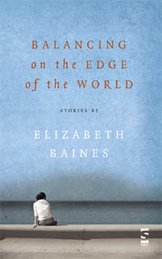
Well, it wasn't a disaster, my Oxfam Bookfest reading last night, in view of the fact that I clashed with the Spain-Germany football match. It certainly wasn't a crowd, but there weren't so very few that it was embarrassing or anything - there were about 10 altogether. I talked about the fact that having The Birth Machine reissued in October has made me look back over my work to see whether my preoccupations have changed or whether there has been a thread developing right from the start. Really, it seems that I have always been interested in issues of knowledge, power and language, and above all with the issues of certainty/uncertainty attached to them. So I read the oldest story in Balancing, 'Who's Singing?' (first published in the Literary Review and broadcast on Radio 3) which is very much concerned with some of the same issues as those in Too Many Magpies (which I also read a piece from) - in particular that of climate change, and in the instance of 'Who's Singing?' with the dangers of too much certainty. We discussed how I'd tackled these issues in this story in view of the fact that they weren't as acknowledged when I wrote it as they are now. Finally I read a new story, 'What Do You do If' which is newly published in Issue 4 of online Horizon Review, and is one of a series I'm writing quite consciously on the issue of uncertainty.
The audience was lovely, and contributed lots, we had a very interesting chat about all of these issues. Thank you to them all for coming, and thank you to Wendy for hosting the event.
Tonight's event in Didsbury Oxfam is Adele Geras, which I recommend, as she always creates a lovely warm evening.
Wednesday, July 07, 2010
Stalled
Not a lot of novel progress lately. I had several visitors for a long weekend - they were up for a wedding they'd been invited to, and I hardly saw them because they were either out at the wedding or the pre- and post-wedding parties or in bed sleeping it all off, but somehow just having a crowd in the house shattered my novel consciousness... Sometimes I think I have such a special and delicate writerly consciousness, and other times I think I'm just too damn precious for my own good.
And since then I've had a mound of washing, and now my mind is turning to the reading I'm doing this evening for the Oxfam Bookfest in Didsbury, and then tomorrow I'm off to London for the Edge Hill Awards ceremony, and won't be home until very late, which means I'll be tired on Friday, and then that'll be another week gone...
Honestly, maybe somebody should just put me out of my misery... (Or let me get back up the mountain where even the internet doesn't work half the time...)
Nice Oxfam Bookfest event last night: Nick Royle and Tom Fletcher, but I'm afraid I've no pics. I'm still getting used to my iphone and I messed up the photos... * My own tonight (7 pm) clashes with the football, so I'm quite prepared for no audience whatever...
*Added: Sharon Ring has come to my rescue and sent me two of her photos, below, the first of Tom reading, the second of Nick talking to the audience.


And since then I've had a mound of washing, and now my mind is turning to the reading I'm doing this evening for the Oxfam Bookfest in Didsbury, and then tomorrow I'm off to London for the Edge Hill Awards ceremony, and won't be home until very late, which means I'll be tired on Friday, and then that'll be another week gone...
Honestly, maybe somebody should just put me out of my misery... (Or let me get back up the mountain where even the internet doesn't work half the time...)
Nice Oxfam Bookfest event last night: Nick Royle and Tom Fletcher, but I'm afraid I've no pics. I'm still getting used to my iphone and I messed up the photos... * My own tonight (7 pm) clashes with the football, so I'm quite prepared for no audience whatever...
*Added: Sharon Ring has come to my rescue and sent me two of her photos, below, the first of Tom reading, the second of Nick talking to the audience.


Subscribe to:
Posts (Atom)