Showing posts with label the nature of fiction. Show all posts
Monday, February 27, 2012
The stories and the stars
My latest piece on The View From Here magazine, taking a (mostly) lighthearted look at celeb culture and the film as star vehicle.
Wednesday, February 15, 2012
Eight Cuts Interview
The energetic Dan Holloway, who was such a brilliant compere at the recent New Libertines night in Manchester which he organised, has kindly interviewed me over on the Eight Cuts blog. Among other things, he asks about the forms in which I write, my view of The Great American Novel and my reflections on the complicated publication history of The Birth Machine
Saturday, October 22, 2011
The Real Thing
My latest piece on the The View From Here magazine, discussing conventional versus experimental fiction.
Wednesday, June 29, 2011
The Good of the Novel
An excellent new book from Faber, The Good of the Novel, edited by Liam McIlvanney and Ray Ryan, is a series of essays on the nature and current state of the novel, circling such questions as What kinds of truth can be told uniquely through novels? and taking in an examination of the role of the critic. Each essay focuses on an individual novel, and the contents include Robert Macfarlane on Alan Hollinghurst's The Line of Beauty; Tessa Hadley on Coetzee's Disgrace and James Wood on Ian McEwan’s Atonement. I have already gobbled up the excellent (and inspiring) introduction and James Wood's opening piece, which I'm not sure I agree with entirely - must read it again, more carefully - but which is exciting food for thought. I'd say the book is a must-read for anyone with an interest in the present-day novel.
There's a discussion on the topic on the Faber blog, to which I was very kindly asked to contribute. In Part 1 Richard T Kelly, editor of Faber Finds and agent Clare Alexander contribute their views, and in Part 2 I have my say along with two other bloggers, Paperback Reader and Juxtabook. Do go on over and contribute your own views.
Cross-posted with Fictionbitch
There's a discussion on the topic on the Faber blog, to which I was very kindly asked to contribute. In Part 1 Richard T Kelly, editor of Faber Finds and agent Clare Alexander contribute their views, and in Part 2 I have my say along with two other bloggers, Paperback Reader and Juxtabook. Do go on over and contribute your own views.
Cross-posted with Fictionbitch
Tuesday, April 14, 2009
Child narrators and adult fiction
Tim Love quotes from the Salt Cyclone virtual book tours which Charles Lambert and I conducted in an article about child narrators in adult fiction.
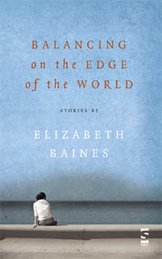
Meanwhile, I have no idea whether the 2-day removal of my ranking from Amazon for Balancing on the Edge of the World was due to a glitch or to its one erotic story and Amazon's apparent bid to strip all 'adult' content of the ranking facility - see here for details of this last and its disturbing implications, and here to sign the petition in protest.
Monday, March 16, 2009
The realism of readings
Issue 2 of Horizon Review is now live, and it includes my new story, 'The Choice Chamber'.
It's not a realist story in any way - quite the opposite, but you don't realize that until the end. Funny thing, realism, or should I say, funny word, or anyway funny how people take it. Last night Carys Davies, Mike Barlow and I did our reading at the Huddersfield Festival. (That's us above taking part in the Q & A.) In the introduction my third prize in last year's Raymond Carver competition was mentioned, and it became clear in the Q & A afterwards that it was consequently taken for granted that I write only realist stories and that Salt - unlike Comma, it was stated - publish realist stories in general - and this in spite of the fact that Carys read from one of her anything-but-realist contemporary fairy tales. It's so far from the truth that we three were a bit gob-smacked for a moment - Salt is nothing if not a broad church for writers, as we quickly told the audience when we recovered. As I said - to everyone's apparent surprise - my Carver prize-winning story is not a realist story. In fact, it's a story which self-consciously challenges the concept of realism, which is what I'm doing generally now in my short-story writing.
Part of the problem, I think, is the all-too-human tendency to pigeonhole, which is quite a stumbling block if you're trying to do something subtle which maybe doesn't shout out about its 'category', or which indeed is intended to break down those categories. And it depends how you read things, anyway. As John and I were speeding back down the motorway afterwards, John said he didn't read Carver as realist anyway.
It seems to me that realism is predicated on the assumption of an objective reality (about situations, characters etc) on which the author is intended to be taken as an authority. This is a notion I am always challenging in my writing - it's a core thing about my writing: the contingency of reality and the contingency of viewpoint - however psychologically convincing I may succeed in making the characters or vivid and real-seeming the situation. Even the story I read out last night, 'Condensed Metaphysics' - which was indeed called by someone last night 'a slice of life' realist story - is intently concerned with this, the fallacy of the notion of an objective reality. Perhaps the problem for this story is that it is now known to be based on a real-life incident, which I had admitted at the start last night, but I think my account on Vanessa Gebbie's blog of how I turned that real-life incident into a story shows precisely that the story is not after all about a real-life incident but the ideas in my own head.
As you can maybe tell from the above, we had a great discussion with a lively and attentive audience in the pub cellar bar we were moved to because of some technical hitches. Cosy and warm with red lighting - hard to see faces for the Q & A, but it didn't seem to matter! See how (realistically!) dark it was without a flash:
We had a great time. Many thanks to the festival for inviting us.
Wednesday, December 24, 2008
21: A New Online Critical Journal
The launch yesterday of 21, a new online critical journal from Edge Hill University, edited by Ailsa Cox and Rob Spence and concerned with contemporary and innovative fiction. Among the articles I haven't yet read is one on post 9/11 fiction, and those I have are a revealing interview with writer Charles Lambert and an interesting piece on the issue of collecting short stories in volumes by Ailsa Cox (instigator of the Edge Hill Prize for short story collections), including a report on a recent linked conference. There's also an article by me on the critical response to Anne Enright's The Gathering and its implications for the way we read now and the contemporary status of fiction.
Saturday, November 15, 2008
Depends what you mean by a story
In today's Guardian Hilary Mantel writes about revision (including the difference that computers have made to the process).
It was odd to wake up to such an article on a day when I'm near the end of a story I have revised over and over, to an extent I've had never to do with a story before. Though perhaps it would be more accurate - yes, it would - to say that actually what I've been doing is re-writing, not revising, it, indeed over a period of a couple of years, abandoning the thing time and time again as unworkable, but then finding myself bugged by it and ending up having another go...
So what's been the problem? Well, in order to explain I guess have to confess that it was based on a short period in my own childhood. I'm always arguing against the biographical reading of fiction, and stressing the fact that fiction is such an alchemical fusion of fact and imagination that to try and tease them apart is hopelessly reductive, and that even to acknowledge the terms of any such discussion is to deny the real nature of fiction. However, it's to the point to acknowledge my story's autobiographical basis here.
Now, when I think about it I've used this period of my childhood often in my writing - slipping its setting into this story, certain of its incidents into that play, its atmosphere into another - disguised in varying degrees. Yet there was something about it that I had never captured and which these fictive mutations always suppressed and belied, and yet which, as the years went by, I wanted more and more to pin down.
I've written quite a bit on this blog about feeling the need to find ways of saying things I want to say which familiar forms somehow belie, and it seemed logical, therefore, that what I needed for this story was an innovative form, and that was the way I had been approaching it as I tackled it time and again.
Then finally, this week I realized (I think) what the problem was: this story was about the very wrong conclusions you can come to, and the way you can belie reality, when you twist things to make up a neat, satisfying story.
And here's the real paradox: the way to say that, I found, was via a pretty traditional story form...
It was odd to wake up to such an article on a day when I'm near the end of a story I have revised over and over, to an extent I've had never to do with a story before. Though perhaps it would be more accurate - yes, it would - to say that actually what I've been doing is re-writing, not revising, it, indeed over a period of a couple of years, abandoning the thing time and time again as unworkable, but then finding myself bugged by it and ending up having another go...
So what's been the problem? Well, in order to explain I guess have to confess that it was based on a short period in my own childhood. I'm always arguing against the biographical reading of fiction, and stressing the fact that fiction is such an alchemical fusion of fact and imagination that to try and tease them apart is hopelessly reductive, and that even to acknowledge the terms of any such discussion is to deny the real nature of fiction. However, it's to the point to acknowledge my story's autobiographical basis here.
Now, when I think about it I've used this period of my childhood often in my writing - slipping its setting into this story, certain of its incidents into that play, its atmosphere into another - disguised in varying degrees. Yet there was something about it that I had never captured and which these fictive mutations always suppressed and belied, and yet which, as the years went by, I wanted more and more to pin down.
I've written quite a bit on this blog about feeling the need to find ways of saying things I want to say which familiar forms somehow belie, and it seemed logical, therefore, that what I needed for this story was an innovative form, and that was the way I had been approaching it as I tackled it time and again.
Then finally, this week I realized (I think) what the problem was: this story was about the very wrong conclusions you can come to, and the way you can belie reality, when you twist things to make up a neat, satisfying story.
And here's the real paradox: the way to say that, I found, was via a pretty traditional story form...
Wednesday, June 25, 2008
Messiness in Fiction
As I've written here before, I'm working on a series of short stories in which I'm trying something new. It's partly my response to, or maybe expression of, the situation we find ourselves in culturally and psychologically post 9/11, and partly perhaps my own rebellion against what I've done before - which you have to keep doing if you're not to go stale as an artist, right?
As I've said here, I've become increasingly impatient with concepts of fixed character, and with plot which leans towards singular meaning, and indeed with the whole conventional notion of story - I guess I always have, really, but I've been tipped over the edge recently. I keep asking myself: How like life is that, after all: the single interpretation, the one (authorial) viewpoint, the satisfying conclusion?
And yet... How to make stories which convey the messiness of life, the fact that sometimes there is no conclusion and we don't know the meaning - which increasingly it seems to me it's important to do - while yet satisfying the entirely understandable desire of readers for pattern and meaning?
It's hard. My story 'Possibility', which will appear in the first edition of the new online lit mag Horizon Review is one attempt. This kind of writing is exhilarating, challenging, but not easy. But an article by Anthony Neilson in today's Guardian has given me courage. He says that works of art which 'attempt to bring order to the unruliness of existence' are reductive, and that this is simply not the business of artists.
As I've said here, I've become increasingly impatient with concepts of fixed character, and with plot which leans towards singular meaning, and indeed with the whole conventional notion of story - I guess I always have, really, but I've been tipped over the edge recently. I keep asking myself: How like life is that, after all: the single interpretation, the one (authorial) viewpoint, the satisfying conclusion?
And yet... How to make stories which convey the messiness of life, the fact that sometimes there is no conclusion and we don't know the meaning - which increasingly it seems to me it's important to do - while yet satisfying the entirely understandable desire of readers for pattern and meaning?
It's hard. My story 'Possibility', which will appear in the first edition of the new online lit mag Horizon Review is one attempt. This kind of writing is exhilarating, challenging, but not easy. But an article by Anthony Neilson in today's Guardian has given me courage. He says that works of art which 'attempt to bring order to the unruliness of existence' are reductive, and that this is simply not the business of artists.
Sunday, January 06, 2008
I shouldn't mince my words
Over on my other blog I'm always going on about the way people read fiction for fact (and how annoying that is for a fiction writer!), but it occurs to me that I once came right up against this issue with one of the stories in Balancing.
It's the first story in the collection, 'Condensed Metaphysics', in which a group of young people out on the town get chatting to some pizza-bar philosophers and discover more things in heaven and earth than are dreamt of in their philosophy (to quote the Great One). I have to say that it was indeed inspired by a real-life event: some mates and I had been to a poetry reading and got a bit drunk, and we did end up having some similar conversations with some strangers in a pizza bar, but needless to say - as all writers reading this will know - I elaborated and invented outrageously (both conversations and characters), pulling it all into my own little ready-set-up world of ideas and obsessions (as we fiendish writers will.) Well, I had the idea right away - woke up the morning after fired up with it, sat down and wrote it in a day or so and slammed it off to the London Magazine.
A couple of weeks later a letter came back from the editor Alan Ross. It was very funny, he said, and he'd like to publish it. But what he needed to know: was it fiction or fact (and actually if it was fact he'd be able to publish it a lot quicker, in the reportage section at the back of the mag)? Well, this made me laugh, and I wrote back what I thought was a pretty smart reply: OK, so he'd guessed that something like it had actually happened, but there was no way that it was true to life!
I sat back and waited, expecting the 2-year wait or so that was normal for short stories in the LM. But then the next issue arrived, and there was my story, printed as travel reportage and under the title 'Chinatown' (which was where the story was partly set)!
That'll teach me to be cryptic, eh?
It's the first story in the collection, 'Condensed Metaphysics', in which a group of young people out on the town get chatting to some pizza-bar philosophers and discover more things in heaven and earth than are dreamt of in their philosophy (to quote the Great One). I have to say that it was indeed inspired by a real-life event: some mates and I had been to a poetry reading and got a bit drunk, and we did end up having some similar conversations with some strangers in a pizza bar, but needless to say - as all writers reading this will know - I elaborated and invented outrageously (both conversations and characters), pulling it all into my own little ready-set-up world of ideas and obsessions (as we fiendish writers will.) Well, I had the idea right away - woke up the morning after fired up with it, sat down and wrote it in a day or so and slammed it off to the London Magazine.
A couple of weeks later a letter came back from the editor Alan Ross. It was very funny, he said, and he'd like to publish it. But what he needed to know: was it fiction or fact (and actually if it was fact he'd be able to publish it a lot quicker, in the reportage section at the back of the mag)? Well, this made me laugh, and I wrote back what I thought was a pretty smart reply: OK, so he'd guessed that something like it had actually happened, but there was no way that it was true to life!
I sat back and waited, expecting the 2-year wait or so that was normal for short stories in the LM. But then the next issue arrived, and there was my story, printed as travel reportage and under the title 'Chinatown' (which was where the story was partly set)!
That'll teach me to be cryptic, eh?
Wednesday, November 21, 2007
Whose right to write?
Oh, I am all churned up again.
Reading group last night (report when I finish decorating that ruddy room!), and it was my turn to make suggestions for next time. One of the two books I suggested, and the one plumped for by the others was Anne Michaels' Fugitive Pieces. Talking about the book to the others, and waving my signed copy, I remembered the Waterstone's Deansgate reading at which I got it signed, and the fact that someone in the audience asked Anne Michaels if she was Jewish. (The book deals with a Jewish theme.) Now I don't know if this guy was meaning to be aggressive, but he certainly came over as challenging, and Anne Michaels clearly felt wrong-footed if not threatened as she declined to reveal her cultural identity, saying that she didn't feel her own racial or cultural identity was relevant, that the book should stand up for itself. The guy persisted, saying he wanted to know because he was Jewish, and it was a pretty sticky moment before he finally gave up.
Me, I was hot and cold all over, just as I was again last night remembering it, because of course this issue - the idea which I'm sure the guy was pushing, that only certain people have the right to write about certain experiences - was the issue over which my own writing career stumbled.
As if fiction is merely testimony! (Yet there have been literary movements where this notion has been seriously held.) Fiction operates via imagination and empathy, and this is what makes it more potentially socially dynamic than is nowadays acknowledged. You can't change society without empathy, after all.
Reading group last night (report when I finish decorating that ruddy room!), and it was my turn to make suggestions for next time. One of the two books I suggested, and the one plumped for by the others was Anne Michaels' Fugitive Pieces. Talking about the book to the others, and waving my signed copy, I remembered the Waterstone's Deansgate reading at which I got it signed, and the fact that someone in the audience asked Anne Michaels if she was Jewish. (The book deals with a Jewish theme.) Now I don't know if this guy was meaning to be aggressive, but he certainly came over as challenging, and Anne Michaels clearly felt wrong-footed if not threatened as she declined to reveal her cultural identity, saying that she didn't feel her own racial or cultural identity was relevant, that the book should stand up for itself. The guy persisted, saying he wanted to know because he was Jewish, and it was a pretty sticky moment before he finally gave up.
Me, I was hot and cold all over, just as I was again last night remembering it, because of course this issue - the idea which I'm sure the guy was pushing, that only certain people have the right to write about certain experiences - was the issue over which my own writing career stumbled.
As if fiction is merely testimony! (Yet there have been literary movements where this notion has been seriously held.) Fiction operates via imagination and empathy, and this is what makes it more potentially socially dynamic than is nowadays acknowledged. You can't change society without empathy, after all.
Subscribe to:
Posts (Atom)