Giles Foden writes in today's Guardian about the dangers of having one's fiction adapted for the screen. It's a funny business, as I've said on my other blog. As a reader I would say I don't like screen adaptations: I usually try never to see one before reading a book, yet if I watch one afterwards I'm always frustrated by the gap between the director's vision and my own. I haven't read Foden's novel The Last King of Scotland, but on this occasion I was dragged along, reluctantly, to see the film. I was bowled over - rarely has a film made such a lasting impact on me - but I know now that I'll never be able to read the book without its images and those actors in my head.
As a writer, though, it's a different story. Someone comes along and offers you a big bag of money to turn your novel into something which will make it a hell of a lot more famous than it ever was before - or in, my case, famous in a way it never was. I had had bad luck with my second novel, Body Cuts. Halfway through the editing process my editor at the small publishing house left to pursue her own novel career, and the publisher failed to tell me, or to make clear to her replacement where we were in the editing process, and as a result the book went to press without my final editing. The reason for such mix-ups suddenly became evident. Weeks before the book was due out the publisher was bought up by another, and although my book had been announced in the trade press, it failed to appear. When it was eventually published, no new announcements were made in the trade press by the new publisher, and not long after that the original publisher's fiction list was remaindered.
In the meantime, however, during the short time that book was in the bookshops, the TV director John Glenister happened to pick it up, got hooked and immediately decided that he wanted to adapt it for TV. How cool was that? How could I refuse such a chance of resurrection? My usual reservations about screen adaptations went shooting off into the ether.
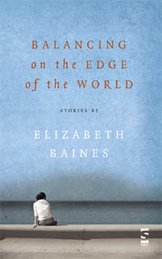
In fact, in the end that adaptation didn't happen - people at the BBC had moved on, artistic and funding policies had changed - but as I had been working on the adaptation with John, I took it to a Channel 4/arts-board screenwriting scheme, and here my reservations dropped back down from the sky. My God: the changes I was expected to make!! My main male character should be a different sort of person, my female character's mother ought to die!!! Needless to say I soon dropped the whole idea, and contented myself with salvaging from this last experience insights for my satirical (and entirely fictional) story, 'The Shooting Script', which may be included in my forthcoming collection from Salt, Balancing on the Edge of the World.
We haven't yet decided which stories will go in this collection, but one which probably will is 'Power', which looks at the stresses on children of quarrelling parents through their contrasting voices (previously published in Power [Honno]), a story I adapted as a radio drama. It was the second time I had adapted my own fiction for radio: earlier I worked on my first novel, The Birth Machine. Both times I worked with the director Michael Fox and both times I was given free rein to adapt my work in ways which allowed me to stay as true to the original as I wished. I have to say that adaptation for the verbal, non-visual medium of radio is a different thing altogether: I don't feel in any way that the transformations stole the souls of the original fictions in the way screen adaptations so often seem to do.
Showing posts with label Body Cuts. Show all posts
Showing posts with label Body Cuts. Show all posts
Saturday, February 17, 2007


Friday, December 08, 2006
Lost Literature
You can't help wondering what literature, both written and potential, is lost through lack of outlets. Commenting recently on my other blog, nmj relates how she started out as a short-story writer and got an agent on the strength of her short-story writing. However, she discovered, it wasn't the stories themselves the agent was interested in, and she was immediately persuaded to write a novel, and her short-story writing went by the board.
My own experience was the same, and I'm sure we are not the only two. It seems to me that the AL Kennedys and Ali Smiths are only the exceptions that prove the rule: Ali Smith, indeed, has stated in an interview that she feels she was helped towards publication of her first collection by things extraneous to her (marvellous) prose: the fact that she was Scottish, and the fact that she was lesbian.
Once upon a time short stories were all I ever really wanted to write. I loved the form with its special poetic yet muscular compression. Once I had published several stories in literary magazines, I began hoping to publish a collection. I went on an Arvon course and to my delight and gratitude my tutor Martin Booth sent my stories off to his agent, who immediately rang me. (And there are people in the blogosphere insisting that you don't need assistance and contacts to get taken up!) But this agent said the same to me as nmj's did to her: we have to have a novel, it's impossible to sell short stories. So I wrote a novel (The Birth Machine) - not a very long one that first time, more of a novella really; it took me a while to ease out of the short form - and then another (Body Cuts).
I didn't stop writing stories; I just went on publishing them in magazines. But then the magazines began to die away, and there didn't seem any point in writing them any more... And my novel publishers got bought up, the usual story, and the list I was on was remaindered. And, just as I found myself out in the cold, the commercialisation of publishing accelerated, and, after a beginning when all doors had opened before me, getting fiction published seemed no longer the easiest thing in the world. And since the doors in radio were flung wide open - I had written a play on the off-chance and it had been broadcast and won a prize - I became a radio dramatist instead.
Of course you don't stop altogether, you can't keep the urge down. And this week a collection of short stories won the Guardian first book award. Small presses like Comma, Salt, Elastic and Leaf are springing up to specialise in short stories. There are doors swinging open again.
My own experience was the same, and I'm sure we are not the only two. It seems to me that the AL Kennedys and Ali Smiths are only the exceptions that prove the rule: Ali Smith, indeed, has stated in an interview that she feels she was helped towards publication of her first collection by things extraneous to her (marvellous) prose: the fact that she was Scottish, and the fact that she was lesbian.
Once upon a time short stories were all I ever really wanted to write. I loved the form with its special poetic yet muscular compression. Once I had published several stories in literary magazines, I began hoping to publish a collection. I went on an Arvon course and to my delight and gratitude my tutor Martin Booth sent my stories off to his agent, who immediately rang me. (And there are people in the blogosphere insisting that you don't need assistance and contacts to get taken up!) But this agent said the same to me as nmj's did to her: we have to have a novel, it's impossible to sell short stories. So I wrote a novel (The Birth Machine) - not a very long one that first time, more of a novella really; it took me a while to ease out of the short form - and then another (Body Cuts).
I didn't stop writing stories; I just went on publishing them in magazines. But then the magazines began to die away, and there didn't seem any point in writing them any more... And my novel publishers got bought up, the usual story, and the list I was on was remaindered. And, just as I found myself out in the cold, the commercialisation of publishing accelerated, and, after a beginning when all doors had opened before me, getting fiction published seemed no longer the easiest thing in the world. And since the doors in radio were flung wide open - I had written a play on the off-chance and it had been broadcast and won a prize - I became a radio dramatist instead.
Of course you don't stop altogether, you can't keep the urge down. And this week a collection of short stories won the Guardian first book award. Small presses like Comma, Salt, Elastic and Leaf are springing up to specialise in short stories. There are doors swinging open again.
Subscribe to:
Posts (Atom)