Sorry for the blackout on my blogs at the moment: I'm up the mountain again, this time to help out with decorating work: too busy to blog, and my head's gone dead anyway or rather has been taken over by thoughts about woodfiller and whitewash and paint and drying times and suitable surfaces and - oh you don't want to know. Suffice to say that I'm now on most friendly terms with the staff at Bangor B&Q (literary conversation: what's that?). And if I should ever get a literary inspiration, well, that'll usually be when the signal for the mobile internet goes blank instead: it's much worse when it's windy for some reason - which here, opposite the ridge by the sea, it nearly always is. It's as much as I can do to keep up with my emails (and then I have to use the very primitive server mail platform: can't send block emails, each email takes an age to load through, and the platform doesn't keep a copy of what I've sent). Twitter hardly works at all. (So much for getting all my mates to vote for my book on the new Salt Just One Book poll and keeping up my books's exposure - what this does expose, I guess, is something of a flaw in the blanket contemporary acceptance of a culture of internet-based author marketing). And some days I don't get out in time to get a newspaper, though yesterday evening on my way to a fabulous meal in Molly's restaurant in Caernarfon, I did manage to buy a Guardian, and read an article by Nick Laird bemoaning the need for authors to market their own work and describing all the feelings we all have to squash in order to do it (or I do anyway): 'For one thing, it seems the height of bad manners, like going on about your own children' - which is exactly what I said the other day on this blog. Oh, and a profile of Fay Weldon, who always makes me laugh... No way I can give you all the links, sorry: it would take half an hour at least, and there's a door waiting to be painted.
As for reading, I got quite hooked on a book in ms by a friend, in the half-hour each day I read in bed in the morning - more hooked than by most published books by well-known writers, to be honest. And having left our next reading group book at home (Angela Carter's Nights at the Circus, which I bought years ago but for some reason never read) I sent off for a second-hand copy from Amazon (and that took half an hour!) but it never arrived, presumably due to the remoteness of this location...
Should be back in full swing again by the second week of September (and of course publicising my new book, Too Many Magpies). Meanwhile, I'll blog if I can...
Cross-posted with Fictionbitch.
Sunday, August 23, 2009


Saturday, August 15, 2009
Vote for the Salt book you have found most important.
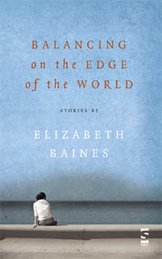
Latest in the Salt Just One Book Campaign: you can nominate and vote for the book published by Salt which has been most important to you, and Balancing on the Edge of the World has been nominated. To nominate or vote go here.
Thursday, August 13, 2009
Reading group: Changes of Address by Lee Langley
 Ann suggested this 1987 novel which she'd enjoyed years ago, narrated by the adult Maggie who is looking back on a late-thirties and early-forties childhood in which she was dragged around India by a scandalous mother exiled and self-exiled from the British colonial community into which Maggie had been born.
Having read it again for the group, Ann said that she was interested in the different things one can take from a novel at different times in our lives. If I'm remembering correctly, she said that the first time she read it, when she was very young, she liked it for the vivid way that the community was depicted, and the echoes it provided of her own expatriate childhood. This time she appreciated that and the portrayal of the mother as she declines into poverty and squalor, but what really struck her was the fact that the novel was about memory, and how far we can trust our memory, as narrator Maggie wonders whether certain memories are her own or have been imposed by her mother. Ann was particularly struck by the narratorial technique of alternating between the first-person past-tense retrospective narration in which these doubts are raised and a historic-present mode of narration grounded in the sensual experience of Maggie the child yet paradoxically cast in the alienating third person illustrating, Ann thought, the mother's alienation from what she calls 'The Child'. Ann also very much appreciated the exploration of the notion of home for expatriates - the idea that there is never just one 'home' and yet nowhere is really 'home' - as did Clare who also spent her childhood abroad, and I who spent my childhood moving around Britain.
I too very much appreciated the theme of the dubiousness of memory - not least because it's the theme of an (as yet unpublished novel) I've written. I was also struck by the double-narration technique, but wasn't quite sure that it worked, or that its purpose was clear. I couldn't help thinking that the third-person narration indicated a certain alienation of the narrator from herself, or at least from her childhood self, either conscious or unconscious on the part of the author, and I wasn't sure what to make of this. Sometimes the narrative slips from one mode to another in mid-section or even -paragraph, and I felt that this indicated a certain lack of authorial clarity of purpose. Indeed, I found that sometimes at such moments and others there was an uncertainty of rhythm and tone. This links perhaps to my main doubt about the book, which was that it read as a memoir rather than as a novel, lacking the kind of shaping that a novel requires. The whole narrative is incredibly linear in the most fundamental way: events occur and characters appear in sequence, each in turn presented vividly, sometimes portentously so that you take them as symbolic or prefiguring future developments, yet then they drop away to be forgotten and overtaken by new, similarly vivid yet transient characters and events, and (while everyone agreed that the book was a very easy read) the narrative has a particularly static feel.
John strongly thought the same, and others agreed. The one dissenter was Trevor, who said that that static quality was what characterized the life the girl was being forced to lead (a life on the move but repetitive, motored only by the selfish mother's repetitive series of sexual liaisons: there's a consequent sense of arrest, exacerbated by the mother's public and sometimes even private underestimation of Maggie's age in order to minimize her own - a factor which makes the adult Maggie uncertain of her own age at various moments when she looks back). In any case, Trevor said, children don't shape their experience: it is to them a linear series of events, none more significant than others.
I'm not sure I agree with that last, but didn't say so because even granting it I didn't agree that that meant that the novel needed to lack shape. John thought that too: he said that a great novelist would find some way of replicating that childhood experience, yet also manage to select and point up for significance. For instance, he said, there was the moment that the child Maggie walks into a mirror. That seemed so symbolic at the time of reading it, yet it is never really used symbolically and indeed the novel appears to replicate the child Maggie's lack of awareness of its symbolic potential. Trevor stuck to his guns that that was acceptable as a replication of her experience, but I said actually it wasn't, precisely because the author provides herself with a narratorial shaping device, ie the retrospective consciousness of Maggie as an adult narrator.
In the light of such apparent authorial uncertainties, the narrator's uncertainties about what she remembers come to be seen as potentially rather those of the author, and the more we discussed the book the more sure we felt that the material was intensely autobiographical and incompletely processed. There is one thing that Maggie is certain about, and that is that her mother treated her inexcusably badly (and as a teenager at the end of the remembered story she cuts herself off from her mother, never to meet her again). This is indeed the one-dimensional way that the novel presents the mother, and I said I found it somewhat odd that, having been a mother herself (something which she makes much of, having vowed to be a different kind of mother), the middle-aged Maggie hasn't come to any understanding of her own mother's position at the time. Only at the very end, prompted by the memory of a remark by the man her mother finally settles down with, does it occur to the narrator Maggie to wonder if maybe her mother wasn't quite the baddie she's always thought her, but a more complex character. I said that the way this felt to me was that this was a thought which had occurred newly to the author, that it was the process of writing the story that had brought her to this conclusion, and that what she really needed to have done then was to go back and redraft the novel taking the notion into account: this may have resolved many of the uncertainties and provided a far more complex character in the mother and a consequently richer story.
Ann said, Well maybe she couldn't, and everyone felt that that must be the truth: that that very cutting off from the mother (if, as it seems, the novel is autobiographical) would make emotional resolution very difficult. John noted that there was a certain avoidance of exploration of emotion in the novel, and while this could be regarded as representing the mores of the time, we felt it ran deeper: for instance, in the scene where for the first time Maggie fights back when her mother tries to beat her, there's a retreat in perspective and tone: To anyone watching, it might look funny: this slow, silent combat, a tableau-vivant - 'The Gladiators' - as the child hangs like a mongoose on the throat of a threshing snake, slowly dragging the woman's head backwards (that coyly jovial tableau-vivant - 'The Gladiators') which indicates an authorial holding-back.
Trevor insisted (repeatedly) that no one could ever come to terms with having had such a mother and I think he was saying that this justified the novel. Also, in spite of his previous comments, he insisted now that it was simply not possible ever to replicate the psychology of a child in writing, because one always comes to it with an adult consciousness (which I don't agree with either), so I'm not quite sure I've got the gist of what he was saying overall.
It was also noted that the India around the characters and the tense political situation of the time were only vaguely indicated in the novel, and while again this could be said to be a function of the self-obsession and isolation of the British characters, there is an unutilized opportunity to deal with them via the adult narrator. There is in fact some perfunctory retrospective comment by the narrator, a kind of wondering realization that momentous things were happening around them of which as a child she had been unaware, but this disjunction is not woven into the fabric of the remembered story in any satisfactory novelistic way.
There was some general talk about the difficulty of writing about experiences close to you, and an acknowledgement of the fact that if you change details like setting etc you can distance your own experience and make it easier to process in writing. That, I said, is what's so cathartic about writing, and we all then agreed that there was something painful about this novel and it didn't feel like catharsis at all.
Then Doug said it was 'a bit girly' - only partly ironically, which made us all hoot with laughter, and then some people went home but some of us stayed and Clare got some more drink, pink fizz, out of the fridge and I am afraid to say I got quite drunk.
Our archived discussions can be found here, and a list of all the books we have discussed here.
Wednesday, August 12, 2009
Too Many Magpies cover

Well, here it is : the cover of my novel, Too Many Magpies, due from Salt 1st October. I love it - just the right kind of spookiness and sense of things being scratched/rubbed out and redrawn. Thank you so much, Chris of Salt!
I'm going to do an outrageous copy from Fiona Robyn and offer ten free copies in a draw consisting of the names of those who write a review of my story collection, Balancing on the Edge of the World, and send me a link to it by October 1st. (Doesn't have to be a positive review to qualify!) Anyone who's already reviewed Balancing will be eligible if they email me (via my profile) to say they'd like to be included.
Friday, August 07, 2009
Just waiting for the cover
Well, the text pages of Too Many Magpies went to press last week I believe, but there's a delay with the cover as my poor overworked publisher Chris, who has designed it, had a day's sickness which has set his whole schedule out of joint. It's basically done bar some tweaking and I love it - I'm dying to give you a preview, just as soon as it's finalized!
Saturday, August 01, 2009
AQA anthology
 Here's the new online GCSE anthology of stories and poetry which includes my story from Balancing, 'Compass and Torch'. The web pages, which are still in development, will include teaching resources and I think are due to be fully functional by September and the new school term.* As a former English schoolteacher I think it looks pretty exciting, and of course I'm thrilled that my story is included.
My story appears in the section 'Modern Prose' alongside 4 others by Penelope Lively, Haruki Murakami, Claire Wigfall and Helen Dunmore.
* Woops, no, just read it properly: it's for use in 2010. (Edited in)
Friday, July 31, 2009
How not to try to finish a story
This week I've been writing a new short story, and yesterday I nearly finished the first draft. But the ending was so complicated and subtle (well, at least I think it is!) and needed, as far as I could see, such a job of orchestration, that I decided there was no way I could tackle it, tired as I was by then, at the end of the morning. I would let it simmer overnight and do it today.
But today my novel, Too Many Magpies, is going to press, and this morning we have been doing some tiny last-minute tweaks, and needless to say there is no way I have been able to concentrate on the story...!
Ah well, tomorrow...
But today my novel, Too Many Magpies, is going to press, and this morning we have been doing some tiny last-minute tweaks, and needless to say there is no way I have been able to concentrate on the story...!
Ah well, tomorrow...
Wednesday, July 29, 2009
Just One Book: New Summer Sizzler Offer
You know the best way to while away a rainy or (here's hoping) hot August, don't you? Yes, with just one book (or 3, or 3) from Salt, and Salt are making it easy for you by continuing their Just One Book campaign with yet another fantastic offer: a whole third off all Salt books for the whole of August! Here's what Salt's Chris Hamilton Emery has to say:
August summer sizzlerAnd if you haven't yet bought Balancing for yourself, or your loved ones, or your friends....
The JustOneBook campaign continues with a further sensational August deal.
In order to keep Salt on track through the wet British summer, we're offering you another special deal throughout August. All Salt books are available from us at 33% discount yet again. That's a third off all Salt titles, and free shipping on orders with a cover price of over £30 or $30. Offer ends 31 August 2009.
Simply enter the coupon code HU693FB2 when in the store to benefit.
As before, all we ask is two things—
1. Buy one book. Or perhaps another one ... go on.
2. Pass it on. Share this offer with everyone who loves gorgeous books and likes a bargain (whilst saving independent literature).
Tuesday, July 28, 2009
How I feel about publicity
I have another nice Amazon Review titled High Wire Storytelling. You know, I'm amazed I'm telling you that, and how much my attitude to publicity has changed since Balancing was published. See, I was brought up NEVER to blow my own trumpet, and when I became adult, on an intellectual level I always agreed with the idea. It was always clear to me that those who did blow their own trumpets did pretty OK in this world - it's amazing how people believe what boasters and the self-satisfied say about themselves (which has been a great source of comedy for radio plays for me!), but even when I felt proud of myself, I reckoned the true litmus test was other people, their judgment of my behaviour or, more specifically with regard to writing, my work. And how could I know what that judgment truly was if I'd gone and influenced it?
When I wrote for radio this worked beautifully. I wrote the plays and then sat back as a national broadcasting company, the BBC, deployed a host of personnel to create advance publicity, and broadcast the plays to millions as a matter of easy course. It was in writing novels published by independent presses that I could see the flaws in my approach - most especially when the publisher of my second novel was bought up halfway through the production process, putting paid to most publicity possibilities for my novel. What I learnt then is that NO ONE CAN JUDGE YOUR WORK IF THEY DON'T KNOW ABOUT IT, and what I have learnt since is that small publishers with tiny resources need authors to help with that job of putting the knowledge out there, and indeed with marketing, which means telling people why they might like your book, which in turn involves telling them about the nice things others have said...
It's not me, after all, it's my book. (Though even boasting about my own children seems too much like boasting about myself to me!)
When I wrote for radio this worked beautifully. I wrote the plays and then sat back as a national broadcasting company, the BBC, deployed a host of personnel to create advance publicity, and broadcast the plays to millions as a matter of easy course. It was in writing novels published by independent presses that I could see the flaws in my approach - most especially when the publisher of my second novel was bought up halfway through the production process, putting paid to most publicity possibilities for my novel. What I learnt then is that NO ONE CAN JUDGE YOUR WORK IF THEY DON'T KNOW ABOUT IT, and what I have learnt since is that small publishers with tiny resources need authors to help with that job of putting the knowledge out there, and indeed with marketing, which means telling people why they might like your book, which in turn involves telling them about the nice things others have said...
It's not me, after all, it's my book. (Though even boasting about my own children seems too much like boasting about myself to me!)
Sunday, July 26, 2009
Reading group: The Autograph Hound by John Lahr
This meeting was a mauling, and a pretty unfair one at that, since most of us hadn't even really read the book. Published in the early seventies, it is narrated by its 1960s anti-hero Benny Walsh, collector of autographs and busboy at the New York Wild-West-themed Homestead Restaurant, a place frequented by top celebrities and so a source of the choicest autograph pickings. Trevor had suggested it, as he read it when he was in the process of dropping out of university in the seventies, and thought it was absolutely fantastic.
Well, we thought that as a book about an obsession with celebrity it sounded good and, spurred on by Trevor's enthusiasm, we went away looking forward to it. The first obstacle we encountered was that it was out of print, and we all set about ordering it from ABE Books. Mine and John's came back fairly quickly, the original British hardback complete with glossy pink-purple dust cover, but unfortunately I had only just started reading it when I left it in a taxi and we had to order the book all over again. Granted I was coming back from A & E in that taxi, having fallen and sprained my ankle, which may have made me less than competent, but I can't help thinking that the fact that I simply couldn't get into the book may have had something to do with it too. And I know I was also not in the best state for getting into a book, but not many other people in the group could get into it, either, it turned out.
Most of us gave up and failed to read much more than half of it - John giving up very soon after the beginning - and I'm afraid we had a very hazy impression of what we had read. Clare did get to the end but in such a fast, skipping manner that she had missed the dramatic denouement which Trevor revealed to us. We wondered why we had found it so hard to engage with. The critics' comments on the paperback edition I finally got hold of praise the book for its contemporary aphorisms, and we wondered if this was the problem: that Benny's voice, and thus the novel, were so steeped in late-sixties language and mentality that the book was simply dated (much of the lingo, which seems to be authorially relished, now seeming old fashioned or cliched; eg: 'See you later?' 'Not if I see you first.') Anne also said, to general agreement, that the long lists of names of celebrities which mean nothing to us now is de-focussing and distancing.
Trevor groaned in disbelief. But, he said, the book was brilliant! So fantastically written! I said, How could it be well-written if it doesn't draw you in, or give you any sense of what it's all about? What about the character of Gloria, for instance (a young actress Benny meets early on and who eventually tries to get him to sell his autograph collection to save himself from the pickle he ends up in)? It was ages before I got a handle on her, I said, and at the start I pictured a middle-aged woman. I argued that the reason for this was unfocused prose which failed to realize Gloria: I had been left with the impression that Gloria is simply not described early enough. Trevor could hardly believe I was saying this, and argued that one of the great things about the book was its vivid descriptions. After the meeting I set myself the task of starting the novel again and reading it carefully through to the end, and I found that Trevor was right: Gloria is described by narrator Benny the moment we meet her, indeed in list-checking detail, thus: The lady stands out like Mary Martin across a crowded room... She's wearing a long dress down to her ankles, a veil hangs from her hat. So why did I, and others, fail to see her clearly?
The language, along with the atypical clothes, put me off the scent: that word 'lady', and the fact that Benny goes on to refer to her (and characterize her) as 'the well-dressed lady'. But it's not the language in itself. It's not that I simply saw Gloria in the wrong light, but that I had a very strong sense of not really grasping her and, as I say, an impression that she had not been made vivid at all. There are plenty of novels the language of which is now dated but which we can read without trouble, feeling that we are getting a true sense of the world being depicted. It seems to me the problem is deeper and relates to the way we are meant to take Benny. How significant is Benny's use of the word 'lady'? Are we meant to take it as language of the era and not in any way notable, or are we meant to see it as indicative of Benny's singular psychology - his prudishness and sexual repression (he is 35 years old but worries like a child about his own penis - which he calls 'it', he has failed to detach psychologically from his mother, is clearly frightened of any sexual relations with Gloria and refers coyly to horses lifting their tails and doing their 'number twos')? Or is this dichotomy - prudishness and arrested development alongside streetwise lingo and sex dens - meant to be typical of the age (which I think it may have been), and significantly so? There was huge (initial) disagreement in our group about how we are meant to take Benny. Having read the book properly now it's clear to me that Lahr intends Benny as an anti-hero: he reveals himself as viciously racist and worse, if also pathetically lost in a fantasy world. Yet those of us who hadn't read much of the book had come away without any sense that we were meant to see Benny in this light. Hans gave a list of objections to the book which I don't recall specifically but which amounted to the fact that he considered it juvenile, the very thing which characterizes Benny with his stunted personality, his obsession with celebrity, and his totemic belief in the power of autographs of the famous. In other words, Hans had not seen any distinction between the narrator and the author, and neither had I: I had even come away with the impression that we were meant to see Benny as cool. Those who had read properly to the end - Trevor, Jenny and Doug - were quick to put us right, but all three - even Jenny, who was irritated by the style of the novel - said that they felt sorry for Benny, for his emptiness and his pathetic and doomed attempt to fill it with celebrity.
It seems to me that the problem is that by taking too much relish in its anti-hero's mentality and language, the novel fails to distance and satirize them enough - which is interestingly the complaint made by James Wood about Zadie Smith's similarly titled novel (The Autograph Man) on the same subject and theme.
I said that I thought that the book's take on celebrity was dated too: that nowadays people don't hero-worship celebrities so much as identify with them and desire fame for themselves, a phenomenon fed by reality TV. Some people strongly disagreed, citing the huge sales of Heat etc (which, frankly, I didn't see as destroying my argument), and that they definitely feel a bit in awe if they ever meet celebrities. I also said that I didn't really understand this interest in celebrity, which I don't, but I am very interested in the interest in celebrity, and by the time I went home I was in danger of writing my own and yet another novel on the subject...
PS: In a somewhat ironic twist, after I lost our first copy John and I each ordered a copy (so we ended up doubling up) and John's copy turned out to be the original US hardback bearing, of all things, the author's autograph.
Our archived discussions can be found here, and a list of all the books we have discussed here.
Well, we thought that as a book about an obsession with celebrity it sounded good and, spurred on by Trevor's enthusiasm, we went away looking forward to it. The first obstacle we encountered was that it was out of print, and we all set about ordering it from ABE Books. Mine and John's came back fairly quickly, the original British hardback complete with glossy pink-purple dust cover, but unfortunately I had only just started reading it when I left it in a taxi and we had to order the book all over again. Granted I was coming back from A & E in that taxi, having fallen and sprained my ankle, which may have made me less than competent, but I can't help thinking that the fact that I simply couldn't get into the book may have had something to do with it too. And I know I was also not in the best state for getting into a book, but not many other people in the group could get into it, either, it turned out.
Most of us gave up and failed to read much more than half of it - John giving up very soon after the beginning - and I'm afraid we had a very hazy impression of what we had read. Clare did get to the end but in such a fast, skipping manner that she had missed the dramatic denouement which Trevor revealed to us. We wondered why we had found it so hard to engage with. The critics' comments on the paperback edition I finally got hold of praise the book for its contemporary aphorisms, and we wondered if this was the problem: that Benny's voice, and thus the novel, were so steeped in late-sixties language and mentality that the book was simply dated (much of the lingo, which seems to be authorially relished, now seeming old fashioned or cliched; eg: 'See you later?' 'Not if I see you first.') Anne also said, to general agreement, that the long lists of names of celebrities which mean nothing to us now is de-focussing and distancing.
Trevor groaned in disbelief. But, he said, the book was brilliant! So fantastically written! I said, How could it be well-written if it doesn't draw you in, or give you any sense of what it's all about? What about the character of Gloria, for instance (a young actress Benny meets early on and who eventually tries to get him to sell his autograph collection to save himself from the pickle he ends up in)? It was ages before I got a handle on her, I said, and at the start I pictured a middle-aged woman. I argued that the reason for this was unfocused prose which failed to realize Gloria: I had been left with the impression that Gloria is simply not described early enough. Trevor could hardly believe I was saying this, and argued that one of the great things about the book was its vivid descriptions. After the meeting I set myself the task of starting the novel again and reading it carefully through to the end, and I found that Trevor was right: Gloria is described by narrator Benny the moment we meet her, indeed in list-checking detail, thus: The lady stands out like Mary Martin across a crowded room... She's wearing a long dress down to her ankles, a veil hangs from her hat. So why did I, and others, fail to see her clearly?
The language, along with the atypical clothes, put me off the scent: that word 'lady', and the fact that Benny goes on to refer to her (and characterize her) as 'the well-dressed lady'. But it's not the language in itself. It's not that I simply saw Gloria in the wrong light, but that I had a very strong sense of not really grasping her and, as I say, an impression that she had not been made vivid at all. There are plenty of novels the language of which is now dated but which we can read without trouble, feeling that we are getting a true sense of the world being depicted. It seems to me the problem is deeper and relates to the way we are meant to take Benny. How significant is Benny's use of the word 'lady'? Are we meant to take it as language of the era and not in any way notable, or are we meant to see it as indicative of Benny's singular psychology - his prudishness and sexual repression (he is 35 years old but worries like a child about his own penis - which he calls 'it', he has failed to detach psychologically from his mother, is clearly frightened of any sexual relations with Gloria and refers coyly to horses lifting their tails and doing their 'number twos')? Or is this dichotomy - prudishness and arrested development alongside streetwise lingo and sex dens - meant to be typical of the age (which I think it may have been), and significantly so? There was huge (initial) disagreement in our group about how we are meant to take Benny. Having read the book properly now it's clear to me that Lahr intends Benny as an anti-hero: he reveals himself as viciously racist and worse, if also pathetically lost in a fantasy world. Yet those of us who hadn't read much of the book had come away without any sense that we were meant to see Benny in this light. Hans gave a list of objections to the book which I don't recall specifically but which amounted to the fact that he considered it juvenile, the very thing which characterizes Benny with his stunted personality, his obsession with celebrity, and his totemic belief in the power of autographs of the famous. In other words, Hans had not seen any distinction between the narrator and the author, and neither had I: I had even come away with the impression that we were meant to see Benny as cool. Those who had read properly to the end - Trevor, Jenny and Doug - were quick to put us right, but all three - even Jenny, who was irritated by the style of the novel - said that they felt sorry for Benny, for his emptiness and his pathetic and doomed attempt to fill it with celebrity.
It seems to me that the problem is that by taking too much relish in its anti-hero's mentality and language, the novel fails to distance and satirize them enough - which is interestingly the complaint made by James Wood about Zadie Smith's similarly titled novel (The Autograph Man) on the same subject and theme.
I said that I thought that the book's take on celebrity was dated too: that nowadays people don't hero-worship celebrities so much as identify with them and desire fame for themselves, a phenomenon fed by reality TV. Some people strongly disagreed, citing the huge sales of Heat etc (which, frankly, I didn't see as destroying my argument), and that they definitely feel a bit in awe if they ever meet celebrities. I also said that I didn't really understand this interest in celebrity, which I don't, but I am very interested in the interest in celebrity, and by the time I went home I was in danger of writing my own and yet another novel on the subject...
PS: In a somewhat ironic twist, after I lost our first copy John and I each ordered a copy (so we ended up doubling up) and John's copy turned out to be the original US hardback bearing, of all things, the author's autograph.
Our archived discussions can be found here, and a list of all the books we have discussed here.
Saturday, July 25, 2009
A brilliant fifth 24:7 Festival

I'm having a great time this week at the 24:7 Theatre Festival (though I'm getting a bit tired!). I've seen thirteen shows so far (out of 21) and expect to see at least another one. Such a pity not to see them all, but it's practically impossible. A theme which is quite dominant this year has been the somewhat classic one of two or three men confined together in a small space. I've seen three of these plays, 5.30 and As We Forgive Them (both of which I read as scripts and wrote a bit about earlier) and Out of Dead Air, about three long-time prisoners of war faced with the possibility of freedom and the risk involved in seizing it, well-written too, beautifully acted and very smartly and sensitively directed by Mike Heath.
As last year, the houses have been packed. From its small beginnings the festival has become a phenomenal success. Yesterday, in fact, was 24:7's fifth birthday, and its founders, Amanda Hennessey and Dave Slack (above) had every reason to celebrate.
This year's festival isn't over yet though. There are shows at 3.30 this afternoon and this evening, and at 12.30 and 3pm tomorrow afternoon.
Friday, July 24, 2009
A stranger makes my day
I've had a really lovely new review on Amazon for Balancing, entitled 'Fabulous Collection', and which includes these sentences:
'These stories tell you more about who we are and how we live than a dozen big fat novels. If you like short stories, you should certainly get a copy of this book. If you think you don't like short stories, you should get two - one to surprise yourself with and one to give to someone else!'You know, those trees through the window looked so green when I read that, and the rain looked so silver! So if you liked my book, and you want to make my day, you know what to do...
Tuesday, July 21, 2009
24:7: Lub You and Exit Salford
 Last night I went down to 24:7 again and saw the truly fabulous Lub You at Pure (Blue). This to me was a riveting piece of physical theatre, yet also linguistically spot-on: funny yet moving. We follow the viewpoint of a child, Charlie, as he develops from babyhood, only partially able to understand the sounds his parents make - in a brilliant stroke we the audience share his experience of this - through the birth of his younger brother and the cracks that appear in his parents' marriage as a result of the strains of parenthood. Finally, we move to share the consciousness of his developing brother in the complex family setup which ensues.
Eve Steele (well-known as Curly Watts' stalker in Coronation Street) wrote the play and brilliantly performed the role of Charlie - her acute observation is stunning, allowing us to recognize a child's behaviour anew while taking you right inside his world. As I said to Eve in the bar afterwards, I loved the script when I read it, and the production has fulfilled my expectations. New Arden graduate Amy Spencer was wonderful as Charlie's baby brother Bo-Bo, as were Ted Holden and new MMU graduate Tanya Hug as their parents.
You know, so far I have been sitting there stunned at the acting talent in this city...
The acting was excellent too in Exit Salford, another play I read (I'm trying to see first all the plays I read) (also on at the Blue Room in Pure). This is the tale, based on a true incident, of an ex-writer who befriends the youths who hang around his Salford home only to have them turn on him when he rents his rooms to foreigners. Alan French takes the role of the ex-writer and Rebecca Elliot, Emily Spowage, Ant Singleton and Tim Fallows play the youths and a host of other characters with fast switches.
Monday, July 20, 2009
Manchester Book Fair and 24:7 Theatre Festival
Well, it rained. Every so often a great deluge started hitting the tent roofs and drowning out the readers, most of whom really, honestly, weren't standing close enough to the mic, and St Ann's Square cleared. I have to say I got quite cold. I sold one book, to a friend, Hazel Roy, who was manning the bookstall, mainly I am pretty sure because I bought hers. All the books on the stall were going for £8.00, but Hazel's was £10.00 because there was an extra donation to charity, and she got mine for £7.50 because there was an offer of £15.00 for two and she bought Ailsa Cox's book as well. So I actually lost £2.50. But as we were leaving a kind lady gave Ailsa and me a pound each for our readings because she couldn't afford to buy our books. (So I lost £2.50 and made a pound.)
Readings, eh? This was much better however than the time I was invited to read to students at Sheffield Hallam and told to bring lots of books because the class was big and keen, and then when I got there with my heavy bag found 3 students in the lecture theatre, because when the lecturer had booked me he'd overlooked the fact that it would be reading week.
And my lovely friend Adele Geras came down to support me.
And afterwards a group of us went for coffee, and coming out of the coffee shop we met a friend who told us that there were returns going for the Manchester Feast in Albert Square, and so that's where we went, wrist-banded and herded in on a bell, just like school dinners, but worth it for a free meal, though I missed the pudding because I was rushing off to the Printworks to see previews of two of the 24:7 Festival plays I read as an adjudicator.
Brilliant: both of them two-handers seething with tension and menace: 5.30, in which a young man is trapped on a train with a scary yob, and As We forgive Them, in which a US congressman is shut in a prison cell with his daughter's young murderer. Brilliantly written, directed and acted, and I thoroughly recommend them. If I hadn't been at the Book Market yesterday I'd have been to the previews of other plays I read, and I'll try to see them this week: Lub You, a physical piece in which we follow the viewpoint and experience of a baby/small child (I absolutely loved this when I read it), Dancing to the Sound of Crunching Snails, Working Title, The Coffee Hour and Exit Salford. Of course, I'll get to see as many shows as pssible. Last year there were practically full houses and there were some shows I didn't get to see as a result, so I recommend booking early.
Readings, eh? This was much better however than the time I was invited to read to students at Sheffield Hallam and told to bring lots of books because the class was big and keen, and then when I got there with my heavy bag found 3 students in the lecture theatre, because when the lecturer had booked me he'd overlooked the fact that it would be reading week.
And my lovely friend Adele Geras came down to support me.
And afterwards a group of us went for coffee, and coming out of the coffee shop we met a friend who told us that there were returns going for the Manchester Feast in Albert Square, and so that's where we went, wrist-banded and herded in on a bell, just like school dinners, but worth it for a free meal, though I missed the pudding because I was rushing off to the Printworks to see previews of two of the 24:7 Festival plays I read as an adjudicator.
Brilliant: both of them two-handers seething with tension and menace: 5.30, in which a young man is trapped on a train with a scary yob, and As We forgive Them, in which a US congressman is shut in a prison cell with his daughter's young murderer. Brilliantly written, directed and acted, and I thoroughly recommend them. If I hadn't been at the Book Market yesterday I'd have been to the previews of other plays I read, and I'll try to see them this week: Lub You, a physical piece in which we follow the viewpoint and experience of a baby/small child (I absolutely loved this when I read it), Dancing to the Sound of Crunching Snails, Working Title, The Coffee Hour and Exit Salford. Of course, I'll get to see as many shows as pssible. Last year there were practically full houses and there were some shows I didn't get to see as a result, so I recommend booking early.
Wednesday, July 15, 2009
Selling out
Thanks to the Just One Book campaign, Salt's own stocks of Balancing on the Edge of the World are now so low that they have only 4 copies to send for the Manchester Book Market this weekend (fortunately I have some here with me in Wales, where I am this week, which I can provide). It's a strange moment when a print run is coming to be exhausted: it's so gratifying to think that so many have sold, but then you worry that you'll miss sales before the next printing. Thank you to all those who have bought the book, and I do hope you have found it worth it. I hasten to add, for those who haven't, that meanwhile Amazon and The Book Depository still have copies, as do the book distributors, Gardners.
Tuesday, July 14, 2009
Proofs, an offer and Cath Staincliffe at Oxfam
It's nearly a month now since my first proofs for Too Many Magpies arrived, and it's only now that they are finished (I hope!). How hard it is to spot those errors! Each time I went through the script with my corrections, sent them off and then got them back again from Jen for approval, I spotted some more. Three times they were looked at, and not just by me, but by others, and I finally thought they were done. And then last week I was looking out a tiny section to read as a taster at my Oxfam Bookfest reading, and I discovered, in the piece I picked out, the 'd' missing off the word 'noticed' (of all words!). I knew then I would have to go through the latest proofs with a fine-tooth comb again, though I hadn't yet done so when I was sitting the following evening in Cath Staincliffe's Oxfam Bookfest reading. She used the word 'reined' twice in quick succession, and suddenly the image of the word as it appeared in my own script rose up before me, wrongly spelt, with a 'g'! And yet each of the three times I had looked at it in the actual script the error had not struck me, and neither had it anyone else!
It's a miracle books ever get published without errors, and in fact not many do. I went through the proofs of Balancing over and over, and John did too, but there's still at least one error, which I only found when I was reading the story in which it appears aloud to an audience.
So here's an offer: the first five people who find the typo in Balancing will get a free signed copy of Too Many Magpies from me as soon as it's published. (Email me via my profile.)
Cath's reading was great: she talked about the importance of place in her crime novels, and answered questions about her research methods and much more, and read the stunning beginning of her Sal Kilkenny novel, Missing. And she too sold loads of books! I've got pics but I'm in Wales again and the signal strength isn't great enough to upload them at the moment.
It's a miracle books ever get published without errors, and in fact not many do. I went through the proofs of Balancing over and over, and John did too, but there's still at least one error, which I only found when I was reading the story in which it appears aloud to an audience.
So here's an offer: the first five people who find the typo in Balancing will get a free signed copy of Too Many Magpies from me as soon as it's published. (Email me via my profile.)
Cath's reading was great: she talked about the importance of place in her crime novels, and answered questions about her research methods and much more, and read the stunning beginning of her Sal Kilkenny novel, Missing. And she too sold loads of books! I've got pics but I'm in Wales again and the signal strength isn't great enough to upload them at the moment.
Sunday, July 12, 2009
Manchester Book Fair
Next weekend there's to be another great three-day Independent Book Fair in St Ann's Square Manchester, to coincide with the Manchester Festival. Independent publishers are coming from all over the country to display and sell their wares. The market runs from Friday 17th - Sunday 19th, 12 noon to 6pm each day, and in a special cafe area there will be author readings throughout, organized by enterprising Comma publisher Ra Page. A whole host of Manchester and North-West writers will be reading, including yours truly. Other writers I know of so far are: Joe Stretch, Tony Walsh, Julian Daniel, Mike Garry, Akiel Chinelo, Louise Wallwein, Conrad Williams, Ailsa Cox, Zoe Lambert, Eleanor Rees, Mike Duff, Tim Lees, Annie Clarkson, Segun Le French, Tom Fletcher, Lula Blue, Zoe Lambert, but I understand there are many more.
My own slot is at 3.30 pm on Sunday. Do come along and listen and browse (and buy!!). Last time, I remember, there was a wonderful buzz when I went along...
My own slot is at 3.30 pm on Sunday. Do come along and listen and browse (and buy!!). Last time, I remember, there was a wonderful buzz when I went along...
Saturday, July 11, 2009
Sally Zigmond reviews Balancing on the Edge of the World
The wonderful, estimable Sally Zigmond has written a lovely review of Balancing on the Edge of the World and Salt Publishing in general, in the context of the discussion on the concept of 'literary fiction' which she is currently running on her other blog. I am thrilled to say she calls the stories in Balancing 'stunning' and thinks the book dispels all complaints about 'literary fiction' as 'flowery', unsatisfying on a narrative level, and lacking in humour. One of the stories she picks out for special mention is 'The Shooting Script', the satirical tale of a writer with an arts-funded mentor who turns out to be a rogue - which curiously, if I remember rightly, only one other reviewer, Adele Geras, has picked out. Sally says of it:
You know, the difference such things can make to your weekend....!
The characterisation is so good and I laughed all the way through it even as I winced. The satire is as sharp as a stiletto.Thank you, Sally!
You know, the difference such things can make to your weekend....!
Thursday, July 09, 2009
Bibliobrat reviews Balancing on the Edge of the World
Balancing is reviewed today on the Biblio Blogazine, and I'm pleased to say that overall the book meets with approval there!
Reading at Oxfam

I had a lovely time at my reading last night in Oxfam Didsbury - there was a really great audience with lots to say and contribute, and I only hope they enjoyed it all as much as I did. Thank you to everyone who came, and thank you to Oxfam for holding the event. And I sold LOADS of books!!!

Tonight it's Cath Staincliffe, author of, among others, the televised Blue Murder series. Kick-off at seven, venue details in the sidebar above.
Wednesday, July 08, 2009
Readings at Oxfam Didsbury: me tonight, Tom Fletcher and Nick Royle last night
Tonight it's my turn at the Didsbury shop for the Oxfam Bookfest. We start at seven. 778 Wilmslow Rd, Didsbury, Manchester M20 2DR 0161 434 5380.
 Last night it was Thomas Fletcher and Nicholas Royle. I went, but for the second time recently I forgot my camera (don't know what's up with me!), so I'll just have to rely on words to report. (The pic of Tom is from Facebook.) Tom read from his forthcoming debut novel, which he has written under Nick's mentorship (a writing prize he won), and which turns out to be written in quite stunning prose. The novel will be published next July by Quercus. Tom also turned out to be a stunningly good reader, po-faced yet ironic, giving the audience a real chance to savour his words which are often blackly funny. He also read from a collection of work by four writers in which his work appears. I'm really sorry but I can't remember the titles of either of these books - the second is something to with rain, I think (and it's a bright-green book: I do remember that). Damn! I'm losing my brains! (And if I'd had my camera I'd have had a pic of it, title and all). I'll look it up when I go back tonight, and edit it in: it's now on sale in the shop.*
*Edited in: Hooray, Sarah Hymas, the editor of Tom's earlier book informs me in the comments that the book is called Before the Rain (see, I remembered the rain). His co-writers are Peter Wild and Mollie Baxter. Thank you, Sarah.
**Edited in Thursday 9th: Tom's forthcoming novel is called The Leaping.
Nick Royle is the author of hundreds of short stories and several novels including The Director's Cut and The Matter of the Heart. His writing has a real signature style. With often dead-pan prose conveying the mundane but vivid details of everyday life and places we know (for the satisfaction of this audience he read a piece which began in the very room in which we were sitting, the Oxfam bookshop, and wended its way across Didsbury to my favourite cafe, The Art of Tea, and the second-hand bookshop at the back of it), Royle makes you thus identify closely, but then edges towards the mysterious and surreal, and in this way his stories are truly spookily affecting. He read us stories and extracts from his novel in progress, which I don't think has a title yet, so it's not just me failing to register that...!
Anyway, better go and prepare my own event for tonight. I'm on my own of course, and it's an awful long time to read on your own, so I guess I'll get some audience participation going at some point...
Do come along if you're around and have a spare evening. Maybe you'll get to see my brains disintegrating!
 Last night it was Thomas Fletcher and Nicholas Royle. I went, but for the second time recently I forgot my camera (don't know what's up with me!), so I'll just have to rely on words to report. (The pic of Tom is from Facebook.) Tom read from his forthcoming debut novel, which he has written under Nick's mentorship (a writing prize he won), and which turns out to be written in quite stunning prose. The novel will be published next July by Quercus. Tom also turned out to be a stunningly good reader, po-faced yet ironic, giving the audience a real chance to savour his words which are often blackly funny. He also read from a collection of work by four writers in which his work appears. I'm really sorry but I can't remember the titles of either of these books - the second is something to with rain, I think (and it's a bright-green book: I do remember that). Damn! I'm losing my brains! (And if I'd had my camera I'd have had a pic of it, title and all). I'll look it up when I go back tonight, and edit it in: it's now on sale in the shop.*
*Edited in: Hooray, Sarah Hymas, the editor of Tom's earlier book informs me in the comments that the book is called Before the Rain (see, I remembered the rain). His co-writers are Peter Wild and Mollie Baxter. Thank you, Sarah.
**Edited in Thursday 9th: Tom's forthcoming novel is called The Leaping.
Nick Royle is the author of hundreds of short stories and several novels including The Director's Cut and The Matter of the Heart. His writing has a real signature style. With often dead-pan prose conveying the mundane but vivid details of everyday life and places we know (for the satisfaction of this audience he read a piece which began in the very room in which we were sitting, the Oxfam bookshop, and wended its way across Didsbury to my favourite cafe, The Art of Tea, and the second-hand bookshop at the back of it), Royle makes you thus identify closely, but then edges towards the mysterious and surreal, and in this way his stories are truly spookily affecting. He read us stories and extracts from his novel in progress, which I don't think has a title yet, so it's not just me failing to register that...!
Anyway, better go and prepare my own event for tonight. I'm on my own of course, and it's an awful long time to read on your own, so I guess I'll get some audience participation going at some point...
Do come along if you're around and have a spare evening. Maybe you'll get to see my brains disintegrating!
Tuesday, July 07, 2009
Adele Geras at Oxfam Didsbury

First of the evening Oxfam Bookfest readings in the Didsbury shop last night: the prolific Adele Geras, who gave one her lovely relaxed, enjoyable and informative evenings. She opened by reading to us from the proof of her new novel Dido, which puts an interesting spin on the story of Dido and Aneas and is a really great read for young adults (I know, because I read a manuscript proof). There's Adele above with the beautiful proof cover - the colours are amazing, like jewels - and here she is reading from the text proof:

Then Adele asked for questions and, trust her, she got us all talking and a very interesting discussion ensued, which took us, via her impressive career, to the current monumental changes in publishing, such as ebooks and the demise of the mid list in publishing since the loss of the Net Book Agreement. Some interesting facts emerged: Oxfam's Wendy, who is in charge of a wonderfully stocked bookshop in Didsbury, said that even second-hand buyers prefer paperbacks over hardbacks nowadays, which surprised many of us.
Finally someone asked Adele for another reading, and she read from the American edition of her wonderful book of Jewish folk tales, My Grandmother's Stories. I had only ever seen the UK edition with its stunning mostly black-and white illustrations by Jael Jordan, and it was a great surprise to see the difference in this edition. As Adele pointed out, the illustrations in this edition, also lovely but by a different artist, were set in Russia rather than Israel, jollier and mostly in colour, and the effect was to create a very different kind of book - which shows the power of the image in creating a book.
And then the evening was over, which it was hard to believe - it had gone very quickly.

Tonight it's Nicholas Royle and Thomas Fletcher, and on Wednesday I'll be taking my turn. Readings at 7 pm. Further details in the sidebar here.
Sunday, July 05, 2009
The need for madness

I've just come back from another few days in Wales, and I'll tell you something: I can really write there! Peace and quiet, all the pressures of the normal routine removed, and the mobile internet so slow that I never stay online for longer than I have to. I sat down the first morning to a story I'd been getting into only slowly, and somehow, pow, those synapses started sparking, and by 5.30 I had finished the whole thing. Then another day I took up a story I've been trying to write for a couple of years now and which just somehow hasn't gelled (like an idiot I've sent it out a few times, but I've known really all along that it just hasn't hit the mark) and all of a sudden the real voice of the story came to me, as if out of the ash trees outside the window, and I re-wrote the story from scratch and it was done by 11.30.
It set me thinking. That idea of the synapses sparking really does feel to me to have something to do with it. Not so long ago, if I'm remembering rightly, there was yet another study proving that artistic activity was somehow linked to 'madness', most specifically to schizophrenia, that there are certain ways of thinking that are linked to both, a facility for making unusual connections. And connections were indeed the things that were coming to me, and which had previously been eluding me, and most importantly, they were coming to me in a non-conscious way. I'm so often complaining about needing a different 'head' for writing, the fact that writing needs a more dream-like state than most other activities. It struck me forcibly last week that a rational state of mind can be the enemy of the creative writer, and that that's what had been wrong with that story: every time previously I had tackled it I had been in too rational a state of mind. And then those hills of Wales set me dreaming again...
Well, then I came back in order to go last night to the Edge Hill Award ceremony, won by SF writer Chris Beckett, and which I report on here, and to which, believe it or not, I forgot to take my camera!!! (See where dreaming gets you?) And after which I have a mild hangover today, unused to booze as I am recently.
So it's back to busy-ness. On Wednesday evening I'm reading for the Oxfam Book Fest at the Didsbury shop (see sidebar for details), one of a series of events for the next fortnight. Tomorrow night it's Adele Geras, and Tuesday night Nick Royle and Thomas Fletcher. (And of course I love social events, and I love reading myself...)
Just One Book into Second Phase
Salt's Just One Book campaign moves into a new phase today. While the campaign has been amazingly successful, a push is still needed. As a result of the campaign total trade figures for June were up 21% on the previous June, a summer month when sales are usually down rather than up. However, trade sales for the first six months of this year are still down 4% on 2008, and Chris Hamilton-Emery says 'our challenge is to grow our trade sales over the coming months to keep the business on track'.
This is how he says you can help:
This is how he says you can help:
Of course, if you wanted to write an Amazon review of Balancing on the Edge of the World, that would not just help Salt but make me very happy indeed...
We need to keep Salt in the public eye. Here's how you can help. If you've bought a book from Salt and you enjoyed it please continue to support us by doing two important things (they're both free):
1. Firstly, tell your friends about the Salt title you enjoyed. Recommend it to them. Tell your friends on Twitter what you thought about it. Blog about it, if you like. Pass it on in anyway you can. Spread the word.
2. Secondly, please post a brief review of the book on Amazon to help the author. Amazon reviews do work.
Thank you for all your support. It really does matter.
Very best from me and Jen
Chris
Wednesday, July 01, 2009
Balancing on the Edge of the World reviewed on Bookmunch
I have a nice thoughtful review this morning by Katie Rathfelder on Bookmunch. She says some pretty nice things, and one thing that made me think was this:
This is ... a much more unified collection than I had expected from hearsayWhat it made me think is that I have been too hung up myself on the differences between the stories, and have unfortunately transmitted this in discussions about the book. This is the trouble, when you're the author that's what you see, the differences, and when you're writing that's what you're trying to make: it's like families, you can see all the differences between your sisters and the ways they are trying their utmost to be unlike each other, but what other people notice is the family likeness they can't escape. Anyway, Katie has seen the family likeness between my stories.
All the stories here are about the disenfranchised, people whose stories aren’t told as often. It’s a collection of women (especially mothers), the homeless, the people you might pass by on a grey city street without noticing. And it’s very good at it.This is a lovely honest review. Katie makes clear that she doesn't love all of the stories, which makes her praise all that much more worth having. She particularly likes 'Daniel Smith Disappears off the Face of the Earth' which she calls
a description of a mugging that manages to be both beautiful and harrowing, one of those perfect pieces of short fiction that sticks with you and makes you see the next puddle you walk past differently.She says:
There’s this great sense of delight in words, in expression, that lends a freshness to even the most traditional piece here. It feels rather like her characters are really glad to just be able to tell you about their lives, even when those lives are not necessarily much fun. The overall effect is like walking down the street and seeing people in their living room who have forgotten that people outside can see in, except this time you can hear them, too.Above all she says that the many of the stories will leave you 'randomly remembering [them] at odd moments', which she calls 'the mark of a pretty good story collection', and is to me is one of the best things to be told.
Friday, June 26, 2009
Just Four Days...
Just a reminder that the Salt offer of a whacking 33% off books ordered via their site lasts only another four days. Use coupon code G3SRT453 in the checkout.
Tuesday, June 23, 2009
Reading group: Falling Man by Don DeLillo
This book was chosen more or less by default: Jo, whose turn it had been to suggest our next reading, failed to turn up, and, off the top of his head, Doug tentatively suggested this because he'd just bought it. Having read Panjak Mishra's Guardian article on 9/11 literature I said I thought it was a book we should perhaps read, and since we'd very much admired DeLillo's prophetic White Noise, we agreed on it.
We were very disappointed, and I found that the book bore out the criticisms in Mishra's article. One of Mishra's main complaints is that, as a study of the psychic effects on a bourgeois couple after the husband Keith survives the twin towers, the book is a retreat into the domestic, and thus away from the wider issues. I'm not sure that such a focus, in theory, would necessarily carry inbuilt failure in exploring the important issues, but we certainly found that it failed here: we found the couple almost entirely unsympathetic (with the exception that John thought the wife Lianne a fairly sympathetic character), and the conversations between Lianne and her mother Nina and Nina's lover almost shocking in their seemingly inappropriate urbane novel-of-manners style - convoluted, arcane and indeed very difficult to follow - and making it hard at times feel the urgency or import of the twin-tower context even when they are discussing the politics. We could see that there might be a political authorial point here, that DeLillo is showing the inability of Americans to absorb the reality of the situation, and indeed Keith's journey through the novel seems to be one away from reality (into a life of gambling), but the effect on us as readers was fatally ennervating. (As Jo said to me in the cafe the week before the meeting, she didn't care a hoot about the characters, and she wouldn't have gone on reading if she hadn't been doing it for the group.) As a result we found similarly ennervating the fragmented non-linear structure and the glancing, cumulative prose which I felt should in theory have been powerful as a depiction of the breakdown of bourgeois American certainty.
For a long time in our discussion we failed even to mention the fact that each of the three sections of the book is concluded with a piece which takes the viewpoint of Hammad, one of the 9/11 hijackers, and the three together chart his progress from his initial conversion to Islamism to the moment of impact. The fact that we omitted them so long from our discussion is an interesting comment, I think, on the ultimately bourgeois focus of the book, and once they were mentioned, people didn't really know what to make of them. Mishra's comment, in line with some other critics, is that the depiction here is founded in unsubtle stereotype. Our group wasn't quite sure what to think, but did find the depiction unconvincing (and someone questioned the factual/historical accuracy of Hammad's geographical origins). It's perhaps again an interesting comment on the failure and pallor of the rest of the book that, even so, some said they found these sections the most engaging and vivid.
If I understand him correctly, Mishra charges DeLillo with subscribing, via this sterotyping and the 'Western'-centric focus of the rest of the book, to a profile of Muslims as regarding 'Westerners' as 'other', while indeed colluding in a view of Muslims as 'other'. I believe that DeLillo is striving hard to avoid this: there are various tropes in the book which seek to break down such concepts of otherness. Most obvious is the fact that Nina's German lover has himself been a terrorist/freedom fighter (and argues the case for Islamist dissatisfaction with the West). Then there is the moment at the end of the book when the concept of 'organic shrapel' (in which pellets of the skin of suicide bombers become embedded in the flesh of survivors) is taken to a striking level when the body and consciousness of Hammad morph in the moment of impact into those of Keith in the tower. Such self-conscious tropes, however, are at odds with the psychic centre of the novel, which is indeed 'Western', forcing the 'eastern' into otherness, and in consequence, it seemed to me, the sections concerning Hammad's story felt more like colonization than the empathy which DeLillo may have intended. As Mishra notes, most Muslims already live with a complex sense of their own Westernization, rather than the polarization on which DeLillo feels compelled to mastermind such a striking conversion in this final scene.
Meanwhile, on the less conscious level, it seems, an undercurrent of polarization runs through the novel: Clare and I in particular felt shocked by an episode in which Lianne hits the woman in the downstairs flat purely for her insensitivity in playing eastern music in the aftermath of 9/11. While there was some sense that her behaviour was a kind of madness that had overcome Lianne (and Keith suffers a similar 'madness' when he hits a man in a department store for a perceived personal slight), there seemed too little authorial indication that the true madness is that her sense of injury and insult could only emerge from a sense of the music as 'other', and it was this that felt shocking.
And the street performance artwork mimicking the famous image of the man falling from one of the towers seemed - apart from highly unlikely: people thought that in reality the artist would have been lynched by New Yorkers - yet another dislocation into artifice of this urgent real-life issue.
Trevor was very late for this meeting, having double-booked, and we had finished the discussion when he arrived. Since he so often likes books others don't, we expected him to put up a defence for it, but when we asked what he thought he lifted his hand and stuck his thumb down, not exactly perpendicular but almost. And Hans had the last word when he said that he had looked on the internet for a film of 9/11, and the very short one he had found had left him a hundred times more profoundly affected than had this novel.
Our archived discussions can be found here, and a list of all the books we have discussed here.
We were very disappointed, and I found that the book bore out the criticisms in Mishra's article. One of Mishra's main complaints is that, as a study of the psychic effects on a bourgeois couple after the husband Keith survives the twin towers, the book is a retreat into the domestic, and thus away from the wider issues. I'm not sure that such a focus, in theory, would necessarily carry inbuilt failure in exploring the important issues, but we certainly found that it failed here: we found the couple almost entirely unsympathetic (with the exception that John thought the wife Lianne a fairly sympathetic character), and the conversations between Lianne and her mother Nina and Nina's lover almost shocking in their seemingly inappropriate urbane novel-of-manners style - convoluted, arcane and indeed very difficult to follow - and making it hard at times feel the urgency or import of the twin-tower context even when they are discussing the politics. We could see that there might be a political authorial point here, that DeLillo is showing the inability of Americans to absorb the reality of the situation, and indeed Keith's journey through the novel seems to be one away from reality (into a life of gambling), but the effect on us as readers was fatally ennervating. (As Jo said to me in the cafe the week before the meeting, she didn't care a hoot about the characters, and she wouldn't have gone on reading if she hadn't been doing it for the group.) As a result we found similarly ennervating the fragmented non-linear structure and the glancing, cumulative prose which I felt should in theory have been powerful as a depiction of the breakdown of bourgeois American certainty.
For a long time in our discussion we failed even to mention the fact that each of the three sections of the book is concluded with a piece which takes the viewpoint of Hammad, one of the 9/11 hijackers, and the three together chart his progress from his initial conversion to Islamism to the moment of impact. The fact that we omitted them so long from our discussion is an interesting comment, I think, on the ultimately bourgeois focus of the book, and once they were mentioned, people didn't really know what to make of them. Mishra's comment, in line with some other critics, is that the depiction here is founded in unsubtle stereotype. Our group wasn't quite sure what to think, but did find the depiction unconvincing (and someone questioned the factual/historical accuracy of Hammad's geographical origins). It's perhaps again an interesting comment on the failure and pallor of the rest of the book that, even so, some said they found these sections the most engaging and vivid.
If I understand him correctly, Mishra charges DeLillo with subscribing, via this sterotyping and the 'Western'-centric focus of the rest of the book, to a profile of Muslims as regarding 'Westerners' as 'other', while indeed colluding in a view of Muslims as 'other'. I believe that DeLillo is striving hard to avoid this: there are various tropes in the book which seek to break down such concepts of otherness. Most obvious is the fact that Nina's German lover has himself been a terrorist/freedom fighter (and argues the case for Islamist dissatisfaction with the West). Then there is the moment at the end of the book when the concept of 'organic shrapel' (in which pellets of the skin of suicide bombers become embedded in the flesh of survivors) is taken to a striking level when the body and consciousness of Hammad morph in the moment of impact into those of Keith in the tower. Such self-conscious tropes, however, are at odds with the psychic centre of the novel, which is indeed 'Western', forcing the 'eastern' into otherness, and in consequence, it seemed to me, the sections concerning Hammad's story felt more like colonization than the empathy which DeLillo may have intended. As Mishra notes, most Muslims already live with a complex sense of their own Westernization, rather than the polarization on which DeLillo feels compelled to mastermind such a striking conversion in this final scene.
Meanwhile, on the less conscious level, it seems, an undercurrent of polarization runs through the novel: Clare and I in particular felt shocked by an episode in which Lianne hits the woman in the downstairs flat purely for her insensitivity in playing eastern music in the aftermath of 9/11. While there was some sense that her behaviour was a kind of madness that had overcome Lianne (and Keith suffers a similar 'madness' when he hits a man in a department store for a perceived personal slight), there seemed too little authorial indication that the true madness is that her sense of injury and insult could only emerge from a sense of the music as 'other', and it was this that felt shocking.
And the street performance artwork mimicking the famous image of the man falling from one of the towers seemed - apart from highly unlikely: people thought that in reality the artist would have been lynched by New Yorkers - yet another dislocation into artifice of this urgent real-life issue.
Trevor was very late for this meeting, having double-booked, and we had finished the discussion when he arrived. Since he so often likes books others don't, we expected him to put up a defence for it, but when we asked what he thought he lifted his hand and stuck his thumb down, not exactly perpendicular but almost. And Hans had the last word when he said that he had looked on the internet for a film of 9/11, and the very short one he had found had left him a hundred times more profoundly affected than had this novel.
Our archived discussions can be found here, and a list of all the books we have discussed here.
Sunday, June 21, 2009
The art of typesetting, school study, and a great review
It was my birthday this week, and I have had some wonderful birthday week treats, writing-wise. To start with of course there were the first proofs of my novel Too Many Magpies. This is such a magical moment, and for me has been even more magical since I was a typesetter myself, for the short-story mag metropolitan: I know exactly the care that has to go into getting the right look on the page for the text, the choice of font, of margins and point size and leading, the clever fiddlings needed sometimes with kerning (manually altering the spaces between the letters) (which I know I didn't always get right), the understanding of language and respect for the reader's perception in judicious hyphenation, the overall patience yet artistry needed. Text as paint, is how I used to think of it, and still do, and so now when I get my first proofs, it's not just that thrill of authorization I feel, but also the almost physical sense of the way my words have been shaped into something concrete by an artist. And something beautiful - the typesetting for TMM, which has been done personally by my lovely publisher Jen Hamilton-Emery, is beautiful! So that was a really lovely start to the week.
Then Jen told me that the story 'Compass and Torch' (which appears in my collection Balancing) is to be included in an anthology and accompanying DVD for GCSE students - the second school book in which it is to appear. Mind you, from some of the comments by schoolkids clearly forced by teachers to read it on the East of the Web site where this story first appeared, I'm wondering if it's a double-edged thing. And if I'm remembering rightly, when Vulpes Libris had a week devoted to short stories, some of the negative comments about short stories as a form were from people who had clearly been put off them by studying them at school! But then it's not just short stories, is it, that people get put off by school study, and not everyone gets put off, do they: when I mentioned my worry to my visitor Ben, who was staying on Friday, he said, 'Oh no, I really loved the stuff I studied for English at school - and all my Art School friends, did too!' - which reassured me a little.
Finally, I got an absolutely wonderful review for Balancing on the Shelf Life blog. Here are a couple of extracts:.
Oh, and on the non-writing front: I bust my sewing machine and thought that would have to be an end to my hobby of buying charity-shop clothes and altering them, but then was told it could be repaired and be good as new! A great birthday present from the man in the nice old-fashioned sewing machine shop in Eccles!
Then Jen told me that the story 'Compass and Torch' (which appears in my collection Balancing) is to be included in an anthology and accompanying DVD for GCSE students - the second school book in which it is to appear. Mind you, from some of the comments by schoolkids clearly forced by teachers to read it on the East of the Web site where this story first appeared, I'm wondering if it's a double-edged thing. And if I'm remembering rightly, when Vulpes Libris had a week devoted to short stories, some of the negative comments about short stories as a form were from people who had clearly been put off them by studying them at school! But then it's not just short stories, is it, that people get put off by school study, and not everyone gets put off, do they: when I mentioned my worry to my visitor Ben, who was staying on Friday, he said, 'Oh no, I really loved the stuff I studied for English at school - and all my Art School friends, did too!' - which reassured me a little.
Finally, I got an absolutely wonderful review for Balancing on the Shelf Life blog. Here are a couple of extracts:.
Balancing on the Edge of the World is a slim volume, but what it lacks in heft it makes up for in emotional power...
Every story is meticulously crafted, and I loved how the stories are told with such a compact grace. Baines takes life's mundane moments and invests them with meaning, power, and a sort of magic. I also loved how the stories all made me feel something. I am not someone who cries while reading, but I definitely wiped away a few tears while reading some of these stories. There is an emotional honesty to them that is really raw and intense, and I found them very affecting.
I was really impressed with Baines, and how she gets to the heart of the matter. I'm looking forward to reading more by this author.
Oh, and on the non-writing front: I bust my sewing machine and thought that would have to be an end to my hobby of buying charity-shop clothes and altering them, but then was told it could be repaired and be good as new! A great birthday present from the man in the nice old-fashioned sewing machine shop in Eccles!
Saturday, June 20, 2009
Ten days left to take advantage of Salt offer
Salt's Just One Book campaign made the paper Guardian today. And here's a reminder that there are just ten days left to take advantage of the huge 33% discount on all Salt books. Offer ends 30th June. Use the code G3SRT453 at the checkout on the Salt website.
Go on, you know you want at least one (or one more)...


Go on, you know you want at least one (or one more)...


Friday, June 19, 2009
Summer reading under trees

Eco Libris, who are planting a tree for every copy printed of my forthcoming novel Too Many Magpies, are running a summer-long series on summer reading. Every Thursday an author or publisher with whom they are working will recommend their favourite summer reads. This week is the turn of two of us from Salt, me and Tania Hershman, author of The White Road and Other Stories.
Tuesday, June 16, 2009
First proofs!

I have just printed off these - my first proofs for Too Many Magpies, and they look lovely. I don't know how Jen does it!
Latest in Just One book campaign
Here's the latest on Facebook from Salt director Chris Hamilton-Emery:
And apparently Jay Merill, author of the haunting story collection Astral Bodies, is helping out in the Salt office for a week, despatching US orders.
A month in to the Just One Book campaign we’ve had 1,400 orders and taken over £30K (two months’ cash): it’s been extraordinary, exhausting and exhilarating.The ICA is now supporting the campaign, there's to be a new ad in the London Review of Books (which reminds me I must take out a subscription again), and Birminghan New Street Waterstone's is doing a Salt table display. Wonderful!
And apparently Jay Merill, author of the haunting story collection Astral Bodies, is helping out in the Salt office for a week, despatching US orders.
Monday, June 15, 2009
Stuck at the desk, out and about and busy with the hoover
Not sure why I haven't been blogging much in the last few days - ah, yes, I remember, I was writing a story. On Friday I was so immersed in it and tensely intent on getting it finished I typed from nine in the morning until six in the evening and ended up with a hideous RSI shoulder to add to my bad ankle.
Ah well. You have to suffer for your art...
And then the really nice things happen. On Friday too I was invited to read in Prague - a city I love! - for Alchemy Prague, the writing community which I know Clare Wigfall (The Loudest Sound and Nothing) was involved with when she lived there. Couldn't make it before Christmas, however, so I'm reading there in February, and so looking forward to it!
And then last night I discovered this lovely comment about Balancing on the Shelf Life blog:
What else have I been doing? Well, on Saturday evening I was hobbling up and down the old warehouse stairs in the Rogue artist's studio for their open evening. I really should get out more. I had been invited by Jen Orpin, whose stunning paintings of the sea horizon in Williamstown, Australia bowled me and John over, but there was also new work to see by other artists I know: David Gledhill whose still, haunting paintings of suburbia so conjure for me a period in my teenage years when I lived on one of those housing estates, Jackie Wylie with her fascinating knitted pieces, and some photos which leave Tracy Emin's latest exhibition looking a bit tame by a photographer we once featured in the short story mag Metropolitian, Sue Fox. And I bumped into an old writer friend there: Julia Brosnan, who is now part of the cabaret production company, Mish Mash. Their latest show will be at the Bury Met on 18th June, 8.30 £5.00, 0161 761 2216.
And then on Sunday I cleaned, because we're having visitors later this week and also the place was filthy after my writing stint. What is this thing with homes, and the way they become so chaotic when you're writing? Surely, if you're stuck away at your desk everything else should stay perfect and untouched? But then of course there are those forays to the fridge when you leave the stuff out on the table because you've just got to get back to it, and the unwashed pots for ditto reason, and the clothes you don't hang up but leave lying about because your head is just somewhere else and can't accommodate the here and now, and all the other stuff you just drop on the floor instead of putting away... etc etc
Ah well. You have to suffer for your art...
And then the really nice things happen. On Friday too I was invited to read in Prague - a city I love! - for Alchemy Prague, the writing community which I know Clare Wigfall (The Loudest Sound and Nothing) was involved with when she lived there. Couldn't make it before Christmas, however, so I'm reading there in February, and so looking forward to it!
And then last night I discovered this lovely comment about Balancing on the Shelf Life blog:
I'm still under the spell of Elizabeth Baines's short story collection Balancing on the Edge of the World, which I finished last night. These stories are very short, but hypnotic--I found they definitely transported me to another world. Sometimes that other world was the world of a child's mind--those stories were particularly good.It's just so wonderful when someone says they've been affected like that by your writing. I'm sure you never stop feeling thrilled when it happens.
What else have I been doing? Well, on Saturday evening I was hobbling up and down the old warehouse stairs in the Rogue artist's studio for their open evening. I really should get out more. I had been invited by Jen Orpin, whose stunning paintings of the sea horizon in Williamstown, Australia bowled me and John over, but there was also new work to see by other artists I know: David Gledhill whose still, haunting paintings of suburbia so conjure for me a period in my teenage years when I lived on one of those housing estates, Jackie Wylie with her fascinating knitted pieces, and some photos which leave Tracy Emin's latest exhibition looking a bit tame by a photographer we once featured in the short story mag Metropolitian, Sue Fox. And I bumped into an old writer friend there: Julia Brosnan, who is now part of the cabaret production company, Mish Mash. Their latest show will be at the Bury Met on 18th June, 8.30 £5.00, 0161 761 2216.
And then on Sunday I cleaned, because we're having visitors later this week and also the place was filthy after my writing stint. What is this thing with homes, and the way they become so chaotic when you're writing? Surely, if you're stuck away at your desk everything else should stay perfect and untouched? But then of course there are those forays to the fridge when you leave the stuff out on the table because you've just got to get back to it, and the unwashed pots for ditto reason, and the clothes you don't hang up but leave lying about because your head is just somewhere else and can't accommodate the here and now, and all the other stuff you just drop on the floor instead of putting away... etc etc
Wednesday, June 10, 2009
Pre-ordering Too Many Magpies
Yesterday the super Nik Perring asked if it's possible to pre-order my novel Too Many Magpies, (which, thanks to the success of the Salt Just One Book campaign, is coming out according to schedule in October after all) so I thought I'd explain the situation here. It will be possible to pre-order the book on Amazon eventually, but not yet. Salt don't have a pre-order facility on their web site, but Jen says that if anyone would like to send a cheque for £8.99 or bank card details, they'll pop one in the post to you as soon as it's back from the printer (cheques won't be cashed or credit card details processed until the books are sent off).
Salt Publishing
14a High Street
Fulbourn
CAMBRIDGE
CB21 5DH
Salt Publishing
14a High Street
Fulbourn
CAMBRIDGE
CB21 5DH
Tuesday, June 09, 2009
Too Many Magpies going ahead, and on schedule!
I am so, so thrilled be able to tell you that, as a result of the wonderful response so far to the Salt Just One Book campaign, my novel, Too Many Magpies, is going ahead - and on schedule, the beginning of October! (Which is such a marvellous relief, as I already have readings set up for it at that time.) Yesterday Jen began the typesetting and we are discussing layout, and we've chosen the photo (one of mine) which whizz designer Chris will work into a cover - quite a snap decision, that last, but I think it'll be perfect: luck, or sheer inspiration, is going our way! Really, my wonderful publishers, Jen and Chris Hamilton-Emery are nothing short of miracle workers, and I can't say how lucky I feel to have such a publisher in such a difficult time for authors, but also how indebted I know I am to all the poetry and short story lovers who have responded so magnificently to the campaign.
Thank you so much to all of you (and in particular, of course, thank you to those of you who have bought Balancing on the Edge of the World and sent it and other Salt story collections into the Amazon UK short story bestellers list). Do please keep passing on the word, as of course the future for Salt, and any further writing they publish, depend on keeping up this wonderful boost in sales.
Thank you so much to all of you (and in particular, of course, thank you to those of you who have bought Balancing on the Edge of the World and sent it and other Salt story collections into the Amazon UK short story bestellers list). Do please keep passing on the word, as of course the future for Salt, and any further writing they publish, depend on keeping up this wonderful boost in sales.
Saturday, June 06, 2009
Me and the world and other people's words

What is it about other writers' readings that gets me throwing myself about the place?
See, I'm seeing a pattern here. Last month on my way to Ailsa Cox's launch in Liverpool I went over very painfully on my ankle. Last summer, the night of Katy Evans-Bush's launch in London, I just about concussed myself coming out of the toilets in a restaurant beforehand by not seeing a semi-concealed step in time. And on Wednesday evening of this week, I was leaving Central Library in Manchester after a great reading by John Baker from his new novel Winged with Death (picture above, and see his book tour on this blog), and I went headlong on St Peter's Square over one of those kerbs I've always thought were lethal, the ones that rise up at an angle from nothing in the middle of a walkway, and that you just don't know are there if you happen to be looking the wrong way as I was, checking that there were no trams coming. So here I am with my foot up, my ankle swollen like a ball and a tubigrip bandage from toe to knee, a bruised shoulder and a bruised hip, and an afternoon in Wythenshawe A&E to add to my store of material and my sense that no one cares about anything or anyone else now that the recession is on us - ie I had to wait in a queue of fainting and injured people, all of us standing, while the automatic doors kept closing on us, to be treated like an object by a triage nurse who seemed never to have learnt about eye contact, and finally, after about three quarters of an hour, to get to book in, or rather to stand at the booking-in desk while two clerks discussed the silver bracelet of one of them for at least three minutes, after which I had to wait another five minutes while the one on duty logged into the computer, because it turned out they had just changed shifts. And then the usual waits, which of course you accept because there are other patients in need of more urgent treatment, but then finally when I got to the x-ray department and turned up at the counter with my card I had to wait another three minutes while the receptionist there finished her conversation about their shifts with another staff member already standing at the desk.
You know, I didn't feel very looked after. To be honest, I felt all weepy, and when the taxi driver taking me home missed my turning and started heading off into town, I wanted to burst out crying, but when he said he'd been lost in a world of his own I'm glad to say I felt like laughing instead.
Hm. Last year, when they saved John's life I thought the NHS was marvellous, and I guess they are in an emergency, and I suppose that's what counts, but I had to keep reminding myself of that on Thursday afternoon.
And this thing of other people's readings... It's as if the power of their words sends me out of touch with the physical world...
More thoughts about writing and dreaming.
It's in the moments of waking that I often get my best clues about what I'm writing - that magical slope that slides you from the dream world into the real one.
Yesterday I said that my problem with my new story is that it hasn't yet replaced the last story as my deepest obsession, my true mental landscape. But in the moments of waking this morning it came to me (I think): I 'heard' it, a subtle change in the voice I've been using for the story, very subtle in fact, but enough to resonate truly and to make all the difference (I hope), with a new energy that I think will give the story the momentum it's been lacking.
Well, we'll see. I'm off for breakfast now and then it's back to the Pukka pad, and I'll soon find out...
Yesterday I said that my problem with my new story is that it hasn't yet replaced the last story as my deepest obsession, my true mental landscape. But in the moments of waking this morning it came to me (I think): I 'heard' it, a subtle change in the voice I've been using for the story, very subtle in fact, but enough to resonate truly and to make all the difference (I hope), with a new energy that I think will give the story the momentum it's been lacking.
Well, we'll see. I'm off for breakfast now and then it's back to the Pukka pad, and I'll soon find out...
From the brink towards a possible future
Just One Book has changed from a campaign to save Salt from immediate demise to a campaign to build a sustainable business. Here's Salt's latest announcement:
Crossposted with Fictionbitch.
We’ve been busy campaigning over the last two weeks to save Salt. The business has faced some serious financial difficulties as the recession hit us hard. I’m pleased to say we’ve stabilised the business, but we still need to build our cash reserves to secure our future. We’d like to thank all our customers for supporting us; but more than that, we thought we’d offer everyone a summer treat:—
A THIRD OFF ALL SALT TITLES THROUGHOUT JUNE
We’re now giving you a huge 33% off ALL books till the end of June. Use the coupon code G3SRT453 when in the checkout to benefit. Don't forget if you spend £30 or $30 you get free shipping too.
Please continue to spread the word, and spread news of this offer. Please don't let up. It's been extraordinary, but we're not out of danger yet. Every penny goes into developing Salt's books and services. We want to start a new children's list, and offer more resources to teachers and schools. We want to extend our publishing in new areas including our translations programme, we want to offer you more free magazines online. We want to help develop more support for debuts with the enhancement of our Crashaw and Scott prizes. We're planning audio books, ebooks and new videos for you. We only want to move forward, to develop and expand what we do and deliver great books in new ways to you and yours.
We need your support throughout June. We'll try and organise more readings and promotions with our authors. Virtual book tours. More launches. We'll work with bookstores to bring you short story and poety evenings. Stick with us throughout June and we can do something astonishing. That's the power of Just One Book — we want you to be a part of it. Follow us on Twitter look for #SaltBooks and #JustOneBook. Join our Facebook Group.
And have a giggle at the vid, too.
http://www.youtube.com/watch?v=ZdcTqXaOD2s
Oh, and one last special offer — Catherine Eisner’s magnificent crime novel, Sister Morphine for £7.50 plus P&P, simply enter coupon code EISNER in the UK checkout http://bit.ly/8rHDa
Watch out for more special offers throughout June.
Crossposted with Fictionbitch.
Friday, June 05, 2009
The hard work of dreaming
Whoever said that short stories are easier than novels has no bloomin' idea, I say.
As far as I'm concerned, the real work of writing is done not at the desk, but beforehand, inside your head (well, mine, anyway): you need to start dreaming a piece of fiction before you can put it into words on the page, you need to see it, smell it, hear the characters talking, be fascinated by their bodily movements, get obsessed so that you can't help thinking about the damn thing, it just won't leave you alone. Which, when you're writing a novel, is great: it's what keeps you at it, those long months it takes to write it. It's also great, of course, while you're writing a single short story.
But if you're writing a collection... Well, you need to keep dreaming up new worlds over and over, and in order to dream up the next one you need to let go of the last. Which I'm finding really difficult to do at the moment: I've got a new story to write, and I know it has the potential to engross me utterly, but the last one is still trailing me, my mind keeps slipping back towards it, the old dream still following me around in a cloud.
Grr.
As far as I'm concerned, the real work of writing is done not at the desk, but beforehand, inside your head (well, mine, anyway): you need to start dreaming a piece of fiction before you can put it into words on the page, you need to see it, smell it, hear the characters talking, be fascinated by their bodily movements, get obsessed so that you can't help thinking about the damn thing, it just won't leave you alone. Which, when you're writing a novel, is great: it's what keeps you at it, those long months it takes to write it. It's also great, of course, while you're writing a single short story.
But if you're writing a collection... Well, you need to keep dreaming up new worlds over and over, and in order to dream up the next one you need to let go of the last. Which I'm finding really difficult to do at the moment: I've got a new story to write, and I know it has the potential to engross me utterly, but the last one is still trailing me, my mind keeps slipping back towards it, the old dream still following me around in a cloud.
Grr.
Success: but the Just One Book Campaign needs to keep going
Wonderful news! Thanks to all the poetry and story lovers who have bought Salt Books in response to the Just One Book Campaign, Salt has been saved for the present and can go ahead with the business. This is an amazing result - such a turnaround in just a fortnight, and it's just so heartening to think that people care this much about these two forms of literature and about keeping such a great (little) publisher afloat (and, once they are aware of them, want those great Salt books!). Wow, I have a warm feeling in my chest today! There are too many days when, as a short-story writer, one is fighting off that old sense of defeat and invisibility - fighting it off, of course: one has to, right? But that feeling is hovering nowhere near today. People do love poetry and short stories, it seems.
Of course the battle isn't over: inevitably, it will all be very precarious. Salt now depends entirely on sales, and the test will be whether this new market stays with Salt and keeps buying its books. And indeed the campaign needs to keep going. So if you haven't yet bought your one book (or your six, or dozens, as Griff Rhys Jones suggests!) please do so. Or build up a collection - your life will be vastly enhanced, I promise!
And for the rest of June there's Salt's fantastic offer: 33% off Balancing on the Edge of the World and all other Salt books. Use the coupon code G3SRT453 in the checkout.
Thank you to all of you who have supported this campaign so far.

Of course the battle isn't over: inevitably, it will all be very precarious. Salt now depends entirely on sales, and the test will be whether this new market stays with Salt and keeps buying its books. And indeed the campaign needs to keep going. So if you haven't yet bought your one book (or your six, or dozens, as Griff Rhys Jones suggests!) please do so. Or build up a collection - your life will be vastly enhanced, I promise!
And for the rest of June there's Salt's fantastic offer: 33% off Balancing on the Edge of the World and all other Salt books. Use the coupon code G3SRT453 in the checkout.
Thank you to all of you who have supported this campaign so far.

Thursday, June 04, 2009
Funny

Here's the funniest thing (especially for a shoe fetishist): customers who bought my book, Balancing on the Edge of the World, from Amazon also bought... a shoe!!
Tuesday, June 02, 2009
Griff Rhys Jones supports Just One Book

Griff Rhys Jones has weighed in to support the Salt campaign. He says:
"Don’t let Salt fall. If the recession is going to take things down, let it be motor manufacturers, let it be bad banks, let it be chains of fast food restaurants. We can lose a few of them, but we don't have enough small independent and daring publishers like Salt. I think I can be a little more forthright than Chris and say ‘Just six books’. Buy dozens why don’t you? It’s a great list. And apparently you will help the economy in many subtle ways too complicated for studious folk like us.”
Subscribe to:
Posts (Atom)