Friday, June 27, 2014

Unthology 5 launched, and some reviews.

Today is the official launch day of Unthology 5 - it's live now, and available from Waterstones and all good booksellers, Book Depository and Central Books for £9.99.

For £3.99, it's available to download for your Kindle and iPod, iPad or iPhone. 

On Wednesday we had the physical launch at the Garden House in Norwich, a fabulous evening at the centre of a four-day holiday for John and me (well, two of them were mainly spent driving!) - we had never been to Norwich before, or the Norfolk coast, and we took this opportunity to do so. (We almost went there once before, but didn't quite manage it. We had gone to interview the novelist and short-story writer Scott Bradfield for metropolitan magazine, but he turned out to live not quite in Norwich, but this side of it, and we only arrived in the late afternoon and then spent the evening with him, and had to rush back early next day). I must say that I loved Norwich - in spite of all the history, I had never quite imagined it to be as obviously steeped in it as it is, and our time there could be blog in itself if only time allowed. (And it's such a writers' place: every pub or cafe we went into seemed to host writers' events.)

It was great to be introduced to the phenomenon that is Project U, Unthank's series of events, to Ashley Stokes, our indefatigable editor, and to the other two contributors who read, Maggie Ling and Sharon Zink - it was also the launch for Sharon's amazing-sounding novel Welcome to Sharonville. (I read from my story in Red Room, too.) The room was filled with a really thoughtful and friendly audience, many of them writers themselves, and apparently a good few books were sold - I know I signed a fair few - and there were delicious cakes, made by Unthank's Lily Bradic!

Here are some photos John managed to take with my (by now pretty ropey) camera:


Maggie reading:


Sharon reading:


Signing books:


Chatting afterwards with Tommy Collin, designer of Unthology 5's striking cover:


Already Unthology 5 is getting rave reviews. To add to the first, which described it as 'flawless', there are now two more: a customer review on Amazon by Lander Hawes and a review by The Workshy Fop who  says 'Unthology is quietly becoming a reliable guide to the state of the modern short story, a companion to Nicholas Royle’s annual Best of British Short Stories anthology'. I'm chuffed that he calls my story, 'Clarrie and You', 'a well-told subtle piece', although he considers it to be about ageing, which I don't - actually, it's about something quite different, to my mind - but then, as Dan Powell said at the London Short Story Festival, you can't legislate about how people take your stories; once they're out there they're other people's to take as they want.

Sunday, June 22, 2014

London Short Story Festival

A feast of short stories this weekend: on Friday evening and on Saturday I was at the London Short Story Festival, at Waterstone's Piccadilly. The festival opened with the launch of Best British Short Stories, in which my story 'Tides' is included. Three of the contributors - Louise Palfreyman, Sian Melangell Dafydd and Stuart Evers - read, and our publisher Jen Hamilton Emery was on hand. After the readings there was a discussion in which festival organiser Paul McVeigh quizzed the three contributors on the ways in which their stories were chosen for the book, and their reactions to having them chosen, and Jen on the evolution of the book and the series. There were several other contributors present, and it was great to meet up with them. I had taken my camera, but I was so engrossed in the proceedings and in talking that I mostly forgot to take photos. Here are the two I did take: first, Stuart reading, with Sian in the background


then Louise and Paul pondering a serious point:


I was a bit more systematic with my camera next morning, at the event 'The Weird and Wonderful World of Short Stories', though not entirely. Tania Hershman introduced the three readers, Adam Marek, Dan Powell and Robert Shearman, by throwing out some questions about the nature of the surreal literature - often called 'weird' - which all three write (as Tania said, in their different ways), and after the readings chaired a discussion. 


I managed to get shots of Adam and Dan reading, remembering only just in time because I was so involved in their readings:


but then forgot altogether as Robert held us spellbound.

How are we meant to take stories in which surreal things happen, such as people turning into tables? Tania wondered. Are we meant to see it as metaphor or actual? For her own part, she said, she was happy to take it as actual, and Dan and Adam agreed, though I got the impression that Robert saw his own work as metaphorical. Dan said he didn't mind, though, if people took his work as metaphorical: once a story was out there, it belonged to readers to interpret as they saw fit. Asked why he writes surreal short stories, Robert talked about the liberty compared to the restrictions of writing for stage and TV: no one to say, 'Oh can you take that out because it wouldn't really happen'. Adam talked of coming across Kafka's 'Metamorphosis' before he started writing, and how it blew him away with its mode of taking a very ordinary situation and inserting into it something strange. It made him want to write, and it made him want to write like that. All three writers talked about the playful nature of it all. An audience member asked how you retain that playfulness, and Adam talked about the ability to keep that childlike lack of a sense of boundaries (children haven't yet learned to 'box up the world' as he put it). Robert, concurring, spoke of the need to accept and allow your own 'silliness'. Adam also spoke of openness, of the need to be open to your subconscious. He never rejects an idea out of hand, and so always keeps a notebook: some ideas fail, but you've got to try them out. What about the business of knowing where a story is going to go before you start? Dan said that he very rarely did: he usually starts with an image and waits to see where it will take him. Only at the end of a first draft will he know what a story's about, and then subsequent drafts will be honing the story in the light of this.

Now an audience member stated that she thought quite a lot of surreal writing was written out of anger and alienation, and did they recognise that? Adam and Dan strongly said no. Adam said that although he felt that a certain sense of alienation was germane to all writers, anger wasn't part of his emotional spectrum. He wouldn't write as catharsis or simply for himself, and he reiterated that writing for him was play and fun and that his project was to entertain. Dan said that he too didn't write from a position of anger, and in fact he thought writing stemming from anger wouldn't be good to read; writing weird stories was, rather, a way of explaining the world. Robert said that, far from anger, what he felt on approaching a story was a sense of excitement. In fact, he said he didn't believe in nihilistic writing: the act of writing itself is a form of optimism, and all writing involves the experience of joy - which I think is right. Earlier, however, when asked whether he was ever surprised where the weirdness of his stories sometimes takes him, he said yes, he was often surprised by where a story takes things emotionally. My feeling is that the very joy of writing is the joy of overcoming, processing and distilling emotions such as anger, so that the questioner and the panel weren't as far at odds as may have seemed.

Someone now asked about the balance between form and content. As the content of stories gets weirder, is it harder to create meaning? All three conceded that this was so, and Adam referred back to Kafka's grounding technique of having just one weird thing happen in a mundane context. Dan strongly stated the undesirability of weirdness for weirdness' sake, and Robert agreed: the story has to be saying something true and genuine about the world, and there has to be a recognisable reason behind it.

And here are all three signing books:


A quick lunch, and then it was the panel discussion on short-story 'gatekeepers', which I'll blog about another time - if I get a space in the coming days.

Thursday, June 19, 2014

Short-story summer

 I have a busy time coming up, and it's all to do with the buzz around short stories this summer. Tomorrow I'm off to the London Short Story Festival. The first event, tomorrow evening, is the launch of Best British Short Stories (Salt), edited by Nick Royle (in which I'm delighted to say my story, 'Tides, or How Stories Do or Don't Get Told' is included), followed by a reading by Jackie Kay.  Saturday lunchtime there's a very interesting-looking panel discussion on short-story 'gatekeepers' with editors and an agent, chaired by my writing friend Vanessa Gebbie, to which I'm going, and I can't miss the morning session, The Weird and Wonderful World of Short Stories, not least because the chair, Tania Hershman, and two of the readers, Adam Marek and Robert Shearman, are my very good writing friends, and I have been looking forward for ages to meeting the third reader, my online writing colleague, Dan Powell. The three readers are billed as 'surreal writers', and although I'd agree that they write surreal stories, I have to say they're anything but surreal in person, but very real and warm! All LSSF events take place at Waterstone's Piccadilly. You can book here.

I'm really sorry that as a result, I'll miss the Southport launch of the debut novel of another superb short-story writer, Carys Bray - I just won't make it back in time for the 5 pm start on Saturday. Carys's Sweet Home (Salt), with which she won the Scott Prize, is one of my favourite story collections - she has the most superb linguistic control along with a tough yet humane sensibility - and A Song For Issy Bradley, her novel about the effect on a Mormon family of the death of one of the children, is already receiving huge attention and praise, which I'm sure it deserves, with newspaper profiles, posters on the underground and an appearance by Carys on tonight's Radio 4 Front Row. I believe that all are welcome at Cary's launch, so if you're in the Southport vicinity on Saturday at 5pm, you could drop in to Broadhurst's Bookshop and help her celebrate and get yourself a truly rewarding read.

Next week I'm off to Norwich for Project U, to read at Unthank Books' Wednesday launch of Welcome to Sharonville, a novel by Sharon Zink, and of Unthology 5, the latest in their series of short-story anthologies, in which my story 'Clarrie and You' appears. All welcome to that, too. Then the following week it's the Edge Hill awards to which I'm lucky enough to be invited again, and later in July the 13th International Short Story Festival in Vienna (which I'll hope to blog about on my Fictionbitch blog).

No rest for the lucky!


Monday, June 16, 2014

Proofs and copyediting


It surprises me that it's never happened before, but for the first time ever I've received a copyedited version of one of my manuscripts as a Word document displaying the tracking of changes (above),which I can add to as I see fit.

It's a very long time now since copyedit proofs came through the post to be marked in red pen with British Standards Institution proof marks:


Usually though with short stories in those days, if you got proofs at all, they were the final or so-called page proofs, which is what my first-ever proofs were: I remember how anxiously I referred to the Writers' and Artists' Yearbook (where the BSI marks were printed - I don't know if they still are), worrying about getting it right, and about neatness and clarity: in those days of metal type, it was the printer you needed to communicate with (via the editor, of course), and at that final proof stage you only had the one chance.

BSI marks were a wonderful shorthand though, and generally unequivocal (apart from one occasion, I found: I'm not sure whether the fault was mine or the printer's, but a line in the first edition of The Birth Machine, which I thought I had indicated should be moved in position, was repeated instead, and the effect was ridiculously sonorous). But as I've commented before, even before the internet really took off, BSI marks had begun to fall out of use. When Ailsa Cox and I edited the short-story magazine Metropolitan, we had the use of a computer (remember desk-top publishing? - how things change!) so we were able to print out typeset copy, but we still sent it by post to the authors for their approval. Very few of them in fact used the BSI marks, which surprised me: it seemed so laborious to have to explain in writing the necessary changes, and so open to misinterpretation. Yet once the internet made it possible to whizz proofs back and forth at the press of a button, that's mostly what I've ended up having to do with my own work. We've gone straight to typeset (page) proofs and I've had to send emails with laborious lists of items such as: 'Para 2, line 3, the word "out" should be omitted' - even though change-tracking software has been available.

But Honno, the Welsh Women's Press is ahead of the game. The copyedited extract above is from my story 'A Matter of Light', to be included in their anthology of ghost stories, The Wish Dog, which will be published in the autumn.

Saturday, June 14, 2014

Short Fiction Longlisting


It's a rum business sending off stories. When I'm writing only short stories there's no problem - my mind is fixed entirely on the short-story world, but once I'm involved in something longer, as I have been recently, I find it hard to remember competition or magazine deadlines or even, frankly, to think about the stories I have waiting around for publication. I'll miss deadlines altogether, or will scrabble around sending something at the last minute and then promptly forget I ever sent it (even though I make notes of submissions - I forget all about the notes too!). So it was a surprise to me to open up my email yesterday to find that my story 'Looking for the Castle' has been long listed for the competition run by Short Fiction magazine - where I hadn't even remembered I'd sent it! I'm in great company: the long list includes the wonderful writers Tania Hershman and Sara-Mae Tuson, and Graham Mort, winner of the Edge Hill Prize.

Short Fiction, produced annually from Plymouth University and edited by Anthony Caleshu and Tom Vowler, carries the subtitle The Visual Literary Journal: special care is taken over presentation and illustration of stories, which makes it a great treat to read. It's pretty prestigious, too, and guest editors have included Ali Smith, Toby Litt and Jayne Anne Phillips, so I'm thrilled to have got to this stage in a competition associated with it.

Thursday, June 05, 2014

First review for Unthology 5

I've been away in North Wales (and in internet blackout for some of the time, off and on), and when I got back a couple of days ago my copy of Unthology 5 was waiting for me. There's really nothing like that moment when you first see your story between the covers of a book alongside others you're dying to read - maybe it's not quite as piercing as the first time that happened to me, but the feeling is still strongly there. The copy's by my bed now and I'm eking it out, one story a night - that's the best way to savour stories, I find - and last night I began with the first, Andrea Readman's striking tale of an abduction and imprisonment form the child's point of view - very vivid.

And today we have our first review, on Goodreads, from my writer-contact, Alan Beard. He finds the book 'a fine mix of voices and styles' and 'another excellent contribution to a great series of anthologies'.  He calls my contribution, 'Clarrie and You', a 'sharp story of family fallout coming to a head at a funeral' - but then he does also say that 'of course' he likes his friends' stories best!

Monday, May 26, 2014

The mother in 'Compass and Torch'

Now and then one is pulled up short by the sexism inherent in the odd literary-critical comment. I've been shocked on a couple of occasions by interpretations of the female character in my story 'Compass and Torch' which is on the AQA GCSE syllabus, most recently by the BBC Bitesize website page designed to help students revise the story.

The story concerns an eight-year-old boy and his father, who don't see each other very often, as the father and the boy's mother are separated, setting out awkwardly and self-consciously together on a camping trip on which a lot consequently rides in terms of cementing, indeed repairing, their precarious relationship. As they unpack the car there are two flashbacks, located in the child's consciousness, featuring the mother, the first when he overhears her talking to her live-in boyfriend about the coming trip and about the father's general conduct as an absentee father, and a second one in which the father picks the boy up for the trip from the mother's home.

BBC Bitesize tells us that the mother

is presented as an angry and embittered person. Her anger is spoken to her current partner, Jim, and is directed against her former husband whom she regards mockingly as having made a poor effort to act as a father to his son. "There was a choke in her voice now, and suddenly a kind of snarl: 'You wouldn't expect him to start now, would you - accommodating his child into his life?'" (ll. 24 - 26)

Well, OK, the mother is angry. But angry why and in what way? I'd say she's chiefly angry about what she sees as the father's inability to be a better father, both as an absentee parent and previously, before the parents separated - there is italicisation that isn't replicated on the Bitesize site on both the word now implying a previous, similar situation, and on life, implying an inability by the father to adapt to fatherhood. This last, the father's inadequacy, is something that the incidents on the camping trip go on to support, but the critic implies it is just the mother's view: he says she 'regards' the father as putting on a poor show as a father. One can extrapolate that this, the mother's sense of the father's inadequacy, was one of the reasons for the breakdown of the parents' relationship in the first place, and thus that the mother's comment on the irony (ie if he didn't do it when they were together, how is he going to do it now?) indicates that her anger is also about the irony of the general situation. Nevertheless her anger  - I don't think it's just anger, but I'll come to that - is directed towards a particular (and very important) issue, the fact that her son and his father aren't close.

However, the wording of the Bitesize commentary implies something different. She is an angry 'person' we are told, implying a general anger typical of her personality, with a possible resulting implication that she doesn't have justification for anger on this particular occasion. There is something pejorative about this in itself, and once 'angry' is paired with 'embittered', a word generally used pejoratively (it generally implies an unjustified, self-centred resentment), we can be in no doubt about the critic's negative view of the mother. Thus he (I'm kind of assuming the critic is a he, but I may be being entirely unjust) sees the mother's ironic comment as 'mocking', with its hints of cruelty and a position of cool superiority. This last runs completely counter to my own view of the situation and my literary intentions. I see all of the characters, including the mother, as caught up in a painful situation and suffering. The mother, as I say, is not simply angry. There is a 'choke' in her voice, which surely - well, I intended it anyway - implies that she is beginning to cry. One of the things I am trying to say in this story is that it's just about impossible to shield children from their parents' unhappiness. So when the boy comes downstairs and hears his mother saying this thing about his father he is not only upset on behalf of his father, but also catches his mother's unhappiness. He hears the choke in her voice, and 'the light seeping through her fuzzy hair made the bones of his shoulders ache'. The BBC Bitesize tutor/critic does note that the mother tries to shield the boy from what she has been saying about the father, but does not seem to see that this is one of the ironies on which the story pivots: the mother stops (and is alarmed and ashamed that the boy may have heard) because she wants the child to have good relationship with the father. In fact, the critic states that the most obvious judgement of the mother's sudden silence and change of manner is that the mother is being 'hypocritical', and agrees with that judgement, before going on to state that, actually, I present it as 'more complex'. The mother's 'behaviour', he/she tells students, 'is what adults do when they try to protect their children from the ugly truths of the adult world.' This is a vague phrase, including no sense that the mother is trying to hide not only the discord between herself and his father but also her own unhappiness from a child she understands will in turn be made unhappy by both of these things ('wrenching a look of bright enthusiasm onto her face'). It is the boy's happiness she is concerned with here.

But no. According to the critic, the mother is thinking of herself and lacks concern for the boy. (It is interesting that he uses the word 'behaviour', implying that she is not well-behaved.) It is true that the boy knows what the mother will be saying, which means that he has heard her saying it in the past. Rather than seeing this (as I intend) as proof of the enormity of the problem to the mother and the household, which will inevitably filter through to a child constantly alert to his parents' broken relationship, the critic sees it as proof of the mother's lack of concern for the boy. 'The mother is also presented as selfish' we are told in no-uncertain bolds. She cries, for goodness' sake, when the boy and his father are leaving! (Crying's no amelioration after all - it's a sin!) (Well, actually, she doesn't just cry - she is once again trying to stop herself doing so but the child sees that 'her eyes are bulging and wobbly with tears'). To the critic this indicates not the extent of her distress, but a selfish dereliction of maternal duty, and it is this, specifically, that to the critic 'spoils [the boy's] enjoyment of the weekend', rather than (as I see it) the child's more general apprehension of the adults' pain and the father's inability to relate to him. He ends his revision note on the mother by stressing the use in the story of the word 'unforgivable' to describe the mother's warning to the father not to camp too near an edge, and the implication, which the boy picks up - and which distresses him - that the mother doesn't trust the father with the boy. He seems to overlook the fact that, since the flashback is contained within the boy's point of view, this is just the boy's - momentary - judgement of his mother. As far as I am concerned it's an instance of the complicated emotions all parties experience in such situations - after all, in the next instant the boy feels he doesn't want to leave his mother and doesn't want after all to go with his father. But as far as the critic is concerned, it's my overall judgement of the mother (which he seems to justify by calling 'unforgivable' an 'adult' word), and it's clearly his. Clearly, in this critic's view, mothers are not allowed the human emotions of unhappiness and anger. Any failure to shield their children from their emotions is simply unforgivable, and any attempts they may have made to do so before failing need not be acknowledged. A less-than-perfect mother is a Bad Mother. (In the light of all this, a pretty pejorative halo surrounds the critic's reference to the mother's 'current' relationship, and a feckless woman moving from partner to partner is potentially conjured.)

This is sexism, and this is what students studying this story for this exam are being taught by the BBC.

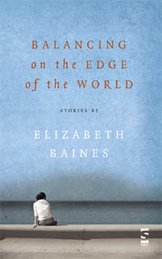
You can read 'Compass and Torch' on East of the Web (where it was first published), and it's included in my collection Balancing on the Edge of the World (Salt).

(Crossposted to my critical blog, Fictionbitchhttp://fictionbitch.blogspot.com.)

Tuesday, May 20, 2014

Unthology 5 pre-order


It's now possible to pre-order Unthology 5 (which includes my story 'Clarrie and You') from Central Books. The book will be published on 27th June and will soon be available from the Unthank Books website and from Amazon.

Saturday, May 10, 2014

Best British Short Stories 2014


I'm thrilled to have a story in this year's volume of the wonderful series Best British Short Stories, published by Salt and edited by Nicholas Royle. The stories in these anthologies have always been published for the first time in the previous year, and my story in this one is 'Tides, Or How Stories Do or Don't Get Told,' which was published last autumn in the online magazine The View From Here. I love the covers of these books, too!

Best British short Stories 2014 will be launched at the London Short Story Festival on Friday 20th June 6.30 - 7.30 pm, at Waterstone's Piccadilly.

Tuesday, May 06, 2014

Reading group: Harriet Said by Beryl Bainbridge

Warning: partial plot spoiler (or improver).

This was Jenny's suggestion, a book she had on her shelves but had never read, the story of two thirteen-year-old girls in a small Merseyside town just after the war, an unnamed narrator and the malevolent Harriet, who during the school summer holidays set out to beguile then humiliate Peter Biggs, an unhappily married middle-aged man they have encountered all their childhood on their forays to the beach, and whom they call the Tsar. Initially, as she waits for Harriet to return from holiday, it is the narrator who first encounters the Tsar on the beach this particular summer and becomes obsessed with him, simultaneously attracted and repulsed, but once Harriet returns, the campaign begins, motored by Harriet's insistence. Right from the start we know that something drastic happens in the end, as the first chapter opens with the two running from 'the dark house' screaming and the narrator's mother asking 'if I was sure it was Mr Biggs', and what follows is a retrospective account of the events leading up to that.

However, we all found that on a first reading, this narrative trajectory, and the motives of the girls, weren't as clear as I have made them above, and a lot of the meeting was spent actually working out those motives (since everyone but me had read the book only once). Introducing it, Jenny said that although it was such a short book physically, in the experience of reading it she had found it quite long, and most of us nodded. Mark had said beforehand that he thought it was very obviously a first novel (it wasn't Bainbridge's first published novel, but it was the first she wrote, originally turned down for its 'disgusting' characters, later of course published for that very reason, its transgressive characters). I thought that there was indeed a lack of narrative focus, as did John. John thought that even though adolescents experiment with formal language, the overall narration was too formal, which is a novice writer's error, and there was an uncertainty of tone. The narrative isn't an internal monologue, but it's not clear from what vantage point it's being addressed, or to whom. Everyone agreed with this. I said that in addition there are basic errors in story-telling: I wasn't even clear on my first reading that the book wasn't entirely linear, that the second chapter moves back in time. Immediately after the dramatic escape which forms the first very short chapter, the second chapter begins thus:
When I came home for the holidays, Harriet was away with her family in Wales. She had written to explain it was not her fault and that when she came back we would have a lovely time.
The simple insertion of an 'earlier that summer' would have prevented me from reading this as an aftermath scenario with Harriet explaining that whatever had happened with Mr Biggs was not her fault (rather than making a simple apology for being away when the narrator comes home from boarding school), and forming the notion that both girls had been sent away because of the incident concerning Mr Biggs. Once I realised my mistake, I needed to go back and start again, which inevitably contributed to my sense of a lengthy and somewhat rambling narrative. Perhaps as a result of this, a significant past event which is mentioned near the beginning - the fact that the girls have already been in trouble for going in the sand dunes with Italian prisoners of war - didn't seem to me to be mentioned until much later on  in my reading, which surprised me: indeed, I wondered why it hadn't been mentioned earlier, and it was only on a second reading that I realised that the mention did come early. As a result, its narrative impact was reduced for me. I wasn't the only one: Trevor, too, thought it was mentioned much later, and the group were generally muddled about when certain events had happened, ie in what order.

We were all clear by the meeting that the novel was precisely about that transition period in girls' lives when they are becoming sexually focussed and intellectually strong yet are still in many ways children - an important topic to address at the time Bainbridge was writing, as Mark and Clare pointed out, since up until then adolescence hadn't been recognised as a developmental stage, and children were expected simply to turn overnight into adults. However, we are not told until a good way into the book that the girls are at that significant age, thirteen, and I was much exercised at the start in trying to work out what the protagonist's age was as she veered between on the one hand gnomic pronouncements and subtle observations (was she an older teenager? There's an early reference to their leaving school) and, on the other hand, childlike behaviour, becoming sure I was reading about a small child when a two-page description of the alternative walks to the sea is presented in terms of a child mapping her environment and includes this line conjuring a picture of innocence: 'I sang as I began to climb the slope among the trees, "All through the night there's a little brown bird singing, singing in the hush of the darkness and the dew ..." It was practically the only song I knew all through...' If I had known the simple fact that the protagonist was thirteen years old, I would have been able to read her behaviour as adolescent ambivalence rather than the possible result of author inconsistency, and my experience of the book would have been much smoother. A consequence of this uncertainty was that I was unsure of the tenor of the narrator's early lone encounters with the Tsar, plumping for the idea of her as an innocent and consequently entertaining the notion that the first chapter depicts a drama of innocents violated by a paedophile. Reading then the girls' campaign with the Tsar through this lens, I was less aware of their sexuality and the strength of their obsession which motor the narrative trajectory, constantly unsure of their motives at any given point, as I think were most people in the group, and missed thus a sense of narrative thrust.

Most people said similarly that they hadn't been grabbed by the book, Ann summing it up by saying that although the subject matter was extremely interesting in theory, somehow the book didn't grip or convince. The one exception was Trevor, who had really enjoyed it. We were exercised by the girls' attitude to their parents, inevitably in adolescents ambivalent but seeming on occasion not to ring true. Harriet's father is violent, and no one in the group found convincing Harriet's matter-of-fact attitude to that, her superior view of him as needing to be handled and pathetic in his anger, nor the fact that both girls use, without irony or comment, his epithet for her mother, 'Little woman.' Indeed, both girls at moments have a protective and superior attitude to their parents which didn't seem realistic. However, having read the novel a second time, I suggested that this was meant as an illustration of their naivety - they are in fact misinterpreting their parents and their own situation. Initially people didn't seem convinced by this, but as the discussion progressed they came to embrace it. Although it was clear to everyone by now that the girls set out to target the Tsar, I suggested the possibility that there was a conscious authorial irony about this; that the narrator is meant to be unreliable, and that - as Jenny, accepting the idea, said - he is simultaneously targeting them, a fact of which the girls are unaware. Everyone in the group then thought of moments pointing to this, such as the way that at the start the Tsar constantly seems to be where the girls are walking, as if placing himself in their way (which, when I first suggested it early on, drew the comment that he was just a bloke out walking there anyway), the fact that he tells the narrator about his unhappy marriage, and various actions betraying his selfishness. I have to say that on a second reading this last irony seemed quite obvious (and the Tsar quite manipulative), and the narrative arc much clearer and more dynamic as a result. John now said that he wondered if the writer was trying to show through the girls' attitude to their parents that the parents, wrapped up in their own concerns and leaving the girls very much to their own devices, had left them vulnerable to the Tsar. Harriet's father's bad temper could be taken as an effect of the not-long-finished war, as well as the less than even temper of the narrator's father who cleans the house manically and bad-temperedly in his old ARP uniform, and one could extrapolate that the parents (and the Tsar himself) are thus damaged by the war and incapable of protecting the girls. The trouble is, however, that the narrative focus of the novel is so narrow - sticking closely to the perspective of the thirteen-year-old narrator - that there is little indication of this. The whole thing takes place too faithfully in the enclosed bubble of childhood, with little of the social or political contextualisation a more expert writer could indicate. All we know of any of the adults' backgrounds or pasts is that once upon a time the Tsar glamorously visited Greece, and the war is presented solely through the girls' consciousness as 'a long time ago', which contributes to the air of vagueness and lack of focus. Jenny now remarked that, having discussed the book, she felt it was a better book than she had thought, with a lot more in it, and people agreed. However, we couldn't escape the fact that it had lacked focus for us, and, although the prose is snappy and lyrical, there really is something about the nuts and bolts of the composition that defocuses everything on a first reading, we found.

People noted too that there was really no sense of eroticism in the girls' pursuit and campaign of humiliation of the Tsar, although there was eroticism in the relationship between the two girls, which seemed like a lack and left the girls' motives and feelings towards the Tsar unclear. People did think, though, that, as Clare said, the relationship between the girls was beautifully and accurately depicted -  the power of the one (Harriet) over the other, the love-hate dynamic tinged with sexual and existential longing. John said that overall, however, he found the book emotionally cold, and others agreed.

It's a book, in other words, that is better read in hindsight, through a knowledge of the end. It's interesting in this light that it's often written about as having been inspired by the Parker-Hulme murder case concerning two New Zealand schoolgirls similarly locked in a folie a deux, on which the film Heavenly Creatures, starring Kate Winslet, was based. If you approach the book knowing this connection (which I didn't at first), you know from the start that the girls have committed a murder, and the whole thing is imbued with a far greater urgency than if you lack this expectation. In fact, I'd say that it's a tall claim that the book is based on the real-life story (rather than vaguely inspired by the general idea of girls in an intense relationship murdering an adult): the Parker-Hulme story is really very different, with an entirely different dynamic. In fact, Harriet Said suffers from the comparison, since the Parker-Hulme murder was committed, and planned, to prevent the girls being separated, thus making the erotic relationship between the girls the pulsing centre, and the murder itself more organically inevitable than it is here. One wonders therefore if that somewhat spurious connection was flagged by an editor, author or publicity department aware that the book is indeed better when read in the light of it.


Our archive discussions can be found here and a list of the books we have discussed, with links to the discussions, here.

Friday, May 02, 2014

Launch of Emma Unsworth's Animals and the question of clothes


I don't think I've ever been to such a well attended launch as Emma Unsworth's last night at Waterstone's, Deansgate, for her new novel, Animals (Canongate)


Emma warned us beforehand that the book was 'filthy', and the extract she read didn't disappoint in terms of anarchy and bad behaviour. Animals comes recommended by Caitlin Moran who calls it 'Withnail with girls', but Emma reckons her best recommendation comes from her mum who told her dad, when he said he wanted to read it, 'No, you don't want to read it, Frank.'


Emma had generously invited others to read at the event, Robert Williams, Greg Thorpe, chef Mary Ellen McTague, and the music-and-words duo Les Malheureux that is writers David Gaffney and Sarah-Clare Conlon, so it was a very full and buzzy evening.

Those who know me well will know that I'm bonkers about clothes and dressing up - though I know you wouldn't think it, the old rags I wear most of the time (since I spend most of my time writing), and pop out to the shops in, or the samey safe things I pull on at the last minute to go out because I've been writing up to the wire and just haven't got time or space in my head to think creatively about clothes. As a result, my wardrobe and trunk and many drawers are stuffed full of charity-shop finds I hardly ever wear. Anyway, I'm in that haitus where you've come to the point in a big project when you can't go any further with it as you're waiting for your first readers' comments, and you don't want to push it from your head by working on other things (and don't have the creative energy anyway). Sometimes I spend such periods sending stories off, but I have no stories I'm ready to let go without further work, so yesterday I actually did some wardrobe sorting (for the first time in a long, long time) and discovered clothes I'd long forgotten about, but which seem to have come back into fashion! Trouble is, though, of course, nationwide or global fashion is never the same as the look sported by particular groups, and quite often, as last night, it's so long since I've been out that I've no idea what people are wearing. So off I went safely dressed in black leggings and leather jacket, most curious to see what folks were wearing to literary dos nowadays. And it turned out: anything and everything. There was Emma looking like Marilyn Monroe in her little black dress, there was novelist Jenn Ashworth in the most glorious fuschia-coloured tights, writer Maria Roberts with a fabulous bright-yellow jacket, and outfits from suit jackets to pretty dresses to sporty gear. 

I know what you're thinking: 'And as a writer she's supposed to be serious-minded!' But the two things are linked, in my view, the clothes and the literature. In the Manchester lit scene it's individual creativity that's all the rage.

Wednesday, April 30, 2014

Salt Spring offer- 70% off selected books!


My wonderful publisher Salt is running an amazing Spring offer - an unbelievable 70% off selected books! My own novel The Birth Machine is included, so if you haven't already got one, now's your chance! Go to the page, it's like a huge platter of jewels - even if you have Kindle editions of some of those books, my guess is you'll be tempted by their beautiful and striking covers and Salt's famously smart typesetting and design - I know I am! Among the many books on offer are the amazing stories by Carys Bray (Sweet Home), David Gaffney (More Sawn-Off Tales), Tony Williams (All the Bananas I've Never Eaten), Alison Moore's Booker shortlisted The Lighthouse and also her stories, the acclaimed Best British Short Stories edited by Nicholas Royle (2011 and 2013), poetry including Chris Emery's The Departure and all three volumes of Best British Poetry, even the much sought after Short Circuit guide to writing short stories edited by Vanessa Gebbie and much, much more. Do take a look!

Friday, April 25, 2014

Things you see from your writing desk.


It's not every day you look up from your writing desk and see a heron in the top of the tree just outside!

Thursday, April 24, 2014

So this is Spring....


Well, you can't accuse me of being big-headed. At least, my head simply wasn't big enough to accommodate much beside my recent writing project plus the various crit jobs I've done - not big enough to accommodate any thoughts about cleaning the house (you should see it! Or maybe not), or anything more than the headlines of the news; no space in there to think deeply about the things that have piqued my attention literary-news-wise, or indeed to compose blog posts. And I haven't been out much. When I first looked down to my desk the world was barren with post-Christmas winter, and I've looked up again finally and it's full of flowers and birds bustling about with nesting material in their beaks (and huge dust-balls all over the floors!). Crikey, I've been missing life!

It's odd, this writing lark. To be a writer you really need to be watching, observing, taking note, yet sometimes you need these periods where you just have to go away inside your (small) head - well, I do, anyway. If I'm not obsessive with a long project, I lose it, the whole thing just falls apart, and I really do envy those who can write while juggling lots of other stuff. As I think I wrote here earlier this spring, I felt tense and raddled when I had to leave off to read and to write reports, and exhausted afterwards. Split personality, moi? (Come to think of it, that's one of the things I've been writing about, fragmented personality...)

Tuesday, April 15, 2014

Reading group: Dark Water by Joyce Carol Oates

I suggested this novella, a fictional parallel of the well-known incident of July 1969 when Senator Edward Kennedy, driving home from a party on Chappaquiddick Island, accidentally drove his car off a bridge into a tidal marsh creek, an accident from which Kennedy escaped, but in which his passenger, 28-year-old political campaign worker Mary Jo Kopechne, died. Subsequent investigations failed to explain certain aspects of the incident, in particular the fact that having left the scene of the accident, Kennedy did not report it for nine hours, a fact that ultimately blighted Kennedy's political career. The novella updates the scenario to the late eighties - early nineties, replacing Kennedy with the physically and politically similar but unnamed Senator, and Mary Jo Kopechne with the slightly younger Elizabeth Anne 'Kelly' Kelleher, its incident set on the resonant date of July 4th.

Aptly for a book borrowing from an incident the outcome of which is well known, the novel adopts a structure based on hindsight, and its primary interest is not in what happens but in unpicking the sexual and political power structures that have led to a situation that is already in place. The book begins when the car is already in the water and Kelly alone and trapped in it, the Senator having swum free, and the central narrative is her struggle to free herself over the next few hours before the car finally fills with water. Meanwhile, however, chiefly (though not entirely) through Kelly's consciousness (via an intimate third person narration), we chart back through the hurried drive for the ferry in the dark on a disused back road, the party beforehand at which Kelly and the Senator met, Kelly's personal history of passionate political campaigning, a painful and potentially abusive sexual relationship and a childhood that has left her with low self-esteem, and the Senator's political background. Since Kelly is of course panicking in the car, all of this comes to us in a fragmented and repetitive form, the scenes lapping in repetitive waves like the water into the vehicle, each time they return bringing new insights, and as they become more jumbled paradoxically creating more meaningful connections. The drowning is thus both structurally and politically the central point from which a whole world of personal and political drama both spreads (like the ripples around the submerging car) and comes meaningfully together. However, there is still a strong narrative thrust due to the prose style which in my view brilliantly recreates the psychology of the trapped woman - breathless with minimal punctuation, obsessive with repetition and alarmed with pulsing rhythms (Ann would say later she found the book emotionally torturous, and found herself metaphorically lifting her head like Kelly to escape the rising water. I had said that if there was any problem with the breathless style, it was that I tended to read the book too quickly, with the feeling that I was missing things, but Ann said that she had found it all so agonising that she had to read it slowly, taking it in bits.)

When I had finished introducing the book to the group along these lines, Ann said she thought the book 'brilliant', and John and Mark agreed. Doug, who was unable to make the meeting, had written beforehand to say that he had found it a 'fabulous' book and didn't imagine there would be much discussion as he couldn't imagine anyone disagreeing. However, up until this point in the meeting Trevor, Jenny and Clare had been very quiet, and Trevor (who has tended to be positive about most books) now said that he was afraid he couldn't agree with us. He said that the book 'got on his nerves'. He said he got the point right from the start and the rest was just over-insistent repetition, and he couldn't stand the prose style, finding it insistent and bullying. He said it was an old story, too familiar to need to be told again, ie the story of a silly young girl having her head turned by an older man when she ought to know better. This led to a chorus of protest, that just because a story is old doesn't mean it can't be told again with a new perspective, that you don't have to be stupid to be seduced by charisma (that's one of the points: that modern politics is fatally based on charisma), that Kelly isn't stupid, she is actually clever and seriously academic and political, she just has low self-esteem (as Jenny pointed out), and, most importantly that the novel isn't just about that sexual scenario, but much more importantly about the last gasps of a moribund political system. This last point was made by Mark; the updating in the novel, he pointed out, reflects the fact that the political rot and the loss of the Democratic vision which had set in at the time of the real-life incident, and of which the whole incident is symbolic, was deeper and more evident by the time in which the novella is set and was published.

Ann and Mark pointed astutely to symbols of rot and breakdown in the novel: the swamp itself, 'a powerful brackish marshland odor, the odor of damp, and decay, and black earth, black water'; the fact that in the car headlights it looks like broken mirrors; the dead trees that Kelly worries might be dead from pollution, the dumped rubbish including the resonant image of a headless doll; the old disused road that the Senator takes instead of the new modern road (a route leading to disaster); the diminishing air bubble in the car (the last gasp); the fact that the car here is a Toyota (unlike Kennedy's Oldsmobile) and thus a symbol of the loss of American economic power. The seven-foot rushes in the marsh are described as being 'like human figures grotesque without faces', thus symbolising the lack of humanity in both the Senator's ultimate treatment of Kelly and of capitalist politics in general. Mark said in strong disagreement with Trevor that everything in the novel was symbolic or significant in some way, everything in it mattered and nothing was superfluous.

Jenny now said that her problem with the novella was that, unlike us, she didn't find it psychologically realistic: she found on the contrary a lack of urgency; she thought that Kelly would be panicking far more than she found the novel gave an impression of her doing. Also she didn't agree with me that the memories of the preceding and past events recurred with added insight or information, an observation that left us staggered and speechless. It seems to me that although certain moments are repeated and thus dwelt on, the memory-flashbacks do follow a narrative trajectory, showing the development of Kelly's involvement with the Senator at the party and her changing attitudes towards him (she is initially politically suspicious of him, but becomes charmed). Those moments that are obsessively dwelt on do to my mind re-emerge with added insight. The Senator first appears as attractive and attentive: 'big, gregarious ... playful' 'how tall he was, how physical his presence,' then with a hint of attractive vulnerability: 'And his grin wavered, just perceptibly. As if, for that moment, he was doubting himself: his manly power'; slowly however hindsight reveals him as domineering and selfish: 'The Senator was in the habit of making queries that were in fact statements'; 'that tongue thick enough to choke you' when he kisses Kelly; speaking to her 'as if speaking to a very young child,' and insulting her by telling her she's too young to understand. After the initial impression of vigour come hints of lack of wholesomeness: 'an exhausted middle-aged man beginning to go soft in the gut', his sports shirt 'damp with perspiration' and 'his seersucker trousers ... rumpled at the rear.' Then towards the end there is the self-regard revealed in the curiously repulsive image of the Senator eating 'ravenously, yet fastidiously, wiping his mouth with a paper napkin after every bite' and the resulting 'catsup on his napkin like smears of lipstick' with their inevitable connotations of blood. Towards half-way through the book the initial impression of generosity and gregariousness is cut across by this memory: 'Actually, the first thing the Senator did after greeting his hostess was to draw Ray Annick [his lawyer friend] off to confer with him, out of earshot of the others', and by the end of the novel two ominous memories have surfaced: Kelly's friend Buffy saying to her as she leaves with the Senator for the fateful car ride: ' "Don't forget, he voted to give aid to the Contras' ', and, as Kelly passes through the party kitchen, Ray Annick on the phone: 'speaking in a low, angry voice, the words asshole, fuck, fucking punctuating his customarily fastidious speech ... so unlike the genial smiling man ... courteously and sweetly attentive to Kelly Kelleher... His  eyes ... followed her as she passed ... as a cat's eyes follow movement with an instinctive impersonal predatory interest, yet as soon as she passed beyond his immediate field of vision he ceased to see her, ceased to register her existence'. This last of course prefigures the terrible end in which, in order to save the Senator from scandal and damage to his political career, Ray Annick will try to help the Senator to dissociate from the accident so that Kelly will be left in the car to die. However, none of this was enough to prevent Trevor and Jenny from experiencing the book as repetitive and static.

Ann said she wondered a bit about a fairly lengthy interjection towards the end of a treatise on capital punishment. This is the substance of the article that Kelly has written for the left-wing paper she works for, which discusses the role of the state in the matter (state-sanctioned or indeed -operated murder), and which at first the Senator gives the impression of having read, but hindsight makes clear he probably hadn't. John thought this was very important, not only as an illustration of Kelly's intelligence, acuity and left-wing passions, but as a comment on the fact that of course Kelly Kelleher is in effect murdered by the state, as was indeed the real-life Mary-Jo Kopechne.

Clare had been quiet for most of the meeting but she now said that like Trevor she hadn't liked the prose and as a result, like Trevor and to some extent Jenny she had been unable to engage with the book.

Our archive discussions can be found here and a list of the books we have discussed, with links to the discussions, here.

Saturday, April 05, 2014

Unthology 5 Cover


Here's the striking and intriguing cover of Unthology 5, due out in June from Unthank Books, and which I'm thrilled to say includes my story, 'Clarrie and You' about two sisters and the long-term corrosive effects on their relationship of secrets imposed by the prejudices of society.

Arresting, isn't it?

Monday, March 31, 2014

Reading group: Swimming Home by Deborah Levy

Clare suggested this 2012 Booker-shortlisted novel in which a group holidaying in a villa near Nice (poet and philanderer Joe Jacobs, his war correspondent wife Isabel, their fourteen-year-old daughter Nina and their two friends Laura and Mitchell) is disrupted by the unexpected arrival of a stranger, come to seek out Joe whose poems she is obsessed with, the mysterious and unbalanced twenty-three-year-old Kitty Finch, a fey-seeming (but devastatingly disruptive) creature with long red hair and green-painted fingernails, appearing first swimming naked in their pool.

However, we know before the narration of this moment that Kitty and Joe end up having sex, as the opening section has them driving back together from the hotel where they have done so, a scene that will keep recurring through the book, and which is steeped in an air of loss and doom.

The book is strikingly imagistic, and we were all agreed that it created rich pictures in the mind of the reader, but in her introduction Clare said that she felt at too much of a distance from the characters, and there was something about the imagery and the very conscious patterning of symbols that seemed somehow superficial and left her cold, and most people agreed.

Symbols recur throughout the text: when Kitty is first sighted in the water she is seen as a body - a prefiguring of death or tragedy that then hangs over the book - and Joe jokingly asks if it's a bear, a point that is laboured in dialogue between the characters and a symbol that will recur at the devastating end of the book. John pointed out the recurring image of hairballs - someone choking on one, hair getting caught in the pool filter system - and there are frequent references to mice including sugar mice which appear twice in an unsettling chronology for the reader, first in a dream of Nina's (which she doesn't communicate to anyone else) and then in a later incident when Joe and Kitty are walking away from the hotel and Kitty buys one. There's also frequent flagging of the antique guns that Mitchell, a trader in such artefacts, has bought, and of his love of guns and shooting. John pointed out the symbolism of Kitty Finch's name, the cat and bird references indicating a woman both at war with herself and of ambiguous significance to the others.

Thus while the novel is predicated on a familiar setup of the realist novel of middle-class mores and also displays some of the characteristics of the whodunnit, it is yet a novel with a strong and intricate symbolic system that draws attention to itself in a non-realist, and indeed postmodern way.

Although everyone in our group enjoyed reading the book, no one found the combination satisfactory. One chief complaint was that, as Clare had indicated, it was impossible to like or care about the characters, since they are very much viewed from outside, and their motives are, for the most part, unclear. John noted that the characters are placed, puppet-like, in scenes like tableaux - the family by the pool, the family around the dinner table, Kitty and Joe in the orchard, various couples on the beach, retired doctor Madeleine watching them all from her balcony etc - and I said that since there was a gun placed at various moments, including under a bed, it also had echoes of the game of Cluedo, which I take to be deliberate. Trevor (without knowing that Levy had been a playwright), said he thought the novel was thus really a play. I wasn't sure that it was that simple, since the concerns of most plays (realist ones anyway) are indeed motivation, character and dialogue - all things that this novel eschews (much of the dialogue seeming non-realistic, and to many in our group unconvincing). I pointed out that a postmodern novel is intended precisely to disrupt and disturb and even alienate the reader, rather than to reassure and immerse, and that the concern of this novel is the fluidity of personality and identity (eg the sugar mice of Nina's undisclosed dream entering the real-life experience of Kitty and Joe, Kitty's ability to challenge and break down Joe's carefully-honed middle-class-English persona and to bring to the fore his searing past as a child refugee who had been hidden in the woods from the Nazis, and her conviction that the child Joe had entered her mind). People readily accepted this as a principle, but they didn't think it worked here.

Some suggested that the problem was that the middle-class-realist novel setup of a moneyed family taken from their normal environment and thus vulnerable to disruption, led you into a realist reading which then in turn left you dissatisfied with the postmodern elements. The discussion showed that people were indeed wedded to a realist reading of the book, as there was much pondering of the characters' motives and a huge argument over what had really happened in the tragic moment towards the end, with people indeed wanting the clear-cut explanation you get with a murder mystery. The notion that we were not meant to know exactly what happened, that it was indeed muddled, seemed not have occurred to anyone, nor was acceptable to them. There were also objections to elements that are unconvincing on a social-realist level: what poet can live on his royalties as Joe does? and how was Mitchell supposed to get the guns he had bought there out of the country? Do pebbles really get holes worn in them in the mildly lapping Mediterranean? And why isn't Kitty's background filled in when she's such a disruptive force?

I felt that the middle-class-novel paradigm had been deliberately set up to be subverted: Joe's urbane middle-class Englishman's veneer masks a tragic past and ongoing emotional damage, Mitchell's gourmet interests and impulse to hire an expensive car hide the fact that he's about to go bankrupt, and the whole apparently concrete and vivid middle-class setup is haunted by an existential uncertainty. I wondered if the problem was the imagery itself, and the way it's employed. Having had my attention drawn so acutely to the symbolism (Ann said you almost thought of charting it all out on a spreadsheet), I personally felt the need both to understand its meanings on an intellectual level as well as to be influenced by it emotionally, but as Clare had indicated in her introduction, I often did neither, and often what an image brought to my attention to was not the themes and ideas so much as an author creating an artefact.

Why, for instance, the bear image, (rather than that of any other wild and dangerous animal)?  In fact, it seems an inappropriate image: one has to stretch one's mind to imagine how a very thin girl swimming naked looks like a dead bear, in spite of her long red hair (not to mention the fact that bears aren't endemic to the countryside around Nice), and the association does not in fact spring organically from the scene, but stems from Joseph's head. It is explained that the previous day an article had appeared in the newspaper about a bear stumbling into a Los Angeles garden and swimming in the pool, and that Joe had wondered then whether the tranquillised bear had found its way home (so he has bears on his mind). This plants the central theme of exile and home, but by being located in the consciousness of a man whose consciousness is largely shrouded, the image is essentially divorced from the scene. This may be deliberate - Levy may be making a point about consciousness - but the effect for me is to give the image an academic quality, which in turn made me think of the author imposing it on her text, and ultimately gave me a sense of artificiality and interfered with my engagement with the book. I felt the same about much of the rest of the imagery. I still don't know, having thought about the book, what the sugar mice signify specifically, and although I could perhaps work it out intellectually if I thought about it further, the point is that in the process of reading it didn't impress anything on me emotionally apart from bafflement. At one point, caught fish are described, in Joe's consciousness, as having failed to 'swim home' and although this metaphor is potentially more organic (we know by now about Joe's background of exile and emotional damage), the over-exact verbal echoing of the title of the book seems forced and draws one's attention to the author and her manipulations rather than to any world of meaning she is creating.

The overall viewpoint appears omniscient in that for much of the time the characters are seen from outside, viewpoints are constantly shifted - in the introductory scene by the pool from paragraph to paragraph - and the whole thing has a watching, observational air. However, this seemingly external viewpoint is only partial: we don't know everything about the characters' thoughts, and we often share the characters' lack of understanding of each other and their motives. John suggested, rightly, I think, that the overall viewpoint is intended to be that of Nina, at the time a bystander to the adult dramas yet affected by them, looking back and trying to piece it all together from the standpoint of the very final section.

This final section is strikingly different from the rest of the book. Narrated in the first person by Nina several years later, it lacks the glittering imagistic quality of the rest of the book, but throbs with a rhythm and felt emotion seemingly withheld until this moment. While everything up to this point has seemed to happen indeed through the vivid and glittering distortions of water, this last section feels utterly real. It's a hymn of grief (restrained but all the more affecting for being so) that brings retrospectively into shocking focus the importance and significance of the tragedy underlying that past summer's events. It had me in floods of tears, but when I pointed all this out to the group they looked rather blank, and if they had already found it noteworthy that the section was tonally and narratorially different, they gave no indication, in which case the author's strategy hadn't worked on them. As for me, although I'm aware of the possibility that that last section depends to some extent for such an effect on the very contrast, I can't help wishing that the rest of the book had been more like it.

Doug, who didn't make the meeting, sent a note to say that he had found the setup and characters cliched a la Miss Marple, but that he had in fact very much enjoyed the imagery, found that there was some tension generated, and that the book 'cantered towards the denouement with the gusto of a frisky pony. What's not to like?'

Our archive discussions can be found here and a list of the books we have discussed, with links to the discussions, here.