Thursday, June 21, 2012

Reading group: A Pale View of Hills by Kazuo Ishiguro

Warning: plot spoiler (maybe).

Trevor suggested this book in which widowed and middle-aged Japanese narrator Etsuko, now living in England, is visited by her younger daughter Niki after the suicide of her elder daughter Keiko, and is prompted to remember a short friendship she had  in Nagasaki just after the war as a young married woman pregnant for the first time, with another young woman, Sachiko, whom the war had left single with a disturbed and sometimes sinister-seeming child, Mariko.

This was a very interesting discussion which became focused in part on the issue of whether, in reading a novel, one should ever take into account known authorial intention.

Firstly, Trevor introduced the book appreciatively by saying that he liked its portrayal of the two different women, Etsuko and Sachiko, and their radically different reactions to the aftermath of the war, Etsuko still accepting the subservient role of the traditional Japanese wife, and Sachiko rebelling against it all, leaving her uncle's traditional house to live alone with her child, and hoping to depart for America with a lover Frank. Trevor commented that the book was very oblique in its treatment of the atomic bomb: the characters never refer to it directly. The book, he said, seemed a conscious portrayal of Japanese reticence and formality - the characters constantly bow to one another and their conversation is characterised by formal repetition - but he was troubled by a sense of being unable to judge how authentic that was. He didn't know if this was just because he knew that the author, though born in Japan, was brought up in England, but he felt that there was also something very English about the book. One or two people in the group murmured that they too had felt that the tone of the book was somehow hybrid.

Jenny now said that she agreed about the characters, and that what she really liked about this book and Ishiguro's work in general is the way that he never tells you what characters are feeling but you always know exactly what they're feeling.

I said, But what did people think of the idea that Etsuko and Sachiko are in fact the same person (which rather puts paid to the notion that their, or rather her, motives and feelings at any one time are clear)? There is a passage towards the end where Etsuko, talking to the child Mariko about Mariko's imminent departure for America with Sachiko, switches from second person plural to first person plural, from 'you' to 'we', which gave me this distinct impression - and, it turned out, others in the group too. This had sent me off on the internet to the Paris Review interview with Ishiguro (Trevor made his usual cynical comment about appeals to the internet), and here Ishiguro explains that through working with homeless people he had come to realize that people often tell their own painful stories via another character. He says he had expected readers to be caught up short by the fact that Etsuko almost immediately starts talking about her involvement with someone else in the past (rather than her daughter Keiko's recent suicide, which is shrouded for the reader in mystery, or her own story that led up to it), and the implication seems to be that he expected readers to be jolted into guessing fairly soon that Etsuko is making Sachiko stand in for herself (in which case, to reveal it here is not, after all, to plot-spoil). I said that I didn't feel it worked, and others, in particular Ann, agreed. Pretending to talk about someone else, usually an invented character, when really talking about oneself, is a technique employed specifically to avoid referring to oneself, but here Etsuko inserts herself into the story as a large-as-life character minutely involved (for the short period they know each other) with Sachiko and her daughter Mariko, and very different from the more mysterious Sachiko not only in character but in concrete circumstance. There are too many internal inconsistencies to fulfil the notion that they are the same person. On the more trivial level, but nevertheless sending a strong diversionary signal, Sachiko runs off with an American to America while Etsuko has clearly come to England with an English serviceman. More problematically, it's difficult to see the parallels between Etsuko's meticulously-portrayed home situation, living with her husband and father-in-law, and the rather mysterious yet significant-seeming setup with an uncle and ancient female cousin that Sachiko has left behind; more glaringly, if Sachiko is really Etsuko, then Sachiko's daughter Mariko must be Etsuko's elder daughter Keiko (and indeed if Keiko is this disturbed child, then her suicide is explained) but at the time when the two women are friends, Etsuko, significantly for her emotional state at the time, is pregnant with her first child. These things are, clearly, enough to put many readers right off the scent. Although Ann and I had wondered at times as we read if Sachiko and Etsuko were one, the inconsistencies had made us discount the notion until we reached that final pronoun shift. Then, instead of having the desired Of course! reaction, we racked our brains to try and see how it had all fitted, and couldn't. I told the group that in the Paris Review interview Ishiguro acknowledges that the book is baffling, that he failed to handle 'the texture of memory' and resorted to 'gimmickry' at the end, leaving the ending 'like a puzzle.'

Like many readers of this book, Jenny and Trevor hadn't picked up on the intended conflation of the two characters, and Jenny now said that this proved the mistake of reading about authors' intentions, as it was a better book if you saw the two characters more simply as separate. John endorsed this by putting in that some writers, such as Beckett, famously refused to explain their work. I said that I agreed absolutely that an author's intentions are irrelevant in any critical appreciation of a book: authors can fail to achieve what they intend, and they can also achieve things they didn't intend or envisage, and what matters is the words on the page, and everyone in the group strongly agreed.

However, we were somewhat at odds about the effect of the words on the page. Clare now said that she didn't read things as pinned down in such a concrete way, ie that Etsuko and Sachiko were actually the same person: she saw the parallel as looser, Sachiko and Mariko being characters in their own right but their experiences and desires and fears echoing those of Etsuko and Keiko at another time in their lives. Disregarding Jenny's injunction and looking now more closely at Ishiguro's remarks about this book in The Paris Review, I see that this is closer to his aims: he says, (erroneously, I think) that people often use the experience of a friend (rather than an invented character) to talk about about their own. Nevertheless, Clare's was a seductive argument, which seemed to make sense of the book and its inconsistencies. Its inconsistencies and conflations, she suggested, echoed the fragmentation and fusions of the bomb and its aftermath in Nagasaki society and the psychology of its citizens. What, someone had asked earlier, was the puzzling business about the mysterious (possibly threatening) woman that Mariko kept seeing, and her connection with the woman Mariko had seen drowning her baby? And Sachiko drowning Mariko's kittens, and Etsuko keeping dragging a rope on her foot when she looks for Mariko in the dark by the river? Seen in the light of Clare's interpretation, these are dreamlike connections rooted in Etsuko's concerns during her first pregnancy for her competence as a mother, and illuminating the hints at the start of the novel that she might blame herself for Keiko's death. In addition, this reading accommodates the differences in the attitudes and psychology of the two women as the opposing aspects of one woman's psychology, suppressed or released by circumstances.

Jenny said that she felt that that was the clever interpretation of the novel, but it didn't satisfy her, it left her with too many things unresolved, and she likes to have things resolved in novels and ultimately to know what really happened when. I felt (though didn't say) that, attractive as Clare's take was, it didn't play out on the page: there simply weren't enough pointers while reading to make me read in this highly non-naturalistic way. Trevor said that he still preferred to read the book on the more simplistic, realistic level, ie that Etsuko and Sachiko were simply two contrasted characters. Clare's interpretation, and Ishiguro's stated intention, however still posit separate identities for Etsuko and Sachiko, and this poses a problem that Doug now homed in on, and which creates, in both Clare's and Trevor's interpretations, a huge gap in the novel: mysterious as Sachiko is, we know much about how she came to leave Japan, especially the flavour of her leaving, yet we know nothing about how Etsuko, our very different narrator whom we feel we know much better, negotiated her similar situation. I said, Yes, it is only if we take Etsuko as Sachiko that we can know this about Etsuko (and then of course we come up against the inconsistencies). Then Mark, focusing on the words on the page in the way that we had agreed was the only useful way to approach a novel, drew our attention to another passage near the end. A key section in the novel is the outing taken by Sachiko, Etsuko and Mariko to the hills outside Nagasaki that Etsuko can see from her window, the pale hills referred to (and thus made significant) in the title. (It's also interesting that the title is A Pale View of Hills, rather than A View of Pale Hills, implying distortion in perception.) In the passage pinpointed by Mark, Etsuko, talking in the present time to her second adult daughter Niki, seems to refer to that outing and says, 'Keiko was happy that day.' This may be, in Ishiguro's view, a mere 'gimmick', cutting across his subtler intentions, but the fact remains that the words are there on the page, and it's very hard not to interpret them as meaning that Keiko and Mariko, Sachiko's daughter, are the same, and that therefore Etsuko and Sachiko too are one and the same.


Our archive discussions can be found here and a list of the books we have discussed, with links to the discussions, here

Monday, June 11, 2012

Manchester Book Market


 Of course you can bank on bad weather if you plan an outdoor event. The Manchester Book Market, run by Comma Press's Ra Page, was held on Friday and Saturday, an annual event showcasing independent publishers. As well as market stalls there were over 60 authors - mainly poets, but a few, including me, with very short fictions - reading from noon onwards each day. And yes, the weather was dreadful, but spirits weren't dampened in the least - well we're used to it by now, aren't we? (I have to say, though, that stupidly I wasn't as warmly dressed as some my fellow writers - if I'd gone out in the morning beforehand I'd have known how cold it was, but I didn't). Above is Zoe Lambert whose story collection The War Tour is shortlisted for the Edge Hill Award, and below are Adrian Slatcher and Claire Massey. Thank you so much to Ra for organising the event, and to all the independent presses who keep literature alive.


Saturday, June 02, 2012

'Used to Be' review

I've recently been moaning about the lottery of competitions, but of course I'm thrilled whenever I get anywhere in one. Mind you, when I do I tend to find it's with stories I feel less satisfied with: stories in which the 'message' is too obvious, or simple, or the form too conventional, for my own purposes. It's no surprise, I suppose: there's always going to be a danger that when you're trawling through hundreds or thousands of stories, the more obvious things are going to rise to the surface. So I was staggered and delighted when 'Used to Be', which I consider one of my more ambitious stories, won third prize in the 2008 Raymond Carver competition, and I'm now pretty chuffed to have found this review of it by Rio Liang in the Carve blog's Spotlight series.

Sunday, May 27, 2012

Avian distractions


I'm in Wales at the moment. I've been working on a short story and trying to write a review but I've been very distracted - not just by the beautiful weather but by this nest of baby crows right outside the house and above my writing window (you can see two in the pic, but there were four altogether). We first noticed them on Thursday, the morning after we got here, and it soon became clear that the parents were keeping away because of our sudden presence. As the day progressed, the babies became ever more noisy calling out for food, and when John and I sat outside in the hot sun to eat our lunch, three of them were leaning over in a row and calling to us! Worried that they'd starve, we decided to try and keep a low profile but by late afternoon there was still no sign of the parents, and the babies were getting frantic and beginning to climb up onto the sides of the nest. I was afraid both that they'd fall out and that the parents had abandoned them altogether, but after we went off out in the car for the evening the parents clearly returned. They kept away for much of the next day, Friday, but did sneak back now and then and the babies were calmer. At one point the cuckoo that's calling in the valley all day long descended into the tree with a clear eye on the nest, and a black shape appeared and made an arc around the area, and the cuckoo flew off: the parent crows were obviously keeping watch all the time.

In the late evening a huge wind came up and lasted all night, and it brought home what the nursery rhyme Rock-a-Bye Baby really refers to. The tree, an ash, was whipping and swaying, and the nest with it, bits of it falling away. When the wind woke me in the the early hours yesterday I could see that the mother bird was more or less sitting on top of the brood to stop them falling out. However, although the wind continued all day the babies were left alone again and we began to realise that the parents' absence may no longer be motivated by fear, and that the babies were ready to fly. No longer focused on the house doorway as they had been, the babies were calling towards a tree further up the field, where the parents were obviously stationed. They kept standing and flexing their wings and once again climbing up onto the edge of the nest, and now and then one would climb out on to the branch before dropping back in again. There came a point when we realised that there were fewer in the nest than there had been. As the day wore on the numbers dropped, and finally, half-way through the afternoon, there was only one left, calling and calling and not seeming to dare even to climb out. It took a long time, but in the end, at five o'clock, as I was sitting at my desk, a black rag-shape dropped down across my window, and the last fledgling landed on the slates in front of the house. It stood, wobbled, fell, righted itself and looked around with seeming huge interest. It set off wonkily up the grass in front of a low wall, found it was going nowhere, looked puzzled, then perkily set off in the opposite direction, stumbling and righting itself, and in a miraculously short space of time found the strength of its surprisingly long legs and was gone at speed up the side of the house in the direction of the tree from which the mother was calling.

So the nest is empty, and I find I'm missing them. Still, I've finished my review...

Tuesday, May 15, 2012

Carys Bray reviews The Birth Machine

Having just discussed Fitzgerald's Tender is the Night with the reading group (yesterday's post) and considered the reasons that the revised edition has fallen out of favour, I was beginning to feel a little edgy about the revised edition of The Birth Machine, since, as blogger and writer Adrian Slatcher commented at the Manchester launch, by bringing Chapter 4 of the originally published version to the beginning, the new edition makes a very similar change to the one made to Fitzgerald's novel.

However, Carys Bray has now written an in-depth review of The Birth Machine showing how the current structure conveys the themes, and so I feel entirely vindicated. After all, it is how I wrote the book in the first place (see my Author's Note on the Salt website)...

Carys concurs with Lisa Glass's recent review in finding 'the masterful examination of "polite cowardice" compelling', and calls it 'a disturbing and thought-provoking meditation on power, control and the uncertain language of logic'.

Monday, May 14, 2012

Reading group: Tender is the Night by F Scott Fitzgerald

When John first suggested this book, the story of the disintegration of brilliant psychiatrist Dick Diver, married to wealthy psychiatric patient Nicole, he hadn't realised that there were two versions with radically differing beginnings - the first published in 1934, and a revised edition in 1948. On realising this, John quickly contacted everyone to suggest that we read the revised version. However, some people had already obtained and begun reading the original, which turned out to be more readily available, since - as it also turned out - the revised version has now fallen out of favour. The net result was that when the group convened, people had read different versions.

The first edition begins with the arrival of movie starlet Rosemary on the Riviera where Dick and Nicole Diver preside from their expensive villa over a seasonable fashionable community of expatriate pleasure-seeking Americans. The overall viewpoint is that of Rosemary who becomes infatuated with the Divers, falling immediately in love with Dick - and, encouraged by her mother, setting out to seduce him - and fascinated by Nicole's beauty and a mystery that surrounds her. At a party held by the Divers, another guest, Mrs McKiscoe, sees Nicole in some unspecified compromising situation, compromising enough for Mrs McKiscoe's lack of discretion to occasion a duel. Later, when Rosemary accompanies the Divers to Paris - her affair with Dick gathering apace - the mystery of what Mrs McKiscoe saw is uncovered for her. After this, Rosemary drops from the story and the narrative explains the background to the mystery by flashing back to Dick's early years in Zurich as a brilliant young up-and-coming psychiatrist and his first meeting with psychiatric patient Nicole. The events in their lives up to their present-day reign on the Riviera are then filled in, and having brought their story back up to date, the novel follows Dick's subsequent slow disintegration.

It seems that Fitzgerald worked on the book for many years, beginning at the height of the roaring twenties and initially intending a kind of post-war Vanity Fair type social-observation novel in which the American Dream turns to nightmare, conveyed via the downfall of the main protagonist. By the time the book was published, in 1934, the Depression had set in, and the book, seeming to be a depiction of a selfish moneyed class and a bygone era, was less well received than Fitzgerald's previous novels. Having already worked many versions of it - up to seventeen - he recorded in his journal suggestions for revisions to a future edition, and after his death his friend Malcolm Cowley carried these out in the revised edition of 1948. In this edition the section dealing with the early years in Zurich is moved to the beginning and the novel follows a strict chronological sequence. In his Introduction to that edition, Cowley outlines the improvements this makes. The first edition, as had been generally noted, lacked focus and fell into two disparate parts, the first seeming to be striving to be the social-realist novel that Fitzgerald originally intended, and the second, after the disappearance of Rosemary from the story, the more modernist psychological study of the disintegration of one man. In addition, as has often been pointed out, Rosemary is both too complicit with the values of the Riviera society and too excluded from the mystery at its heart to be its successful observer. The editorial change unifies the novel by structurally making Dick the focus from the beginning, and the novel becomes more properly psychological. As Henry Claridge points out, too, beginning the novel with Dick's early brilliance and professional success highlights more powerfully the irony of his downfall.

However, in his Introduction to the 1995 Worsdworth Classics reprint of the first edition, Claridge, while careful not to dismiss the arguments for Cowley's version, sets out arguments for the earlier version. Once we know the truth about Nicole and Dick, as we do from the start in the revised version, there is not the same mystery for the reader, and the narrative tension of the first part of the first edition is lost. When Rosemary appears well into the revised version, her mystified perspective is not shared by the more knowledgeable reader and can seem, with the attention given to it, like 'an intrusion and an irrelevance'. In addition, Claridge says, 'Nicole's mental illness is the more touching when refracted [as it is in the first edition] through Rosemary's perspective on the indulgent lifestyle of the American expatriate community'.

I was very interested to see if the two different versions had created correspondingly different opinions of the book among the group. Doug, who sent a message to say that he wasn't going to be able to make the meeting after all, must have been reading the early edition, as he said in the message that he didn't think the time-shift structure quite worked. He also felt that 'the whole thing feels like you're viewing it through the bottom of a glass - making some of the points I think Fitzgerald is trying to make on class, Americans / the Old World, war etc. just a bit fuzzy and imprecise', but in spite of that he was finding it 'hugely captivating and there's something pretty magical in the writing.'

I'm afraid, however, that although we had read different versions, not one of us present found it captivating or agreed with him about the magical quality of the writing, although we all agreed with his vivid description of seeming to view it all through the bottom of a glass. Every one of us found the prose contorted and imprecise, a shock to us after The Great Gatsby which we had loved and admired, and a reflection, presumably, of the contortions and changes of direction Fitzgerald had gone through in the writing.

Referring to this ridiculously overblown and illogical metaphor: 'Dick got up to Zurich on fewer Achilles' heels than would be required to equip a centipede, but with plenty', John kicked off his introduction by saying that he had as many good things to say about the prose style as a centipede has Achilles tendons, ie none. Ann immediately said, laughing, that she had noticed that metaphor too. It occurs in the first few pages of the early-years Zurich section, a section which is particularly clogged with overconscious, imprecise or laughably over-concrete metaphors, such as in this description of the face of a professor: 'beautiful under straight whiskers, like a vine-overgrown veranda of some old house.' Elsewhere there are other hilarious examples, such as the women in a car 'small and buoyed up by the power of a hundred superfluous horses', Nicole's 'brown back hanging from her pearls' and the travellers 'tracing down the hot sinister shin of the Italian boot.' Dick arrives among a group of women and 'brought with him a fine glowing surface on which the three women sprang like monkeys with cries of relief, perching on his shoulders, on the beautiful crown of his hat or the gold head of his cane.' The novel is scattered with other imprecisions: Nicole's sister crossing and recrossing her knees 'frequently in the manner of tall restless virgins' is not only hard to get your head around but doesn't in fact bear too much thinking about, especially as her sexuality or virginity is not exactly at issue in the context; there are the 'white mirrors of teeth', and people's nerves 'crackle suddenly like wicker chairs.' There is laugh-aloud clumsiness such as when Dick dives 'literally' into bed (at a moment intended as tense), and when, in another moment meant to be serious, Nicole kisses Dick several times, 'her face getting big every time she came close.' There are ugly adverbial locutions: 'conciliatingly' (at least twice), 'exteriorly' and 'muscularly' (this last within dialogue!). Worst of all, though, are the overblown, abstract and convoluted sentences which seem hardly to make sense, and which John in his introduction said he thought were an attempt to imitate D H Lawrence at his worst - and Lawrence is indeed name-checked in the book. Everyone said they'd had problems with them; most said they had frequently had to go back and re-read them, though Trevor said he often ended up skipping and reading on. In the first edition there are even malapropisms (corrected in the revised edition but replicated in subsequent reprintings of the first edition): palpable for palatable and cervical for cortex (of the brain), slippages which reinforce the notion that, as Ann pointed out, Fitzgerald was befuddled and distracted at the time of writing by alcoholism and his wife Zelda's madness. The worst section in these ways is the early-years Zurich section, which gives the revised version an impenetrable beginning. This was the version which John, Chris, Ann and I had read (Trevor and Jo had read the first published version), and both Chris and I had had several times to go back and start reading the book again before we had got very far. Ann and I thought it highly likely that this was one reason that the revised edition had fallen out of favour. Ann said that if it hadn't been for her admiration of The Great Gatsby she wouldn't have gone on reading this, and several people agreed.

John noted that the point of view was very dodgy. This is particularly noticeable in the Rosemary section, I'd say, since it doesn't consistently take Rosemary's perspective but shifts in seemingly random ways between characters (and sometimes within the same paragraph), creating the lack of focus that has been generally noted. (It also seems to me that moving from Rosemary's mystification about Nicole to Dick's perspective, and at least once to Nicole's, without revealing the mystery must make the whole seem somewhat tricksy in the first edition, and reduce the dramatic power in that edition for which Claridge argues.) There is also a lot of telling and not showing with regard to characters' personalities and feelings, without any indication of why they are as they are and feel as they do, leading to the sensation for the reader that Doug described of being at a distance from everything. We are several times told that characters are wearing strange expressions without those expressions being described. John said it was a great irony that in a book about a psychiatrist there is so little psychological insight, in particular on the part of the psychiatrist Dick, whom in fact one can view as a paedophile: he has affairs with two seventeen-year-old girls (Nicole then Rosemary) and is later involved in a sexual situation with a fifteen-year-old patient, and, in keeping with a typical paedophile's attitude, he is chased by them, it's never his fault - and there appears to be no authorial irony about this.

In fact, John said, the whole idea of Dick being a psychiatrist is risible. He arrives in Zurich with a scintillating reputation as a practitioner and having already written a widely admired and adopted textbook, but more or less newly qualified and without any of the necessary training and experience (and also having served time in the army during the war as an administrator rather a practising doctor). In reality, to have reached that stage he'd have had to have followed a general medical degree with further study of neurology, further study of psychiatry, about five years of personal analysis (as did Freud's pupils) and many years of clinical practice. And as Jo and Trevor said, how has he got time to go on writing his books, as, according to the narrative, he is doing, when he spends most of his days bumming about on the beach and partying with the fast set. It's clear that, due to the obvious autobiographical nature of the novel - like Dick, Fitzgerald achieved sudden fame and then married a much younger and wealthy woman with psychiatric problems - Fitzgerald was really painting a portrait of himself. This would also account for the fact that, although there are moments of sharp irony, not enough of it appears to be directed towards Dick's fatal complicity with the wealthy and decadent society his marriage introduces him to.

This last is clearly what gave rise to objections to the book on its first publication, objections which our group couldn't help sharing, Jo especially. We were unanimously alienated by the casual cruel snobberies and selfish and high-handed behaviour of the characters, which often went seemingly unremarked by the narrative: the constant reference to 'types', both 'higher' and 'lower', that the characters would or would not want to associate with, the fact that servants are worthy of notice only when they are 'shiftless' or found drinking the wine, the casual witty dinner conversation about what would be inside a waiter if you dissected him ('Old menus ... pieces of broken china and tips and pencils stubs'), the easy and taken-for-granted way that on two occasions Dick pays off the police to protect reputations.  And as for Nicole: as John pointed out, it seems that her 'madness' consists merely of being upset when she realises that her husband is involved with another woman and in being the only person to get upset when a man, who happens to be black, is found dead on Rosemary's hotel bed! (Dick, as someone in the group pointed out, seems to find Nicole's reaction to this last far more remarkable and a far greater matter for concern than the discovery of the body, which he characterises as 'only some nigger scrap'.) After Nicole receives a letter informing her that Dick has seduced a fifteen-year-old patient and confronts Dick with it, his behaviour seems astonishingly reprehensible. The narrative informs us, without any irony that we could pick up, that Dick was not at all to blame, the girl had tried to seduce him, and all he had done was kiss her! In front of their children, Dick orders Nicole to pull herself together and initiates an immediate family outing. Nicole's distraught behaviour during the outing, which from our perspective seemed natural reaction, is then proof to Dick that she must be institutionalised once more in a psychiatric hospital. In this episode the narrative seems to share Dick's view of himself as hard-done-to and of Nicole as his unfair burden. Nicole's final recovery at the end of the novel involves her rejection of Dick (marriage to whom had originally been seen as her cure) and this is seen, quite straightforwardly it seemed to us, as his tragedy.

John did say, however, that awful as he thought the book was, he found it fascinating, and several of us agreed. Ann said she found it extremely interesting as a depiction of the way those moneyed classes behaved as they travelled around Europe in that era, and I strongly concurred. Finally Trevor said that although he shared all the criticisms, he nevertheless enjoyed reading the book.

Our archive discussions can be found here and a list of the books we have discussed, with links to the discussions, here

Monday, May 07, 2012

Bookshops I love: Bath Waterstone's


 And here is The Birth Machine on its Fiction shelves. (See why I love it?):


I nipped over to Bath from Bristol on Friday. I'd never been there before, but ever since reading Persuasion and Mansfield Park in my teens, I've had a strong image of it in my head. And, inevitably, I suppose, it turned out to be different from my  image, the architecture much grander and more imposing. Was I influenced by the neatness and economy of Austen's prose, and her intimate human perspective, I wonder? See what happens when you view life through books?


Tomorrow I'm off to a school in north Manchester to talk to three classes about my story 'Compass and Torch' which is on the syllabus of the GCSE English exam they're about to sit. (You can find the story online or in my collection, Balancing on the Edge of the World). I'm finding it a bit strange, quite frankly, thinking about my own work in the necessary analytic terms, the whole process of writing being far more intuitive than people often guess. And, as Mark from the reading group said when I met him in the supermarket last night, I'd have a devil of a job to come anywhere near the brilliant teaching podcast about the story made by teachers Andrew Bruff and Ollie Hayne.

Sunday, May 06, 2012

The launch of Tania Hershman's new collection

 Just back from a weekend in Bristol where John and I went for the fabulous launch of a new book by my very good writing friend Tania Hershman: My Mother Was an Upright Piano: Fictions, a wonderful collection of 56 flash stories, published by Tangent Books. Loads of us crowded the lovely Arnolfini bookshop to snap up the piles of this beautiful book and hear Tania read a few of the stories.


Tania's writing has a winning surreality, great wit and lyrical rhythm, and combines the vividly particular with the profoundly universal. Plus, she's a pretty brilliant reader. So we were hugely entertained (and moved):


It was great, too, to meet Calum Kerr, National Flash Fiction Day Supremo, and Joe Melia who runs the Bristol Short Story Prize.

We were generously wined and canaped by Tania's publisher, Richard Jones, who in his appreciative introduction spoke of the need to support our independent bookshops. A smashing evening with a great buzz, and I'm really looking forward to reading the book!

Lots more pics on Tania's own blog here.

Saturday, April 28, 2012

Vulpes Libris review of The Birth Machine

Funny how sometimes you can't write straight away about books that have had a deep impression on you - you need time to get to grips with them in a less emotional way. That's the experience that novelist Lisa Glass says she has sometimes, but that those are the books that turn out to be her favourites. I'm thrilled that she counts The Birth Machine as one of those books, and that it now appears, with a simply lovely review, among her four Books of the Year (so far) on Vulpes Libris.

She refers to its 'gorgeous layers, its portrayal of wild childhood, and ... the bold questions that it dares to ask about the way that people allow themselves to be subsumed by received opinion' and says that 'just like Elizabeth Baines’s other recent novel Too Many Magpies, The Birth Machine leaves an indelible mark on its reader.'

Sunday, April 22, 2012

Reading group: The Book of Evidence by John Banville

Jo suggested this novel narrated by 38-year-old Freddie Montgomery, waiting to be tried for the murder of a maid who happened to appear in the doorway while he was bumblingly stealing a Dutch painting from the stately Irish home of long-term family associates. It's an apparent explanation of his actions in which however his motives remain unclear, and in which he paradoxically expresses views that repudiate concepts of motive and cause and effect.

Jo said that she had already read this book three or four times, and she will probably do it again, because although the narrator is so repellant - pompous, self-centred, utterly misanthropic (he refers to 'golliwog' hair and expresses his distaste for 'queers' and his view of women is pretty unreconstructed) and without moral sense (his view of pity is as the only permissible version of the urge to give weak things a good hard shake) - she found it so very beautifully written. We all agreed that the prose, for which Banville is famous, is indeed striking: beautifully modulated sentences and stunning visual descriptions making the whole extremely visually vivid, (including in this case repeated descriptions of the quality of sunlight that one critic has acutely pointed out aptly chimes with the Dutch masters' preoccupation with light), though peppered throughout with archaic vocabulary - he uses words like bespeaks, tarried and athwart - and others requiring reference to a dictionary. Elegant is the word I'd use for this prose, and this is Freddie's prose purportedly, since this is his confession: elegant, sensitive, educated; fastidious yet lush.

He's really revolting, though, Jo said of Freddie, and spent some moments exclaiming about him: the way, at the start of his story, having given up a career as an academic scientist to spend a life of selfish idleness on Mediterranean islands, he toys with a man who amuses him by blackmailing him to lend him money with no intention of paying it back, money that the man clearly hasn't got and must acquire from elsewhere,  and is unconcerned when the man then has his ear cut off by those he borrowed from in turn. Leaned on now however by gangsters for the money, Freddie legs it back to Ireland, leaving his wife and child in the gangsters' 'care'. The way, said Jo, he doesn't seem to care about his wife, or his child - the fact that we don't even find out until near the end that the child is disabled!! The way he abducts the maid without even really having a motive (she's just in his way, but it's not as if he's really panicking or even thinking about what he's doing, and he seems in the ensuing hours to have no conception of the danger from witnesses), the psychopathically clinical way he notes that when he hits her head with a hammer it feels like hitting clay or hard putty! His revolting drunkenness! His utter self-centredness in the way he tells the story!

Still, Jo said, she thought the book was a wonderful read because it was so well written, by which she meant that the prose was so beautiful, and Trevor agreed that the book was really great.

Doug said, though with a rather mischievous grin, that he didn't actually think the character was all that awful, and he found himself identifying with him, and even feeling that in certain circumstances he too could hit someone on the head with a hammer. I think by this he was implying that the prose was so good it drew you into Freddie's psychology, however horrible. Others, however, didn't feel that it did. John said that he was alienated by the self-consciously fine writing, the long passages without variety of tone, the sameness of the obsessive viewpoint without the relief of others. Jenny said she hadn't enjoyed reading it at all: it was made quite clear from the start that Freddie was a murderer and a horrible person, and there was no further development on that notion: all that the book was was an explication of that, and it wasn't an enjoyable experience.

In fact, though, it's very hard to get to grips with the nature of Freddie's psychology. There's huge ambiguity running through the whole thing. As noted, although this is purportedly a confession, Freddie's motives always remain unclear. Initially it seems that he has returned to Ireland to raise the money to pay back the debt and free his wife and child, but both the debt and his family seem quickly to drop from his consciousness, and when he discovers that his mother has sold off the paintings he considered his inheritance, and has spent the money, his main preoccupation seems be the injustice of his disinheritance and the personal slight to himself. When he drives to the house of the dealer and old associate to whom she sold them (and who, it turns out, has sold them on at a profit), and spies the Dutch master, he seems driven not by revenge or financial need so much as a simple falling in love with the painting itself and a desire to possess it - and yet he very soon dumps it along with the body of the maid, and with a consequent farcical and self-important sense of triumph: I would never again need to pretend to myself to be what I was not.

Indeed, Freddie comments on his own lack of definition and the lack of clarity of motive. He has always, he says, had a sense of myself as something without weight, without moorings, a floating phantom. He was always different from others who
did not realise that everything is divisible. They talked of cause and effect, as if they believed it possible to isolate an event and hold it up to scrutiny in a pure, timeless space, outside the mad swirl of things ... to speak even of an individual with any show of certainty seemed to me foolhardy. [My bolds]
Is this honesty or obfuscation? This is the greatest ambiguity at the heart of the book. Freddie's 'honesty' seems often an affectation, a way of justifying his selfishness and misanthropy while yet indulging in it, and a self-centred revelling in his own awfulness, in particular in the descriptions of his actions and physical state after the murder, and his subsequent bouts of drunkenness. This, to me, makes the elegance of his prose an elegance of decadence - an ornate covering for ugliness - and so I couldn't relish it, as Jo could, for its own sake, and for this reason, although I found the novel immensely clever, I didn't actually enjoy reading it. On the other hand, there are shards of what seem to me like real honesty, moments of self-irony, in particular in Freddie's treatment of his attitude to his mother. In the group discussion Ann said that the problem in discussing Freddie's motives was that you couldn't be sure that any of the events he related actually happened: for one thing, he'd been drunk most of the time. Yes, I said, and for another there are quite pointed and perhaps paradoxically honest moments indicating that Freddie is making the whole story up. Right at the start he makes this statement: Do you swear to tell the truth, the whole truth and nothing but the truth? Don't make me laugh. On more than one occasion he wonders what to decide to call a character and at one point exclaims, For God's sake, how many of these grotesques am I expected to invent? In other words, Freddie is specifically playing with the concepts of reliable and unreliable narrators, and, as I said to the group, it seems to me that the subject of the whole novel is the fakeness of (conventional) narration, with its assumptions about 'character' and cause and effect. (Although at this, John told me later, Trevor, who was sitting next to me, gave me a very amused and dubious look.) Viewed in this light, the decadence I see in Freddie's prose usefully highlights the point: the way that 'fine writing' can be a blind for flimsiness or superficiality or even lack of moral rectitude. In this light, too, Freddie's abandonment of science seems not so much louche laziness as the result of a metaphysical crisis:
I took up the study of science in order to find certainty. No ... to make the lack of certainty more manageable.
Towards the end of the novel and his confession Freddie concludes that the reason he had been able to murder the maid was that he had failed to see her as a real person, had failed to imagine her properly:
This is the worst, the essential sin, I think, the one for which there will be no forgiveness: that I never imagined her vividly enough, that I never made her be there sufficiently, that I did not make her live ... I could kill her because for me she was not alive.
People had commented how one of the most horrific things about Freddie was the contrast between this failure and the way that he was able to imagine the life of the woman in the Dutch painting he stole, a reproduction of which he now has on his cell wall. This reconstruction of the girl's days in front of Rembrandt's easel and her relationship with her widowed father is very moving, an act of real and surprising empathy on Freddie's part that brought tears to at least this reader's eyes. I said I thought that this signalled a moral development on Freddie's part, but others didn't agree: after all, they said, he was taken by the woman in the painting in the very moments that he saw the maid merely as an object in his way, and John said to me later, isn't it horrific that he can show empathy to an imaginary woman but finds real women a threat? However, it seems to me that a message of this novel is that we should not make that distinction between real life and the imagination - we have to inject the latter into the former, and while story-telling can be fake, it is the power of the imagination that makes us empathic moral beings. And at the end of the novel, when Freddie's wife visits him in prison, he comes to realise that he had never really known or understood her - in other words, never truly imagined her. As for the maid, he sets himself the task of truly imagining her and her life, and at the very end begins to do so:
Today, in the workshop, I caught her smell, faint, sharp, metallic, unmistakable. It is the smell of metal-polish - she must have been doing the silver that day. I was so happy when I identified it! Anything seemed possible. It even seemed that someday I might wake up and see, coming forward from the darkened room into the frame of that doorway which is always in my mind now, a child, a girl, one whom I will recognise at once, without the shadow of a doubt.
However, when I read that quote to John just now, he snorted, and I must say that in view of Freddie's earlier comments about certainty, that without the shadow of a doubt possibly has an ironic ring.

I did say to the group that I thought that Freddie's realisation of his own failure seemed to me to come about rather suddenly, without any prior development, and the others nodded, Doug in particular agreeing that it was clunky. I said too that I had some fundamental problems with the arcane diction: not only did it seem out of character - why would a mathematician use such language? His justification, that he uses a dictionary, doesn't seem adequate - also it is too similar to the diction of the narrator of Banville's The Sea which we read previously, and one begins to suspect that it's Banville's diction rather than Freddie's. As a result, although in many ways I found the novel clever,  I didn't sense enough separation between narrator and author to make me feel comfortably secure in an author's controlling hands, and, although Trevor had said how much he enjoyed the book, he strongly agreed.

  
Our archive discussions can be found here and a list of the books we have discussed, with links to the discussions, here

Sunday, April 15, 2012

A trip, a reading, a new magazine and some story chapbooks


Some bits and bobs - which is about all I can manage at the moment: I've had a lousy cold for over a week and am feeling pretty washed out. I spent Easter in Berlin, and the very first afternoon began to feel low and chilled; I thought maybe it was just the weather, which was very cold and drizzly-damp, but no, by next day I had a fully-fledged cold and a chest infection so bad that from then on I had to sleep partly propped up. But I had never been to Berlin before, and I wasn't about to miss out on anything, so I kept on going through the cold - the day we visited the horrendous former Stasi prison, it was blowing snow and hail - but once we got back to the UK I completely succumbed and have been good for nothing since. (Just hope I didn't give it to too many people on the plane).

As for Berlin, apart from the overwhelming history, there were some striking literary resonances for me: Hans Fallada's Alone in Berlin is a book that left a great impression on me when we read it for the reading group, and it turned out that Jablonskistrasse, in which the protagonist lives, was only two streets away from the friend's flat in which we were staying. I felt spaced out the whole time not only by a virus but also by the stunning intersection of past and present and fiction and reality.


I hope also that I didn't give anyone the cold on Thursday evening, as I wasn't going to let it stop me going to a significant event at Blackwell's Manchester University Bookshop: Salt publisher Chris Emery launching his striking new poetry collection, The Departure, and reading with Ian Duhig and Michael Symmons Roberts. Superb readings compered by Fat Roland in inimitable style, and a great meet-up with some familiar figures - writers Adrian Slatcher, David Gaffney, Sarah-Jane Conlon, Edmund Prestwich, Eleanor Rees, Steve Waling and Ian Pople - and introductions to poet Lindsey Holland and novelist Tim Shearer. A convivial drink in the Salutation afterwards, when I learnt from Adrian of his exciting new venture, a new literary magazine for innovative fiction - called 'New Magazine' - for which he is seeking material. And then, before anyone else, I left and stumbled back home to bed.

Every so often an envelope comes through my door containing the latest publications from Nick Royle's Nightjar Press - chapbooks, each containing a single uncanny story - and another came not long before I went away, this time two stories by Claire Massey. The uncanny needs sophisticated handling, not least to avoid that less-than-uncanny descent into the over-literal and the sensationalist presentation of macabre event either insufficiently or over-explicitly yoked to psychology, and in a whole imprint dedicated to the uncanny the results are therefore inevitably variable. But the idea of lovingly publishing short stories in a way that concentrates the attention on each one individually - the way they should be read, in my view - is a good one, and the chapbooks are indeed fine objects.

Wednesday, April 11, 2012

The life of books on the web

A great thing about the web is the way books can go on getting reviews long after publication. To my delight yesterday, four and a half years after Balancing on the Edge of the World came out, Bookersatz published a review by Claire Marriott.  She calls it 'an intense collection of stories' and finds the 'characterisations ... particularly vivid, ranging from comic to tragic but always retaining their believability'. I'm always immensely interested to find which are people's favourite stories in the collection - it's amazing how much that differs! - and this is what Claire says:
'My favourite pieces are Daniel Smith Disappears Off the Face of the Earth which contrasts one life-altering moment in the life of a teenage boy with “all the times and places in the history of the world” and Power, the haunting story of a young girl listening to her parent’s relationship fall apart.'

And of course people go on discussing books on the web on a more casual level. I was thrilled when a couple of days ago poet Steve Waling urged his Facebook friends to read The Birth Machine and called it 'really rather brilliant, deep dark and moving.' And once again it struck me how a book that was first published only for a women's market is now, on its republication by Salt, finding such favour with male readers.

Tuesday, April 10, 2012

A visit from Vanessa Gebbie with The Coward's Tale


Today I’m delighted to host Vanessa Gebbie who’s on a blog tour to celebrate the paperback publication of her novel, The Coward’s Tale, first published by Bloomsbury last November.


The Coward's Tale is the first novel from Vanessa, who is also the author of two vivid collections of short stories from Salt, Words from a Glass Bubble, and Storm Warning, as well the contributing editor of Short Circuit: A Guide to the Art of the Short Story (Salt).

The Coward’s Tale is a striking novel: set in a mid-century Welsh-Valleys mining town, it’s a mosaic of vivid stories concerning the inhabitants, told by the old beggar Ianto Jenkins to anyone who’ll listen. But there’s one story he hasn’t told, his own – until, that is, he’s finally prompted by his friendship with young Laddy Merridew, an unhappy little boy who has come to stay with his granny in the town. It’s a story which strikes at the heart of the town, concerning a disaster in the past, the collapse of the ironically named Kindly Light pit, and which, when he finally tells it, brings together all of the stories. It’s very clever, the way Vanessa brings together so many threads, and the novel is striking too for the distinctive voice in which it’s told – both demotic and lyrical, a voice that’s been compared to that of Dylan Thomas – and the sheer inventiveness of the tales, which, while concretely vivid, have something about them of magic or miracle.

This is a novel about the redemptive power of storytelling, and, inspired by its striking images and motifs, I asked Vanessa about her own considerable storytelling powers:


TOFFEES

EB: Ianto Jenkins tells his stories to the cinema queue, but only if they’ll give him a toffee or two. ‘Stories need fuel, they do,’ he says. What is your fuel for telling stories, Vanessa, and what do you consider your reward?

VG: Hmm, interesting question. I think my main fuel for telling stories is firstly that I love stories - and maybe I am telling them to myself? But secondly the possibility that someone will listen to it, or read it. While I am writing, I rarely plot - so in a way the story is telling itself to me as I type alongside - and that can feel really exciting even though it doesn’t happen nearly often enough!  I want to share that sense of discovery with others. There is, for this writer, no point in writing for a filing cabinet, or a hard drive. Even if I was only given the opportunity to have work ‘out there’ years after I’d gone, I think I would still write - actually, it would be blissfully liberating. (Although someone would have to work out the payment issue while I was still around, please!)
My reward is feedback from readers. It doesn’t come often, in the form of written feedback, but I’ve been lucky enough to have a couple of letters from complete strangers who’ve read The Coward’s Tale -   and the fact that they have been moved to write and tell me how much they’ve loved it, is wonderful fuel.

But I also love toffees... and liquorish...just like Ianto.

EB: Me too re liquorish. I must say it all took me back to my own childhood in Wales when we were all the time dipping into bags of sweets (terrible for our teeth - and how did we ever manage to eat our meals?!). There was a real sense of authenticity about the book in terms of those details. My Welsh Mum read it too - I bought her a copy of the hardback for Christmas. And the detail that amazed her was the smell of the lead blacking when an oven heats up. She said she'd forgotten all about it and you brought it right back, and it was just so right in conjuring up the atmosphere of that time!


WOODEN FEATHERS

EB: Icarus Evans the Woodwork Teacher has striven all his life to do the seemingly impossible, to carve feathers out of wood so light they will float. (And, magically, in the story it turns out to be not so impossible.) The novel too has a magical quality, but I read that you worked hard, like Icarus, to perfect and polish the prose. How long did you work on this editing stage, and how much store do you set by that kind of editing graft when you write?

VG: Ah there is nothing magical about the answer to Icarus’s question, really.  The answers are under our noses, most of the time, we just don’t see them!
I finished the first complete draft in January 2010.  I’d reached my own limit, and needed help to polish and strengthen the structure, so it wouldn’t be just a ‘novel in stories’ much as I enjoy those, but a different beast. With an Arts Council Grant for the Arts, I was able to pay for a period of mentoring with the wonderful novelist Maggie Gee, whose own work is so beautifully structured and lucid, I knew I had a lot to learn from her.  She was (and is!) incredibly generous. We’d meet and she’d give painstakingly detailed feedback on the manuscript and I’d go off and work on it - I was very disciplined!  She might comment on the prose, and I’d always marched up and down  reading it out loud - so more of that got done.
In the end, every paragraph, every sentence, every space, got reassessed during that time, either by us both, or by me, in the course of the general revision.
When my agent sent the novel out, he said ‘they are either going to go for it as it is, or not at all...’ and he was right.  Because I’d worked so hard on edits over some nine months in the end, give or take (my Dad died in the middle, so there were some months were nothing much got done at all, I hope understandably...) there were not many tweaks to make when it came to preparing the manuscript  for publication with Bloomsbury.

I work hard at my writing, as I know you do. There was a time when I thought my early drafts were terrific, with a bounce and a buzz that was easy to kill with too much tinkering. But now, I’ve learned to approach editing in a more subtle manner, and hopefully, I don’t edit the life out as I go.

  
FISHING: 

EB: Matty Harris, the Deputy Bank Manager, fishes obsessively in the river for the elusive big fish, while Half Harris, the ‘half-wit’ brother he won’t acknowledge, fishes for random objects. But it is Half Harris who catches the fish. How often does it happen for you that a story you’re writing is different from what you planned? Did that happen at all with this novel?


VG: Oh golly, constantly. I don’t plot and plan. I follow a vague shape, and see what happens to make the clay as it were, and I shape it later. As I said above, I see writing as telling myself a story. If I know what’s going to happen, why bother writing it?
I remember being told once, ‘if the writer isn’t surprised by the story, the reader sure as hell isn’t going to be...’ or words to that effect. That is so true!  But back to the editing question - I suppose the skill is to keep the surprise, whilst smoothing...


DIGGING AND SILVER LEAVES:

EB: There are some mysterious goings-on in the town, as well as some seemingly weird behaviour. James Little, the old Gas-Meter Emptier, digs his allotment by moonlight, and every year Judah Jones the Window Cleaner collects the silver leaves that fall from the trees in the park and disappears with them off into the church. While this makes them seem odd, even weird characters, both turn out to have very good reasons. How do you feel about your characters as you write?


 VG: I think people are endlessly interesting. Even the most seemingly ordinary people have oddities and quirks if you look closely enough.  As I write, I am very close to the characters. I care hugely about their predicaments - even though the predicaments are something I must have put them into.  I hang around until they’ve extricated themselves, like walking to the shops behind your four-year-old, hidden behind trees, just to make sure he’s OK. There are always reasons why people do things - reasons why we are as we are - one layer of The Coward’s Tale is peeling away that first layer, to show that, hopefully. It’s so easy to make a snap judgement about someone -  and usually, that leads to the wrong conclusion, don’t you think?

 EB: Most definitely. And the book definitely does that: pulls away those layers to show the sometimes surprising truth about people in moving ways.


MAPS:

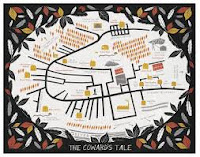
EB: Bloomsbury made you a lovely musical map of the town, which can be seen and heard here - and which also appears in the paperback edition. How concrete a map of the town did you have in your head as you wrote? There’s also a theme of maps in the novel: can you comment on the significance of the fact that Tutt Bevan the Undertaker is looking for a straight line through the town, a true line that maps, with their complicated boundaries, can’t tell?
VG: Bless the lovely Alice Shortland at Bloomsbury, who came up with the idea, and put my husband and I through our paces over a whole weekend, while I tried to draw the street pattern I remembered from my childhood stays in Merthyr, and he played the artist! Basically, no - I had no map. I just wandered in my memory down real streets, into real kitchens, front rooms,  back gardens and parks. But  the memories of childhood places are shifted by time, aren’t they, and by competing memories. So in the end I put a note in the back to that effect. “I have moved mountains, I have shifted your streets,” basically - in case anyone got upset at what I’d done to their town.

It’s hard to comment and explain what Tutt is doing - in a way, explanation deadens it, possibly? All I know is, his grandfather dealt with a death by going on a journey - and Tutt is perhaps dealing with his own coming twilight (literally, too, as his sight is weak...) by trying to do the same?
But also - specifically talking about Tutt’s journey, don’t we try to iron out all the twists and turns of life, to make things simpler for ourselves? Like Icarus, he sets himself an impossible task. At the end of that tale - there is an answer, again, although maybe not what he was expecting!

Following a map stops us taking unexpected detours and discovering new places... that’s so true. Look at Sat Nav - half the time I have no idea where I’ve just driven. I’ve just gone where I have been told.


TUNNEL:

EB:  The old railway tunnel is the scene of another disaster, the death of a child, but also in the end the scene of closure for the bereaved mother. The novel doesn’t shrink from darkness, yet is full of humour and in the end redemption. Can you talk a bit about this, and the role of story-telling in overcoming grief?

VG: Life is a glorious mix of light and dark, isn’t it? I have great faith in the strength of the human spirit to make the best of things - but sometimes, don’t we need a bit of help to do that, in the form of a mirror, metaphorically, so we can see ourselves and our situation reflected back at us?  Stories are that mirror. In stories,  as we learn about characters, don’t we also learn about ourselves?

I have read in many learned places how stories are important as they teach us to empathise with others. Without them, we become centred on self, perhaps - I like to think the airing of the stories in The Coward’s Tale is one way in which the community begins to understand itself, and takes a step towards healing itself.

Howzat for philosophy?

Elizabeth, its been great - thank you so much for hosting a stop on the tour, and thanks for such searching questions. 

EB: And thank you so much, Vanessa, for stopping by and giving us such great insights into the process behind your very distinctive and moving novel.

Readers: do give yourselves a treat and read The Coward's Tale if you haven't already. And Bloomsbury are offering a free copy for one lucky winner: just say in the comments below if you'd like to be put in the draw.
If you don't win, or can't wait, it can be ordered from here.

The previous stop on Vanessa's tour was over on Jen Campbell's blog, and tomorrow she will be with Charles Lambert discussing the novel's story of a same-sex love and its theme of the elusive question of human happiness. Details of the complete tour can be found here).

Thursday, March 15, 2012

Reading group: Generation X by Douglas Coupland

This meeting was another near-fight.

Jenny chose this iconic early-nineties novel about a group of three educated late-twenties escapees from corporate life, Andy, Dag and Claire, looking for a deeper meaning while working at 'McJobs' in California and telling each other stories that reflect their frustrations, fears and longings.

As soon as I arrived in the already full room I was aware of an attitude of contempt, and Mark said straight off that he hadn't read the book as it was clear from the blurb that it was self-indulgent and he found the format pretentious - he had the early square format edition in which illustrations and, in my opinion, wittily ironic definitions of contemporary phrases are situated in wide margins at strategic points in the text. He said he even found the typeface pretentious and unreadable.

Notwithstanding, Jenny then introduced the book and said that she had enjoyed it, that she saw that it was about anomie, but that there wasn't actually much of a story in that nothing much happened, so she didn't really have a lot to say about it, and that what she liked most of all were the footnotes (which is how the definitions appear in her later edition).

I said, isn't the book more specifically about the fact that these young people have inherited a soulless materialistic world which makes it difficult for them to fulfil themselves?,  a comment which was met with derision by those who hadn't even read the book. Pretty annoyed at having to defend the characters, and the book, against such opinionated condemnation from people who hadn't even read it, I said that I had found the characters touching, especially in their relationships: they were a platonic friendship group (of two men and one woman) who cared for each other in a touching way. Yes, said Clare, who had read the book: They snuggle up together in a hippy-dippy way - making it clear that she wasn't enamoured of the characters either, and eliciting vindicated groans from the others. I had praised the narrative voices of the characters as astute and witty - I loved for instance the description of Toronto as giving 'the efficient, ordered feeling of the Yellow Pages sprung to life in three dimensions' - but Clare said that she had found the voices slick and the characters consequently smug. I said but surely, as well as being ironic about the world around them, narrator Andy is self-ironic. It's best evidenced, I think, in this 'footnote' which however I didn't quote at the time: 'KNEE-JERK IRONY: The tendency to make flippant ironic comments as a reflexive matter of course in everyday conversation'. Clare said that she really wasn't sure that there was self-irony. She said that the characters and their attitudes reminded her very much of those in Dave Eggers' A Heartbreaking Work of Staggering Genius (discussed previously) which she had also disliked - but which I had admired. It turned out too that Doug, who had also read the book, couldn't relate at all to the characters and had found them unengaging.

There was much derision about the fact that the characters drop out of supposedly soul-destroying yuppie jobs only to get 'McJobs', working in shops and bars, which are hardly more fulfilling! Even Clare defended the characters on this, saying that the point is that they are no longer defined by their unfulfilling jobs, but that didn't wash with the detractors: surely, the answer came, they are just messing about, knowing that they can depend on their middle-class parents, so they are hardly rebelling against their parents' generation. And they go home for Christmas!! Only middle-class people can afford to drop out, it was cried. Ann, had, like me, liked the prose and especially the 'footnotes', but did now agree with the detractors that the characters' situations were something of a middle-class indulgence. In fact, there is a 'footnote' which comments on this, self-ironically in my opinion, but I didn't recall it during the discussion:  'SAFETY NET-ISM: The belief that there will always be a financial and emotional safety net to buffer life's hurts. Usually parents.' There was more derision about the fact that the characters choose to do their dropping-out in California. I should have quoted a passage from near the beginning which I think carries conscious irony about the compromise involved. Noting the lordly luxuries of the rich retired inhabitants of the area, narrator Andy says,  
 Nevertheless, the three of us chose to live here, [that, surely, is self-ironic, even potentially straightforwardly self-critical] for the town is undoubtedly a sanctuary from the bulk of middle-class life. And we certainly don't live in one of the dishier neighborhoods. There are neighborhoods here where, if you see a glint in a patch of crew-cut Bermuda grass, you can assume there's a silver dollar lying there. Where we live, in our little bungalows that share a courtyard and a kidney-shaped swimming pool [more self-irony, surely?], a twinkle in the grass means a broken scotch bottle or a colostomy bag that has avoided the trashman's gloved clutch. 
But in a discussion in which people arguing vociferously and dismissively hadn't even read the book, such textual focusing was hardly possible. I did say that what we hadn't discussed were the vivid descriptions of the detritus filling the environment - notably, as John pointed out, the fact that as the book opens Andy is clearing from his dogs' nostrils a fatty substance that he suspects is from the bins of the nearby liposuction clinic. Those who had read the book now cried with recognition and agreement, but I'm not sure if I got my point across, ie that what's indicated by these descriptions is that these young people have inherited a mess of a world not of their own making.

I said, maybe in the wider context the ability to choose to try, at least, to 'drop out' from it is a middle-class privilege and the doing so therefore a middle-class indulgence, but that didn't mean you could characterise these three young people as simply personally self-indulgent: they were thoughtful, and concerned with the conundrum of it all, and also suffering. In a more thoughtful and measured discussion I might have been able to draw attention this early passage:
We live small lives on the periphery; we are marginalised and there's a great deal in which we choose not to participate. We wanted silence and we have that silence now. [An ironic sentence, that last, I'd suggest: the silence isn't exactly unproblematic.] We arrived here speckled in sores and zits, our colons so tied in knots that we never thought we'd have a bowel movement again. Our systems had stopped working, jammed with the odor of copy machines, Wite-Out, the smell of bond paper, and the endless stress of pointless jobs done grudgingly to little applause. We had compulsions that made us confuse shopping with creativity, to take downers and assume that merely renting a video on a Saturday night was enough. But now that we live here in the desert, things are much, much better.
The overprotestation of that final repetition and stress carry especial conscious irony, I'd say.

Mark said that it was all well and good to complain about the state of the world but the book doesn't provide any answer (not that he'd read it), and then we had a skirmish about whether or not novels need to provide answers, which Mark insisted they do. Some people referred to fact that the trio finally go off to Mexico with the notion of starting a hotel, and Mark's derision quadrupled: another kind of running away!! And in order to run a hotel, he objected, wouldn't they end up needing the very structures (accountants etc) they were supposed to despise?! People told him, no it's not that kind of hotel, the characters say they wouldn't charge for rooms: it's just a kind of idealistic dream really; and Mark's derision went through the roof. Backed by John, I said, yes, it's flakey, but that's the point: the book is about the fact that if you can't face the structures society endorses - you're unsuited to them or you disapprove of them - then there aren't really any other very viable options. John brought in the question of the situation for artists, which I thought confused the issue, but Jo, who up to this point had been a detractor, took up his point and agreed that there are certain jobs in our society that are rewarded and others, including artistic endeavour, that tend not to be. To some extent this did back up my point, but, I said, the characters here are not artists, and so don't even have the compensation of artistic fulfilment. Having rejected the endorsed structures they have nothing (just that 'silence'). I said, surely that's a legitimate subject for a novel - ie the fact that there aren't any answers - and several people agreed. Mark said, well, in any case the characters were unlikeable, and now we had that other old skirmish about whether or not you need to find characters likeable in order to like a novel, Mark insisting - I'm damn sure for the sake of argument! - that you did, until John brought in Jane Austen and Vanity Fair with their unlikeable but endlessly interesting characters. But then Clare said that she simply hadn't found these characters or their situation, or indeed the book, interesting.

Earlier, in response to the initial accusations of superficiality, John had pointed to the frequent apocalyptic references in the novel: it begins with Andy remembering seeing the eclipse of the sun at the age of fifteen, and Dag is fascinated by the nuclear test sites in Nevada and brings back from there melted sand which terrifies Claire in case it's still radioactive. Their dreams and stories are full of death and nuclear annihilation. Towards the end Andy sees the smoke from farmers burning their fields and thinks it's the fulfilment of his nightmare, a nuclear cloud. Trevor now spoke up at last and said with a great air of reason and calm, which at long last made people shut up and stop interrupting, that in his opinion this book, far from being superficial, was about very serious, important and current matters: the ruination of the world and the wastage of the lives of future generations through environmental pollution, financial collapse and nuclear threat.

Mark, however, was intransigent and went on pooh-poohing the book while the conversation broke up and people began to talk about other things. Ann, Clare and I happened to be sitting together around one corner and the three of us continued talking about the book, and I had what I felt was my first proper and thoughtful conversation of the evening. Clare is a brilliant one for stopping and searching through the text to examine the truth of points that are made in the conversation (I'm hopeless at it at the time, as I find myself swept on by the conversation and the interruptions). In response to the points about death and the apocalyptic, she had remembered Andy's dream about his own death - which I hadn't remembered - and she had been looking for it in the text. She now found it and reminded us that in it a pelican gives him a fish, and she now related this to the end of the novel when he and a party of other travellers are standing watching the nuclear-cloud-like smoke from the fields. An egret flies over, so low that it sears the top of his head, and a party of children with learning disabilities come over and touch him and hug him to comfort him, and this is precisely how the book ends. It's as if, she said, the book is about Andy's search among all the superficiality and cleverness and harshness of the world for simple human comfort, and this then seemed true to Ann and me. The only trouble was, she said, that she hadn't liked the slick voices - which I had earlier pointed out were really one voice, the characters all tending to talk the same. This last I acknowledged as a flaw in the book, and which perhaps to some extent justifies Mark's conflation of the author and the characters. Nevertheless, Ann and I said that we had been really taken with the wit of that voice, but I did concede that the cleverness of the voice itself was in danger of making the book seem more superficial than I considered it to be.


Our archive discussions can be found here and a list of the books we have discussed, with links to the discussions, here