It's great to support your writer friends, isn't it? Hm...
I've had a stinking fluey cold, which is why I haven't even been writing my blog, but last night I felt better, which meant, Great: having missed Nick Royle's launch during the Literature Festival, I could go to his reading with Conrad Williams in Didsbury Library. I kind of knew Conrad, too: I'd met him once, though I couldn't remember where, London, I think, and now, it turned out when I got there, he had come to live round the corner from me.
Nick and Conrad both write stories 'on the dark side' - stories which touch on the surreal and on alternative realities - so this reading, the brainchild, I gathered, of the Manchester Libraries fiction buyer, was intended as a Halloween event. It was intended also as a test of the viability of a series of readings, though as a one-off receiving consequently minimal advertising, it was not expected to be full. Huh. It was packed! They had to bring extra chairs and people had to sit just outside the reading area...
Lucky me, I got there early, making it through the chilly wind and revelling in the fact that I was no longer sneezing and coughing, and got a seat slap-bang in the middle. Nick began, a chilling story about strange events in a lonely pub. Then Conrad: another short spooky story, followed by a longer, seemingly realistic story about a wedding. It was just as you realised that there was something ghostly happening - just when the tension racheted - when, oh no, my throat began to tickle, and the uncontrollable coughing began. Oh no, I'd have to leave, stand up right in the centre, distracting people just when the story was at its most tense, and I did, I walked out, and fled off down the library towards the foyer, whooping and spluttering in a way which the library ceiling seemed to hollow and exaggerate. And, oh no, here came a kind librarian with a cup of water - what a fuss I was causing! - and at last the coughing stopped, but only just in time for the break, and I'd missed the end of Conrad's story.
Worse - in the second half I sat near the edge in case it happened again, and it did, and those lovely librarians chased me with more water, and when that didn't work a sticky toffee, and when that didn't a Strepsil tablet.
How to ruin your friends' readings without even trying...
I don't really think I did, though: the audience seemed thrilled by the readings, and the fiction buyer said that the success of the evening meant that a series was definitely on the cards.
Friday, October 27, 2006


Monday, October 23, 2006
Rhyme or Reason
Yesterday I wrote on my other, critical blog about an article in the Observer by Jason Cowley on our current era of winners-past-the post cultural prizes. Afterwards I fell to thinking about the time I didn't actually win a glitzy prize but may as well have done, and got to experience how it felt.
The occasion was the Sony Radio awards. I had just had my first radio play, Rhyme or Reason, produced. One morning Robert Cooper, my producer, rang up and said that something wonderful had happened: my play had been nominated for the Best Production category, and Harriet Walter, who had played my protagonist, for Best Actress. I was invited to the dinner and ceremony at the Grosvenor Hotel, and since Harriet was in LA and wouldn't make it, would I collect her award if she won?
Crikey. Help. But yes!!! Yes!!
So off I went on the train, worrying about what I was wearing, worrying about getting up on that stage, rehearsing the speech I might have to make, almost shaking with nerves the whole way in fact, in through the doors of the hotel, down the stairs (behind Ned Sherrin, in fact) and into that vast ballroom filled with glittering tables. I'm not sure why I didn't actually faint.
And I couldn't sit with Robert, the only person there I knew; as a nominee (nominated for Best Production for two plays) he'd been placed at a table near the front, and I was stuck right at the back with a table of unnominated BBC employees. They had no idea of course who I was, and I was so small and black in my dress and my nervousness, so removed and silent in my agony (what if Harriet won?) that they clearly decided to leave me alone. I listened a little, understood that some of them were producers whose names I knew, but most of the time I blanked out. Needless to say, I hardly ate a thing.
Then the ceremony. I followed the programme, my heart going like a goose in a bag. 'Best Production.' Robert Cooper! 'Best Actress.' My heart flapped up my throat. 'Harriet Walter. Unfortunately, Harriet can't be here this afternoon, but the writer of the play, Elizabeth Baines, is here to collect her award for her.'
Funny things happen at moments like this. Not for nothing are they done in slow motion in films. That's exactly how they seem to happen. I stood, and in the space of what must have been only seconds - I had to get across that vast floor, between all those staggered tables - I saw in minute and leisurely detail the way the people at my table turned and looked at me in astonishment, the changing of their expressions to realisation and then delight.
In his article, Jason Cowley writes of how winning a prize can change someone's life as a writer, and it's true: even though I hadn't actually won a prize - it was Robert and Harriet who had won - in that moment I went like Alice through a hole into another dimension, out of literary anonymity into recognition, out from 'struggling' into 'established' and 'successful.'
That whole vast room clapping and cheering as somehow, remembering my performance skills, I got quickly across it. Jane Asher kissing me (she was presenting the prizes), then down off the stage to a barrage of flash bulbs. And back to the table and everyone there waiting to hug and kiss me. 'Congratulations!' they kept saying. 'But it's not me who's won!' I said. 'Rubbish!' said the woman with the long hair who had turned out to be the producer Enyd Williams. 'No one gets nominated for a play that isn't great!' 'It's your win too,' they kept telling me. 'Make sure you put it on your CV!'
And then they called me to go with them in their taxi for a celebration at the BBC.
And afterwards? Well, as a radio writer I was made. One unfortunate result was that Robert - Sony-award-winning radio producer - quickly moved off to TV and Dublin, but the prize made it easy for me to get another radio producer. 'Anything you write, I'll produce it!' said Sue Hogg, who did indeed produce my next play. (Though there came a time of course when BBC Radio embraced Marketing, and no producer could say such a thing.)
But you can't help thinking how much luck is involved. What if that play hadn't fallen into Robert's hands? I had entered it in a Radio Times competition, and it hadn't won that - wasn't even a runner-up - and it could have fallen into oblivion if someone running the competition hadn't made the decision to pass it to Robert. I could have taken it as a message that I couldn't do radio plays and abandoned the whole idea... What if Robert had been less ambitious, and hadn't bothered getting a well-known and respected actress to play the part (bound to get more serious attention then)? What if he'd been less good at marketing and hadn't created a series of linked plays of which my play was one (an innovation at the time, that got a lot of attention)? What if, what if... As various people have commented, not least Grumpy Old Bookman, people take prizes as serious measures, but there's much about them that's random and not a lot of rhyme or reason.
The occasion was the Sony Radio awards. I had just had my first radio play, Rhyme or Reason, produced. One morning Robert Cooper, my producer, rang up and said that something wonderful had happened: my play had been nominated for the Best Production category, and Harriet Walter, who had played my protagonist, for Best Actress. I was invited to the dinner and ceremony at the Grosvenor Hotel, and since Harriet was in LA and wouldn't make it, would I collect her award if she won?
Crikey. Help. But yes!!! Yes!!
So off I went on the train, worrying about what I was wearing, worrying about getting up on that stage, rehearsing the speech I might have to make, almost shaking with nerves the whole way in fact, in through the doors of the hotel, down the stairs (behind Ned Sherrin, in fact) and into that vast ballroom filled with glittering tables. I'm not sure why I didn't actually faint.
And I couldn't sit with Robert, the only person there I knew; as a nominee (nominated for Best Production for two plays) he'd been placed at a table near the front, and I was stuck right at the back with a table of unnominated BBC employees. They had no idea of course who I was, and I was so small and black in my dress and my nervousness, so removed and silent in my agony (what if Harriet won?) that they clearly decided to leave me alone. I listened a little, understood that some of them were producers whose names I knew, but most of the time I blanked out. Needless to say, I hardly ate a thing.
Then the ceremony. I followed the programme, my heart going like a goose in a bag. 'Best Production.' Robert Cooper! 'Best Actress.' My heart flapped up my throat. 'Harriet Walter. Unfortunately, Harriet can't be here this afternoon, but the writer of the play, Elizabeth Baines, is here to collect her award for her.'
Funny things happen at moments like this. Not for nothing are they done in slow motion in films. That's exactly how they seem to happen. I stood, and in the space of what must have been only seconds - I had to get across that vast floor, between all those staggered tables - I saw in minute and leisurely detail the way the people at my table turned and looked at me in astonishment, the changing of their expressions to realisation and then delight.
In his article, Jason Cowley writes of how winning a prize can change someone's life as a writer, and it's true: even though I hadn't actually won a prize - it was Robert and Harriet who had won - in that moment I went like Alice through a hole into another dimension, out of literary anonymity into recognition, out from 'struggling' into 'established' and 'successful.'
That whole vast room clapping and cheering as somehow, remembering my performance skills, I got quickly across it. Jane Asher kissing me (she was presenting the prizes), then down off the stage to a barrage of flash bulbs. And back to the table and everyone there waiting to hug and kiss me. 'Congratulations!' they kept saying. 'But it's not me who's won!' I said. 'Rubbish!' said the woman with the long hair who had turned out to be the producer Enyd Williams. 'No one gets nominated for a play that isn't great!' 'It's your win too,' they kept telling me. 'Make sure you put it on your CV!'
And then they called me to go with them in their taxi for a celebration at the BBC.
And afterwards? Well, as a radio writer I was made. One unfortunate result was that Robert - Sony-award-winning radio producer - quickly moved off to TV and Dublin, but the prize made it easy for me to get another radio producer. 'Anything you write, I'll produce it!' said Sue Hogg, who did indeed produce my next play. (Though there came a time of course when BBC Radio embraced Marketing, and no producer could say such a thing.)
But you can't help thinking how much luck is involved. What if that play hadn't fallen into Robert's hands? I had entered it in a Radio Times competition, and it hadn't won that - wasn't even a runner-up - and it could have fallen into oblivion if someone running the competition hadn't made the decision to pass it to Robert. I could have taken it as a message that I couldn't do radio plays and abandoned the whole idea... What if Robert had been less ambitious, and hadn't bothered getting a well-known and respected actress to play the part (bound to get more serious attention then)? What if he'd been less good at marketing and hadn't created a series of linked plays of which my play was one (an innovation at the time, that got a lot of attention)? What if, what if... As various people have commented, not least Grumpy Old Bookman, people take prizes as serious measures, but there's much about them that's random and not a lot of rhyme or reason.
Friday, October 20, 2006
Bitches and Chicks
Manchester Bitch-Lit event last night and Waterstone's packed out for it. This time I wasn't performing, but could sit back and enjoy: delicious performances from Rosie Lugosi, Chris Scholes and Sherry Ashworth.
The tour is over for me now, though there will yet be events in Newcastle, Leeds, York and London. It's been interesting to compare the different events and the different audiences and audience discussions. The 'Bitch-Lit' idea really seems to have struck a chord: events have sold out, with people placed on reserve lists or turned away. (If you still want to go but find it sold out, then reserve a place, because at Manchester some people who had booked failed to turn up - though you might need to turn up on the off-chance.)
In the book and at the readings editors Mary Sharratt and Maya Chowdhry have pointed out that generally in literature female protagonists are allowed to be less trangressive than male ones, or if they are transgressive they must be punished and/or realise the error of their ways. A condition for submissions to this book was that protagonists must not be punished for their behaviour, but must triumph in their transgression. The idea was to counter the censorship on women writers - that sense that you'd better make sure that, in some way at least, your female protagonist can be seen in a good light. The female heroes would be autonomous, answerable to no one, and thus an antidote to Chick-Lit, where your heroine is usually pathetically desperate to get her man (well, that's what they say - I've never read any Chick-Lit myself).
At Sheffield, and especially at Ilkley, you could see that the audiences, mainly female - there were only three men at Sheffield - were really taken by this. 'We're celebrating female badness!' said Mary at Ilkley, and many in the audience grinned and nodded. I have to say that I didn't feel entirely comfortable with this sentiment, though of course it was not completely serious, rather a provocation. I wouldn't exactly celebrate or condone my protagonist's behaviour, I'm simply inviting the reader to understand the extremes of behaviour to which her situation has driven her. At another point (in the book's introduction) Maya says that the women characters in the book are not victims 'lashing out in self-defence'. 'I don't intend to be a victim,' my protagonist says at one point, but it depends what you mean by a victim, and you could say that her act of revenge makes her one, a slave to her vengeful emotions, and as desperate, in a different way, as any Chick-Lit heroine, to get her man. As Suzanne Elvidge, another reader at Sheffield, said to me in the bar afterwards, several of our protagonists are indeed, in this sense, victims lashing out.
As I said, though, in the Q & A at Ilkley, the real difference with this book is that it blows a breath of fresh air over the taboo subject of female badness, and does this largely by reclaiming the word Bitch. As I said then, if we can't say a word then we can't begin to discuss the issues around it, but once you reclaim the word you can break the taboo, and begin to discuss the concept of female badness more rationally.
Most of us were agreed that there has been a real taboo. At Sheffield we were asked if we felt liberated by the book into censoring ourselves less when we write, and even Sophie Hannah said that she did. Sophie is one of the most straight-speaking and independent-minded women I know, and one of the most balloon-pricking of satirical writers, yet she said that it has made her more determined to resist editors' pleas to 'make her protagonists nicer' (and thus, in Sophie's opinion, less lifelike).
Interestingly, however, when I asked Rosie the same question in the Q & A last night, she said that she had been developing in that direction anyway in her writing, and Sherry said that she had never felt censored, even though she writes books for teenagers, an area in which language is inevitably strongly policed by editors. I suppose, however, it depends how far you are already censoring yourself, and Sherry did indeed admit that although she had never been troubled by the b-word, she still found herself shocked by the use of what she called the c-word, a fact which many of the Manchester audience may have found shocking in itself.
It was a different kind of audience last night in Manchester, much more mixed in age and gender. A nineteen-year-old student in a red bakerboy hat said that she felt we were perhaps making too much of it all, and it was the same on the English degree course she had just started, as soon as you get to a woman writer people start on about the feminism thing, it really didn't mean a lot to people of her age and it irritated her, and furthermore she read Chick-Lit and enjoyed it and didn't see anything wrong in it. She clearly felt that there wasn't an issue, as the editors were making out.
The fact remains, however, that when Mary went on Women's Hour to talk about the book, Jenny Murray avoided using that word, as did many of the writers who rang up to inquire about submitting...
The tour is over for me now, though there will yet be events in Newcastle, Leeds, York and London. It's been interesting to compare the different events and the different audiences and audience discussions. The 'Bitch-Lit' idea really seems to have struck a chord: events have sold out, with people placed on reserve lists or turned away. (If you still want to go but find it sold out, then reserve a place, because at Manchester some people who had booked failed to turn up - though you might need to turn up on the off-chance.)
In the book and at the readings editors Mary Sharratt and Maya Chowdhry have pointed out that generally in literature female protagonists are allowed to be less trangressive than male ones, or if they are transgressive they must be punished and/or realise the error of their ways. A condition for submissions to this book was that protagonists must not be punished for their behaviour, but must triumph in their transgression. The idea was to counter the censorship on women writers - that sense that you'd better make sure that, in some way at least, your female protagonist can be seen in a good light. The female heroes would be autonomous, answerable to no one, and thus an antidote to Chick-Lit, where your heroine is usually pathetically desperate to get her man (well, that's what they say - I've never read any Chick-Lit myself).
At Sheffield, and especially at Ilkley, you could see that the audiences, mainly female - there were only three men at Sheffield - were really taken by this. 'We're celebrating female badness!' said Mary at Ilkley, and many in the audience grinned and nodded. I have to say that I didn't feel entirely comfortable with this sentiment, though of course it was not completely serious, rather a provocation. I wouldn't exactly celebrate or condone my protagonist's behaviour, I'm simply inviting the reader to understand the extremes of behaviour to which her situation has driven her. At another point (in the book's introduction) Maya says that the women characters in the book are not victims 'lashing out in self-defence'. 'I don't intend to be a victim,' my protagonist says at one point, but it depends what you mean by a victim, and you could say that her act of revenge makes her one, a slave to her vengeful emotions, and as desperate, in a different way, as any Chick-Lit heroine, to get her man. As Suzanne Elvidge, another reader at Sheffield, said to me in the bar afterwards, several of our protagonists are indeed, in this sense, victims lashing out.
As I said, though, in the Q & A at Ilkley, the real difference with this book is that it blows a breath of fresh air over the taboo subject of female badness, and does this largely by reclaiming the word Bitch. As I said then, if we can't say a word then we can't begin to discuss the issues around it, but once you reclaim the word you can break the taboo, and begin to discuss the concept of female badness more rationally.
Most of us were agreed that there has been a real taboo. At Sheffield we were asked if we felt liberated by the book into censoring ourselves less when we write, and even Sophie Hannah said that she did. Sophie is one of the most straight-speaking and independent-minded women I know, and one of the most balloon-pricking of satirical writers, yet she said that it has made her more determined to resist editors' pleas to 'make her protagonists nicer' (and thus, in Sophie's opinion, less lifelike).
Interestingly, however, when I asked Rosie the same question in the Q & A last night, she said that she had been developing in that direction anyway in her writing, and Sherry said that she had never felt censored, even though she writes books for teenagers, an area in which language is inevitably strongly policed by editors. I suppose, however, it depends how far you are already censoring yourself, and Sherry did indeed admit that although she had never been troubled by the b-word, she still found herself shocked by the use of what she called the c-word, a fact which many of the Manchester audience may have found shocking in itself.
It was a different kind of audience last night in Manchester, much more mixed in age and gender. A nineteen-year-old student in a red bakerboy hat said that she felt we were perhaps making too much of it all, and it was the same on the English degree course she had just started, as soon as you get to a woman writer people start on about the feminism thing, it really didn't mean a lot to people of her age and it irritated her, and furthermore she read Chick-Lit and enjoyed it and didn't see anything wrong in it. She clearly felt that there wasn't an issue, as the editors were making out.
The fact remains, however, that when Mary went on Women's Hour to talk about the book, Jenny Murray avoided using that word, as did many of the writers who rang up to inquire about submitting...
Wednesday, October 18, 2006
Bollards, fences and boxes
When you're doing a reading, always turn up early.
Yeah, right.
Bitch-Lit reading in Sheffield yesterday evening. 7.30 start, plan to get there an hour beforehand to change into costume and check out the venue, so leave at five for the one-and-a-half hour drive. Oh-oh. Traffic blocked at Glossop. At 6.30, when I'm meant to be there, we're still scooping round those scary bends between darkening misty hills, not a city light in sight. 6.40, we hit the outskirts, zoom downwards to the centre only to find what no one has warned us about: the roads around it are completely dug up, it's all bollards and diversions, hardly any lights or signs, and no one around - why not? - it's like the surface of the moon, the dark side. We're going round in circles, and now we seem to be driving away from the centre again... One lone man walking. I wind down the window. 'We're looking for the station!' He scratches his head, not sure how we'd get there with all these altered directions... Another: with all these altered directions, he's not even sure any more in which direction it actually is. It's seven o' clock now. John's driving, so I rummage in my bag, thinking I should change in the car, but then find I don't have the room. Two young girls, about twelve and ten. 'Know where the station is?' 'Oh yes! Well... erm... MUM!' they scream up to a window above the shops. The window opens. 'Mum, where's the station?' The woman starts yelling down instructions we can't hear.
It's 7.10 when we get to the back of the station which we know is opposite the venue, the Showroom Cinema. 'Stop! I'll run from here!' I grab my bags and costume and jump from the car, my skirt dropping from the hanger onto the pot-holed ground. Snatch it up, run through the dark round the side of the station car park, stumbling over potholes, only to come to a high workman's fence and be diverted a very long way round. It's 7.15, when I finally reach the steps of the Cinema Showroom. I fling myself, breathless, onto the box-office desk. 'To the stairs and then left,' I am told. I race down the stairs. There's no left turn... I race back up. 'Where's showroom 5?' I call to an usher. Oh, he meant past the stairs and turn left!
Everyone else is ready and waiting. So where can I change? Not in an office as they'd vaguely suggested we might, but in the loo... Great. Race to the loo. Can't paint my bitch lips on, must have dropped my makeup bag when I rummaged in the car...
I emerge with my arms full of bags, coat, clothes and a coathanger to find the audience already being seated. Where can I put them? Under that table there, I'm told, which I must squash past the legs of the audience to get to. So much for making an impact as your character...
And the setup, which I'd come too late to have a say in? A lectern with a mic we didn't really need, and which would hide our carefully planned costumes. And each side of it and a little behind it, two chairs for the readers, which meant that in the long room where the seating was arranged horizontally, each pair of readers was hidden from half of the audience. And as for the Q & A session: well, I tell you, it's amazing the rapport we achieved with our sell-out audience from behind a big blue box!
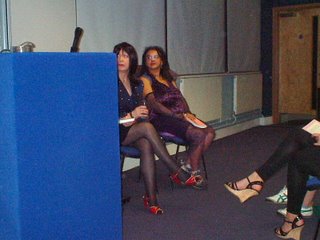
Here Maya Chowdhry and I are trying to converse around the lectern with the other two readers:
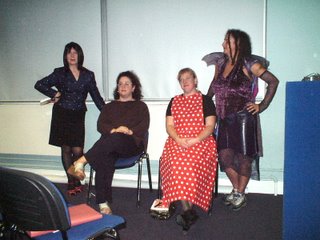
And here we are at last released from the box [From left to right: me in my wig and dressed as my avenging wife character, Sophie Hannah as herself (because, as she told the audience, she is her character), Suzanne Elvidge as her avenging cook, and Maya Chowdhry as a fairy punk]
Yeah, right.
Bitch-Lit reading in Sheffield yesterday evening. 7.30 start, plan to get there an hour beforehand to change into costume and check out the venue, so leave at five for the one-and-a-half hour drive. Oh-oh. Traffic blocked at Glossop. At 6.30, when I'm meant to be there, we're still scooping round those scary bends between darkening misty hills, not a city light in sight. 6.40, we hit the outskirts, zoom downwards to the centre only to find what no one has warned us about: the roads around it are completely dug up, it's all bollards and diversions, hardly any lights or signs, and no one around - why not? - it's like the surface of the moon, the dark side. We're going round in circles, and now we seem to be driving away from the centre again... One lone man walking. I wind down the window. 'We're looking for the station!' He scratches his head, not sure how we'd get there with all these altered directions... Another: with all these altered directions, he's not even sure any more in which direction it actually is. It's seven o' clock now. John's driving, so I rummage in my bag, thinking I should change in the car, but then find I don't have the room. Two young girls, about twelve and ten. 'Know where the station is?' 'Oh yes! Well... erm... MUM!' they scream up to a window above the shops. The window opens. 'Mum, where's the station?' The woman starts yelling down instructions we can't hear.
It's 7.10 when we get to the back of the station which we know is opposite the venue, the Showroom Cinema. 'Stop! I'll run from here!' I grab my bags and costume and jump from the car, my skirt dropping from the hanger onto the pot-holed ground. Snatch it up, run through the dark round the side of the station car park, stumbling over potholes, only to come to a high workman's fence and be diverted a very long way round. It's 7.15, when I finally reach the steps of the Cinema Showroom. I fling myself, breathless, onto the box-office desk. 'To the stairs and then left,' I am told. I race down the stairs. There's no left turn... I race back up. 'Where's showroom 5?' I call to an usher. Oh, he meant past the stairs and turn left!
Everyone else is ready and waiting. So where can I change? Not in an office as they'd vaguely suggested we might, but in the loo... Great. Race to the loo. Can't paint my bitch lips on, must have dropped my makeup bag when I rummaged in the car...
I emerge with my arms full of bags, coat, clothes and a coathanger to find the audience already being seated. Where can I put them? Under that table there, I'm told, which I must squash past the legs of the audience to get to. So much for making an impact as your character...
And the setup, which I'd come too late to have a say in? A lectern with a mic we didn't really need, and which would hide our carefully planned costumes. And each side of it and a little behind it, two chairs for the readers, which meant that in the long room where the seating was arranged horizontally, each pair of readers was hidden from half of the audience. And as for the Q & A session: well, I tell you, it's amazing the rapport we achieved with our sell-out audience from behind a big blue box!
Here Maya Chowdhry and I are trying to converse around the lectern with the other two readers:
And here we are at last released from the box [From left to right: me in my wig and dressed as my avenging wife character, Sophie Hannah as herself (because, as she told the audience, she is her character), Suzanne Elvidge as her avenging cook, and Maya Chowdhry as a fairy punk]
Sunday, October 15, 2006
From the sublime to the wicked
Yesterday I went to the talk by Murat Belge in St Ann's Church - an event I found quite mind-blowing, and which I've written about on my other blog where I try to tackle the more serious matters.
Afterwards I wandered a bit gloomily, musing how in Britain we just don't value serious literature any more, when we damn well ought to: after all, the issues Belge was talking about, and in the novels he publishes by Nobel-Prize winning Orhan Pamuk, are even now being played out in Britain, not least in the current comments by British politicians about the veil.
And then I went into Waterstone's and found something to cheer me right up: there in the anthology section was Bitch-Lit, our light-hearted anthology with nevertheless a pretty serious point, turned out in all its bright-pink glory. Not only that, someone was reaching up to look at a copy! I tip-toed away, thinking, Good Old Waterstones, and Three Cheers for our lovely publisher Cathy Bolton at Commonword!!
Afterwards I wandered a bit gloomily, musing how in Britain we just don't value serious literature any more, when we damn well ought to: after all, the issues Belge was talking about, and in the novels he publishes by Nobel-Prize winning Orhan Pamuk, are even now being played out in Britain, not least in the current comments by British politicians about the veil.
And then I went into Waterstone's and found something to cheer me right up: there in the anthology section was Bitch-Lit, our light-hearted anthology with nevertheless a pretty serious point, turned out in all its bright-pink glory. Not only that, someone was reaching up to look at a copy! I tip-toed away, thinking, Good Old Waterstones, and Three Cheers for our lovely publisher Cathy Bolton at Commonword!!
Saturday, October 14, 2006
Salt added
Yesterday afternoon I'm waiting to cross the road to get to the fish shop and over the other side, waiting to cross in the opposite direction, is Steve Waling, poet and editor of poetry magazine Brando's Hat. He waits for me, looking somehow calm, beatific yet excited... What's cooking, I wonder? When I get there he gives me this exciting news: he has a poetry collection coming from Salt. No wonder he looks like the cat that got the salmon! There is nothing so wonderful, so heart-warming as the joy of a writer who, after years of working away, has achieved success (just look at Marie Phillips' blog recently)! And this small press, Salt, seems to have come from nowhere to become a hugely respected force in publishing in a very short time. Another reason for writers not to give up in the face of the more commercial trends in publishing...
Friday, October 13, 2006
One reason to turn to drink
Reading group last night, and another useful illustration for the writer of how differently people read and the different criteria they apply. 'Brilliant,' said Mark about our choice for discussion, Truman Capote's In Cold Blood. 'Really clever marriage between journalistic and novelistic forms. The objectivity means there's a lack of sensationalism, prurience or moralising, yet it's a compulsive read, you just can't put it down.' Others differed. 'Afraid I struggled with it,' said Doug. Doug and others felt that the marriage didn't work, and that the book did in fact at times induce a prurient reaction on the reader.
See? You hone your prose, you think carefully about your structure and its effect on the reader, and then a load of crisp-chewing, wine-guzzling punters casually bring to your book their own preconceptions and taste and experience...
Ah well.
See? You hone your prose, you think carefully about your structure and its effect on the reader, and then a load of crisp-chewing, wine-guzzling punters casually bring to your book their own preconceptions and taste and experience...
Ah well.
Wednesday, October 11, 2006
Manchester Literature Festival
The Manchester Literature Festival, conceived by outgoing director Chris Gribble and built on the foundations of the Manchester Poetry Festival, kicks off on Thursday, and it looks pretty exciting. I'll be sorry to miss William Boyd that day, as I'm already committed to my reading group, but I'm looking forward to the Amnesty International event on Freedom of Expression in St Ann's Church on Saturday afternoon and to Sebastian Barry at the University of Manchester at six on Monday. Sometimes as a writer you JUST DON'T GET OUT, but I've got an embarrassment of choices later on Monday evening: free tickets to a rarely-performed Tennessee Williams play at the Library Theatre, cult artist and musician Ed Barton reading his poetry at Matt and Phred's, or the Manchester Blog Awards at Urbis. How on earth can I choose? Maybe I'll get a migraine trying...
I'm extremely sorry to be missing the launch of novelist Nick Royle's first short story collection at Matt and Phred's on Tuesday, not least because we published him in metropolitan, but that night I'll be doing the Sheffield Bitch-Lit event. Apparently, to our great delight, the Manchester Bitch-Lit event at Waterstone's on Thursday has long been booked out. Sharon Olds at Manchester Museum on Wednesday is a must-see, I'd say, as well as the 'Celebrating Burgess' event at the Whitworth Gallery on Friday, and the exciting festival-within-a-festival of Palestinian literature and the Decapolis European short story events.
I'm extremely sorry to be missing the launch of novelist Nick Royle's first short story collection at Matt and Phred's on Tuesday, not least because we published him in metropolitan, but that night I'll be doing the Sheffield Bitch-Lit event. Apparently, to our great delight, the Manchester Bitch-Lit event at Waterstone's on Thursday has long been booked out. Sharon Olds at Manchester Museum on Wednesday is a must-see, I'd say, as well as the 'Celebrating Burgess' event at the Whitworth Gallery on Friday, and the exciting festival-within-a-festival of Palestinian literature and the Decapolis European short story events.
Saturday, October 07, 2006
A schizoid moment
What do you do when your relatives decide to come to one of your readings? Bite the bullet, I guess: thank the lord they support you in your mad life's endeavour and hold no grudges about the way you've unfairly portrayed them, decide not to care about the clash between your carefully honed writer's persona and the real embarrassing you they could let slip in flash, and when the night comes shut your mind to the fact that they know precisely which bits of the piece you're reading are autobiographical, and can transmit this to the rest of the audience with their knowing, readier laughs.
My mum rings me: 'We're coming to the Sheffield Bitch-Lit reading.' Eek. 'But we've got this problem. We tried to book, but they told us because we're relatives we'd get complimentary tickets.'
They told them they were my relatives? (Like proud parents or something?!!)
'And they said you'd know all about it and would sort it out.'
Ohmigod. I know nothing. I want to know nothing... 'OK.'
I ring the festival box office, apologetic, foolish. 'Oh, that's fine!' they tell me. 'Yes, your mother and your sister: we've already put two comps aside!'
I feel just like when I was in the school play...
My mum rings me: 'We're coming to the Sheffield Bitch-Lit reading.' Eek. 'But we've got this problem. We tried to book, but they told us because we're relatives we'd get complimentary tickets.'
They told them they were my relatives? (Like proud parents or something?!!)
'And they said you'd know all about it and would sort it out.'
Ohmigod. I know nothing. I want to know nothing... 'OK.'
I ring the festival box office, apologetic, foolish. 'Oh, that's fine!' they tell me. 'Yes, your mother and your sister: we've already put two comps aside!'
I feel just like when I was in the school play...
Sunday, October 01, 2006
There's never not a hitch...
Forget your posh pens or your slick laptops: a writer's best equipment is a damned good sense of humour.
Yesterday we kicked off the Bitch-Lit tour. Drive from Manchester to Ilkley, leave in plenty of time, but the traffic is dire, backed up for miles, and I know others are cutting it finer. Will they make it? Will the folk of Ilkley miss out on the revelation of a row of bitches bitching? And what about the parking? Lucky for me, there's a space right outside the Ilkley Playhouse where we're performing. Grab costume and bags, rush in to find Mary Sharrat our editor there already, and I no longer need my sense of humour: lovely ladies ply us with cups of tea and a bottle of wine (before a performance?) and lead us up to a plush green-room with glorious mirrors and a big plate of fruit and enough hairspray, as Mary said, for Margaret Thatcher if she lived another forty years.
We're already changed when the others arrive in a breathless dash. 'Hi Mary,' they cry and fling their arms around her, but they don't speak to me, just glance at me uneasily. 'You bitches,' I say, and at last they see it's me beneath my wig and in my vamp's jacket and killer heels...
But there's no time for laughing, and in a very short while a sound engineeer who looks all of sixteen has excessively politely spoilt the line of our costumes by sticking mics up our jackets, and we're being led downstairs to the stage. The show begins, it's going well, and Cath Staincliffe is two minutes into her reading, the first. The door opens at the back and a tiny elderly woman in a sharp grey trouser suit bursts in. The usher jumps up to direct her to a seat near the back, but she booms that she has to sit at the front 'because I'm deaf', and, still booming over Cath, is led all the way to the front row.
Hitch over, the show seems to go well. The audience is a gift, laughing at all the right moments and very appreciative in the Q & A session afterwards. We're walking out to the foyer for the signing when I realise the hard-of-hearing lady is right in front of me. She turns and snaps at me: 'You want to invest in a microphone.' 'We had microphones, actually,' I tell her kindly and sympathetically, and then realise I might not be speaking up enough. She heard all right, though: 'Well, they didn't work.' She turns, scowling, to Mary who chaired the event: 'I didn't hear a thing and I'm demanding my money back.'
Hm. Everyone else seemed to enjoy it, however, and we sold a fair few books, the main point of the exercise, after all....
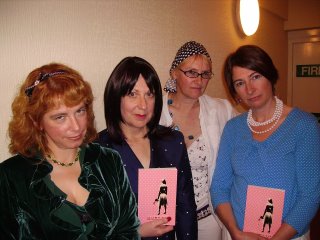 Four bitches, from left to right: Mary Sharratt, me in my wig, Char March and Cath Staincliffe
Yesterday we kicked off the Bitch-Lit tour. Drive from Manchester to Ilkley, leave in plenty of time, but the traffic is dire, backed up for miles, and I know others are cutting it finer. Will they make it? Will the folk of Ilkley miss out on the revelation of a row of bitches bitching? And what about the parking? Lucky for me, there's a space right outside the Ilkley Playhouse where we're performing. Grab costume and bags, rush in to find Mary Sharrat our editor there already, and I no longer need my sense of humour: lovely ladies ply us with cups of tea and a bottle of wine (before a performance?) and lead us up to a plush green-room with glorious mirrors and a big plate of fruit and enough hairspray, as Mary said, for Margaret Thatcher if she lived another forty years.
We're already changed when the others arrive in a breathless dash. 'Hi Mary,' they cry and fling their arms around her, but they don't speak to me, just glance at me uneasily. 'You bitches,' I say, and at last they see it's me beneath my wig and in my vamp's jacket and killer heels...
But there's no time for laughing, and in a very short while a sound engineeer who looks all of sixteen has excessively politely spoilt the line of our costumes by sticking mics up our jackets, and we're being led downstairs to the stage. The show begins, it's going well, and Cath Staincliffe is two minutes into her reading, the first. The door opens at the back and a tiny elderly woman in a sharp grey trouser suit bursts in. The usher jumps up to direct her to a seat near the back, but she booms that she has to sit at the front 'because I'm deaf', and, still booming over Cath, is led all the way to the front row.
Hitch over, the show seems to go well. The audience is a gift, laughing at all the right moments and very appreciative in the Q & A session afterwards. We're walking out to the foyer for the signing when I realise the hard-of-hearing lady is right in front of me. She turns and snaps at me: 'You want to invest in a microphone.' 'We had microphones, actually,' I tell her kindly and sympathetically, and then realise I might not be speaking up enough. She heard all right, though: 'Well, they didn't work.' She turns, scowling, to Mary who chaired the event: 'I didn't hear a thing and I'm demanding my money back.'
Hm. Everyone else seemed to enjoy it, however, and we sold a fair few books, the main point of the exercise, after all....
 Four bitches, from left to right: Mary Sharratt, me in my wig, Char March and Cath Staincliffe
Friday, September 29, 2006
Those literary dos...
To London on Wednesday to attend the Writers' Inc Competition winners evening and collect an award for my short story Compass and Torch. Well, it's only a commendatory award, I'm only in effect a runner-up: is it really worth the fuss of travelling all that way and forcing my hosts out of their bed and onto the living-room sofa bed? Well, the thing is, of course, you just never know... And what shall I wear? I've no idea what kind of do it's likely to be. Better not wear my black trousers and waiter's waistcoat from Afflecks Palace - last time I wore them to London I was waiting for friends at the door of a private view and several people came up to me with a formal 'Good evening' and waited to be shown where to go and handed champagne.
My hosts come with me - they might get a drink out of it for their pains - and we stroll up from Shoreditch to the Barbican library, and sure enough, there's wine waiting. 'Network!' they remind me, but I don't know a soul in the room... and there's no time, anyway: the proceedings are about to begin, and what's this? Turns out it's to be a whole evening of readings, and my hosts are artists, not writers: will they cope?
Turns out they do. Turns out they're downright fascinated. 'We're not used to this,' they tell me: 'the nakedness of the writer-artist out there presenting his/her work on such a personal level.' Crikey. And then in the break they have a big discussion about the fact that competition judge and Writers Inc resident poet Mario Petrucci is introducing us with flattering summaries of our pieces. 'Wouldn't happen in the art world,' they tell me: 'someone else deconstructing an artist's work in front of the artist without reference to him/her.' Blimey.
Then it's the second half, time for the short-story section of the evening, culminating with the winner reading his brilliant story. Turns out he's not only the man in the specs and stripey shirt and trainers whose wine glass I nearly knocked out of his hand, but Michael Carson, whose name I know well from literary magazines. As I'm talking to him afterwards, a woman in a red jacket comes up to me: 'You're Elizabeth Baines! I had no idea until you went up to get your prize...' And who is she? The poet Katherine Gallagher whose poetry I've been reading for years...
'Finished your speed networking?' ask my hosts as I join them at last in the foyer. 'Right, we're hungry, let's go and spend your cheque!'
Definitely worth it after all.
My hosts come with me - they might get a drink out of it for their pains - and we stroll up from Shoreditch to the Barbican library, and sure enough, there's wine waiting. 'Network!' they remind me, but I don't know a soul in the room... and there's no time, anyway: the proceedings are about to begin, and what's this? Turns out it's to be a whole evening of readings, and my hosts are artists, not writers: will they cope?
Turns out they do. Turns out they're downright fascinated. 'We're not used to this,' they tell me: 'the nakedness of the writer-artist out there presenting his/her work on such a personal level.' Crikey. And then in the break they have a big discussion about the fact that competition judge and Writers Inc resident poet Mario Petrucci is introducing us with flattering summaries of our pieces. 'Wouldn't happen in the art world,' they tell me: 'someone else deconstructing an artist's work in front of the artist without reference to him/her.' Blimey.
Then it's the second half, time for the short-story section of the evening, culminating with the winner reading his brilliant story. Turns out he's not only the man in the specs and stripey shirt and trainers whose wine glass I nearly knocked out of his hand, but Michael Carson, whose name I know well from literary magazines. As I'm talking to him afterwards, a woman in a red jacket comes up to me: 'You're Elizabeth Baines! I had no idea until you went up to get your prize...' And who is she? The poet Katherine Gallagher whose poetry I've been reading for years...
'Finished your speed networking?' ask my hosts as I join them at last in the foyer. 'Right, we're hungry, let's go and spend your cheque!'
Definitely worth it after all.
Monday, September 25, 2006
The things writers suffer...
In March I get an email from an editor: would I like to contribute to a book of 300-word short stories? There's no payment, all royalties will go to a charity, but the book will include several well-known names and be published by a named established publisher. Now I'm not that flattered: the editor has been given my name by another writer, so he may never have heard of me, and it's clear he's going to need a lot of contributors to fill up his book. Still, I'm glad I've been asked, and I sit down and write a story - and it's not that easy, actually, writing such a short story - and email it off, and the editor gets back to say he likes it a lot. It does strike me that it's all very casual, and no contract or anything. But still...
At the end of July I meet a friend who was also accepted, and she says, 'We've heard nothing, even though he promised he'd be in touch by now about the charity. Do you think it's all alright?'
'Yes of course!' I cried. 'These things always take time!' 'And, actually,' she says, 'it's annoying, isn't it, that the story could have been 600 words after all?' What? Why did I not hear about that? Well, she didn't either, actually, or not from the editor, but from another contributor...
A couple of weeks ago we still hadn't heard anything about the charity, so I looked the editor up on the web. I was surprised to find that the book was no longer to be published by the established publisher but a new imprint... Why on earth hadn't he informed us? Still, I went and changed the name of the publisher on my web site...
Then last week my friend emailed me. She had heard through a third party that she had been dropped from the anthology! She contacted the editor and was told that, due to the change of publisher 'her story no longer fitted'. So today I emailed the editor and asked what was going on. Guess what, I too had been dropped 'because my story no longer fitted'.
Here's the lesson. However professional a writer you are, don't ever assume you'll get treated professionally. And never sit down and write something for a project you haven't thoroughly checked out.
At the end of July I meet a friend who was also accepted, and she says, 'We've heard nothing, even though he promised he'd be in touch by now about the charity. Do you think it's all alright?'
'Yes of course!' I cried. 'These things always take time!' 'And, actually,' she says, 'it's annoying, isn't it, that the story could have been 600 words after all?' What? Why did I not hear about that? Well, she didn't either, actually, or not from the editor, but from another contributor...
A couple of weeks ago we still hadn't heard anything about the charity, so I looked the editor up on the web. I was surprised to find that the book was no longer to be published by the established publisher but a new imprint... Why on earth hadn't he informed us? Still, I went and changed the name of the publisher on my web site...
Then last week my friend emailed me. She had heard through a third party that she had been dropped from the anthology! She contacted the editor and was told that, due to the change of publisher 'her story no longer fitted'. So today I emailed the editor and asked what was going on. Guess what, I too had been dropped 'because my story no longer fitted'.
Here's the lesson. However professional a writer you are, don't ever assume you'll get treated professionally. And never sit down and write something for a project you haven't thoroughly checked out.
Saturday, September 16, 2006
Writers reading
Since writers are so often called on to read their work out loud, it's worth learning to do this well. It shouldn't matter, but it does: a reading can sometimes have quite the opposite effect to that intended by the publisher. I have nodded off in many a Waterstone's reading by an acclaimed writer, and been unfairly put off their book.
The Bitch-Lit publishers are sparing nothing to help us out in this respect, and we had another rehearsal yesterday afternoon with Contact Theatre's Cheryl Martin. Actually, everyone taking part in the tour reads really well, but Cheryl helped us finesse things, pointing out when people were swaying on the spot (and likely to make the audience sea-sick), or where we could leave a longer beat for effect, or where certain passages might benefit from a subtle change of pace.
It's a completely new experience for me: I'm accustomed to practising in private and with no idea of what other contributing writers will be reading or how my piece will play out against theirs, and without knowing beforehand the running order or even often the basic format. Yet yesterday we were able to discuss and plan everything: how we'll introduce the sessions, the order we'll run in, even - since we're performing in character (in the characters of our narrators) - what we'll wear. And Char March, who reads her story, two intercut dramatic monologues, in a quite brilliant Russian accent, was able to ask people's opinions on a matter that was bothering her: how far she needed to vary the accent between her two characters.
Since my narrator is most definitely not blonde (but takes revenge on a blonde), I took myself off to Paul's Hair World on Oldham Road to buy a dark wig. Well, I have never had a wig before, and this was some experience. Walls draped from floor to ceiling in wigs and hairpieces, rows and rows of wig-topped plastic model heads. And half of them real hair! Where had it come from? I have had long hair cut very short now and then in my life, and never, ever, was it all cut off in one hank, but snipped away in fussy little hairdressery bits and let drop on the floor all higgledy-giggedly and hacked about, for the junior to sweep away. So there in Paul's Hair World I got a bit of the same creepy feeling I had when I went to the Bodyworks Exhibition in Brick Lane, and had images of poverty-stricken women in Eastern Europe or the East forced to sell their hair whether they liked it or not...
But my wig was for the stage, so I could happily get nylon. I would never have guessed, though, how hard it might be to find a wig which on the model had the vampish, wicked look of my character but didn't make me look like either a pea-head or a lion with a mane. 'This one,' I said finally, to the youth who was serving me and whose eyes had long gone glassy either from boredom or from trying not to laugh: black with bitch-red artificial-looking streaks. John seemed quite nervous when I tried it on at home...
Each of our gigs is tied in with a festival. I'm doing one at the Ilkley Festival on 3oth September and another in October for the Off the Page Festival in Sheffield. At the Manchester event, which will take place at Waterstone's Deansgate and be part of the October Manchester Literature Festival, the readers/performers will be Maya Chowdry, Mary Sharratt, Chris Scholes, Sherry Ashworth and Rosie Lugosi the Vampire Queen.
The Bitch-Lit publishers are sparing nothing to help us out in this respect, and we had another rehearsal yesterday afternoon with Contact Theatre's Cheryl Martin. Actually, everyone taking part in the tour reads really well, but Cheryl helped us finesse things, pointing out when people were swaying on the spot (and likely to make the audience sea-sick), or where we could leave a longer beat for effect, or where certain passages might benefit from a subtle change of pace.
It's a completely new experience for me: I'm accustomed to practising in private and with no idea of what other contributing writers will be reading or how my piece will play out against theirs, and without knowing beforehand the running order or even often the basic format. Yet yesterday we were able to discuss and plan everything: how we'll introduce the sessions, the order we'll run in, even - since we're performing in character (in the characters of our narrators) - what we'll wear. And Char March, who reads her story, two intercut dramatic monologues, in a quite brilliant Russian accent, was able to ask people's opinions on a matter that was bothering her: how far she needed to vary the accent between her two characters.
Since my narrator is most definitely not blonde (but takes revenge on a blonde), I took myself off to Paul's Hair World on Oldham Road to buy a dark wig. Well, I have never had a wig before, and this was some experience. Walls draped from floor to ceiling in wigs and hairpieces, rows and rows of wig-topped plastic model heads. And half of them real hair! Where had it come from? I have had long hair cut very short now and then in my life, and never, ever, was it all cut off in one hank, but snipped away in fussy little hairdressery bits and let drop on the floor all higgledy-giggedly and hacked about, for the junior to sweep away. So there in Paul's Hair World I got a bit of the same creepy feeling I had when I went to the Bodyworks Exhibition in Brick Lane, and had images of poverty-stricken women in Eastern Europe or the East forced to sell their hair whether they liked it or not...
But my wig was for the stage, so I could happily get nylon. I would never have guessed, though, how hard it might be to find a wig which on the model had the vampish, wicked look of my character but didn't make me look like either a pea-head or a lion with a mane. 'This one,' I said finally, to the youth who was serving me and whose eyes had long gone glassy either from boredom or from trying not to laugh: black with bitch-red artificial-looking streaks. John seemed quite nervous when I tried it on at home...
Each of our gigs is tied in with a festival. I'm doing one at the Ilkley Festival on 3oth September and another in October for the Off the Page Festival in Sheffield. At the Manchester event, which will take place at Waterstone's Deansgate and be part of the October Manchester Literature Festival, the readers/performers will be Maya Chowdry, Mary Sharratt, Chris Scholes, Sherry Ashworth and Rosie Lugosi the Vampire Queen.
Tuesday, September 12, 2006
Still not gagged
 I am clearing up the breakfast things this morning and dreaming the dialogue I have to write today, when the telephone rings.
'Hello, is that Starling Editions?'
I whip off my dreamy writer's cap and pull on my publisher's hat smartish. 'Yes, it is.'
'This is Gardners. Did you receive the order we sent for The Birth Machine?'
'Yes, the book is in the post. You should receive it by tomorrow.'
I know what this usually means. Some academic is writing a book and wants to refer to my novel, or, since it's the beginning of the academic year, someone wants it for a course.
Not that this last will mean I'll sell a class-worth of copies: a lecturer friend long ago made me aware that classes get by on photocopies nowadays. Do I mind? Do I heck. No, I just jump up and down with glee and triumph because my novel still has a life, long after it was once almost suppressed and people tried to silence me as a writer.
Once upon a time I failed, in the eyes of the feminist world, to be a good feminist (long story), and there were those who thought I should be deprived of a platform and a voice. Letters went out warning feminist journals that my reviews should not be published, and pressure was put on the Women's Press, who had just accepted my first novel. The Women's Press, afraid of 'alienating their market', seriously considered withdrawing their offer, and it was only after I'd jumped through hoops of abject public (well, feminist-public) apology, that they went ahead. They were never happy, though, I think, with my pariah status in the feminist world, and when my novel sold out its 3,000 print run they declined to reprint - unusually for them at that time.
Damn good job I decided to reprint it myself instead. It was also a chance to restore the original and crucial structure which the Women's Press insisted on changing 'for their market' - with no leg to stand on, I felt unable to argue at the time. And why did I call my press 'Starling Editions?' Not simply because a black starling is a significant motif in the novel, but because starlings are noisy, insistent birds. You can't shut them up or easily chase them away.
Aunty Anne comes up trumps
From left: me, actor Mary-Ann Coburn, playwright and organiser Debbie Freeman, actor Nicola Gardner, writer Sue Sterne.
It is of course a writer's duty to take every opportunity to promote her writing. So when playwright Debbie Freeman rang me up to say that she was organising a reading, the culmination of a writing workshop she had been running on the theme of Immigration and Identity, and did I have anything I could read to contribute to the evening, well, I said yes right away: my new novel, The Forgetting (as yet unpublished) hinges to a great extent on this very theme.

It is of course a writer's duty to take every opportunity to promote her writing. So when playwright Debbie Freeman rang me up to say that she was organising a reading, the culmination of a writing workshop she had been running on the theme of Immigration and Identity, and did I have anything I could read to contribute to the evening, well, I said yes right away: my new novel, The Forgetting (as yet unpublished) hinges to a great extent on this very theme.
The reading in the Jewish Museum would be the final event of the three-day Cheetham multi-faith festival. John would also contribute a poem, writer Sue Sterne would read two of hers, and the workshop writing would be read by two professional actors, Nicola Gardner and Mary-Ann Coburn. Everything should be great. Then it got to Sunday afternoon, the day of the reading, and I went to look over the piece we had chosen from my novel.
Problem. My protagonist was a man with a West-Meath Irish accent. Now give me any other accent - Scottish, Yorkshire, Welsh, Dublin at a push - and I can do it, no hassle. But West Meath? With that especially nasal twang, and those particular vowels? Which, actually, though I knew they were particular, I couldn't in fact hear in my head, even though I'd heard them fine, I thought, while writing - even though, for goodness' sake, I had relatives of my own from West Meath? How strange is that? Well, those relatives are dead now so I could hardly ring them up to have a listen. I could just picture those jokers smirking down from their clouds with their mouths tight shut as I tried to remember: did they occlude their 'i's or didn't they? And, you know, that's not the way to learn an accent: the best way is instinctually, not cerebrally, letting the patterns slip sideways onto the back of your brain...
Does it have to be West Meath? John asked me. Well, yes, somehow it did, somehow I had the feeling that any other accent would render the whole piece so fake to me I wouldn't read it convincingly. Just do a hint of an Irish accent, Mary-Ann suggested: just watch the 'r's. Yes, I'd have to do that, but surely it would sound really fake... My heart was sinking.
My turn. I stood. I asked that if anyone present was Irish they'd look kindly on my reading. And then I gave up worrying, stopped thinking, started reading and sank into the time and place of my story, and to my utter surprise, out through my mouth, from the deepest recesses of my brain - with only the odd moment of wavering - came a voice just like that of my dead West-Meath Aunty Anne.
It was a great evening. All the other work was fantastic - moving and funny. Nicola and Mary-Ann gave beautifully judged readings, and Debbie threaded everything together with a thoughtful and entertaining commentary.
Sunday, September 10, 2006
Three of the Best
To Bolton last night and the Octagon Theatre, where the best three plays from the 24:7 Theatre Festival in July (evaluated by the audiences) were being given an extra run: the surreal and funny The Judgement of Mr Jenkins by Ross Andrews; Vegetable by Diane Whitley, the moving and highly topical tale of a woman trapped in a persistent vegetative state yet conscious of everything around her; and Neil A Edwards' shockingly raw play about the devastating effects journalists can have on people's lives, Canaveral's Lurch. This second run is a new innovation for 24:7, and it has been inordinately successful. The two scheduled nights at Bolton were sold out, and so the run was extended to Saturday, when again the house was full. Next year a repeat of the six best plays is planned.
Festivals like 24:7 are a godsend to writers and other theatre artists. Up to 24 plays by North-West production companies are chosen each year for the seven-day festival. It doesn't matter if you're a lone writer, you can still send in your play, and if it's chosen form your own company, and 24:7 will help. I did it two years running. The first year, 24:7 found me a director and with their help I learnt from scratch how to be the producer - the person responsible for making casting calls, setting up auditions, liaising with everyone and doing the marketing and publicity. Last year my experience was more communal: Sue Twist was directing plays by two of us, so we decided to produce the two plays jointly, and there was a greater sharing of the labour.
That's the point: 24:7 allows for all sorts of set-ups, and for people trying things out for the very first time. So three cheers for Dave Slack and Amanda Hennessy for setting it up and making it such a growing success!
Festivals like 24:7 are a godsend to writers and other theatre artists. Up to 24 plays by North-West production companies are chosen each year for the seven-day festival. It doesn't matter if you're a lone writer, you can still send in your play, and if it's chosen form your own company, and 24:7 will help. I did it two years running. The first year, 24:7 found me a director and with their help I learnt from scratch how to be the producer - the person responsible for making casting calls, setting up auditions, liaising with everyone and doing the marketing and publicity. Last year my experience was more communal: Sue Twist was directing plays by two of us, so we decided to produce the two plays jointly, and there was a greater sharing of the labour.
That's the point: 24:7 allows for all sorts of set-ups, and for people trying things out for the very first time. So three cheers for Dave Slack and Amanda Hennessy for setting it up and making it such a growing success!
Friday, September 08, 2006
Network, darlings, network!
Network, network: that's a main piece of advice for aspiring writers nowadays. Time was when you could despise the idea: God, if a writer is good enough he/she will get through anyway! And who wants that horrid doubt scratching away at the back of your mind: am I really only published/broadcast because of whom I know, how can I know if I'm really talented? Pish. None of that pious stuff nowadays. Darlings, you won't get anywhere, however talented, unless you network, network!
Well, I try. An invitation last night to the relaunch of the Circle Club, Manchester's club for media bods. The perfect opportunity!! It's to be a burlesque party, apparently, so I don my high black heels and off we go, John and I, and in to the beautiful Barton Arcade with its glass-domed ceiling and intricate ironwork balconies, 'floor girls' (as I hear them calling each other) running around in burlesque satin bodices and full net skirts, and the place heaving already with guests.
A girl sweeps up to us immediately with drinks on a tray - bright pink and frightening luminous green. 'What's in it?' I ask. 'I don't know,' she replies. We look around, sipping and wincing, ready to begin the networking. Do I know a soul to get going on? Do I hell. We wander off to try a different corner of the arcade. 'There's someone, isn't there?' I say to John, nodding towards a blond bloke who looks amazingly familiar, yet whom I can't place. Maybe he was in one of my radio plays... 'No,' John tells me, 'he's the gay hairdresser in Cutting It.'
Oh.
We concentrate instead on fighting to the bar to get a proper glass of wine. Everyone laughs about the crush, but before you can get talking they're gone, spilling their drinks as they go, off to their own little networking clique... Also, I must stop staring like a writer at all the clothes, and all the gestures, and listening to the fascinating snippets of conversation, and remember to push myself forward...
Wait - there's someone we know! Kirsty who runs Croma restaurant in Chorlton. 'Kirsty, what a fantastic white trenchcoat!.' 'I call it my lab coat. I can only wear it one more time.' Why? Because after a certain date in September, she tells us, according to American tradition, it's unlucky to wear white... Really? Well, I never knew that...
But this is chatting, not networking. Must get on with the task in hand. Although we're side-tracked just then: a burlesque strip tease begins on the stage. Call me sheltered, but I have seen few (call that none) real-life burlesque strip shows in my time, so I was fascinated and my eyes were glued. Very tasteful, actually, and I wonder where she got the costume made, and did she design it herself, and whoops, there was a sticky bit when she got ahead of the music, but altogether very professionally done... But why were so few people really watching, like me? Had they seen it all before? Oh no, that's it, they were too busy networking...
'There's someone,' said John, nudging me as a guy took his place beside me in front of the show. 'Isn't he Paul Oldham, who was in your vampire serial?' No, John, I can see what you mean, but in fact it's Baz who was in Celebrity Big Brother...
And then suddenly Joe Moan, the Circle Club Membership Secretary, for whose company, Glasseye Productions, I may be writing a script (the reason, I presume, I'm invited tonight), appears with a tray of searingly yellow drinks and a big grin on his face. I rush forward, but several others beat me to him to grab the drinks, and, tray emptied, he turns and is gone before I can call him.
Hm. It's half-ten. My high heels are starting to make the balls of my feet ache. We've had enough to drink if we want to write tomorrow. Come on, we said simultaneously. And went home without a single new contact netted.
Well, I try. An invitation last night to the relaunch of the Circle Club, Manchester's club for media bods. The perfect opportunity!! It's to be a burlesque party, apparently, so I don my high black heels and off we go, John and I, and in to the beautiful Barton Arcade with its glass-domed ceiling and intricate ironwork balconies, 'floor girls' (as I hear them calling each other) running around in burlesque satin bodices and full net skirts, and the place heaving already with guests.
A girl sweeps up to us immediately with drinks on a tray - bright pink and frightening luminous green. 'What's in it?' I ask. 'I don't know,' she replies. We look around, sipping and wincing, ready to begin the networking. Do I know a soul to get going on? Do I hell. We wander off to try a different corner of the arcade. 'There's someone, isn't there?' I say to John, nodding towards a blond bloke who looks amazingly familiar, yet whom I can't place. Maybe he was in one of my radio plays... 'No,' John tells me, 'he's the gay hairdresser in Cutting It.'
Oh.
We concentrate instead on fighting to the bar to get a proper glass of wine. Everyone laughs about the crush, but before you can get talking they're gone, spilling their drinks as they go, off to their own little networking clique... Also, I must stop staring like a writer at all the clothes, and all the gestures, and listening to the fascinating snippets of conversation, and remember to push myself forward...
Wait - there's someone we know! Kirsty who runs Croma restaurant in Chorlton. 'Kirsty, what a fantastic white trenchcoat!.' 'I call it my lab coat. I can only wear it one more time.' Why? Because after a certain date in September, she tells us, according to American tradition, it's unlucky to wear white... Really? Well, I never knew that...
But this is chatting, not networking. Must get on with the task in hand. Although we're side-tracked just then: a burlesque strip tease begins on the stage. Call me sheltered, but I have seen few (call that none) real-life burlesque strip shows in my time, so I was fascinated and my eyes were glued. Very tasteful, actually, and I wonder where she got the costume made, and did she design it herself, and whoops, there was a sticky bit when she got ahead of the music, but altogether very professionally done... But why were so few people really watching, like me? Had they seen it all before? Oh no, that's it, they were too busy networking...
'There's someone,' said John, nudging me as a guy took his place beside me in front of the show. 'Isn't he Paul Oldham, who was in your vampire serial?' No, John, I can see what you mean, but in fact it's Baz who was in Celebrity Big Brother...
And then suddenly Joe Moan, the Circle Club Membership Secretary, for whose company, Glasseye Productions, I may be writing a script (the reason, I presume, I'm invited tonight), appears with a tray of searingly yellow drinks and a big grin on his face. I rush forward, but several others beat me to him to grab the drinks, and, tray emptied, he turns and is gone before I can call him.
Hm. It's half-ten. My high heels are starting to make the balls of my feet ache. We've had enough to drink if we want to write tomorrow. Come on, we said simultaneously. And went home without a single new contact netted.
Wednesday, September 06, 2006
How people read
Reading group last night, Revolutionary Road by Richard Yates, a tale about post-war American suburbia. Everyone without exception loved it, everyone thought it prescient, long before its time (as far as we British were concerned). Everyone found it brilliantly observed, the language utterly accurate and telling, the whole extremely moving. Only thing: only three of us found it funny as well, and I don't think anyone found it as funny as I did.
Best to confront this reality as a writer: however well you write, in the end you've no control over the way people read what you've written...
Best to confront this reality as a writer: however well you write, in the end you've no control over the way people read what you've written...
Saturday, September 02, 2006
Saturday afternoon in Manchester
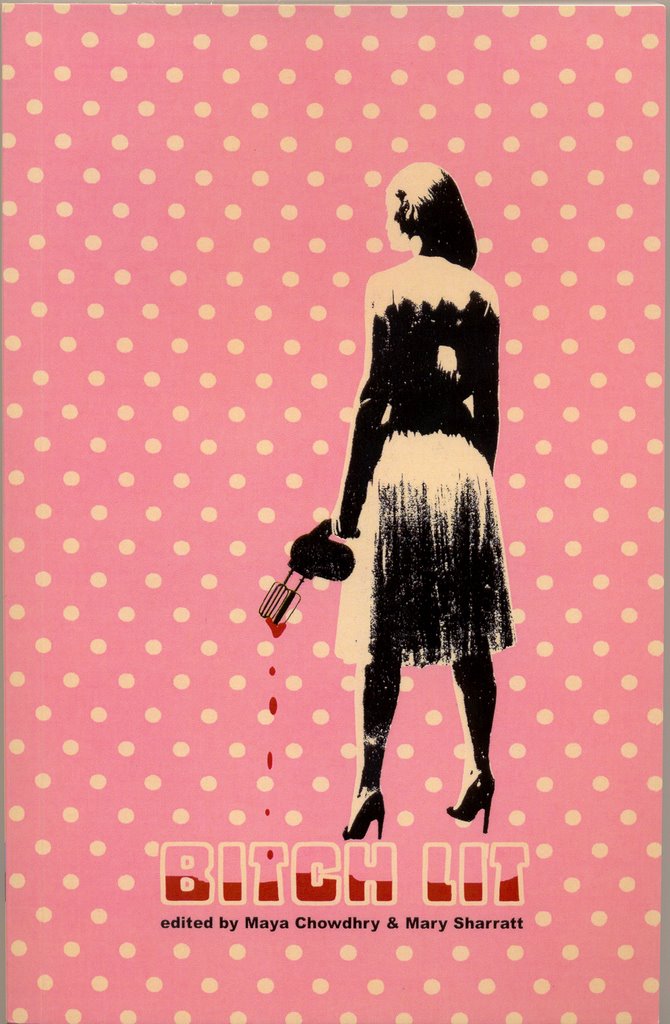 Rehearsal today at Manchester's Green Room for the Bitch Lit tour (to Ilkley, Sheffield, Manchester, Newcastle, York, Leeds and London). A room full of bitches!! People kept letting the side down, though: everyone was so helpful, listening to each other's pieces and making useful suggestions for each other's performance costumes and carefully planning a coordinating colour scheme. But then you've heard of honour among thieves... Camaraderie among bitches...
Seriously, though: apparently we're not getting quite the coverage we were promised in Good Housekeeping, because when the editor saw the image (above) which the journalist had chosen for his article on the upcoming Manchester Literature Festival, she balked: no way would she allow that word in those huge letters... What is it with this word? Why is it so much harder to reclaim than all the others? As John my partner said, the dog world must be wondering what all the fuss is about...
Anyway, the least successfully bitchy woman of the day was Cheryl Martin, our director: she slogged away all day helping us in turn with our readings, yet she was due to perform herself later in the afternoon at the Manchester Book Fair in St Ann's Square. My turn. I began, glanced up, caught her seemingly horrified gaze, my eyes slid away to the ceiling, to the sides, out through the window, anywhere but meet her gaze again. 'Can I stop you there, Elizabeth? Now, my note to you is to speak to the audience, pin their gaze.'
First rehearsals are the hottest hoop of fire. Last year was just the worst, the first rehearsal for my monologue Drinks With Natalie for the 24:7 Manchester Theatre Festival, when my director was Susan Twist, Royal Shakespeare Company and ex-Brookside actress. How could I stand up and perform in front of someone like that? What hubris, what idiocy... But Susie was brilliant, and the first thing she told me was that everybody, however trained and professional and experienced, is scared stiff at the first rehearsal, not knowing precisely what is expected of them - something I had never guessed as a radio playwright when I would walk into the BBC green room the first morning of a production and face a company of well-known actors...
After the rehearsal I made my way to Waterstone's. I'd only gone a hundred yards when I met Trevor from the reading group and his wife Anne, who had just been to the current exhibition at Cornerhouse, and when I got to Waterstone's (via the book fair) I met Debbie, also from the reading group, and the organiser of the reading at the Jewish Museum next Sunday. Manchester: a small world, you say?
Reading at Manchester Jewish Museum 10th Sept
An advert today:
Next Sunday, 10th September at 7.30 there's a reading at The Jewish Museum, Cheetham Hill Road, on the theme of Immigration, organised by playwright Debbie Freeman, and based on a writers' workshop she has conducted there. She's invited me, John Ashbrook and Sue Sterne to contribute: Sue is reading her own poems and I'm reading a section from my new novel - this will be my novel's first outing in the real world. Other pieces will be read by two professional actors, one of whom is my old mate Mary-Ann Coburn, she of the rich voice, big personality and acting talent seeping from every pore, and who recently appeared in Debbie's play Candlesticks at the Royal Northern College of Music and is currenly touring with Function Factory Theatre's play about the Pendle Witches, Cold Light Singing.
Admission to the reading is free, but booking is necessary on 0161 834 9879.
Next Sunday, 10th September at 7.30 there's a reading at The Jewish Museum, Cheetham Hill Road, on the theme of Immigration, organised by playwright Debbie Freeman, and based on a writers' workshop she has conducted there. She's invited me, John Ashbrook and Sue Sterne to contribute: Sue is reading her own poems and I'm reading a section from my new novel - this will be my novel's first outing in the real world. Other pieces will be read by two professional actors, one of whom is my old mate Mary-Ann Coburn, she of the rich voice, big personality and acting talent seeping from every pore, and who recently appeared in Debbie's play Candlesticks at the Royal Northern College of Music and is currenly touring with Function Factory Theatre's play about the Pendle Witches, Cold Light Singing.
Admission to the reading is free, but booking is necessary on 0161 834 9879.
Subscribe to:
Posts (Atom)