Thursday, December 31, 2015

Reading group: The Crying of Lot 49 by Thomas Pynchon

I'm afraid this 1965 book didn't manage to compete with Christmas for our group. We met to discuss it in the pub just before our Christmas dinner, and it turned out that only three of us had read all of it. Ann, Clare, Mark and John had found that it just didn't engage them enough to encourage them to put aside for it the myriad of seasonal things they had to do, and Jenny hadn't even tried. I was one of those who read it to the end, but I found it a struggle, and had a singular experience: when Doug first suggested the book I said I had read it previously - and I believe I had even written about it at some time - but when I came to read it again for the group I recognised nothing whatever about it, which has never ever happened to me before on a reread. I was convinced I had been mistaken about having read it until I started to come across pencilled notes in the margin in my own handwriting. Further, I moaned to John that I still had to finish it, before remembering that I had actually finished it the evening before as we sat in a cafe. That was just how unmemorable the book was for me.

Hans and Doug, however, were more positive, Doug announcing that this was perhaps the seventh time he had read it, that he still wasn't entirely sure what it was about, but that he really loved and admired it. It's the story of a young woman, Oedipa Maas, who one afternoon returns to her California home from a Tupperware party to find she has been made the unlikely executor of the will of a past lover, real estate mogul Pierce Inverarity. If indeed story is a word that can be applied to the off-beat and sometimes seemingly disconnected events that follow as she drives south to carry out this duty, becoming involved with ex-child-actor lawyers, a larky pop group recalling the Beatles or the Monkees, and the mystery of a medieval postal system with the sign of a muted horn, still apparently existing in an underground form and somehow implicated in Inverarity's vast and complicated estate. Or is it? Inverarity (note the echoes of verity/truth in the name) has left behind a postage stamp collection which at the end of the book will become an item in an auction (Lot 49), and appears to hold clues to this, but how can Oedipa be sure that it isn't all a huge practical joke on Inverarity's part?

There are comic disconnected dialogues and madcap scenes reminiscent of a certain kind of film popular at the time, the sixties, and characteristic of that era's popular larky view of itself. It's clear that these are intended, paradoxically, to illustrate the serious theme of the book, that of the difficulties of communication and the impossibility of ever knowing the true significance of things in a culture in which the social and moral barriers are breaking down. Unfortunately, however, I think it was this fragmented nature that made the book unmemorable for me, and some in the group found the events silly rather than funny, in particular John, and Mark who was the most critical of all. The serious purpose is evident in the language, the satirical naming and magnificent long, convoluted sentences which Doug in particular admired. He said that if he himself had managed to write something as good as the riff early in the book on the former car-sales career of Oedipa's husband Mucho, then he would die happy:
Yet at least he had believed in the cars. Maybe to excess: how could he not, seeing people poorer than him come in, Negro, Mexican, cracker, parade seven days a week, bringing the most godawful trade-ins: motorized, mechanical extensions of themselves, of their families and what their whole lives must be like, out there for anybody, a stranger like himself, to look at, frame cockeyed, rusty underneath, fender repainted in a shade just off enough to depress the value, if not Mucho himself, inside smelling hopelessly of children, supermarket booze, two, sometimes three generations of cigarette smokers, or only of dust - [This single sentence continues for another half-page.]
Everyone agreed that the passage was extremely well written, but some pointed out that its subject was never picked up on again, was just left dangling and seemed to be there just for its own clever sake - which may have been the thematic point, but was unsatisfying. There are other sentences that are less easy to read and people expressed irritation at having constantly to go back and read them over and over again, and that on the whole they had lacked the necessary patience - and I have to say that I found, particularly in the latter half of the book, that some of the sentences overreached themselves and resulted in clumsiness. (There is in fact a certain imprecision in the middle of the sentence quoted above, although, as John has said to me, that is perhaps acceptable for the laid-back, 'psychedelic' literary style of the time.)

Which is all that I can remember was said before we dropped the subject of the book, left it dangling, and larkily went off to our Christmas dinner in Aladdin's over the road.

Our archive discussions can be found here and a list of the books we have discussed, with links to the discussions, here

Wednesday, December 30, 2015

Season's greetings, recap of the year and a nice bit of news


Happy festive season! 

Well, it's been a very busy year for me, and as a result I haven't blogged much, in spite of periodic resolutions to get back to it. Since January I've radically redrafted two novels I've had on the stocks, and struggled with a commission for a contribution to a book on writing - one of the most difficult things I've ever had to write, and it's not right yet! - and of course there's been the publication of Used to Be. (Plus we had our house re-roofed, which was naturally very disruptive.) When I went to get the Christmas decorations out, it seemed to me that I'd only just put them away after Christmas 2014!

When you're that short of time it's so much easier to post your news and share your thoughts about writing on Facebook or Twitter, but I have missed the chance to mull things over in the more contemplative way that blogs allow, and I hope that in the next year I'll have more time for that. Come the New Year, I'll be working on typing up and revising the longer of the two novels I worked on last year (I rewrote it in longhand, which for me, is the best way to feel the rhythms of the story and get into the dream-like state I need to imagine it: as I reported earlier, the reason I had to rewrite the other, shorter novel was that I had tried to write it directly onto the laptop, and it just didn't have those rhythms and juice) and of course I'll be trying to finish the ruddy commission. But both of these will be basically polishing jobs, so I'm hoping I'll have more headspace from now on.

That headspace thing is so important - I've constantly felt that I've had nothing to blog about, but of course it's not true, I've had loads of thoughts about writing, but it's all gone into the other things, the commission and the novels. It is also true, however, that being so cocooned inside the creative process, I've done less in the outside world, so have had fewer events to report. (That's the see-saw of writing, particularly with novels: you need the time shut away in order to do it, but then you need to be in the outside world to gather the material!)

As it happens, this morning does bring me some nice writing news to report: Scott Pack highlights a story from Used to Be on his 'Me and My Short Stories' page and gives it four stars. The story he picks out is 'The Choice Chamber' (which Katy Lumsden previously picked out as a favourite in her review), in which a woman thinks back to her younger self and the alternative possible futures she had then. Scott likes the fact that although this might seem to be a familiar situation, there's a 'killer last line' that turns it all on its head. Which, needless to say, leaves me feeling pretty chuffed!

Sunday, November 22, 2015

Chrissie Gittins and Tessa Hadley


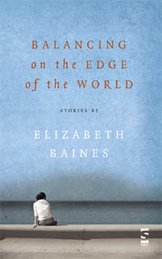
On Friday evening Chrissie Gittins launched her wonderful new collection of stories, Between Here and Knitwear (Unthank), a lovely event upstairs in the cosy central-London Rugby Tavern. I first met Chrissie when she came to read at Manchester Central Library with her then newly published first collection, Family Connections, and when my own first collection, Balancing on the Edge of the World, was forthcoming from the same publisher, so of course we got chatting and have kept in touch ever since. And so of course on Friday I jumped on the train for the launch of the new book.


It's a series of linked stories that chart the life of one woman, Christine, from early childhood to middle age, and the shifts in her relationship with her parents as she grows and then as her parents become vulnerable and aged. The stories are steeped in the kind of physical detail and psychologically acute observations that will have readers exclaiming with recognition, and Chrissie has a beautifully subtle and dry wit.
I loved Mrs Marshall. We all did. We wanted to be her. We wanted to be married to her husband and donate our wedding trousseaus to the school play. We wanted a weekend cottage in Troutbeck, and to start our teaching careers in Wales.
Chrissie read beautifully, and we were all entranced. I read the book all the way back on the train, looking up only once, at Stoke-on-Trent, to see that, without my noticing, it had been snowing. It's a book you'll want to read in one sitting.


Two days earlier I was at Edge Hill University, hearing Tessa Hadley read and talk. She read an early short story and an extract from her latest novel, The Past, and talked very interestingly about the difference between novels and short stories, and the different strategies and mindsets needed for each. She didn't think there was any point in getting indignant about the way short stories don't sell, she said: the fact is that short stories are a 'strenuous' read, requiring a particular kind of focus of attention, and people prefer the immersive experience that novels can provide. Nevertheless, she said, stories are a joy to read and write, and for the writer a wonderful medium in which to hone your linguistic skills. Afterwards I reminded Tessa that we had met in Cardiff at the launch of Power, an anthology published by Honno, in which we both had stories, and she told me that that had been her very first short story - she's come a long way since!

Friday, November 13, 2015

Used to Be reviewed on Everybody's Reviewing.


A lovely review of Used to Be by Hannah Stevens on the Everybody's Reviewing blog, which opens thus:

'A collection packed with bursts of intense short stories, written in clean, sharp prose. The stories are immersive and gripping. I read this book in one sitting.'


Wednesday, November 11, 2015

Goodreads giveaway books ready to go


Here are the copies of Used to Be packed up and addressed to the winners of the Goodreads giveaway. Congratulations to the 10 winners, and thanks so much for the interest of the other 1,382 people who went in for it.

Saturday, November 07, 2015

Katie Lumsden talks about Used to Be (and other books)


Katie Lumsden, who reviewed Used to Be so generously on her blog, Books and Things, also has a YouTube channel in which she talks about her reading, and this month, in the video above, she talks about Used to Be - among many other books - she's a voracious reader and I love her enthusiasm for books!

Thursday, November 05, 2015

Katie Lumsden on Used to Be

A really lovely review from Katie Lumsden on her excellent blog, Just Books and Things. I'm streaming with cold and stuck at home feeling awful when I was meant to be away and meeting people and having interesting discussions as well as writing (I feel too ill to write well), but this review has cheered me up no end. I'll quote just a few of the lovely things Katie says:

These stories are journeys into the past and into possible futures and strike a superb balance between the thought-provoking and the poignant.

Baines is certainly a talented writer, and I find her narrative style fascinating and refreshing. I especially love her use of various voices and narrative perspectives. She uses the second person with a skill and effectiveness I don’t think I even realised was possible... The stories told in the second person – ‘Looking for the Castle’, ‘Clarrie and You’, ‘Possibility’ and ‘What Do You Do If’ – have a strange and beautiful sense both of universality and of uniqueness; they are about specific characters but they are also about you. You are literally pushed into the shoes of these characters. It’s different, clever and wonderfully effective

All in all, I loved this collection, and I am excited to read even more by Elizabeth Baines in the future. Her writing style is strong and refreshingly different... The collection fits together well and was a real pleasure to read.

So, warmed by that, I'll now take myself off with my box of tissues and get myself some honey and lemon...

Wednesday, November 04, 2015

Used to Be reviewed on The Worm Hole

Charlie Place has written about Used to Be on her blog, The Worm Hole. I met Charlie in June when we were both invited to the Simenon event for bloggers: we happened to arrive together in the entrance of the Groucho Club, where the event was being held. I thought a bit hard before asking her if she'd be interested in looking at Used to Be: I didn't want to her to feel obliged, just because we had met. However, she was wonderfully cool and professional, and today she has put up an impartial and thoughtful piece, for which I'm very grateful. Particularly pleased that she thinks that I have a 'distinctive way of writing', and that although the book's literary it's very accessible, and especially that 'it'll blow you away when you least expect it.'

Tuesday, November 03, 2015

First Amazon review for Used to Be - five-star

I never really know how to value Amazon reviews, or whether to quote from them, because there's been so much fuss about their lack of impartiality and openness to corruption, but then it's so hard to get mainstream reviews nowadays (I can't believe that when The Birth Machine first came out it had reviews in the TLS and Literary Review, and I was actually shocked and felt hard done to because, being from a feminist press, it didn't get into the daily broadsheets). So it's hard to resist when you get a nice Amazon review, and this, the very first for Used to Be, comes from a reviewer who is clearly serious about literature and short stories in particular. Since he/she goes under the name 'Manc' it's possible that I know her or him in real life, but if so whoever it is has not revealed his or herself to me, I've no idea who he/she is, and I'm pretty chuffed to get his/her five-star review!

Sunday, November 01, 2015

Reading group: The Quiet Soldier: Phuong's Story by Creina Mansfield

Warning: plot spoil.

This was Hans's suggestion, a novel that sets out to supply the lack that some of us had felt when we read and discussed Graham Greene's The Quiet American, and more: the story of Phuong, the Vietnamese woman fought over in that earlier novel by world-weary narrator journalist Fowler and the young CIA agent Pyle, in the French-occupied Vietnam of the 50s.

This novel begins in 1967 when the Vietcong are fighting the Americans, and with the emergence of Phuong from a Vietcong tunnel, a fully trained Vietcong soldier. Within a very short time it is clear that she is a cold-blooded killer for the cause - a shockingly different figure from the meek and feminine Phuong of the Greene novel. This novel then shows in extended flashback Phuong's journey to this from a genteel background destroyed by her elder brother's espousal of the revolutionary cause and arrest, along with his friend Long and Phuong's elder sister to whom Long is betrothed, and by the famine caused by the World-War 2 machine of the ruling Japanese. Left destitute and alone, a very young Phuong sets out north with an elderly companion to Ba Ra where the three were taken, a rite of passage into toughness as they travel on foot and forage for food. Phuong is raped by an attacker and her companion murdered, and, necessarily trained to kill in self-defence, she becomes a killer herself. From this moment on she will always carry the ivory-handled knife of her attacker, with which she killed him, ready at any moment to use it, and in this novel she will be wearing it beneath her ao dai even as she lowers her eyes meekly for Fowler and Pyle. Finally meeting up with her escaped and much hardened sister and her brother-in-law, she is enlisted as a member of their cell which moves south to Saigon. Here she is commissioned as an undercover spy in the role of concubine, first to Fowler, who as a loose-tongued journalist not given to taking sides is a prime source of information, and then, when he appears on the scene, to the CIA agent Pyle in whose death she will be complicit. One of the fascinations of this for those of us who found it hard to take Greene's narrative attitude to Phuong, is the physical disgust and even hatred that Phuong feels towards both men in this novel as she submits and ministers to them.

Everyone in the group agreed with Hans that this novel was predicated on a brilliant idea. John and Mark didn't feel the book fulfilled the promise of the idea, however, as they found the prose repetitive and pedestrian, and John didn't feel that point of view was always well handled. Most others said that the story was exciting enough to make it a rattling read whatever, and Jenny said strongly that although she felt that the book read rather like an book for young adults (in terms of its prose style and tone), she had absolutely loved it, and all the time couldn't wait to find out what happened next. (She was the one person who hadn't read The Quiet American - she hadn't yet joined the group when we read it.) I said that I had gone back and read The Quiet American again first, in order to not to miss anything of the comment that this book was making on it. As a result, in spite of my historic objection to Greene's portrayal of Phuong, because of his superb prose I had come to this book imbued with Greene's portrayal, and my immediate feeling on beginning reading this book that was that this very different Phuong was simply too far-fetched. Yet as I read on and Mansfield's novel took over, I began to realise that her premise is excellent, that indeed this version of Phuong is in reality the more likely. I felt that this showed something very important about The Quiet American and about prose in general: written, as Ann said, from the colonist's point of view, The Quiet American is culturally suspect, but the brilliance of Greene's prose makes it lethally persuasive. John said however that reading The Quiet Soldier makes The Quiet American a far less good book for him, since it made him think how ridiculous it was that in The Quiet American neither Fowler nor Pyle ever suspect that Phuong could be a spy, which in reality she quite likely would be - particularly Pyle, who is an undercover agent himself.

I said that I did feel that The Quiet Soldier would have made a better if perhaps more predictable story if Phuong had actually killed Pyle (rather than simply being complicit in his murder), as so much is made of her attachment to the knife she carries (and she is at one point prepared to kill Fowler), and she has so much personally to avenge, but no one else agreed with this.

Jenny said that she would now go and read The Quiet American, and everyone commented that she would not be able to read it without the filter of this novel. I said that after finishing The Quiet Soldier I had indeed gone back to the beginning of The Quiet American, when Phuong is waiting in the shadows as Fowler comes back to his flat and when, we will soon find out, Pyle has already been killed, and it was impossible not to see her waiting there as a potential assassin.

Our archive discussions can be found here and a list of the books we have discussed, with links to the discussions, here

Reading group: Christie Malry's Own Double Entry by B S Johnson

Here's the second of my belated reading group reports:

I suggested this metafictive 1973 novel by experimental writer B S Johnson, which has always been important to me (both as a reader and writer), hoping that the group would like it too but not really expecting them to, since some, Jenny especially, have expressed a dislike for experimental novels.

To relate the story - in which seventeen-year-old Christie Malry, 'a simple man', decides to get back at a callous profit-obsessed society that does him down, recording his slights and revenges through a double-entry system of debits and credits learnt at the bank where he is first employed - is to some extent beside the point, since much of the enjoyment in this novel comes from the mischievous voice of the author, directed straight at the reader and deliberately revealing the artificiality of his story and dismantling it, openly discussing and dismissing the conventional mechanics and modes of novel-writing, and finally questioning the whole enterprise of writing a novel in the first place. In a deliberate subversion of the concept of 'rounded character', Johnson sometimes puts into the mouth of the simple Christie diction that is clearly his own, so arcane and erudite that the words need to be looked up in the dictionary (and when they are, are found to be hilariously apt), and Christie's equally 'simple' mother is given a sophisticated formal speech in which, right at the start of the novel, she writes herself out of it because, basically, Johnson is illustrating, she has outlined her narrative usefulness and to resolve her role in the plot in any more conventionally 'realist' way would be dishonest and artificial.
'We fondly believe that there is going to be a reckoning ... when the light of our justification blazes forth upon the world... But we shall die untidily ... most things unresolved... Even if we understand all is chaos, the understanding itself represents a denial of chaos, and must therefore be an illusion... My welcome is outstayed'... Christie's mother died.
Johnson tells us that any attempt he makes to characterise Christie's appearance he does 'with diffidence, in the knowledge that such physical descriptions are rarely of value in a novel... What writer can compete with the reader's imagination!' and so he makes him 'average' in every physical way in order to accommodate this. However, taking us through the novelist's mental process, he goes on: 'But Christie's girlfriend! I shall enjoy describing her! Come along, what's your name, let's have your name. It'll come, like everything else. Try.'
In a further rejection of realist fiction, the story itself is deliberately over the top, increasingly and hilariously surreal as Christie avenges the smallest slights with the most elaborate and excoriating plots that culminate, finally, in mass murder.

When I came to read this novel again for the group meeting - a book that I have acknowledged as having had a profound influence, along with Grace Paley's stories, on my own more metafictive writing - I found to my surprise that I was slightly less enthusiastic than my memory of it had made me. While I recognised the first half of the novel with delight, I found that I didn't recognise the ending at all, and came to realise that I had probably never previously finished it. It's possible that it had so inspired me that I dropped it and went off to write something of my own, but I also remembered that I'd been reading it on a train journey and the journey had come to an end before I finished it, and that that journey had set in chain a series of distracting life events that would have prevented me from picking it up again. In any case, although I found the ending logical - the plot deliberately cut off and the conclusion nihilistic, the author conversing with Christie and discussing his pointlessness: ' "Christie', I warned him, 'it does not seem to me possible to take this novel much further" ', and finally, 'Xtie died' (Christie acknowledged as a mere cipher) -  I found the nihilism emotionally unsatisfying. This was perhaps because I knew now that by the time B S Johnson had written this novel he was sensing that he had written himself into a corner (his novels weren't popular, and his publisher was going cold), and that this led to his suicide very soon afterwards. For this reason, I couldn't help reading into the ending - and retrospectively by association the whole of the book - a kind of despair about the novel as a form, which was not something that as a writer I was happy to feel. Possibly also the ideas of the book were now too familiar to me for it to have the same impact the second time around.

Introducing the book at the meeting, I said this, expecting everyone to be much more down on it than I was. There was a bit of a silence that I realised was a silence of surprise, and then Jenny, of all people, said, 'I thought it was brilliant,' and there followed a chorus of agreement from everyone else present (except perhaps John who was the only other person who had read it previously, and who had had something of the same reaction as me). Ironically, the rest of the meeting consisted mainly of people praising and relishing the book with an air of defending it from me. People loved the wit, the voice of the author and his deconstructions, and found Christie's story itself hilarious, Ann and Doug thinking the latter searingly true about work within institutions and organisations, and no one could understand how a novel that was basically such fun could ever have failed to be popular. Jenny said that she was in fact surprised to find herself liking an experimental novel so much, and the group discussed why this book should have been so different. Mainly, it was decided, it was because, in spite of all the deconstructions, there are realist elements: both Christie and his girlfriend 'the Shrike' are vivid characters depicted in scenes full of relishable physical detail worthy of any realist novel, a paradox which seems to have confounded some critics, but which, after all, lock you emotionally into Christie's story  - B S Johnson's very clever sleight of hand.

Our archive discussions can be found here and a list of the books we have discussed, with links to the discussions, here

Saturday, October 31, 2015

Reading group: The Bridge by Iain Banks

I've been so busy with my current writing project and the publication of Used to Be, that I haven't at all been keeping up with the reports of the reading group meetings. I have three to catch up with, so my memory of this, the first (at least two months off now), is perhaps a bit incomplete.

Clare suggested this novel, a kind of crossover work between the novels with which Ian Banks began his career - not exactly realist, but more conventionally literary - and the science fiction which after this he began to produce simultaneously under the name Iain M Banks. Doug had said when the book was suggested that he particularly admired it, but unfortunately he was unable to attend the meeting at which we discussed it and thus champion it in the face of the more muted reaction of the rest of us.

Clare summed up the events of the book. It begins with a kind of nightmare sequence, told in the present tense and in disjointed prose with short, one-word sentences conveying crisis and confusion, featuring blood, a huge white cat, a bridge and an impact, the crashing of a car. There is then a shift to another dream-like sequence with a very different tone, past-tense, distilled, mysterious and haunting, in which a train leaves a deserted station, whistling off into the dark, and the first-person protagonist sets off too into the dark on a mysterious quest with a horse and a strangely sealed carriage. On a lonely mountain pass, with room only for the carriage, he comes face to face with an identical driver with an identical carriage whose actions mimic his own, neither of them able to pass.

We then discover that this is indeed a dream, the dream of a first-person narrator named John Orr who is recuperating after a car crash but still under the care of doctors in a strange surreal world of an endless bridge on which whole infrastructures and communities have been built. Later we will discover that, unable in fact to dream, Orr has made up the dream about the horse and carriage, along with other similar dreams, to keep his doctor happy. We follow events on the bridge, which grow increasingly surreal: Orr is demoted from his luxury room and stripped of the luxury goods with which he has thus far been provided, and sent to live among workers at a lower level; strange barrage balloons appear at the side of the bridge erected against sinister invading aircraft, and an aircraft (I think - my memory is hazy here) crashes into the bridge. There is the resultant crashing of one of the trains that constantly run through the centre of the bridge, and Orr escapes on another train only to find himself speeding and then rattling through war zones and apocalyptic landscapes, variously imprisoned and enlisted by different warring factions. About a hundred pages in, this narrative is punctuated by moments from another: the past-tense, third person account of a working-class student from Glasgow whose father once took him to look at antique steam trains and who moves to Edinburgh for university and up the social ladder, becoming an architect married to a middle-class girl from the area and leading a life of material success and fast cars. There is a third narrative, in which a seemingly different first-person narrator, speaking in demotic Glaswegian and expressing crude primitive desires, quests, with an argumentative creature on his shoulder, through the familiar but warped landscape of Greek mythology. Meanwhile, occasional sequences like the first section break through, indicating the mind of someone struggling to consciousness. As Clare said, these seemingly disparate stories come together at the end, showing that they are all indeed the dreams, alter-egos or memories of a single architect narrator, once obsessed with the construction of the Forth Railway Bridge, in a moment of crisis crashing his Jaguar (the 'huge white cat') on the road bridge, and now lying in a coma.

Most of us thought that the psychological insights of the book were interesting and clever - the mirror symbolism of the initial 'dreams' signifying the severing of the protagonist from himself (named Orr and implying an alter ego), the id and the super ego cleverly melded with the Greek myths that prefigured such notions, the protracted war struggle signifying Orr's resistance to emerging from the comfort of his coma, and the clever depiction of how our subconscious minds turn both our experiences and words into concrete symbols. However, as Trevor very strongly put it, if you get the connections at the beginning and understand that everything, apart from the realist backstory, is the consciousness of a man in a coma, as he and others of us did, then there's no narrative tension. It's hard to get engaged with the 'real-life' backstory of the architect since, presumably in a deliberate move to show the contrasting vividness of Orr's coma-induced interiority, it's told in a flat, pedestrian prose; the rest is a virtuoso authorial performance of linguistic richness and energy, but knowing it's a dream creates a certain detachment from the experience in the reader. To put it more bluntly, other people's dreams are nearly always boring, simply because they are only dreams.

Some were surprised that people have written PhDs discussing the book. Clare said that she had done some research and had discovered that there were many points of interest that must be compelling to Banks fans and PhD students, such as the fact that the surname of a woman on the bridge who is a love interest for Orr is also that of one of the original architects of the real-life Forth rail bridge, but such connections were of only passing interest to us.

One thing that did attract and intrigue both Trevor and me was the Edwardian character of some of the aspects of the bridge - the fact, most obviously, that the trains were steam engines - showing that we do not live exclusively in the present and that our imaginations are formed to some extent from the past. We both found this strikingly psychologically true.

Clare did say that she didn't feel as detached as most of the rest of us did, but, as far as I remember, Jenny said she just couldn't get on with the book at all.

Our archive discussions can be found here and a list of the books we have discussed, with links to the discussions, here

Launch of Used to Be


The launch for Used to Be was a real celebration - of the publication, of short stories in general, and of literary friendship. Writer friends old and new came, many of them short story writers.


Ailsa Cox, perhaps my most long-time writing colleague and now Professor of Short Fiction at Edge Hill University (and world expert on the work of Alice Munroe), and Nicholas Royle, Creative Writing lecturer at Manchester University and tireless promotor and editor of short stories, both graced the event with superb readings from brilliant short stories of their own.


 It was wonderful to have there with us long-time writer-friends Cath Staincliffe, Livi Michael and Carl Tighe, and those with whom I've more recently chewed the cud about writing matters: fellow members of the Inklings writing group, Sarah-Clare Conlon and David Gaffney, and of the Narrative Research Group at Edge Hill University, John Rutter and Billy Cowan. Lovely too, to have the support of Doug and Jenny from the reading group, and Nick and Diane Duffy with whom John and I have attended many a Waterstone's reading and with whom we've had many a discussion about books, as well as friends from other walks of life. Thank you to all - your presence made the launch of book very special, and thank you to Waterstone's for hosting the event and looking after us so well. Thank you too, to Carys Bray who had been going to read, but was unfortunately prevented from attending.

A first review of Used to Be appears on Tim Love's blog today - in fact, it's a detailed, in-depth look at the book, and I thank him for his thoughtfulness and attention.

Monday, October 26, 2015

Charles May on BBSS and 'Tides'

Short story expert Charles E May has been writing on his blog, Reading the Short Story, about Salt's Best British Short Story series of anthologies edited by Nicholas Royle. Today he turns to BBSS 2014, and in an interesting post on the metafictive story and 'writing what you know', considers three from the volume answering the description, including my own 'Tides, or How Stories Do or Don't Get Told'. Of 'Tides' he says it's
'a thoughtful story about a writer dealing with the so-called "reality" of her life the way writers do when they write fiction—making choices, determining generic approaches, using narrative technique to make meaning how of their experience.'
It's interesting - and rather funny - that he calls the protagonist of the story a writer, as I was very careful not to identify her as such, and she talks about 'telling' rather than writing the story. Given myself away after all, maybe? Or maybe, as he indicates, it's a stupid distinction, since, as he points out,  those of us who write metafiction tend to think of simply living as a fiction-making experience (each experience different from a different point of view).

I must say, though, that although 'Tides' is not the only metafiction in my new book, 'Used to Be', there are stories in there that aren't: sometimes you just want to write a conventional story, after all.

Monday, October 19, 2015

Used to Be: Goodreads giveaway

I'm giving away 10 signed copies of Used to Be on Goodreads, and it opens today. To enter click on the link in the sidebar.

Friday, October 16, 2015

Two story reviews I hadn't seen before

Yesterday I came across two reviews I hadn't seen before of anthologies containing my stories, both by Katie Lumsden, on her great blog, Books and Things.

The first is a review of Best British Short Stories 2014, ed Nicholas Royle, and I'm chuffed to say that she really liked my story, 'Tides' :
I love Elizabeth Baines’s ‘Tides, or How Stories Do or Don’t Get Told’. In part I love it because I like self-reflective writing, because it’s clever, because it’s in part about writing, about telling stories. But it’s also just a beautiful, moving story, a story about the lack of story almost. It’s brilliant.
One of her favourite stories in the book is David Constantine's 'Ashton and Elaine', which led her on to Red Room: New Short Stories Inspired by the Brontes, ed A J Ashworth, where that story was first published, and which she reviewed here. I'm happy to say that she also liked my story in Red Room, 'That Turbulent Stillness', of which she says:
One of my favourite stories was ‘That Turbulent Stillness’. I’ve already come across Elizabeth Baines inThe Best British Short Stories 2014, and it was a real pleasure to read another of her short stories. ‘That Turbulent Stillness’ is movingly written, with strong characterisation. It has a lovely narrative voice in which the narrator intrudes, at first in a very Victorian manner (‘I know very well what happened’, etc), and later in a more self-conscious, almost post-modern way that I enjoy. I plan to buy and read Elizabeth Baines’s novel promptly and expect good things from it.
Both stories are included in my newly-published collection, Used to Be, a box of which arrived yesterday, to my great excitement.


Saturday, October 10, 2015

Used to Be arrives


My author copies, which arrived this week. Aren't they lovely? They feel nice, too - sort of silky! I'll be doing a giveaway on GoodReads, and will add the widget to the sidebar when it begins in about ten days or so .

Thursday, October 01, 2015

Used to Be published


Yesterday I was at my mum's for the day. 'When is your book coming out?' she asked me. I told her it was due back from press any day now, but I couldn't check on my phone to see if it had come yet, as where she lives there's no signal whatever of any kind - well, there is a bit of phone signal, but not great enough to hold a decent mobile phone conversation! So it wasn't until I was on the train back to Manchester that I discovered that Used to Be had arrived from the printer's at Chris and Jen's, along with Jonathan Taylor's novel Melissa, and Roddy Lumsden's poetry collection Melt and Solve. Don't they all look fabulous? (And isn't that a beautiful clock on their mantelpiece?)

I'm holding an event to celebrate the publication of Used to Be at Deansgate Waterstone's, Manchester, on Thursday 29th October (7 pm), and I'm making it a celebration of the short story, with additional readings from three brilliant short-story writers, two of whom are also key players in the recent rise of the short story. Ailsa Cox is Professor of short fiction at Edge Hill University and founder of the Edge Hill short story prize, and was co-editor with me of the one-time short-story magazine Metropolitan. She is the author of numerous prizewinning short stories and the collection The Real Louise and Other Stories (Headland). MMU lecturer Nicholas Royle, has edited numerous short story anthologies and now edits the Best British Short Stories series (Salt) and publishes short story chapbooks under his own imprint, Nightjar. He founded the Manchester Fiction Prize for a single short story. His own stories have been shortlisted for the Edge Hill Prize and he is the author of several novels, including the latest, First Novel. (He was also a valued contributor to Metropolitan.) Also reading, I am thrilled to say, will be Carys Bray, whose debut novel, A Song for Issy Bradley, has been such a resounding success, and whose collection of stories, Sweet Home, won the Scott Prize.

And there will be wine! (Gotta celebrate, yeah?)

Thursday, August 27, 2015

Miss Emily by Nuala O'Connor. Blog tour Stop #2


Today I am delighted to be hosting the second stop on the virtual tour for Miss Emily, the latest riveting and beautifully written novel by Nuala O'Connor (who also writes as Nuala Ní Chonchúir).

Published this month by Penguin USA, Penguin Canada and UK Sandstone Press, it is a story of the friendship between the nineteenth-century American poet Emily Dickinson and a fictional Irish maid. It begins as the Dickinson family of Amherst, Massachusetts bemoan the loss of their previous maid, which has meant that Emily and her sister Vinnie have had to take on the household chores, occasioning burnt potatoes at the table and the loss of Emily's jealously guarded writing time. Meanwhile the feisty seventeen-year-old Ada Concannon, having been demoted as a maid in an Irish baronet's house for turning up at work bedraggled after swimming in the Liffey, decides there's more to life than this and sets sail to join her aunt and uncle and their family in Amherst, soon to fill the gap at the Homestead, the Dickinson household, and thus become the poet's saviour. Told in the voices of the two women, in alternating chapters throughout the book, the novel charts the growing friendship between the down-to-earth but sharp-minded Ada and the reclusive older Emily, sparked in the beginning through their shared love of baking, and culminating in a drama in which Ada's reputation is violated, and Emily must stand up for her against her beloved family.

As always with a book by Nuala, the mesmeric prose draws you straight into the psyches and emotions of the characters with a vivid and sensuous conjuring of atmosphere and scene. As always, there is both a lushness and a toughness, polarised here in the different linguistic registers of the two women, which are acutely handled.
Here's Emily looking around in the garden:
...everything is floral and abundant, while the apple maggots and cabbageworm do their best to undo it all. I sit under a pine, listening to the sounds of the earth, the turn of the beetle and the bone-song of the crickets;
and here's Ada cheerfully taking her to task:
'Now, Miss Emily,' Ada says, 'are you going to sit there like a clump of muck, or are you going to do something useful?'
The descriptions of baking are mouthwatering, there are acute insights into poet Emily's psychology and creative process, Ada's eventual trial is searing, and the drama that finally overtakes the two women is nail-biting.

It's a novel about female friendship across the generations and classes, about two women fighting the different class restrictions of their gender (Emily can write while Ada must toil; Ada can go to the circus while Emily can do nothing so unseemly), forging in the process an unlikely friendship. It's quite simply a wonderful and immersive read.

You don't at all need to know Emily Dickinson's poetry or anything of her life to fully enjoy this novel. Satisfyingly for those who do, though, Nuala has clearly researched her in depth, and the novel dispels a few myths. In an interesting article on the Huffington Post, Who is Emily Dickinson? Nuala talks about those myths and the real Emily, shown in this novel to be more characterful and active than she is often portrayed.

For anyone in Dublin tomorrow night, the book will be launched at the Gutter bookshop, Cow's Lane, Tel. (00353) 1 6799206, info@gutterbookshop.com .

Read the previous tour stop, at Shauna Gilligan's blog, where Nuala is interviewed about the book, here. You can follow the rest of the tour, and discover lots more details about the book and Nuala's work from her blog, Women Rule Writer.


Nuala O'Connor was born in Dublin, Ireland, she lives in East Galway. Already well-known under the name Nuala Ní Chonchúir, she has published four short story collections, the most recent Mother America appeared from New Island in 2012. Her third poetry collection The Juno Charm was published by Salmon Poetry in 2011 and Nuala’s critically acclaimed second novel The Closet of Savage Mementos appeared April 2014, also from New Island; it was shortlisted for the Kerry Irish Novel of the Year Award 2015. In summer 2015, Penguin USA, Penguin Canada and Sandstone (UK) publish Nuala’s third novel, Miss Emily, about the poet Emily Dickinson and her Irish maid. www.nualanoconnor.com

Wednesday, August 05, 2015

New Unthology 7 review

There's a very nice review of Unthology 7 on the Where the Roads are Rivers blog. All of the stories are appreciated and praised, and I'm especially delighted that mine, 'Looking for the Castle', is one of four picked out as favourites "for their evocative settings (Delhi, Barcelona,  Serbia (& California), and, in Looking for the Castle the ‘…knot of tanneries and terraced houses in a curve above the wide watery spaces where the Mersey joins the Manchester Ship Canal…’); I loved them for the voices employed, the pictures they painted, their phrasing and music, the underlying or overt yearning, their understated epiphanies and restraint (and occasional lack of restraint). And for some, perhaps unidentifiable, magic that lies beyond my ability, or indeed my wish, to describe."