Well, I've been holding out against this tagging lark - otherwise how can I go on complaining about the tendency to want to know about writers' lives (rather than their books), as I do on my other blog? But now Jen at Salt has tagged me, and what can you do but comply when your publisher tags you, and anyway she makes it such fun, so I'm giving in:
"Each player starts with eight random facts/habits or embarrassing things about themselves. People who are tagged need to write their own blog about their eight things and post these rules. At the end of your blog, you need to choose eight people to get tagged and list their names. Don't forget to leave them a comment telling them they're tagged, and to read your blog."
Here goes:
1. My mother once dressed me up for a village fete as a summer salad, and what this did for my self image may be a matter for the psychiatrist's chair. (I was only four, but I can still remember in a physical way the shock of cold when she placed the necklace of cucumber slices round my neck.)
2. I recently sat in a cooling bath for an hour and a half (mercifully dressed in a strapless dress) while a film director and cameraman decided on the shot they wanted. By the time they had finished I was a wrinkled prune.
3. I sing to myself without knowing I'm doing it, which made my children want to walk ten steps behind.
4. I talk to myself, too - or more accurately, I mouth the stories I'm writing - which makes my children still not want to walk with me at all.
5. A lost skill: I can't cook any more, I'm always too busy writing to practise.
6. My feet are so big that when John first met me he bought me Fats Waller's Your Feet's Too Big.
7. I'm crazy about cabbage, and never get enough as no one else likes it. What's fantastic about North Wales restaurants is that they serve it up!
8. Something that still makes me blush: I once agreed to use clippers on the head of someone about to go on holiday with a brand-new girlfriend, an event he was somewhat nervous about. I sneered at his worry that I might drop the guard, and then went and did just that and made a bald stripe up the back of his head.
Now I have to tag eight others:
Sally Lawton
Caroline Smailes
Debi Alper
Amanda Mann
Clare Sudbery
Lucy Pepper
Nicola Monaghan
Charles Lambert
Monday, September 10, 2007


Friday, September 07, 2007
Blogstory: readers vote for Central Library
So the vote on the blogstory was overwhelmingly for Manchester Central Library. This is where Cat's mysterious caller will tell her to go for a meeting, rather than the rumbustious pub in Salford or the the slick, slightly wild ambience of the Printworks with its bars and clubs. Not only does this potentially have a bearing on the identity of the caller, it makes me wonder about the readers who have voted. Why have they voted in this way? Is it because Central Library is the place they know and/or like best (in which case of course they're a pretty studious lot)? Or is it that, like the voters on Sarah Hepola's interactive blog story (see earlier post) they want to steer the characters in that more 'worthy' direction? Either way, the reality of readers is already strongly imposed on the story.
So it's quite funny that when I met an (admittedly senior) friend at the bus stop this morning and told him I was writing an interactive blogstory, he grimaced and rolled his eyes and did a comic quick retreat away from me and from something quite so trivial and trendy and 'unliterary'!
So it's quite funny that when I met an (admittedly senior) friend at the bus stop this morning and told him I was writing an interactive blogstory, he grimaced and rolled his eyes and did a comic quick retreat away from me and from something quite so trivial and trendy and 'unliterary'!
Thursday, September 06, 2007
Blogstory voting
Voting is going interestingly for the blogstory, and implies that it's a pretty literary lot who are bothering, since so far Central Library is way ahead as the venue for the narrator's mysterious meeting. That's not how it began, however: at the start the Salford pub was in the lead, but unfortunately the voting site we were using at first went down and we had to swap sites. This meant that we lost the first dozen or so votes, which had been heading the story in that direction. I know that Kate Feld, the site adminstrator, tried to transfer those votes to the new site, but I don't think the software let her. So if you voted on Tuesday morning it's possible that your vote hasn't been counted, but you should be able to vote again on the new site. Voting closes tonight at eight, and then I'll have to get writing again!
Wednesday, September 05, 2007
Sundar Kanta Walker at the Portico Library, a dash to the BBC and a drink in the Lass o'Gowrie

To the Portico Library last night for the opening of Sundar Kanta Walker's final leg in the tour of her fantastic show of paintings, Samsara: The World, The Universe. What a surprise: since the first show in Sale last October, Kanta has added numerous new paintings, some of them huge and all overflowing with vibrant energy - and Kanta is such a little woman, I don't know why she wasn't flat on the floor rather than looking her usual bright-button self.
Some of these new paintings made me shudder in an exciting but disturbing way, and Kanta explained to the assembled guests that the theme of this exhibition is our treatment of the environment and its resultant cataclysmic changes. The picture above is Kanta's vision of a tropicalized Lake District, and others show mountain ranges where the brush-strokes and colour shifts seem dynamically to split mountains between melting heat and desolate uncompromising ice, capturing our sense of the uncertainty of the future in a way which brought my heart into my mouth. But, marvellously, there are pictures too celebrating those things which, if we are not careful, we could lose, and the shot below shows Kanta beside one of them.

I couldn't help thinking there was an interesting culture clash between the urgency of the paintings and the gentility of the venue: live music, a gentle harp and a flute, above us the beautiful recently restored Georgian glass and plaster dome, all around us shelves of old leather-bound books, one wall classified in gold lettering: Polite Literature. And the reading room, where William Gaskell and Roget once sat. I love the place, but there is still an air of nineteenth century elitism about it - the way you have to be let in at the door, the fact that you need a letter of reference before you can ever borrow books and the original club-type membership system still in operation. There's good reason, of course - the books are a special and crumbling resource which need great care and renovation (the library is engaged on a massive ongoing renovation project of the books and the weakening shelves.) But you know me: I stood taking the photo below of the gentleman's-club type reading room, and couldn't help making a connection between nineteenth-century elitism and the state of the world about which Kanta is painting.


And then home for a bite to eat, and out again back to the BBC to talk about the blogstory on Radio Manchester's Phil Wood show, and then across the road to the Lass o' Gowrie and a world Gaskell and Roget would never recognize, where John was chatting to a bunch of ecology students all dressed up as animals (don't ask me why) and who should also be there but Art of Fiction blogger Adrian Slatcher and, guess what, we talked about blogging until chucking-out time.
Kanta's exhibition continues until 27th September.
Tuesday, September 04, 2007
Manchester Blog Story goes live
The Manchester Blog Story, What Would You Do? which I'm writing for the Manchester Literature Festival, has gone live! The first of six weekly mini-episodes, The Caller, is now posted, and readers have till Thursday 8pm to vote on the venue for the next turn in the plot - and then I'll have four days to write the next episode accordingly! It's scary, but exciting - never in my life before have I written so publicly, and never before have I not had the option of going back and changing things which turned out to be extraneous or out of place!
Here's the blurb about it from this week's Manchester Literature Festival e-letter:
The project is produced by Manchizzle blogger Kate Feld and sponsored by Richard Fair richardfair.co.uk
Here's the blurb about it from this week's Manchester Literature Festival e-letter:
Episode One takes place in the hallway of a large Victorian house converted into flats and introduces us to its eccentric occupants. One of the residents has been visited by a mystery caller but will they manage to collect their message?
Monday, September 03, 2007
Never give up
About three years ago I sent a play to a theatre and received a discouraging response: my play wasn't really a play, it was far too schematic, the characters weren't fully rounded, and worst of all, I really needed to learn how to write dialogue and not have them spouting great explanatory speeches.
Well, you know how it is: you think, Couldn't they see that the style of the play was consciously chosen (rather than a mistake!), that the 'schematic' nature of the piece was deliberately devised as a comment on the schematic psychology of the characters, and that in any case it's subverted at the end? That it's not intended as naturalist, for heaven's sake - that televisual standard of 'rounded' characters' and real-life replicating dialogue? And that anyway, the things the characters say in their speeches aren't meant to be taken at face value, they are in fact subverted and overturned by the action? Are there no script readers in theatres educated in the history of theatre and who don't view life through the lens of Coronation Street!!!??? Didn't they read my ****ing letter and see that I have done tons of radio and can write realist dialogue whenever I like, thank you very much?!!! (And probably better than them!!!!) (You're getting vicious now and spitting.) Haven't they ****ing heard of me in any case?!!!!! Are there no script readers who know how to read a script? (You are practically foaming at the mouth by this time.)
And then of course comes the moment of doubt, when, even though you have thought all of these things, you think: But what if they're right? What if I am a crap writer after all? Because there's just no proof that I'm any good if I can't get past these script readers and get my plays on... And you start to think that writing theatre plays is a waste of time and you simply stop doing it...
Well, don't do that. In July I attended a panel discussion, 'Joining the Dots', at the Royal Exchange, held as part of the Manchester International Festival, and was greatly encouraged. One panellist was the inspirational Suzanne Bell, Literary Manager of the Liverpool Everyman - with its admirable record of showing new writing - who proved passionate about new writing. Another was West Yorkshire Playhouse Literary Manager Alex Chisholme who said (with what Chair Tony Clarke, AD of Hampstead Theatre, called admirable honesty) that working recently with a PhD student of Drama had caused her to think that British Theatre may well have been missing plays and playwrights by being too hung up on narrative and character because those are the things it's easiest to teach - at which Tony put in with the statement that he didn't in fact think it was up to other theatre professionals to teach writers how to write.
And guess what? Earlier this year I sent the play I mention above to the very same theatre all over again because the artistic director had changed. And when I got back from Wales there was a wonderful letter understanding everything I was trying to do and lavishing it with praise! They're not putting the play on, but the praise was really inspiring - and what's great is that they want to see anything else I may write.
So never give up, I say. And the best news is, I think things are looking up.
Well, you know how it is: you think, Couldn't they see that the style of the play was consciously chosen (rather than a mistake!), that the 'schematic' nature of the piece was deliberately devised as a comment on the schematic psychology of the characters, and that in any case it's subverted at the end? That it's not intended as naturalist, for heaven's sake - that televisual standard of 'rounded' characters' and real-life replicating dialogue? And that anyway, the things the characters say in their speeches aren't meant to be taken at face value, they are in fact subverted and overturned by the action? Are there no script readers in theatres educated in the history of theatre and who don't view life through the lens of Coronation Street!!!??? Didn't they read my ****ing letter and see that I have done tons of radio and can write realist dialogue whenever I like, thank you very much?!!! (And probably better than them!!!!) (You're getting vicious now and spitting.) Haven't they ****ing heard of me in any case?!!!!! Are there no script readers who know how to read a script? (You are practically foaming at the mouth by this time.)
And then of course comes the moment of doubt, when, even though you have thought all of these things, you think: But what if they're right? What if I am a crap writer after all? Because there's just no proof that I'm any good if I can't get past these script readers and get my plays on... And you start to think that writing theatre plays is a waste of time and you simply stop doing it...
Well, don't do that. In July I attended a panel discussion, 'Joining the Dots', at the Royal Exchange, held as part of the Manchester International Festival, and was greatly encouraged. One panellist was the inspirational Suzanne Bell, Literary Manager of the Liverpool Everyman - with its admirable record of showing new writing - who proved passionate about new writing. Another was West Yorkshire Playhouse Literary Manager Alex Chisholme who said (with what Chair Tony Clarke, AD of Hampstead Theatre, called admirable honesty) that working recently with a PhD student of Drama had caused her to think that British Theatre may well have been missing plays and playwrights by being too hung up on narrative and character because those are the things it's easiest to teach - at which Tony put in with the statement that he didn't in fact think it was up to other theatre professionals to teach writers how to write.
And guess what? Earlier this year I sent the play I mention above to the very same theatre all over again because the artistic director had changed. And when I got back from Wales there was a wonderful letter understanding everything I was trying to do and lavishing it with praise! They're not putting the play on, but the praise was really inspiring - and what's great is that they want to see anything else I may write.
So never give up, I say. And the best news is, I think things are looking up.
Sunday, September 02, 2007
A reading and celebration for Balancing on the Edge of the World
Last night John and I went to the fabulous Croma restaurant in Chorlton, where we often go. Maybe I shouldn't be admitting this, but I often have my best writing ideas with a bit of wine inside me - it's that sideways, non-logical thing that slight inebriation allows - and I've had several in Croma of a Saturday night.
Well, the really exciting thing is that Kirsty, who runs the restaurant, has offered to do me a launch/celebration for my book of stories, Balancing on the Edge of the World, and Vicky of Chorlton Bookshop, next door to the restaurant, has agreed to supply the books. I'm doing several readings at the start of October (see the list on my website), but this will happen later (we've pencilled in 29th) when they've died down a bit, and will be more of a celebration. Details have to be organised yet, but I'll be keeping everyone posted, of course!
Well, the really exciting thing is that Kirsty, who runs the restaurant, has offered to do me a launch/celebration for my book of stories, Balancing on the Edge of the World, and Vicky of Chorlton Bookshop, next door to the restaurant, has agreed to supply the books. I'm doing several readings at the start of October (see the list on my website), but this will happen later (we've pencilled in 29th) when they've died down a bit, and will be more of a celebration. Details have to be organised yet, but I'll be keeping everyone posted, of course!
Saturday, September 01, 2007
Reading group: White Noise by Don Delillo
 Yet another book I read in Wales was Don DeLillo's White Noise, last month's reading group choice, the story of university lecturer and Hitler expert Jack Gladney who lives with his nth wife and a house full of step-children, and suffers existential gloom and unease - or more precisely, a fear of death - in a contemporary world of confusing signs.
It's a while now since we met to discuss it, and in the meantime I've been filming, so my memory of the discussion isn't too detailed: what I remember more than the discussion is the darkness and dampness of the evening, so typical of this odd summer, and the fact that the dog in Hans's house was suddenly different, because his old one had (shockingly) died, and every time we went to the loo the new one jumped up in excitement and wrapped us in her lead.
I know we all liked the book. Some of us, Trevor and I in particular, loved it. Trevor began the discussion by stating that the author was having a go at most things in the modern world, but I said, Wasn't it more precisely about the loss of boundaries between fantasy and reality (see, it's all coming back now) and Jenny said, No, surely it's about the fact that we can no longer distinguish between what's important or not. I had to agree that this was true, too: there's a running joke about the fact that there are 'PhDs now in cereal packets', and key scenes of the book take place in the supermarket, the place where
people scan the small print on packages, wary of a second level of betrayal.. Many have trouble making out the words... Smeared print, ghost images... But in the end it doesn't matter... The terminals are equipped with holographic scanners... This is the language of waves and radiation.We all loved the hilarious discussions between Jack and the younger visiting lecturer Murray, who is studying such cultural signifiers, and the fact that Jack's subject, Hitler, is of no greater cultural significance than Murray's, Elvis, in the scene in which they lecture together, almost physically dancing their subjects together around the room. We loved the way the household TV set ends up in one of the children's bedroom and becomes a god-like voice from above puncturing conversations with surreal and meaningless or trivial announcements. We loved the irony of the fact that when a real threat suddenly enters the family's life - a chemical spill causing a toxic airborne event - no one can immediately recognize the danger for what it is. We found brilliant the book's subsequent joke in the response of the Simulated Evacuation officer to the real-life toxic event:
'The insertion curve isn't as smooth as we would like. There's a probability excess. Plus we don't have our victims laid out where we'd want them if this was an actual simulation... You have to make allowance for the fact that everything you see tonight is real.'One of the brilliant strokes in the book is the suggestion by the authorities that the toxic elements in the spill cause deja vu which is consequently experienced by the characters even after the suggestion is withdrawn.
There were some quibbles: neither Hans nor I were convinced by the original premise of Jack Gladney's obsession with dying - we felt that, on the contrary, nowadays people refuse to think about death - indeed this is one of the notions I explored in my recent play, The Processing Room. However, there is a conversation between Jack and Murray in which Murray states that this is the other side of the same coin. Most people, even I, felt that the book lacked forward momentum before the airborne toxic event, when it suddenly became riveting. Doug said that this was his main objection, the fact that there was no real story, and while he agreed about all the other things in the book, ultimately he was left wondering if it added up to much as a novel, rather than an entertaining and well-written exposition of a point that was made from the very beginning. I said, But isn't this the point: the book formally portrays its thesis, that we can't shape narratives any more, we are at the mercy of forces and codes we can't decipher? Jenny, however, said she liked the comfortable tone of the beginning and went off the book when she got to the toxic event.
John said that he wasn't sure about the ending: were we meant to believe that Jack really had committed such an extreme act at the end, and if so why were there no consequences, when he had left so much evidence? Or were we meant to think he had so lost touch with reality as to imagine it? Everyone else said, No, it was meant to have happened, but it's not remarked on because violence is normal now, and no one knows what's important or what anything means, though John still looked doubtful. I said that I had had similar doubts about the unrealistic lack of conflict or emotional disturbance in a house full of stepchildren, but in the end had put them aside because this wasn't a realist novel. Some people said they had skipped bits as boring - which I couldn't believe, as I thought the prose so brilliant - concise, witty and telling.
We all noted how prescient this book was, pre-imagining Bhopal and even 9/11, and prefiguring our present unease and uncertainty about what we are experiencing - is this a freak period in the weather or a new status quo? We marvelled that the book was published as long ago as 1985.
Finally, John said that when he got to the end of the book he experienced deja vu and thought he had read it before.
Our archived discussions can be found here, and a list of all the books we have discussed here.
Friday, August 31, 2007
Wednesday, August 29, 2007
Gearing up for the Blogstory, Manchester magazines and a reading
Just back from a meeting at Cornerhouse with Manchizzle blogger and writer Kate Feld, the brains behind the Manchester Blogstory commission. We talked about the story: less than a week to go now, and I've started on the first episode, which goes online next Tuesday - scarey! I haven't found it exactly easy coming up with a scenario which fits the format, allowing enough possibilities for developments of the story without creating dead ends. But I think I'm managing it, and I'm pretty hooked on the characters, so I hope others will be. I discovered that Kate conducted an interview for last winter's issue of Manchester's pretty impressive Revolvewire magazine (still on sale at Cornerhouse) with Sarah Hepola, who between 2004 and 2005 wrote a similar interactive fictional blog, The Education of Elisabeth Edelman, for the internet magazine The Morning News. In the interview Hepola says that she found reader interaction created a more boring story than she would have liked - people constantly voted for the safe options for her character - so I hope that doesn't happen here!
Kate and I also talked about the workshop we are running together in the run-up to the festival on 29th September (11 am - 1 pm at Manchester Digital Development Agency) for creative writers interested in beginning a blog or increasing their blogging skills in order to develop and promote their own writing.
And before I left, the brochure for the Festival arrived in the post - it looks like a great eclectic line-up of events.
And speaking of Manchester magazines, I'm delighted that this very morning Jen, my publisher at Salt, invited me to take part in a joint reading with Salt and the splendid litmag Transmission which specializes in short stories. (MMU at 6.30 on Thursday 11th October; MMU readings are open to the public.)
Kate and I also talked about the workshop we are running together in the run-up to the festival on 29th September (11 am - 1 pm at Manchester Digital Development Agency) for creative writers interested in beginning a blog or increasing their blogging skills in order to develop and promote their own writing.
And before I left, the brochure for the Festival arrived in the post - it looks like a great eclectic line-up of events.
And speaking of Manchester magazines, I'm delighted that this very morning Jen, my publisher at Salt, invited me to take part in a joint reading with Salt and the splendid litmag Transmission which specializes in short stories. (MMU at 6.30 on Thursday 11th October; MMU readings are open to the public.)
Tuesday, August 28, 2007
A Hidden Life by Adele Geras
 Here's another book I read in Wales: A Hidden Life, the fourth of Adele Geras's vivid adult sagas packed with memorable characters and ancient feuds and secret histories. One day it rained all day, and I sat tucked up in bed with it for most of the day while the ash trees whipped and swirled outside the window and the mountains disappeared, and got transported by this tale of an unfair will and the shocking revelations that ensue.
There's a Dickensian vividness in Adele's treatment of her characters, and her ability to juggle a large cast while closely portraying the emotional predicament of each is impressive. The central drama of a disowned granddaughter and single parent coping with the machinations of her step-relatives is a truly modern Cinderella tale - with a satisfyingly contemporary resolution.
Before Wales I had begun the book on the train when I went to see my mother for the day, and took my paperback proof copy as easier to carry. Guess what, I came downstairs, and my mother was reading it and hooked - and I had to leave the proof copy behind!
Monday, August 20, 2007
Manchester Blogstory: What Would You Do?
My next project: Manchester Blogstory: What would You Do?
Well, I said last post that after all the drama production I've been involved in this summer I was looking forward to getting back to writing and sole control of the creative process, and I recently contributed to a series on John Baker's blog in which I said that I believe that 'inspiration' comes primarily from a writers' psyche rather than outside influences. But actually it looks as if I'm about the challenge all of this. I am delighted that the Manchester Literature Festival has commissioned me to write an interactive blog story which will appear in weekly episodes from September the 4th until October 10th when the final episode will be read at the Manchester Blog Awards. I won't, after all, have total control: readers will help to steer the story by voting on alternative plot twists and locations, and I'll have to respond to their decisions and thus to outside stimuli in a very concrete way. Hence the title: What Would You Do?
I'm excited to be doing this - it'll be an interesting experiment from which I expect to learn a lot, and above all, it should be great fun.
The Blog Awards will also feature a reading from Caroline Smailes, whose blog led to the publication of her wonderful novel In Search of Adam (reviewed below).
Well, I said last post that after all the drama production I've been involved in this summer I was looking forward to getting back to writing and sole control of the creative process, and I recently contributed to a series on John Baker's blog in which I said that I believe that 'inspiration' comes primarily from a writers' psyche rather than outside influences. But actually it looks as if I'm about the challenge all of this. I am delighted that the Manchester Literature Festival has commissioned me to write an interactive blog story which will appear in weekly episodes from September the 4th until October 10th when the final episode will be read at the Manchester Blog Awards. I won't, after all, have total control: readers will help to steer the story by voting on alternative plot twists and locations, and I'll have to respond to their decisions and thus to outside stimuli in a very concrete way. Hence the title: What Would You Do?
I'm excited to be doing this - it'll be an interesting experiment from which I expect to learn a lot, and above all, it should be great fun.
The Blog Awards will also feature a reading from Caroline Smailes, whose blog led to the publication of her wonderful novel In Search of Adam (reviewed below).
The trials of filming
'I wanna be in this film! Aw, go on, let me!' That was one young lad standing watching as we filmed last night. Seemed to think it was glamorous. Yeah, right. Discovering how short a time it goes dark for in summer, even in late August, because the shoot that was meant to finish at two in the morning actually goes on until half six? Standing around for hours and experiencing at first hand the particular quality of this strange summer's rain (first it drizzles, then it hurtles, then it drifts around like a cloud, and then it hurtles once again)? Hurrying down an alleyway fifteen times pursued by an attacker (my aching legs! My lungs!) while the director of photography got his perfect shot? Sitting for over an hour in a strapless dress in a cooling bath and turning into a prune while the lights kept getting changed? (Yup, that was me at four this morning.)
As Julie my fellow cast member said, halfway through a film shoot you wonder why you do it. Even in radio, which is so much quicker, as a writer I have got irritated by the laborious, piecemeal process of producing a play, the writing of which is so organic and fluid. Well, I've had a summer of practical drama, and it's been a great antidote to the isolation of writing, but I can't tell you how much I'm now looking forward to the peace of my desk and the control of my own creative process - and the new project which I said I'd announce, and will do so next post.
As Julie my fellow cast member said, halfway through a film shoot you wonder why you do it. Even in radio, which is so much quicker, as a writer I have got irritated by the laborious, piecemeal process of producing a play, the writing of which is so organic and fluid. Well, I've had a summer of practical drama, and it's been a great antidote to the isolation of writing, but I can't tell you how much I'm now looking forward to the peace of my desk and the control of my own creative process - and the new project which I said I'd announce, and will do so next post.
Saturday, August 18, 2007
Night filming
A new experience for me yesterday: night filming. Last night at half-three I was standing on a porch in a business park, lighting up a fag (and trying to look as though I'd just finished work as a cleaner and had been smoking all my life) while the rain came down in sheets and what seemed liked a crew of a hundred (I think there were about ten) huddled beneath umbrellas with the camera and lights. Earlier, you could have seen me doing something you won't catch me doing often, hoovering (an office floor), and something I've never in fact done in my life: mop another floor with one of those old-fashioned buckets and mops. Let me tell you there's a knack to this last - which I had to discover PDQ - you have to point the mop at the holey bit of the bucket if it's not to slop over the sides when you twirl it round to squeeze it.
You always wanted to know that, didn't you? And now I'm back to bed with my sponged-out brain, in order to be fit for another long session tonight and being jumped in an alleyway and turning up afterwards traumatised. Because unless I get some kip the makeup artist won't be needed...
You always wanted to know that, didn't you? And now I'm back to bed with my sponged-out brain, in order to be fit for another long session tonight and being jumped in an alleyway and turning up afterwards traumatised. Because unless I get some kip the makeup artist won't be needed...
Friday, August 17, 2007
Review: In Search of Adam by Caroline Smailes
 For a person who calls herself literary, I do shamefully little reading. As I have written before, unlike others, whom I envy, I find it very hard to read while I'm writing - my own writing is too likely to be influenced - and now that blogging is eating into my non-writing time... So going to Wales, where there isn't even a phone line, is a marvellous chance to catch up on books I've been meaning for ages to read. This time one of the books I read was Caroline Smailes' In Search of Adam.
Well, wow. Sorry about the cliches, but sometime you can't avoid them. This is a book I couldn't put down. This is a book I grabbed the moment I woke in the morning and sat reading for the next hour with a full bladder and an empty stomach. It's sad, no, it's harrowing - a tale of a wretched childhood and damaged adulthood, of loss and child abuse and a cycle of despair - yet it's utterly riveting in its psychological precision and manipulation of language, and let me tell you, it's the first convincing depiction I've ever read of the psychological underpinnings of bulimia, and a searing indictment of the way the medical profession deals with it. So it's a very brave book too, and not least in its depiction of the damaging forces at work in a working-class community. I can imagine that many would make objections to this last, but for me the whole thing rang with a truth that would make such objections sentimental.
Read it, is all I say.
Thursday, August 16, 2007
Inspiration
This month John Baker is tackling the age-old question of 'inspiration' by running a series of pieces by writers describing how they create a text. Mine appeared yesterday.
Wednesday, August 15, 2007
Cover as proof
Back from Wales (and whitewashing walls) to find the bound proofs of my collection of stories waiting in the hall. Strange to see several of my stories collected together like that: although most of them have been published previously, and between book covers (in anthologies) at that, they had only ever been published singly and I have always previously seen them as individual and scattered, rather like my kids. Yet here they are together, grouped together in ways that show their links (or I hope they do), and suddenly they seem like a family, and the greater project to which each story has contributed is revealed even to me. Well, whether it will be revealed to readers, remains to be seen of course... And there's the cover, concrete rather than electronic: what will people think of that?
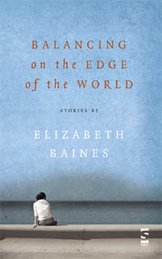
I discover that Emma Barnes of Snowbooks recently wrote on the Guardian books blog about the importance of covers, and there are some interesting comments. Although The Writers' Guild and the Society of Authors have always fought for writers to have a say in their covers, marketing imperatives often mean that this doesn't happen too much in practice, and I understand that it's the big booksellers now who often have the biggest input. But Salt is an independent publisher with a great concern for the writer, and I was asked immediately whether I had any ideas for the cover. This was wonderful, but what a responsibility! Emma Barnes says that a cover needs above all to inform you about the kind of book inside, and I was very conscious of this fact. Trouble was, though, one of my abiding principles in writing short stories has always been to make each one unique, and I couldn't then see the overriding mood or style. It was Ann French, one of the members of my reading group, who came up with the unifying notion of a sea horizon. Salt went with it and added the picture and chose the typography. I love the result and I'm grateful to them all. Needless to say, though, it's the readers who'll decide...
I discover that Emma Barnes of Snowbooks recently wrote on the Guardian books blog about the importance of covers, and there are some interesting comments. Although The Writers' Guild and the Society of Authors have always fought for writers to have a say in their covers, marketing imperatives often mean that this doesn't happen too much in practice, and I understand that it's the big booksellers now who often have the biggest input. But Salt is an independent publisher with a great concern for the writer, and I was asked immediately whether I had any ideas for the cover. This was wonderful, but what a responsibility! Emma Barnes says that a cover needs above all to inform you about the kind of book inside, and I was very conscious of this fact. Trouble was, though, one of my abiding principles in writing short stories has always been to make each one unique, and I couldn't then see the overriding mood or style. It was Ann French, one of the members of my reading group, who came up with the unifying notion of a sea horizon. Salt went with it and added the picture and chose the typography. I love the result and I'm grateful to them all. Needless to say, though, it's the readers who'll decide...
Monday, August 06, 2007
Time out
I'm still pretty tired after the play, and I'm off now to the Welsh hills to recuperate and gear up for my next commission, which I'll announce when I return.
Thursday, August 02, 2007
Sometimes I like reviewers
Now that's nice and enough to pull you out of your post-production anticlimax - a nice review of The Processing Room on Manchester Confidential:
Playing creatively with the idea of the different stages of life and death, the play raised some interesting ideas and also employed a clever use of movement to emphasise and enliven what could have been a very static waiting-room scenario.
Tuesday, July 31, 2007
Reading group: the Maltese Falcon by Dashiell Hammett
 We held our last meeting in the run-up to the play, but I don't think it was just the play which prevented me from finishing the book beforehand - Dashiell Hammett's Maltese Falcon, chosen by Mark - for I had started in plenty of time, beginning in tandem with Jenny, on our weekend to Paris in June.
Now let me put my cards on the table here. I am not exactly a fan of crime-fiction, but I do remember once reading Raymond Chandler and being pretty impressed by the ethos he conjured, and since Orion provide quotes on the cover of their current paperback edition testifying to this book's 'masterwork' status, I was prepared to be won over.
We began in the Paris apartment, me on the sofa with my copy and Jenny on the sofa-bed with hers. I read the first sentence. Sam Spade's jaw was long and bony, his chin a jutting v under the more flexible v of his mouth. Flexible v? I tried to imagine it. And who is this Sam Spade, by the way? (I haven't seen the film.) I read the next. His nostrils curved back to make another, smaller v. Eh? Two nostrils making one v? Didn't he mean two vs? Or does he mean the point the nostrils make when they come together at the end of the nose - in which case why didn't he just say he had a pointed nose? And the next: The v motif was picked up again by thickish brows (brows - rather than a writer or an interior designer -picking up a motif ?) rising outward from twin creases above a hooked nose, and his pale brown hair grew down from high flat temples - in a point on his forehead. High yet flat? And doesn't a widow's peak usually reveal enough of the head to give the forehead a rounded impression? And if it's a widows' peak, how can the hair be growing down? But maybe I've got it all wrong, because the temples are the sides of the forehead, aren't they, and that must be why he says they're flat... But then how is the hair growing down from them into a point on the forehead? Good god, I'm thinking, my mind going fuzzy with all this complicated facial geography and all the points and vs and feeling I could be missing some of them in the picture I'm piecing together, which bears a disconcertingly (or laughably) cartoonish resemblance to Captain Hook in Walt Disney's Peter Pan, and not least because I still have no real clue as to who Sam Spade is. But then the final sentence shattered the image: He looked rather pleasantly like a blond satan. What? How pleasantly? To whom? To the author? To another character in the room? And what is this rather? And can I picture it anyway?
Then before I can find out any more about Spade, we get another disconcerting description:
He said to Effie Perine: 'Yes, sweetheart?' (Who Effie Perrine? and where is all this taking place?)/She was a lanky sunburned girl whose tan dress of thin woolen stuff clung to her with the effect of dampness. Eh? What? Is this 'dampness' symbolic somehow, some thematic hint? It's somehow self-conscious enough to make you entertain the possibility, but we know so little yet about this situation and these people it's hard to grasp the nature of the hint. Or is it simply a fancy way of trying to cover up a cliche, ie 'her dress clung to her'?
You read on, and you know from the imprecision, the clunkiness and the repetition that it's the latter. 'Hey, listen to this,' I said to Jenny: 'His eyes slid from side to side between his lids. Where else would they slide?' Jenny giggled. 'Yes, I'm not finding it very gripping,' she agreed. 'I can't get my head round this,' I said as we sat in Paris airport waiting to go home: 'Spade's elbow dropped as Spade spun round to the right ... Spade's elbow went on past the astonished dark face and straightened when Spade's hand struck down at the pistol. ... His right shoulder raised a few inches. His bent right arm was driven up by the shoulder's lift. Fist, wrist, forearm, crooked elbow, and upper arm seemed all one rigid piece, with only the limber shoulder giving them motion.' The thing that Jenny's shoulders were doing was going up and down. 'I'm still trying to picure him "grinning wolfishly" all the time,' she spluttered.
Well, I'm sorry, folks, but this is a writer struggling with prose. 'You're nit-picking,' Trevor said at the meeting, and Mark, amazed that we hadn't thought the book remarkable, strongly agreed. What about the great plot, Trevor said, and I could hardly comment on it if I hadn't finished the book. I said but plot doesn't interest me in itself, and especially not a simplistic plot about recovering some old antique. Mark expostulated, But the book's not about that really, it's about Sam Spade, about the fact that he becomes humanized, which I would know if I'd read to the end. It's said to be the most complicated and clever plot in fiction, and (John said) one which people are meant to have difficulty grasping. For a start, if I'd read to the end I'd know that Spade and the femme fatale Brigid O'Shaughnessy had been double-crossing one another. I said that I would hardly call that a recommendation, a book based on plot in which the plot can't be grasped, but actually I'd known from very near the beginning what the two were up to. Mark, backed by Doug, said that that was only because the template which Hammett set with this novel has now become familiar. I stuck to my guns. I said to agreement from John that early on it's more or less stated that this is what the characters are doing, and if readers don't pick it up it's because of the fuzziness of the prose rather than any cleverness on the part of the author. In any case, I said, I'm not interested in Sam Spade, he never comes alive for me, he's described in entirely (mechanistic) physical terms, and we are never party to his feelings. For me there's a big problem with viewpoint. Somebody asked suspiciously, What's viewpoint? and I explained, not without the feeling of being thought writerly and precious: We don't share Sam Spade's viewpoint but there's no authorial viewpoint to compensate and fill in for us; the authorial eye is unknowing about Sam Spade, so there's no psychological depth. But they had already stopped listening and were discussing opening another bottle of wine, though Mark said, But that's the point - it underlines the fact that Sam Spade keeps himself close and needs to be humanized.
I said, Well, I'm sorry, but a writer needs to write better than this to convince me that this is a conscious or worthwhile strategy or to engage me at all. Mark said, exasperated, How can you say these things, when this book is held up as the greatest crime novel ever? I said, I thought you were the one that saw through hype! Mark said, But this isn't hype, this novel had stood the test of time and sold in the millions! I said, Well so has Catherine Cookson, and Harry Potter which you despise - sales don't mean great writing. Then people said, Well, no one has claimed this book is literary, it's a genre novel, it doesn't have to have great prose, and I said, Well, yes, that's why I don't go for genre fiction as a rule.
John said, 'The trouble is, most people don't care about things like that when they read a novel - language and viewpoint etc' and everyone agreed, somewhat self-righteously I thought, at which I felt like crawling away and giving up on writing and said so to no sympathy.
Then Trevor said, 'Well, the thing that really upsets us is that you laughed at it,' and I'm sorry, but I laughed again.
Subscribe to:
Posts (Atom)