Sunday, June 29, 2008

Bo Jazz at the King's Arms

I don't go often to the King's Arms in Salford, although one summer I spent a good deal of time there, as my play O'Leary's Daughters was staged for the 24:7 Theatre Festival in their fabulous round-ceilinged upstairs room (I think it used to be a billiards room), and last year after our rehearsals for The Processing Room at Salford University, Mary-Ann Coburn and I used to call in for a drink on our way back into town. I really should go more, because this is where Studio Salford is based, and they always have exciting-sounding programmes of new plays as well as their unique occasional 'embryo' nights where writers and artists can try out new sketches or snippets of plays or short films.

Studio Salford itself seems to be dark at the moment, but on Friday and last night a new independent company formed by actors Jarrod Cooke and Ryan Barber staged  the first of their own entertainments, Bo Jazz, billed as 'a new concept in live sketch shows', and directed by Helen Parry. John, Matthew and I went along. I must say the acting was brilliant. Five actors, Jarrod, Ryan, Curtis Cole, Samantha Siddall and Daniel Hayes each made lightning switches between very different characters, playing them with wonderfully accurate observation.  I liked the innovation whereby between the sketches two musicians, Daniel Willis and Johnny Smith, played live music pieces they had specially composed with the sketches as inspiration. I have to say I did find the sketches a bit laddish, and I'm not sure that the pretty vicious anti-lesbian joke at the end was quite excusable as simply a condemnation of the character who made it.
A great evening, though, and when we came down for the interval who should we bump into but several old friends who just happened to be there drinking.  I told you, I should go there more often....

Thursday, June 26, 2008

The Revenger's Tragedy at The Royal Exchange

Last night I went to the Royal Exchange production of The Revenger's Tragedy. I won't name names but, bloody hell, actors just can't seem to speak early modern English dialogue any more.
I must quickly make an exception for Stephen Tompkinson who played Vindice: none of his TV appearances I've seen have indicated to me the stature of his acting, but after last night I'd say he's a genius. Eileen O'Brien, who plays his mother, was also as brilliant as I've come to expect of her.

I went with my son Matthew and we sat on the banquettes, and I have to say we got sore bums and just before the interval our backs started aching but it was worth it, and John, who didn't come because of the bad reviews the production had had, really missed out. I knew the play from university but I'd never seen it, and it really was an experience. As the RX programme notes explain, the Jacobean playwrights thought of themselves as writing modern versions of Roman tragedy, but had overlooked the fact that the violence of those Roman tragedies was merely reported and not enacted on stage. It was a pretty strange experience to watch the Duke having his eyelids slit and his tongue cut out (you just couldn't help thinking about how they were doing it), and, as the interval started, to watch a stage hand pick up the 'tongue' and put it into a plastic pot ready for the next performance. The production self-consciously acknowledged this difficulty in suspending disbelief for a modern audience (for instance, during the use of the Duke's dead body in an intrigue there's a dance sequence performed to 'The Sun Has Got His Hat On'), but whether it worked - along with the modern dress: guys in suits using daggers and killing dukes without redress? - we're still heatedly discussing. There's no doubt however that it's made an impression and that the images will stay with us for good.

Wednesday, June 25, 2008

Messiness in Fiction

As I've written here before, I'm working on a series of short stories in which I'm trying something new. It's partly my response to, or maybe expression of, the situation we find ourselves in culturally and psychologically post 9/11, and partly perhaps my own rebellion against what I've done before - which you have to keep doing if you're not to go stale as an artist, right?

As I've said here, I've become increasingly impatient with concepts of fixed character, and with plot which leans towards singular meaning, and indeed with the whole conventional notion of story - I guess I always have, really, but I've been tipped over the edge recently. I keep asking myself: How like life is that, after all: the single interpretation, the one (authorial) viewpoint, the satisfying conclusion?

And yet... How to make stories which convey the messiness of life, the fact that sometimes there is no conclusion and we don't know the meaning - which increasingly it seems to me it's important to do - while yet satisfying the entirely understandable desire of readers for pattern and meaning?

It's hard. My story 'Possibility', which will appear in the first edition of the new online lit mag Horizon Review is one attempt. This kind of writing is exhilarating, challenging, but not easy. But an article by Anthony Neilson in today's Guardian has given me courage. He says that works of art which 'attempt to bring order to the unruliness of existence' are reductive, and that this is simply not the business of artists.

Sunday, June 22, 2008

Reading group: Anil's Ghost by Michael Ondaatje

Michael Ondaatje's The English Patient is one of the few books I have loved so much that I have read it three times in spite of all the other books out there waiting to be squeezed into the time and, more importantly, the headspace left over from my own writing. Once I told him so, at one of those legendary Waterstone's Deansgate readings, and I'm not sure what he thought - whether he was embarrassed or amused or believed me, but anyway I had to say it. It's the structure I find most beautiful - a structure so resonant with aching meanings - so I'm not a huge a fan of the film which alters it so radically.

So anyway, when Doug suggested this, Ondaatje's next novel, I had mixed feelings. Surely this too, would be great, but then surely no writer could ever come up with something so thrillingly resonant twice? In any case, I read it through the filter of the first.

The novel is set in the late eighties and early nineties in Sri Lanka, when government squads were hunting down and murdering antigovernment insurgents and separatist guerillas, and concerns the events which ensue when Anil, a young forensic anthropologist, born in Sri Lanka but having lived abroad for most of her adult life, returns to uncover on behalf of a human rights group the source of the organized campaigns of murder.

This book takes further Ondaatje's use of unusual structure to embody the themes, and this time the rationale is more overtly political. It is essentially episodic, moving from character to character and back and forth in time in a way which can seem baffling, but which people in the group quickly noted mimics both the processes of civil war in which people and meanings are scattered and the procedure of forensic archeology which must piece together seemingly disparate elements. Introducing the book, Doug began by saying that it is about Anil, although he said this rather uncertainly and we quickly agreed that it's not possible to talk about this book in such conventional terms, or appropriate to bring to it conventional expectations. While the beginning appears to focus on Anil - arriving in Sri Lanka, remembering a doomed love affair, and meeting Sarath, the Sri Lankan anthropolgist with whom she will work - by the end of the book the focus has shifted to Sarath. Indeed, it is significant that the first section is titled 'Sarath' and the title of the book does not refer to Anil herself but to her 'ghost'. Most people in the group took this last reference - the 'ghost' - to concern the skeleton on which Anil and Sarath work, but I thought it meant something much more significant: it is revealed some way into the novel that a 'ghost' is a Sri Lankan informer, and Anil does indeed have her 'informer' on the deepest level: someone who points out to her that she with her outsider's perspective is not only useless but potentially dangerous to those she purports to be working to help. As people noted, Anil has dropped out of the book's focus altogether by the end, and by creating such a major shift in perspective the structure of the book thus makes a deeply political statement. I had intended to ask the group why they thought certain sections of the book were in italics, notably Anil's memories of her work life, but I forgot and it wasn't discussed. I think now that it's another authorial device to distance and parenthesize Anil's perspective and illustrate its impotence.

Nearly everyone thought this was an immensely clever book, and nearly everyone seemed to agree that it was moving (although it struck me that they said it without seeming particularly moved). Doug said he had found it very vivid - both in terms of the depiction of the scenery and atmosphere and in terms of the character depiction, although there were some things he couldn't quite get to grips with, like the point of Anil's memories of her affair and of her friendship with another, female colleague with whom she has now also lost touch. Clare said she thought that the point of these last were that they illustrated that people never really made lasting connections because they never really knew each other, another instance of Anil's impotence and alienation.

All of this praise had rendered John completely silent, as he had been unable to engage with the novel at all, and I now said that in spite of everything I admired about the book, my experience had been rather similar: unlike others I hadn't been moved by the book since I hadn't found the characters ever came to emotional life. Jenny suggested that that was deliberate authorial strategy, a replication of the repression of people living under such regimes - which is probably true, but sadly means for me that the novel's devices were too successful, and deprived it of the resonance I'd found in The English Patient.

Our archived discussions can be found here, and a list of all the books we have discussed here.

Saturday, June 21, 2008

Succour launch at the Briton's Protection

The literary magazine scene is thriving again, thanks to the web, and one mag which has achieved prominence and a good deal of acclaim is Succour. Last night the latest and seventh issue was launched in the Briton's Protection pub here in Manc, and John and I went along and met Max Dunbar, one of Succor's several UK regional editors, and Managing Editor Anthony Banks, and heard two great readings by contributors to the current issue, Animals. Nick Royle's striking story 'The Bee Eater' displayed his trademark style, whereby everyday reality is slyly shifted into the surreal and indeed shockingly weird. Aidan Clarkson's poem, 'Feathers, Families', dealing with a strange mass metamorphosis, was equally arresting and otherworldly - all the more so for its deadpan demotic tone. Great stuff: I bought the mag forthwith.

Nick and Anthony Banks also read stories of their own which had appeared in the London Magazine (which, in spite of recent Arts Council cuts, is still going strong due to the energetic efforts of the acting editor Sarah Mae Tuson and her team). John also read: his recent serious illness has somehow pushed him back into writing poetry after years away from it and writing academic texts instead, and last night he put his toe back in the reading water with a very short poem from his Peterloo collection, In the Footsteps of the Opium Eater.

It was a great evening, and great to drive home with a sense that the small magazine scene is buzzing once again.

Sunday, June 15, 2008

Inspiration again

Speaking of 'inspiration': Nick Laird follows Anne Enright in the new Guardian Author, Author slot with an endorsement of her account of the process of beginning writing a piece as fundamentally unwilled and out of the author's conscious control. (Can't find a link, I'm afraid.) However, Laird is only speaking for poetry, the conception of which he says has 'no aspect of choice':

The right words are little coughs from off-stage, promptings, triggers, intimations of something near and distant ... and finally connected to you, right through your skin.

I like this, and I also like the fact that he says that this is why you can't just go making poetry out of other people's suggestions or reported incidents, but I'm pretty uncomfortable (as I guess Anne Enright might be) with his suggestion that the same can't be said for fiction.

As far as I'm concerned, this is a pretty accurate description of the conception of fiction (as I've indicated in the piece I wrote as part of the series on author 'inspiration' for John Baker's blog) - especially short stories which I believe are closely related to poems. Laird's account of a poem's gestation: 'Not a wholly intended process', depending on Maeterlink's 'concentration, intensity of mood', is not unlike my own description of a story's gestation in my Quill magazine interview, and for me the 'clarification' of a story similarly depends (if to lesser extent) on 'sonic effect'.

And actually, when it comes to novels, it's not that different, either, as far as I'm concerned...

This is why, when my mum rings up on Sundays with the latest scandal or family crisis and the inevitable rider: 'There's a story there for you!', like Laird I can only politely murmur agreement, knowing it won't go anywhere.

Saturday, June 07, 2008

The Short Review reviews Balancing on the Edge of the World

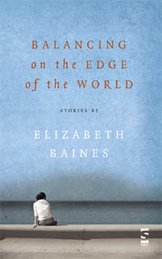
Issue 8 of The Short Review is now up, and it includes a pretty fabulous review by Melissa Lee-Houghton of my story collection Balancing on the Edge of the World .

She calls it '
a stunning debut collection by a writer whose prose deliberates its characters and themes with a keen sense of literary drama'. She also says of the stories that they are:
contemporary in the acutest sense without being limited to being fashionably modern ... Place and time are not necessarily pinned down in many of the stories, but rather swoon toward a universality which is wholly admirable ... The stories never feel forced, but prickle with a high-sensitivity to the themes which bleed through Baines’s concept of power: often nameless individuals dish out and receive humility, fear, violent threat, expectation ... Each story, though offering a heavily unreassuring perspective, feels weightless and tuned in, in the balance of the fickle order of things.

And here's what The Short Review says about me (!):

Her reputation is consistent amongst her peers and readers alike, as an innovative and committed writer of distinctly pure talent.

Eeek! Now I'll have to live up to that!

This seems to be a bumper issue, with reviews of nine other great-looking collections as well, and interviews with seven authors (including yours truly).

Wednesday, June 04, 2008

Salt's Short Story Bank

Want to get loads of contemporary short stories and a bargain to boot, including discounts and beautiful hardbacks?

Subscribe to my innovative publisher Salt's Short Story Bank.

Sunday, June 01, 2008

The need to be ready to write

Anne Enright writes about the difficulty of starting a novel, and the tricky conditions required for doing so, including one's own emotional relationship to the material. What comes over is an impression that the ability to get going on a piece is not ultimately under the author's conscious control or will.

I've written something similar on this blog, but after reading the Enright piece I got to thinking that actually, sometimes being forced to start writing rather than waiting around for the ripe moment or 'inspiration' is useful, and fruitful (well I hope it was for me!). All but the first two of my radio plays were written to commission and deadline, as were at least two of the stories in Balancing: 'The Way to Behave', which was commissioned for the Bitchlit anthology, and 'Into the Night' which was requested for a Welsh anthology of erotic stories (though the anthology never happened - not enough Welsh writers came up with erotic stories!) I've also written here agreeing with AL Kennedy that literary competitions which dictate subject-matter militate against innovation, but both of these short stories were responses to prescribed themes.

I guess, though, it's more a question of being lucky if the prescribed theme or the imposed deadline fits your own prior state of readiness, because unless you're in the 'zone' whatever you write will be dead in the water before it swims.

Friday, May 30, 2008

A good rejection?

No, I didn't get the part. But for the best reason, in this ageist world: I didn't look old enough! (If they're telling the truth, that is, and if they didn't just decide to up the age of the character to suit other actors they'd chosen, which does sometimes happen...)

It's this kind of morning when I'm glad I'm a writer really....

Thursday, May 29, 2008

Auditioning

I went for an audition today. I must be mad. I am: I don't even have to do this for a living, my career doesn't depend on it. So there I am getting dressed. What shall I wear? Well, I want to look interesting in my own right, of course (one has to get attention!), and switched-on and competent, but I also have to give some idea of my ability to inhabit the (somewhat sad) character I'm reading for.

OK, so I've made my decisions, I'm dressed, I'm off on the bus to the theatre. As I emerge from the cubicle in the theatre loo another woman is washing her hands, and I see immediately the tell-tale signs sticking out of her bag: the actor's failsafe bottle of water, the bundle of papers which is clearly the script. We eye each other swiftly and smile: camaraderie and rivalry hopelessly entwined: Is she better than me? She's bound to be, she'll be trained... Does she look more the part? I think perhaps she does...

Well, they liked my reading, the writer and the director. But then there were those looks passing between them, and I can guess what they were thinking, that thing I've thought myself as a playwright auditioning actors: Pity, she just didn't look the part...

Wednesday, May 28, 2008

Reading group: The Gathering by Anne Enright

Jenny looked pretty intent as we gathered in her living room, and when we were all seated she asked in some disgust, 'Who chose this?' I think she thought it was me, since when Clare had offered it as one of her two alternative suggestions I'd persuaded everyone to choose it over the other possible book.

Clare looked a bit non plussed, but went ahead with her admiring introduction. She thought it was wonderfully written, she said. It was a very bleak book in many ways: the first-person narration of 39-year-old Veronica Hegarty who is grieving her brother Liam's suicide and coming to terms with it by imagining the events at the heart of a family secret which may or may not have led to it. But the writing transcended the bleakness of the subject matter, Clare said: lively, witty and full of the most stunning phrases. She was most struck by the scene which Veronica first imagines early on, that of the first meeting between her grandmother Ada as a young woman and Lamb Nugent, a man she could have married but didn't, marrying his best friend instead. However, Clare had one criticism: these scenes were so beautifully imagined and written that she didn't feel that they were realistically Veronica's (as we are meant to take them), but were too much those of the author. I said that this too been Adam Mars-Jones's only criticism, just about, in his review for the Independent, and (although I loved this book so much I was loathe to criticize it) I supposed I had to agree that the register wasn't exactly Veronica's, although it hadn't struck me as I was reading it.

At which point everyone else began laying into this book. Ann said that she had liked the beginning too, but she felt it went nowhere; as she went on reading it she was thinking, 'Come on!' 'Come on what?' asked Clare, but if Ann gave an explanation it was overridden by the others' criticisms so I don't remember it. John said he too was disappointed: he had thought the book was going to be about uncovering the mystery of how Liam died, but it turned out to be something far more amorphous. Trevor and Doug said that they liked the Ada stuff but not the rest, or maybe they said the opposite, or maybe one expressed one view and the other the other, but Jenny came in most memorably with the firm view that the book was terrible and she had no idea how it could have won the Booker. None of it was consistent or made sense, she said: nothing happened, it was all conjecture.

I said, but that's the point: it's a book about not knowing, and how we deal with that. Jenny countered that none of the characters were realized: you were expected to take for granted the close relationship between Veronica and her dead bother Liam: it was never shown except for perhaps one childhood scene when they stole into a bus garage; and Veronica's estrangement from her husband over the loss of Liam is never made understandable. And look at Veronica's other brother Mozzie: he's supposed to have been a psychopath, as Veronica calls him, and then he's supposed to have this miraculous change at the end and be some kind of nice family man: you're just expected to take that on trust, and it's just not believable.

I said, But isn't that all about Veronica's perception of him, which changes? Isn't this a book about that very thing, perception, and how we make up stories about other people and give them characters in order to cope?

Jenny looked even more disgusted and said that I was putting a spin on the book it didn't deserve: these things just weren't there.

I have to say I had had one niggle about the book and now someone honed in on it: the connections that we are indeed meant to take on trust between the circumstances which led to the sexual abuse of Liam as a child and Liam's adult emotional problems and suicide. Would Liam really have been that affected by it? people asked. Clare said, Well, it depends what the abuse means to the child. Abuse is most damaging when the child is emotionally involved with the abuser. We all agreed that this must be so. But Liam could not have been emotionally involved with his abuser, and people cited examples of others they knew, including spouses, who had similarly experienced abuse by a family friend but without growing up to be emotionally disturbed by it. But then Clare pointed out a moment in the book which even I, its great champion, had missed (and which I won't give away here), and everything fell into place.

This moment is fleeting, though vivid. Once you catch it it is devastating, and in retrospect justifies the whole structure of the book and Veronica's speculations. At this point in the discussion even I began to wonder if the glancing, allusive prose which I love in Anne Enright's work does sometimes militate against her.

Doug now asked us what we thought about the sex, which he had found so graphic it was somehow disturbing. People agreed and wondered about it without coming to any conclusions, and the discussion turned, with some relief it seemed, to a general consideration of sex. In fact, said Doug, getting back to the book, he had found the whole book disturbing. He had certainly admired the prose, and he was glad he had read the book but he had found it extremely painful to read.

Clare and I were stunned, insisting that it was witty, even funny, only to be met with sceptical stares. Jenny reiterated that she thought it was awful.

Some days later Hans called round at our house to find out about the next meeting, and we discovered why Jenny had informed us so meaningfully yet cryptically that he wasn't coming to the last one. He hated the book, he told me. He had travelled back from Glasgow that day and he couldn't face sitting talking about a book with which he had utterly failed to engage, and which he had found frankly pretentious.

His wife Jan had liked it, though...

Our archived discussions can be found here, and a list of all the books we have discussed here.

The Salt Frank O'Connor Prize Blog

Want to read all about the Salt books on the Frank O'Connor long list - an astounding eight story collections, including my own, Balancing on the Edge of the World?

Then go to the The Salt Frank O'Connor Prize Blog, where you can also read and watch interviews with the authors, hear clips from their stories and see photos of their readings and launches.

Monday, May 26, 2008

Why prose fiction is sometimes the best option for writers

Who'd be a writer of films in this world of images?

I've twice had a go, experiences I satirized in one of the short stories in my collection Balancing, 'The Shooting Script', which I read on Thursday at Manchester Central Library to an audience which always includes some writers, and which responded on this occasion with wry heartfelt laughter. I don't want to boast, but Adele Geras said in a review that this story should be 'required reading for anyone who fancies themselves writing for television.'

But it's not just the structures of the industry which divest writers of power (as this story indicates), it's the requirements of the form.

On Saturday I went to a screening of a short student film which I took part in as an actor last summer. Well, I loved being in this film: I love acting, I love the camaraderie (such an antidote to the isolation of the desk!) and I loved being part of the team working on the vision of the two writer-directors. But that's just it: you are part of a team, and there's never a guarantee that everyone on that team will share the vision of the writer or indeed respect it. And let's face it, when there's a camera and an editing suite at the heart of things it's the person behind the camera and/or with their finger on the computer button who wields the power to impose their own vision. On this occasion it didn't matter, because the writers were also the directors, and bitter past experience had taught them that they needed to do their own editing.

But just how much script writers can be marginalized by the form itself was illustrated for me when I finally saw the film at a screening in a bar on Saturday afternoon. I ordered up the film (it was on the 'menu' from a bar as part of a mini film-festival) and a fortifying glass of Chardonnay (seeing yourself on film playing an overalled cleaner and later naked in a bath is NOT an ego-stroking experience!) (and nearly choked at the exorbitant price of the wine) and settled down in the dark alcove set aside for viewing.

The film opened with beautiful shots, as I knew it would, of empty offices at night time, with the lone cleaner (me) silhouetted as she busied away in the vast spaces, strangely competent yet vulnerable - scenes which we never even rehearsed: I just turned up on the appointed night and we did it. Later the film cuts, as intended, to a kitchen in a house and here the dialogue begins. But they had cut half the dialogue! Half the ruddy dialogue, which we had laboured to learn (it was difficult dialogue to learn, because it was deliberately confused, illogical and inconsequential, as the characters were stressed) and which we had rehearsed over and over...

What had happened here was that image had squashed out the words: rightly, as it happened, because the way the film begins sets up a certain grammar which needed to be fulfilled, but also because sometimes - or indeed more often, in films - image is enough to tell the story: one closeup of me saying nothing but closing my eyes was more expressive and convincing than the speech which had followed the gesture but was now cut.

Writing for film is thus not so much the writing of a script - based in dialogue - but the provision of a kind of choreography of image. It's an interesting challenge, but you could ask: Why bother, when it's the director and the cameraman who really have the power to create and choose the images? And it's not surprising, I guess, that so many directors, like the two on this film, 'write' their own.

Sunday, May 25, 2008

Quill Magazine Interview

I feel very privileged to have been interviewed by Quill editor Eric Forbes for his blog and for the July-September issue of the magazine, along with three other authors also long-listed for the International Frank O'Connor Short Story Award: Clare Wigfall, Nam Le and Wena Poon. Eric describes himself in these terms which are succour to the hearts of all writers and committed readers:
I am a book editor who lives in Kuala Lumpur, Malaysia. I am hopelessly in love with books and the freedom to read whatever makes me happy: fiction and nonfiction. I have always been obsessed with the relationship between literature and life and its role in society. As an editor, I have edited many books, both good and bad, but never get tired of the grand adventure of reading. We must never underestimate the redeeming power of fiction in our lives.

Friday, May 23, 2008

Salt reading at Manchester Central Library

So there we were on Thursday in the impressive wood-panelled committee room in Central Library, with its amazing marbled fireplace, four authors all published by Salt, Carys Davies, Andre Mangeot, Shamshad Khan and yours truly. The audience, though smallish, was a great one, laughing gratifyingly in all the right places - at Carys's wry story Boot about a dog who gets the better of his owners, at my satirical story The Shooting Script about a conman arts worker - and murmuring appreciatively at the touching story which Andre read from A Little Javanese (which had only come from the printer's the previous day!). And we all sat spellbound as Shamshad had the lights turned out and then, in the dimness, wove her customary performance magic with her voice and the words of her poems.

First off was Carys reading from her fantastic collection Some New Ambush:


Next up was Andre:


Because Shamshad read in the dark we didn't get any photos of her reading from her poetry collection Megalomania, so here she is afterwards chatting to me:


Finally, I read from Balancing on the Edge of the World, and here below is an instructive photo for all writers, reminding you to get your hair out of your face when you're reading, and try not to gurn when you're doing the characters!


And here we are chatting afterwards:

Wednesday, May 21, 2008

Salt reading and workshop


Tomorrow (Thursday 22nd May) I'll be taking part in a Salt reading at Manchester Central Library 1-2 pm, Committee Room, 2nd Floor. Free. I'll be reading from my story collection Balancing on the Edge of the World. Carys Davies will also be reading from Some New Ambush, her wonderful collection of short stories which is up for the Wales Book of the Year Award, Manchester performance poet Shamshad Khan will be stunning us all with her Salt poetry collection Megalomania, and we'll hear Andre Mangeot read stories from A Little Javanese which is hot off the press today!!

You can read more about the event here.

And on Saturday I'll be reading and running a workshop for the Chorlton Arts Festival at Chorlton Library 11.30 am - 1.30 pm. Also Free.

Tuesday, May 13, 2008

Edge Hill Prize shortlist

So here's a prize I didn't get on the shortlist for:

Tania Hershman sends me this:

The second Edge Hill Prize shortlist was announced on Saturday 10 May, at the climax of the Oceans of Stories Conference, hosted by Liverpool John Moores University and Edge Hill University. Author Helen Simpson presented the shortlist, which was selected by three judges: author Hilary Mantel, BBC Producer Duncan Minshull, and Prof. Rhiannon Evans.

The shortlist in full is:

Tiny Deaths by Robert Shearman (Comma Press)
The Separate Heart by Simon Robson (Jonathan Cape)
Walk the Blue Fields by Claire Keegan (Faber and Faber)
The People on Privilege Hill by Jane Gardam (Chatto and Windus)
Old Devil Moon by Christopher Fowler (Serpent’s Tail)


It's hard to comment if you're involved (though I don't even know if I was involved, since each publisher was allowed to enter only two books and my publishers Salt would have had to choose between several of the short story collections they have published this year). So apart from noting that, unlike the Frank O'Connor long list, this one leans towards established publishers (Comma being the one truly small press), I'll confine myself to saying many congratulations to these authors.

More about the prize here.

Wednesday, May 07, 2008

To innovate or not to innovate

I've been thinking about innovation and I've embarked on a series of short stories which are a departure from any of my previous styles. While I love a good plot and I'm a sucker for imagery, I've been getting increasingly cynical about the power of conventional narrative tropes to express our post 9/11 condition of uncertainty. The contingency of story has always been a running theme in my fiction, but now I'm thinking that character and metaphor are closed circuits unable to express our current loss of existential grasp, and above all that narrative arc is just one big - but impotent - authorial con, and in these new stories I've been trying to find a way to question them without ditching them altogether.

It can be really scary doing something new. There's no guarantee that other people will see what you doing - rather than assume you're just making a mistake, failing to achieve the conventions you're actually questioning - or if they do that they'll find it palatable. And no guarantee that you're not failing unless someone else tells you you're not. So it was with great relief that I heard this week that the last one I wrote has been accepted by an exciting new online magazine Horizon Review, named after Cyril Connelly's original Horizon, coming from the Salt umbrella and edited by poet and novelist Jane Holland. In fact, on the Horizon website Jane says that she is indeed open to writing that dares to take risks, and wishes to make the mag a place of question and challenge.

It so happened that the other day, via the Story website, I came across some pertinent comments in an article by AL Kennedy. She says rightly that the magazines that used to print stories have largely disappeared and instead:
they're left to be harried by endless small-scale competitions that merrily dictate size, content, themes and even title options.

Yes, this is the rub. Competitions which impose such restrictions (and that's most of them, as she says) make my heart sink, because they always imply certain expectations or certain acceptable norms, which simply cannot apply to innovative writing, and cannot encourage the innovative urge in writers. Clearly innovative stories do sometimes win competitions, but it seems to me a triumph over circumstance when it happens.

Sunday, May 04, 2008

Balancing on the Edge of the World on Frank O'Connor Longlist

Well, along with 38 other short story collections, including 7 wonderful others from my fabulous publisher Salt. I'm always going on, on my other blog, about the invidious aspect of literary prizes, and the way that choosing some books over others for long lists and short lists inevitably bestows negative associations on the books omitted. But this international prize, The Frank O'Connor Short Story Award, was set up specifically to draw attention to the short story and to publicize collections which have appeared within the year, and, as a function of this, the long list is deliberately inclusive.

This list is a thermometer showing the robust health of the re-emerging short story, a map of its geographical growth and an indication of the areas of publishing in which it is thriving. As last year, it shows that it is within independent publishing that the short story is thriving, and this year that Britain is now the great home of the short story. There are 8 collections here from the US, 5 from Ireland, 4 each from Australia and New Zealand, 1 each from Singapore, Taiwan and Nigeria and a whopping 14 from Britain, including 8 from Salt, who are thus announced as the Biggest Champions of the Short Story in the World!!!

Sunday, April 27, 2008

What to do on a writing retreat

Writing retreats. Joel Rickett reports for the Guardian that they've gone so exotic that you can now go on 'literary adventure holidays' to places like Thailand with recitals and elephant trekking laid on.

Writing retreats? You've got to be kidding me. I've been on two fairly conventional British writing weekends, but the last thing I could do was write I was so busy watching the writing tutors preen and compete with each other, the students getting off with each other and the retreat managers getting cross either because someone had used the spare room for an assignation or because no one would bring the wood in for the fire!!

Friday, April 25, 2008

A proper book tag

I don't normally like tags of course, but this time I'm really happy to be tagged by Norm with this good one:

1. Pick up the nearest book.
2. Open to page 123
3. Find the fifth sentence.
4. Post the next three sentences.
5. Tag five people, and acknowledge who tagged you.

My nearest book was happily one I love, a volume of short stories, The Loudest Sound and Nothing by Clare Wigfall. I was (and am) sitting on the landing at the top of the stairs: it's where I banish my computer when I'm working hard on a first draft, which I always do in longhand, or trying to get back to writing after a disruption, which I am now, after John's recent illness. The Loudest Sound and Nothing was sitting on the top step ready to go downstairs to the shared bookshelves: tidying my study is another way back into writing for me, so that's what I'd been doing.

Page 123 was unfortunately blank, so I turned to the next printed page, 125, where the story 'Night after Night' begins, and here's what I ended up with, just one example of the multifarious voices in the book:
I couldn't for the life of me think why they'd be ringing on us. Took off me apron and fluffed up me hair in case the two bobbies at the door was going to want to come in, but then Stan come back with his coat and hat on and tells me he's gotta go down to the station to answer a couple of questions.

'Couple of questions?' I said. 'What do they want with you?'

I'm tagging Debi Alper, Ms Baroque, Tania Hershman, Vanessa Gebbie and Charles Lambert, who can ignore it of course if they wish.

Wednesday, April 16, 2008

Reading group: The Hours by Michael Cunningham

Three parallel narratives, featuring respectively Virginia Woolf struggling with her demons, a young woman, Laura Brown, trapped in suburban motherhood in the nineteen-forties and longing to escape and read Virginia Woolf's novel Mrs Dalloway, and a middle-aged woman Clarissa arranging a party in the nineteen-nineties for an old lover who is dying of Aids and who once nicknamed her Mrs Dalloway after that fictional Clarissa.

Ann, who had suggested this novel, said that in the event she wasn't sure what she thought of it, as she didn't feel that the perspectives of the three women were sufficiently differentiated and in particular she couldn't get to grips with the Laura Brown character: she understood the trap Laura was in but couldn't see how such a strong-willed character could have got into such a trap in the first place.

This caused some surprise: others felt on the contrary that the characters were very well differentiated, and those who had grown up in sixties suburbia in Britain had found Laura Brown and her position entirely recognizable. Indeed, everyone else thought this book was wonderful - even Jenny. Initially Jenny had resisted the idea of this book as she didn't like parallel narratives, but even though the connections between the different strands had seemed superficial she had found it absorbing, and in any case at the end it is revealed that they are not separate stories at all.

We had quite some discussion about this last. Trevor said that when he suddenly realized the connections so near the end he wondered if he had been really thick in not guessing them before. I said I didn't think so: I thought it had been deliberate structural strategy on Cunningham's part to spring a surprise. I thought that there was nothing so moving as to discover that an old woman you were despising along with one character was in fact the same person as a young woman you'd been identifying with, and Hans strongly agreed.

On the other hand, I couldn't help questioning this strategy, since had we known the connections as we were reading there would have been resonances which inevitably we missed - though as Jenny said, the thing about great literaure is that it makes you want to read it again, and on a second reading we would experience them.

I think we were in no doubt that this was great literature. John had been seriously ill while I had been reading it, and the book's overriding theme of death had at times made it quite difficult for me to read, yet I had always gone back to it: it had seeped into my consciousness the way great literature does. The only other quibble was Doug's: he wondered about the occasional breaches of the novel's convention when we are given the viewpoint of minor characters; yet Doug was perhaps one of the greatest admirers of this book.

It wasn't overall a long discussion. It was the kind of occasion, I think, where a book hits you in the gut, and intellectual discussion seems not quite the point.

Our archived discussions can be found here, and a list of all the books we have discussed here.

Monday, March 31, 2008

Balancing on the Edge of the World reviewed on Stuck in a Book

Simon Thomas at Stuck in a Book reviews Balancing:
Baines' stories are executed with a subtle smoothness, and a precise portrayal of human relationships - both the surface of them, and what goes on underneath.

His favourite in the collection is 'Compass and Torch', of which he says:
The story I wanted to pick out is 'Compass and Torch' - in the third person, an uncertain boy on a trip with his Dad, whom he doesn't often see. 'The boy is intent. Watching Dad. Watching what Dad is. Drinking it in: the essence of Dadness.' The awkwardness of their relationship - with its latent closeness, and surface of discomfort - is portrayed so exactly. We see it first in relation to the torch, of which the boy is so anxiously proud:

The boy is chattering: 'Have you brought one too, have you brought a torch?'
'Oh, yes!'

Is this a problem? the boy suddenly wonders. Does this make one of the torches redundant? For a brief moment he is uncertain, potentially dismayed, a mood which the man, for all his distraction, catches.

'We can use both of them, can't we, Dad?'


'Oh yes! Yes, of course!'

Then a swoop of delight: 'We can light up more with both, can't we?'

'Oh yes, certainly!' The man too is gratefully caught on a wave of triumph. 'Oh, yes, two are definitely better! Back-up, for a start.'
I shouldn't dream of telling you the end of this story, except that it is done calmly in a couple of sentences, and won't leave your mind for some time.

He reviews it alongside Vanessa Gebbie's wonderful collection, Words from a Glass Bubble, also published by Salt, and which he also loved.

The whole review here.

Sunday, March 23, 2008

Fragments from the Dark, edited by Jeni Williams and Latefa Guemar

So I went to Swansea for the launch of Fragments from the Dark, to which I feel privileged to have contributed with one of the stories in my collection and a piece from a novel in progress. It's an anthology of writings about home and exile, edited by Jeni Williams and Latefa Guemar and produced by Hafan (Haven), the Swansea Bay Asylum Seekers support group. The book includes work from professional women writers either born or settled in Wales, such as Carol Rumens, Trezza Azzopardi and Tessa Hadley, and many moving testimonies from women expelled from many different parts of the world and finding themselves in Wales.

A vast crowd crammed into the Dylan Thomas Centre to hear speakers from refugee support groups, readings and music.
In the week when we learn that in our complacent, supposedly 'post-feminist' society Women's Studies are being dropped from some universities and in which, out of a narrow, middle-class perspective, people have called for an end to the Orange Prize as outdated positive discrimination, the point was strongly made here - most clearly by Lynn Hughes from Oxford Cymru - that asylum issues at any rate are women's issues. 'Women do two-thirds of the world's work and make half the world's food and are more likely than men to be involved in community groups', she pointed out, 'yet are less likely to be decision makers... Domestic violence is still the biggest cause of death in women... The asylum system still does not recognise the differing needs of men and women.' Editor Latefa Guemar asked the gathered crowd to take a moment to think of one of their female members who was being held in detention.

Yet if there were solemn and urgent issues running through the evening, there was also a sense of celebration - celebration that people could come together like this and support each other. And then, unbelievably, we were treated to a banquet such as I have never seen before: food prepared by 20 different cooks from 20 different countries.

The large audience:


The woman in blue at the front, who was sitting next to me (and is avidly reading the book), turned out to be Beth Thomas from the Welsh history museum at St Fagans, and who was there on behalf of contributor Elin Ap Hywel (who edited the Honno anthology Power which includes my story 'Power').

Editors Jeni Williams and Latefa Guemar:


Amani Omer Bakhiet Elawad reads the Arabic version of her poem 'I Journey towards You', and Jeni Williams reads the English version (a translation they made together):


The amazing food:


I was very moved (and very full!) by the time John and I left for our hotel which, though slap-bang in the centre of town, was like one of those old-fashioned country hotels with proper wooden wardrobes and antique lamps and breakfast served in the old-fashioned way, and - fittingly, I guess, for the home town of Dylan Thomas - literary novels on the shelves in the lounge.

Next day we nipped off the M4 and called unannounced on my one remaining relative in the village I come from, my Aunt Peggy, who failed to answer the door right away because she thought we were Jehovah's Witnesses.

So, you could say I went home for the launch of a book about home. But so much has changed. When I was little and lived in that village, there was no motorway and Swansea was a very long way away: we were nestled among the trees and cut off from the world, and I'm ashamed to say we sometimes felt invaded when incomers came down for the day from Cardiff to the beach.

Some things change for the worse, but that evening in Swansea, that sense of connection across borders - so beautifully symbolized in the book's cover image of footprints criss-crossing the sand - showed that some things do change for the better.

Wednesday, March 19, 2008

Sartre, eat your heart out.

We had a secondhand bookshop here in Didsbury - well, it still is a secondhand bookshop (though once it was an ethnic clothes and bit-and-bobs shop run by my friend Judy), but they've now turned the front bit into a little teashop and called it The Art of Tea (though they also serve pretty good coffee) and bake yummy cakes on the premises. Anyway, in spite of what the local paper would have you believe, I've never been a big frequenter of the local cafes, but just recently John and I have been tempted into the Art of Tea, and would you believe it, just as the local paper would have it, it turns out to be a right Mecca of metropolitan arty types. First off this afternoon we discovered poet Phil Davenport working away on his computer, and then when we sat down at a nearby table we discovered among the used cups and plates a discarded draft of someone else's poem - a poem full of food images, perhaps not surprisingly.

I tell you, it's the Left Bank of the Mersey round here...

Monday, March 17, 2008

Reading group: The Sheltering Sky by Paul Bowles

Trevor suggested this novel which concerns a young married but sexually estranged couple, Port and Kit Morseby, who escape the aftermath of the Second World War by travelling to North Africa and later into the Sahara, only to find themselves divided further.

Trevor said he thought the novel would raise some really interesting issues, but as it happened no one else was fired enough by it to discuss it with much passion. Two people said that they couldn't even finish it, Jenny because she simply found it boring and Ann because, having lived in that area of the world, she found it unrealistic.

Trevor found this hard to believe. He said he thought it was great: didn't we all think it was dead exciting and vivid, for instance, when Port went off on his dangerous sexual adventure at the beginning of the novel? And weren't the larger-than-life mother and son, the Lyles, whom they meet along the way - with the hint of their incest - fascinating? And what about that amazing scene when the dogs are running around in one of the towns with pieces of the body of an abandoned baby?

People seemed a bit nonplussed by Trevor's reaction. Sure, these things were vivid, they said, as were the striking descriptions of the North African towns and the Sahara, but what about the central characters? They just weren't at all likeable and you couldn't care about their story.

I said that you don't need to like the characters to like a novel - though Jenny said she did need to like at least one - but I did agree that you do need to have some emotional investment in their fate. I wondered if the reason we didn't is that although we are treated by the omniscient narrator to very detailed accounts of their feelings and motives, those accounts are very clinical and so those feelings and motives remain at a distance to us.

The book is in three parts and, for reasons I won't reveal here, in part three Kit has an adventure alone, joining a merchant camel train in the desert, and in this part the book undergoes a pretty radical change of style. John said he said he found this third part the best, in fact he really only liked this part, at least things start happening and the pace of the prose hots up - and Trevor quickly agreed. Doug and I cried that we much preferred the first two parts, in fact we hated the last part, not finding it believable in the slightest. Trevor said, But Kit had no choice but to join the caravan, and she had no choice but to succumb to whatever the merchants then demanded of her. I said, that's not the point: I can well imagine in theory that this would be the case, but the novel doesn't convince me, ie the way it's told, and Clare said, You mean the writing, and Trevor said sardonically, Oh, the writing!

I insisted. I said it is the prose in part three which is unconvincing - rushed and staccato. Clare said, but rushed and staccato prose can be appropriate, after all Kit's in a state of turmoil. I said, Yes, it can - for instance I thought the rushed (though fluid) prose replicating Port's typhoid delirium is beautifully done and this is one of the points in the book I find psychologically and emotionally involving - but in part three the prose rhythms and the sentence constructions seem rushed to me in the sense of being unconsidered, even lazy.

John said that what he liked about this last part was that in focussing on Kit it made the book about women and the condition of women, and most of the men agreed. I said that I didn't actually think that this was a specific intention on Bowles' part, as not only are parts one and two more about Port than Kit, I had read in Michael Hofmann's introduction to the new Penguin Classic that when Bowles had got to the end of part two he had decided to use a different writing method for the rest of the book: automatic writing (which eschews thought or conscious 'art') - which would also explain not only the change in style but the nature of the prose here.

In other words, I felt that by loosening the reins of his artistic consciousness, Bowles had merely reproduced here an unconvincing male fantasy about a woman, a fact which showed up in the prose.

At which Trevor insisted once more that this was how Kit would have behaved.

Ann said that she wasn't even convinced by Kit's behaviour in the first two parts, which was why she had stopped reading before then. Also, she had found the book unremittingly colonial in its perspective, and that it colluded too far with Port's racist view of Arabs as 'monkeys'. (How on earth could they have made a film out of it at that rate? I asked, and Clare, who had seen the film, said that they had excised all the racism and romanticised it all, especially part three, and indeed bleached it of the real theme - the emotional and existential barrenness of the characters - so that in fact it had been like watching paint dry.) Some people quibbled with Ann's point, saying that there were some sympathetic Arabs in the book, that the author is not necessarily to be identified with Port, and that even Port despises the anti-semitism of the Lyles. But as Ann said, the perspective of no Arab is ever represented (although she guessed that was par for the course at the time of the novel's writing), and it's all relative.

And then Trevor said how much he'd enjoyed the exciting bit towards the end and Kit's imprisonment and escape, and explained to us doubters why she would have acted exactly as she did.


Next time, we're discussing Ann's choice, The Hours by Michael Cunningham - by the skin of our teeth, as Jenny said that she didn't like novels with parallel narratives.

Our archived discussions can be found here, and a list of all the books we have discussed here.

Friday, March 14, 2008

Getting into the zone

I've been writing really slowly, which is unusual for me. Partly I think it's because I'm trying something new - a new way of writing stories for me - and I'm feeling my way with it, but it's also because I've been pretty distracted by family illness.
Every now and then I read something, usually on the web, which implies that writers have no business letting themselves get distracted, that it's just too precious, for writing is a job of work, and writer's block is nothing but a pretentious excuse for something much more down-to-earth: simply getting stuck.

Well, I've given out plenty of advice in my time for dealing with this last but, you know, sometimes it really isn't just a matter of practicalities. As far as I'm concerned, in order to write you really do need a particular psychic state - emotionally different for each thing you write, but always a separate space from that which you inhabit day-to-day. It's as the athletes and sports people say: you need to get 'in the zone'. It's a kind of dream-like state, a kind of trance - indeed, John has sometimes come into my room when I'm writing and touched me on the shoulder and I haven't even noticed. And it's hard to get into it when there are other things on your mind like your brother's chemo or your partner's hospital tests.

As fellow Salt author Carys Davies has said to me, writing time needs to be 'pure'.

Well, maybe it doesn't for some people. Maybe they are better than me and Carys at cutting off and getting into the zone whatever's going on. But then if you can't do it so easily, aren't you disadvantaged or disabled? And no one wants to condemn the disabled for their disability, do they?

Thursday, March 13, 2008

Some New Ambush by Carys Davies long-listed for Wales Book of the Year 2008

Last time I decided to go to Welsh Academy's Wrexham Library launch of the long list for the Wales Book of the Year Award, it was called off at the last minute due to snow, and yesterday I thought I might not make again it because of the gales, but luckily the winds died down during the afternoon. I especially wanted to go this time because I had an exciting hunch that my fellow Salt author, Carys Davies, was on the long list (I'm psychic, right? No, actually, I just picked up some clues and put them together) and sure enough she had, and had made it there too (in a roundabout way, due to the closure of the Thelwall viaduct)!

The three judges for the English Language prize were represented at Wrexham by writer and broadcaster Mavis Nicholson. Introducing their long list, she said that they'd had 200 books to consider (which is more than the Booker judges have to contend with). Like former Booker judges who have commented recently, she said that with such a large number the job was very onerous, and constantly going from one book to a very different other made it difficult to be sure to give each book the right kind of attention. She suggested, therefore, that in future, particularly in view of the fact that so many of the books had been 'fluffy', the organizers operated some kind of filtering system before handing over to the judges. She said also that the judges had been very struck by the poor editing of books nowadays and that it was very clear that many books are now hardly edited at all.

Then she announced the ten long-listed books, five of which come from small presses:

Winterton Blue - Trezza Azzopardi (Picador)
Hector's Talent - Kitti Harri (Honno)
Don't Cry for Me Aberystwyth - (Bloomsbury)
The Claude Glass - Tom Bullough (Sort Of Books)
Blue Sky July - Nia Wyn (Seren)
Trouble in Heaven (Gomer)
Some New Ambush - Carys Davies (Salt)
The Presence - Dannie Abse (Hutchinson)
The Master Bedroom - Tessa Hadley (Cape)

Congratulations to all of them and especially (since I know her) to Carys!

Mavis Nicholson happened to be leaving for the car park at the same time as John and me. She said her husband would be turning in his grave if he thought she'd judged a competition, since he didn't believe in them. I said, Well, I don't really, and I told her that I'm always going on about it on my other blog, but then when someone you know wins one, well you can't help but be very pleased indeed!

Wednesday, March 12, 2008

Launch of Words from a Glass Bubble by Vanessa Gebbie

Really great time last night at the launch of Vanessa Gebbie's collection of short stories from Salt, Words from a Glass Bubble. John and I arrived completely windswept to find ourselves in the most beautiful surroundings in London's Foundling Museum, champagne being poured and Vanessa resplendent at a table piled high with her beautifully produced book and people already queueing to have copies signed. Periodically throughout the evening Vanessa read instalments of her wry and touching title story, which was a nice way to do it. And three of us turned out to be wearing almost identical costumes, me, Vanessa and the gent in the oil painting below which she read. And then, all too soon it was time to rush off through the wind again to Euston and to spend the journey immersed in those stories, heartbreaking yet witty, gritty yet other-worldly and totally original - so that we got to Stockport before I realized and had to make a scramble for the door.


People queueing:


Me and Jen from Salt having a natter:


and sporting our fabulous Salt bags:

Monday, March 10, 2008

Salt wins Nielsen Innovation of the Year Award

I am thrilled to be able to announce that my fabulous publisher Salt has won the Neilsen Innovation of the Year Award at the Independents Publishers Awards
'...for its imaginative efforts to increase sales of collections of poetry and short stories despite very challenging market conditions. It impressed with its range of web-based marketing initiatives and partnerships and energetic development of its brand.'

Publisher and fiction editor Jen Hamilton Emery (pictured with publisher and poetry editor Chris Hamilton-Emery) says:
it's great to win an award that matters to us, and especially one which signifies that the literary sector is able to drive sales and get noticed on a national scale.

Saturday, March 08, 2008

Hanif Kureishi at Manchester University

On Thursday night Hanif Kureishi read and talked to a sold-out theatre at Manchester University. Kureishi turned out to be a frank yet even-handed speaker and said what seemed to me eminently sensible things about writing. Yes, he thought intuition was a big part of writing but then you always had to have a rational understanding as to why you were following your intuitions. Yes, he thought (like me) that the distinction between autobiographical and non-autobiographical writing was a dubious one. Yes, he thought you developed as a writer as you got older, you learnt more skills but you can lose some of the fire of untutored youth. Yes, he had swapped about from form to form but he wouldn't say he liked any of them better than the others, films were good for making money and for getting away from the isolation of the desk, prose gave you more or less total creative control. Novels are great to get your teeth into but also hard work and short stories can come as light relief when you've finished one. Did he like working with actors? Well, if we thought writers were a pain we should meet some actors, they were awful, but then on the other hand he's been really grateful to the actors he's worked with, they can give an underwritten part wonderful life.

The narrator of his latest novel, Something to Tell You, is a psychoanalyst, and writing as therapy was a strong thread through the evening. The way he told it, he himself took up writing as the best form of therapy, but then on the other hand, as he always tells his creative writing students, you've always got to be aware of the reader and write for the reader. I'm not sure how the Creative Writing students in the audience must have reacted when, asked whether he agreed with Will Self's condemnation of the teaching of Creative Writing, Kureishi said that he could see where Self was coming from, there really was something dodgy about it all: what the universities are up to in fact is making money out of the fees, and it would be an utter cruelty to give 'these people' the impression they were likely to get a publishing deal, the point of it all for most of them was therapy (which of course is important), and some of them in fact were 'absolutely barking' - in fact he's noticed that when you get these shootings in American universities the perpetrators always turn out to be students of Creative Writing. But then after all it's true that madness is close to genius and all great writers really have to be mad - at which point the audience laughter turned from nervous to relieved.

It was an extra nice evening for me, as while I was waiting for the reading to begin, I looked up at the woman who was sitting down beside me and realized it was my friend, writer and counsellor Brenda Mallon whom I hadn't seen for ages. One of the many books Brenda has written is Women Dreaming, and afterwards she asked Kureishi how much he used his dreams in his writing, and he answered: 'All the time.'

Friday, March 07, 2008

Where do you get your inspiration? or The distraction of literature

Yesterday I went to have my hair cut.

I've been wanting a change but I've been having trouble getting my hairdresser to make it.

Me: Well, last time you did agree I should have a few layers at the front, but actually you didn't do it in the end.

My hairdresser: Oh yes, yes, that's what we'll do!

He starts snipping. He says, So what have you been up to? and I tell him, I'm doing a new series of short stories. What about? he wants to know. I tell him about the one I'm writing now set on a train. I tell him about the ones I've already finished, the one about the airport, and the one about driving too fast on the motorway, and one about getting lost with a map, and the one I'm going to write about a robbery.

He snips thoughtfully. He says, I guess you can write a story about anything!

I agree that you can.
I say: Oh. Don't you think I could have some shorter layers than that?
Oh, yes, yes, sure! he says, and gets snipping at the front.

He's thoughtful again. He looks up excitedly, scissors poised. He says: You could write one about a hairdresser! Shenanigans in the salon!

I say I could! Go on then, give me some material!

He says quickly: Or you could make him a mobile hairdresser! All those things he could get up to in women's houses!

And then we talk about the earthquake and other things. He goes quiet. He says: Or the salon. All those things he could get up to in the salon!

I say, Yes, right! Give!

He laughs. No, no I'm not telling you anything!

He says he's done.

What happened to the shorter layers? I say.

Thursday, March 06, 2008

Monday, March 03, 2008

Selling short stories

Recently I noted how unusual (and good) it was that Faber have promoted as a virtue the varied nature of the stories in Clare Wigfall's collection The Loudest Sound and Nothing, and BookFox has commented similarly on the promotion of John Shepard's prizewinning collection Like You'd Understand Anyway.

BookFox now alerts us to an interesting essay by publisher Gina Frangello, replicated on The Literary Outpost, a section of which deals with the reasons why for so long now the typical published short story collection has been interconnected facets of a unified whole (or indeed an episodic novel):
Often, when I presented at panels, writers in the audience asked why short fiction had met with such a decline in popularity. After all, many reasoned, if the contemporary attention span has become geared towards sitcoms and videogames, then aren’t short stories the ideal medium for the hip young reader? The answer, I often suspected, had nothing to do with what the contemporary reader would actually read, and much more to do with what marketing departments could successfully tell them to read. While a novel can be easily marketed with a few plot-summarizing taglines (and a memoir even more so, especially if its author is famous and his/her life already well-documented in the tabloids), it is much harder to “sell” a collection of 10 or so diverse stories with no common characters or plots.

As I think I have said here before, when my own collection, Balancing on the Edge of the World, was in production I nearly died when we had to start thinking of a single unifying characteristic for marketing purposes, since my aesthetic purpose in writing the stories had been to make each one unique. I had approached each story as a whole new adventure: a new idea which required its own unique way of telling (so that you won't even find a unity through the book in the way the dialogue is punctuated, as each story required its own particular mode). But of course, since they had all been written by me with my continuing obsessions, I was able to choose fourteen stories which linked thematically, and there are other links - in subject matter and in style - criss-crossing the collection.

Shepard's publishers have no qualms, though: here's the brave or foolish but undoubtedly exhilarating blurb on his book (thanks to BookFox): "So varied in tone, theme, voice, and setting are these stories that they might've been written by a hydra."

Friday, February 29, 2008

The necessary evil of research

How I hate research. I mean I like it in itself but oh how I hate what it does to the writing process. I've just spent most of this morning on the internet turning into a train nerd and researching how modern trains work - all for one small section of the short story I'm writing. And I found out what I needed to and was armed to carry on with the story - and I couldn't! Because of course you need a different kind of thinking: you need to let the research sink back away into your less conscious brain, and wait for the story to reassert itself with the new information attached in the ways that suit it best.

Grr. May as well give up and go and get lunch.

Thursday, February 28, 2008

Letting writers be who they are

Playwright Dennis Kelly complains in today's Guardian about the way that writers must be pigeonholed, expected to write the same thing over and over and assumed to be unable to move from one genre to another. People can't come to terms, he says, with the fact that he writes both serious theatre and comedy for TV.

I know exactly what he means. At the playwrights' Christmas get-together, where all the old Theatre Writers' Union members but me were now or had been Emmerdale writers, I was asked why I had never written for TV. Good question. Once a very well known TV playwright, who is known also for generously helping other writers, put my name forward to a TV drama executive. Well, you can't imagine a better leg-up than that, can you? But guess what, it got me nowhere: my track record of prizewinning radio plays and literary prose fiction (about which the drama exec was very complimentary) were just not the right qualifications for an aspiring TV playwright - quite the opposite, I suspect.

Kelly's comments also apply to the system of 'writer development' in most of our new-writing theatres, which I've written about before, and of course, while Kelly is writing about playwrights, the same applies for writers of books.
'...it's time we let new writers be who they want to be, without forcing them to make artificial decisions about who they are and what they should write.'