Funny how sometimes you can't write straight away about books that have had a deep impression on you - you need time to get to grips with them in a less emotional way. That's the experience that novelist Lisa Glass says she has sometimes, but that those are the books that turn out to be her favourites. I'm thrilled that she counts The Birth Machine as one of those books, and that it now appears, with a simply lovely review, among her four Books of the Year (so far) on Vulpes Libris.
She refers to its 'gorgeous layers, its portrayal of wild childhood, and ... the bold
questions that it dares to ask about the way that people allow
themselves to be subsumed by received opinion' and says that 'just like Elizabeth Baines’s other recent novel Too Many Magpies, The Birth Machine leaves an indelible mark on its reader.'
Saturday, April 28, 2012
Sunday, April 22, 2012
Reading group: The Book of Evidence by John Banville
Jo suggested this novel narrated by 38-year-old Freddie Montgomery, waiting to be tried for the murder of a maid who happened to appear in the doorway while he was bumblingly stealing a Dutch painting from the stately Irish home of long-term family associates. It's an apparent explanation of his actions in which however his motives remain unclear, and in which he paradoxically expresses views that repudiate concepts of motive and cause and effect.
Jo said that she had already read this book three or four times, and she will probably do it again, because although the narrator is so repellant - pompous, self-centred, utterly misanthropic (he refers to 'golliwog' hair and expresses his distaste for 'queers' and his view of women is pretty unreconstructed) and without moral sense (his view of pity is as the only permissible version of the urge to give weak things a good hard shake) - she found it so very beautifully written. We all agreed that the prose, for which Banville is famous, is indeed striking: beautifully modulated sentences and stunning visual descriptions making the whole extremely visually vivid, (including in this case repeated descriptions of the quality of sunlight that one critic has acutely pointed out aptly chimes with the Dutch masters' preoccupation with light), though peppered throughout with archaic vocabulary - he uses words like bespeaks, tarried and athwart - and others requiring reference to a dictionary. Elegant is the word I'd use for this prose, and this is Freddie's prose purportedly, since this is his confession: elegant, sensitive, educated; fastidious yet lush.
He's really revolting, though, Jo said of Freddie, and spent some moments exclaiming about him: the way, at the start of his story, having given up a career as an academic scientist to spend a life of selfish idleness on Mediterranean islands, he toys with a man who amuses him by blackmailing him to lend him money with no intention of paying it back, money that the man clearly hasn't got and must acquire from elsewhere, and is unconcerned when the man then has his ear cut off by those he borrowed from in turn. Leaned on now however by gangsters for the money, Freddie legs it back to Ireland, leaving his wife and child in the gangsters' 'care'. The way, said Jo, he doesn't seem to care about his wife, or his child - the fact that we don't even find out until near the end that the child is disabled!! The way he abducts the maid without even really having a motive (she's just in his way, but it's not as if he's really panicking or even thinking about what he's doing, and he seems in the ensuing hours to have no conception of the danger from witnesses), the psychopathically clinical way he notes that when he hits her head with a hammer it feels like hitting clay or hard putty! His revolting drunkenness! His utter self-centredness in the way he tells the story!
Still, Jo said, she thought the book was a wonderful read because it was so well written, by which she meant that the prose was so beautiful, and Trevor agreed that the book was really great.
Doug said, though with a rather mischievous grin, that he didn't actually think the character was all that awful, and he found himself identifying with him, and even feeling that in certain circumstances he too could hit someone on the head with a hammer. I think by this he was implying that the prose was so good it drew you into Freddie's psychology, however horrible. Others, however, didn't feel that it did. John said that he was alienated by the self-consciously fine writing, the long passages without variety of tone, the sameness of the obsessive viewpoint without the relief of others. Jenny said she hadn't enjoyed reading it at all: it was made quite clear from the start that Freddie was a murderer and a horrible person, and there was no further development on that notion: all that the book was was an explication of that, and it wasn't an enjoyable experience.
In fact, though, it's very hard to get to grips with the nature of Freddie's psychology. There's huge ambiguity running through the whole thing. As noted, although this is purportedly a confession, Freddie's motives always remain unclear. Initially it seems that he has returned to Ireland to raise the money to pay back the debt and free his wife and child, but both the debt and his family seem quickly to drop from his consciousness, and when he discovers that his mother has sold off the paintings he considered his inheritance, and has spent the money, his main preoccupation seems be the injustice of his disinheritance and the personal slight to himself. When he drives to the house of the dealer and old associate to whom she sold them (and who, it turns out, has sold them on at a profit), and spies the Dutch master, he seems driven not by revenge or financial need so much as a simple falling in love with the painting itself and a desire to possess it - and yet he very soon dumps it along with the body of the maid, and with a consequent farcical and self-important sense of triumph: I would never again need to pretend to myself to be what I was not.
Indeed, Freddie comments on his own lack of definition and the lack of clarity of motive. He has always, he says, had a sense of myself as something without weight, without moorings, a floating phantom. He was always different from others who
I did say to the group that I thought that Freddie's realisation of his own failure seemed to me to come about rather suddenly, without any prior development, and the others nodded, Doug in particular agreeing that it was clunky. I said too that I had some fundamental problems with the arcane diction: not only did it seem out of character - why would a mathematician use such language? His justification, that he uses a dictionary, doesn't seem adequate - also it is too similar to the diction of the narrator of Banville's The Sea which we read previously, and one begins to suspect that it's Banville's diction rather than Freddie's. As a result, although in many ways I found the novel clever, I didn't sense enough separation between narrator and author to make me feel comfortably secure in an author's controlling hands, and, although Trevor had said how much he enjoyed the book, he strongly agreed.
Our archive discussions can be found here and a list of the books we have discussed, with links to the discussions, here
Jo said that she had already read this book three or four times, and she will probably do it again, because although the narrator is so repellant - pompous, self-centred, utterly misanthropic (he refers to 'golliwog' hair and expresses his distaste for 'queers' and his view of women is pretty unreconstructed) and without moral sense (his view of pity is as the only permissible version of the urge to give weak things a good hard shake) - she found it so very beautifully written. We all agreed that the prose, for which Banville is famous, is indeed striking: beautifully modulated sentences and stunning visual descriptions making the whole extremely visually vivid, (including in this case repeated descriptions of the quality of sunlight that one critic has acutely pointed out aptly chimes with the Dutch masters' preoccupation with light), though peppered throughout with archaic vocabulary - he uses words like bespeaks, tarried and athwart - and others requiring reference to a dictionary. Elegant is the word I'd use for this prose, and this is Freddie's prose purportedly, since this is his confession: elegant, sensitive, educated; fastidious yet lush.
He's really revolting, though, Jo said of Freddie, and spent some moments exclaiming about him: the way, at the start of his story, having given up a career as an academic scientist to spend a life of selfish idleness on Mediterranean islands, he toys with a man who amuses him by blackmailing him to lend him money with no intention of paying it back, money that the man clearly hasn't got and must acquire from elsewhere, and is unconcerned when the man then has his ear cut off by those he borrowed from in turn. Leaned on now however by gangsters for the money, Freddie legs it back to Ireland, leaving his wife and child in the gangsters' 'care'. The way, said Jo, he doesn't seem to care about his wife, or his child - the fact that we don't even find out until near the end that the child is disabled!! The way he abducts the maid without even really having a motive (she's just in his way, but it's not as if he's really panicking or even thinking about what he's doing, and he seems in the ensuing hours to have no conception of the danger from witnesses), the psychopathically clinical way he notes that when he hits her head with a hammer it feels like hitting clay or hard putty! His revolting drunkenness! His utter self-centredness in the way he tells the story!
Still, Jo said, she thought the book was a wonderful read because it was so well written, by which she meant that the prose was so beautiful, and Trevor agreed that the book was really great.
Doug said, though with a rather mischievous grin, that he didn't actually think the character was all that awful, and he found himself identifying with him, and even feeling that in certain circumstances he too could hit someone on the head with a hammer. I think by this he was implying that the prose was so good it drew you into Freddie's psychology, however horrible. Others, however, didn't feel that it did. John said that he was alienated by the self-consciously fine writing, the long passages without variety of tone, the sameness of the obsessive viewpoint without the relief of others. Jenny said she hadn't enjoyed reading it at all: it was made quite clear from the start that Freddie was a murderer and a horrible person, and there was no further development on that notion: all that the book was was an explication of that, and it wasn't an enjoyable experience.
In fact, though, it's very hard to get to grips with the nature of Freddie's psychology. There's huge ambiguity running through the whole thing. As noted, although this is purportedly a confession, Freddie's motives always remain unclear. Initially it seems that he has returned to Ireland to raise the money to pay back the debt and free his wife and child, but both the debt and his family seem quickly to drop from his consciousness, and when he discovers that his mother has sold off the paintings he considered his inheritance, and has spent the money, his main preoccupation seems be the injustice of his disinheritance and the personal slight to himself. When he drives to the house of the dealer and old associate to whom she sold them (and who, it turns out, has sold them on at a profit), and spies the Dutch master, he seems driven not by revenge or financial need so much as a simple falling in love with the painting itself and a desire to possess it - and yet he very soon dumps it along with the body of the maid, and with a consequent farcical and self-important sense of triumph: I would never again need to pretend to myself to be what I was not.
Indeed, Freddie comments on his own lack of definition and the lack of clarity of motive. He has always, he says, had a sense of myself as something without weight, without moorings, a floating phantom. He was always different from others who
did not realise that everything is divisible. They talked of cause and effect, as if they believed it possible to isolate an event and hold it up to scrutiny in a pure, timeless space, outside the mad swirl of things ... to speak even of an individual with any show of certainty seemed to me foolhardy. [My bolds]Is this honesty or obfuscation? This is the greatest ambiguity at the heart of the book. Freddie's 'honesty' seems often an affectation, a way of justifying his selfishness and misanthropy while yet indulging in it, and a self-centred revelling in his own awfulness, in particular in the descriptions of his actions and physical state after the murder, and his subsequent bouts of drunkenness. This, to me, makes the elegance of his prose an elegance of decadence - an ornate covering for ugliness - and so I couldn't relish it, as Jo could, for its own sake, and for this reason, although I found the novel immensely clever, I didn't actually enjoy reading it. On the other hand, there are shards of what seem to me like real honesty, moments of self-irony, in particular in Freddie's treatment of his attitude to his mother. In the group discussion Ann said that the problem in discussing Freddie's motives was that you couldn't be sure that any of the events he related actually happened: for one thing, he'd been drunk most of the time. Yes, I said, and for another there are quite pointed and perhaps paradoxically honest moments indicating that Freddie is making the whole story up. Right at the start he makes this statement: Do you swear to tell the truth, the whole truth and nothing but the truth? Don't make me laugh. On more than one occasion he wonders what to decide to call a character and at one point exclaims, For God's sake, how many of these grotesques am I expected to invent? In other words, Freddie is specifically playing with the concepts of reliable and unreliable narrators, and, as I said to the group, it seems to me that the subject of the whole novel is the fakeness of (conventional) narration, with its assumptions about 'character' and cause and effect. (Although at this, John told me later, Trevor, who was sitting next to me, gave me a very amused and dubious look.) Viewed in this light, the decadence I see in Freddie's prose usefully highlights the point: the way that 'fine writing' can be a blind for flimsiness or superficiality or even lack of moral rectitude. In this light, too, Freddie's abandonment of science seems not so much louche laziness as the result of a metaphysical crisis:
I took up the study of science in order to find certainty. No ... to make the lack of certainty more manageable.Towards the end of the novel and his confession Freddie concludes that the reason he had been able to murder the maid was that he had failed to see her as a real person, had failed to imagine her properly:
This is the worst, the essential sin, I think, the one for which there will be no forgiveness: that I never imagined her vividly enough, that I never made her be there sufficiently, that I did not make her live ... I could kill her because for me she was not alive.People had commented how one of the most horrific things about Freddie was the contrast between this failure and the way that he was able to imagine the life of the woman in the Dutch painting he stole, a reproduction of which he now has on his cell wall. This reconstruction of the girl's days in front of Rembrandt's easel and her relationship with her widowed father is very moving, an act of real and surprising empathy on Freddie's part that brought tears to at least this reader's eyes. I said I thought that this signalled a moral development on Freddie's part, but others didn't agree: after all, they said, he was taken by the woman in the painting in the very moments that he saw the maid merely as an object in his way, and John said to me later, isn't it horrific that he can show empathy to an imaginary woman but finds real women a threat? However, it seems to me that a message of this novel is that we should not make that distinction between real life and the imagination - we have to inject the latter into the former, and while story-telling can be fake, it is the power of the imagination that makes us empathic moral beings. And at the end of the novel, when Freddie's wife visits him in prison, he comes to realise that he had never really known or understood her - in other words, never truly imagined her. As for the maid, he sets himself the task of truly imagining her and her life, and at the very end begins to do so:
Today, in the workshop, I caught her smell, faint, sharp, metallic, unmistakable. It is the smell of metal-polish - she must have been doing the silver that day. I was so happy when I identified it! Anything seemed possible. It even seemed that someday I might wake up and see, coming forward from the darkened room into the frame of that doorway which is always in my mind now, a child, a girl, one whom I will recognise at once, without the shadow of a doubt.However, when I read that quote to John just now, he snorted, and I must say that in view of Freddie's earlier comments about certainty, that without the shadow of a doubt possibly has an ironic ring.
I did say to the group that I thought that Freddie's realisation of his own failure seemed to me to come about rather suddenly, without any prior development, and the others nodded, Doug in particular agreeing that it was clunky. I said too that I had some fundamental problems with the arcane diction: not only did it seem out of character - why would a mathematician use such language? His justification, that he uses a dictionary, doesn't seem adequate - also it is too similar to the diction of the narrator of Banville's The Sea which we read previously, and one begins to suspect that it's Banville's diction rather than Freddie's. As a result, although in many ways I found the novel clever, I didn't sense enough separation between narrator and author to make me feel comfortably secure in an author's controlling hands, and, although Trevor had said how much he enjoyed the book, he strongly agreed.
Our archive discussions can be found here and a list of the books we have discussed, with links to the discussions, here
Sunday, April 15, 2012
A trip, a reading, a new magazine and some story chapbooks
Some bits and bobs - which is about all I can manage at the moment: I've had a lousy cold for over a week and am feeling pretty washed out. I spent Easter in Berlin, and the very first afternoon began to feel low and chilled; I thought maybe it was just the weather, which was very cold and drizzly-damp, but no, by next day I had a fully-fledged cold and a chest infection so bad that from then on I had to sleep partly propped up. But I had never been to Berlin before, and I wasn't about to miss out on anything, so I kept on going through the cold - the day we visited the horrendous former Stasi prison, it was blowing snow and hail - but once we got back to the UK I completely succumbed and have been good for nothing since. (Just hope I didn't give it to too many people on the plane).
As for Berlin, apart from the overwhelming history, there were some striking literary resonances for me: Hans Fallada's Alone in Berlin is a book that left a great impression on me when we read it for the reading group, and it turned out that Jablonskistrasse, in which the protagonist lives, was only two streets away from the friend's flat in which we were staying. I felt spaced out the whole time not only by a virus but also by the stunning intersection of past and present and fiction and reality.
I hope also that I didn't give anyone the cold on Thursday evening, as I wasn't going to let it stop me going to a significant event at Blackwell's Manchester University Bookshop: Salt publisher Chris Emery launching his striking new poetry collection, The Departure, and reading with Ian Duhig and Michael Symmons Roberts. Superb readings compered by Fat Roland in inimitable style, and a great meet-up with some familiar figures - writers Adrian Slatcher, David Gaffney, Sarah-Jane Conlon, Edmund Prestwich, Eleanor Rees, Steve Waling and Ian Pople - and introductions to poet Lindsey Holland and novelist Tim Shearer. A convivial drink in the Salutation afterwards, when I learnt from Adrian of his exciting new venture, a new literary magazine for innovative fiction - called 'New Magazine' - for which he is seeking material. And then, before anyone else, I left and stumbled back home to bed.
Every so often an envelope comes through my door containing the latest publications from Nick Royle's Nightjar Press - chapbooks, each containing a single uncanny story - and another came not long before I went away, this time two stories by Claire Massey. The uncanny needs sophisticated handling, not least to avoid that less-than-uncanny descent into the over-literal and the sensationalist presentation of macabre event either insufficiently or over-explicitly yoked to psychology, and in a whole imprint dedicated to the uncanny the results are therefore inevitably variable. But the idea of lovingly publishing short stories in a way that concentrates the attention on each one individually - the way they should be read, in my view - is a good one, and the chapbooks are indeed fine objects.
Wednesday, April 11, 2012
The life of books on the web
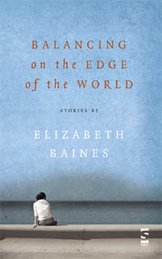
A great thing about the web is the way books can go on getting reviews long after publication. To my delight yesterday, four and a half years after Balancing on the Edge of the World came out, Bookersatz published a review by Claire Marriott. She calls it 'an intense collection of stories' and finds the 'characterisations ... particularly vivid, ranging from comic to tragic but always retaining their believability'. I'm always immensely interested to find which are people's favourite stories in the collection - it's amazing how much that differs! - and this is what Claire says:'My favourite pieces are Daniel Smith Disappears Off the Face of the Earth which contrasts one life-altering moment in the life of a teenage boy with “all the times and places in the history of the world” and Power, the haunting story of a young girl listening to her parent’s relationship fall apart.'
And of course people go on discussing books on the web on a more casual level. I was thrilled when a couple of days ago poet Steve Waling urged his Facebook friends to read The Birth Machine and called it 'really rather brilliant, deep dark and moving.' And once again it struck me how a book that was first published only for a women's market is now, on its republication by Salt, finding such favour with male readers.
Tuesday, April 10, 2012
A visit from Vanessa Gebbie with The Coward's Tale
Today I’m delighted to host Vanessa Gebbie who’s on a blog tour to celebrate the paperback publication of her novel, The Coward’s Tale, first published by Bloomsbury last November.
The Coward's Tale is the first novel from Vanessa, who is also the author of two vivid collections of short stories from Salt, Words from a Glass Bubble, and Storm Warning, as well the contributing editor of Short Circuit: A Guide to the Art of the Short Story (Salt).
The Coward’s Tale is a striking novel: set in a mid-century Welsh-Valleys mining town, it’s a mosaic of vivid stories concerning the inhabitants, told by the old beggar Ianto Jenkins to anyone who’ll listen. But there’s one story he hasn’t told, his own – until, that is, he’s finally prompted by his friendship with young Laddy Merridew, an unhappy little boy who has come to stay with his granny in the town. It’s a story which strikes at the heart of the town, concerning a disaster in the past, the collapse of the ironically named Kindly Light pit, and which, when he finally tells it, brings together all of the stories. It’s very clever, the way Vanessa brings together so many threads, and the novel is striking too for the distinctive voice in which it’s told – both demotic and lyrical, a voice that’s been compared to that of Dylan Thomas – and the sheer inventiveness of the tales, which, while concretely vivid, have something about them of magic or miracle.
This is a novel about the redemptive power
of storytelling, and, inspired by its striking images and motifs, I asked
Vanessa about her own considerable storytelling powers:
TOFFEES
EB: Ianto Jenkins tells his stories to the cinema queue, but only if they’ll give
him a toffee or two. ‘Stories need fuel, they do,’ he says. What is your fuel
for telling stories, Vanessa, and what do you consider your reward?
VG: Hmm, interesting question. I think my main
fuel for telling stories is firstly that I love stories - and maybe I am
telling them to myself? But secondly the possibility that someone will listen
to it, or read it. While I am writing, I rarely plot - so in a way the story is
telling itself to me as I type alongside - and that can feel really exciting
even though it doesn’t happen nearly often enough! I want to share that sense of discovery with others. There
is, for this writer, no point in writing for a filing cabinet, or a hard drive.
Even if I was only given the opportunity to have work ‘out there’ years after
I’d gone, I think I would still write - actually, it would be blissfully
liberating. (Although someone would have to work out the payment issue while I
was still around, please!)
My reward is feedback from readers. It
doesn’t come often, in the form of written feedback, but I’ve been lucky enough
to have a couple of letters from complete strangers who’ve read The Coward’s
Tale - and the fact that
they have been moved to write and tell me how much they’ve loved it, is
wonderful fuel.
But I also love toffees... and
liquorish...just like Ianto.
EB: Me too re liquorish. I must say it all took me back to my own childhood in Wales when we were all the time dipping into bags of sweets (terrible for our teeth - and how did we ever manage to eat our meals?!). There was a real sense of authenticity about the book in terms of those details. My Welsh Mum read it too - I bought her a copy of the hardback for Christmas. And the detail that amazed her was the smell of the lead blacking when an oven heats up. She said she'd forgotten all about it and you brought it right back, and it was just so right in conjuring up the atmosphere of that time!
WOODEN FEATHERS
EB: Icarus Evans the Woodwork Teacher has striven all his life to do the
seemingly impossible, to carve feathers out of wood so light they will float.
(And, magically, in the story it turns out to be not so impossible.) The novel
too has a magical quality, but I read that you worked hard, like Icarus, to
perfect and polish the prose. How long did you work on this editing stage, and
how much store do you set by that kind of editing graft when you write?
VG: Ah there is nothing magical about the
answer to Icarus’s question, really.
The answers are under our noses, most of the time, we just don’t see
them!
I finished the first complete draft in
January 2010. I’d reached my own
limit, and needed help to polish and strengthen the structure, so it wouldn’t
be just a ‘novel in stories’ much as I enjoy those, but a different beast. With
an Arts Council Grant for the Arts, I was able to pay for a period of mentoring
with the wonderful novelist Maggie Gee, whose own work is so beautifully
structured and lucid, I knew I had a lot to learn from her. She was (and is!) incredibly generous. We’d
meet and she’d give painstakingly detailed feedback on the manuscript and I’d
go off and work on it - I was very disciplined! She might comment on the prose, and I’d always marched up
and down reading it out loud - so
more of that got done.
In the end, every paragraph, every
sentence, every space, got reassessed during that time, either by us both, or
by me, in the course of the general revision.
When my agent sent the novel out, he said
‘they are either going to go for it as it is, or not at all...’ and he was
right. Because I’d worked so hard
on edits over some nine months in the end, give or take (my Dad died in the
middle, so there were some months were nothing much got done at all, I hope
understandably...) there were not many tweaks to make when it came to preparing
the manuscript for publication
with Bloomsbury.
I work hard at my writing, as I know you
do. There was a time when I thought my early drafts were terrific, with a
bounce and a buzz that was easy to kill with too much tinkering. But now, I’ve
learned to approach editing in a more subtle manner, and hopefully, I don’t
edit the life out as I go.
FISHING:
EB: Matty
Harris, the Deputy Bank Manager, fishes obsessively
in the river for the elusive big fish, while Half Harris, the ‘half-wit’
brother he won’t acknowledge, fishes for random objects. But it is Half Harris
who catches the fish. How often does it happen for you that a story you’re
writing is different from what you planned? Did that happen at all with this
novel?
VG: Oh golly, constantly. I don’t plot and
plan. I follow a vague shape, and see what happens to make the clay as it were,
and I shape it later. As I said above, I see writing as telling myself a story.
If I know what’s going to happen, why bother writing it?
I remember being told once, ‘if the writer
isn’t surprised by the story, the reader sure as hell isn’t going to be...’ or
words to that effect. That is so true!
But back to the editing question - I suppose the skill is to keep the
surprise, whilst smoothing...
DIGGING AND SILVER LEAVES:
EB: There are some mysterious goings-on
in the town, as well as some seemingly weird behaviour. James Little, the old
Gas-Meter Emptier, digs his allotment by moonlight, and every year Judah Jones
the Window Cleaner collects the silver leaves that fall from the trees in the
park and disappears with them off into the church. While this makes them seem
odd, even weird characters, both turn out to have very good reasons. How do you
feel about your characters as you write?
VG: I think people are endlessly interesting.
Even the most seemingly ordinary people have oddities and quirks if you look
closely enough. As I write, I am
very close to the characters. I care hugely about their predicaments - even
though the predicaments are something I must have put them into. I hang around until they’ve extricated
themselves, like walking to the shops behind your four-year-old, hidden behind
trees, just to make sure he’s OK. There are always reasons why people do things
- reasons why we are as we are - one layer of The Coward’s Tale is peeling away
that first layer, to show that, hopefully. It’s so easy to make a snap
judgement about someone - and
usually, that leads to the wrong conclusion, don’t you think?
EB: Most definitely. And the book definitely does that: pulls away those layers to show the sometimes surprising truth about people in moving ways.
MAPS:
EB: Bloomsbury
made you a lovely musical map of the town, which can be seen and heard here - and which also appears in the paperback edition. How concrete a map of the town did you have in your head as you wrote? There’s
also a theme of maps in the novel: can you comment on the significance of the
fact that Tutt Bevan the Undertaker is looking for a straight line through the
town, a true line that maps, with their complicated boundaries, can’t tell?
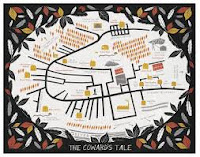
VG: Bless the lovely Alice Shortland at
Bloomsbury, who came up with the idea, and put my husband and I through our
paces over a whole weekend, while I tried to draw the street pattern I
remembered from my childhood stays in Merthyr, and he played the artist!
Basically, no - I had no map. I just wandered in my memory down real streets,
into real kitchens, front rooms,
back gardens and parks. But
the memories of childhood places are shifted by time, aren’t they, and
by competing memories. So in the end I put a note in the back to that effect.
“I have moved mountains, I have shifted your streets,” basically - in case
anyone got upset at what I’d done to their town.
It’s hard to comment and explain what Tutt
is doing - in a way, explanation deadens it, possibly? All I know is, his
grandfather dealt with a death by going on a journey - and Tutt is perhaps
dealing with his own coming twilight (literally, too, as his sight is weak...)
by trying to do the same?
But also - specifically talking about
Tutt’s journey, don’t we try to iron out all the twists and turns of life, to
make things simpler for ourselves? Like Icarus, he sets himself an impossible
task. At the end of that tale - there is an answer, again, although maybe not
what he was expecting!
Following a map stops us taking unexpected
detours and discovering new places... that’s so true. Look at Sat Nav - half
the time I have no idea where I’ve just driven. I’ve just gone where I have
been told.
TUNNEL:
EB: The old railway tunnel is the scene of another disaster, the death of a child, but also in the end the scene of closure for the bereaved mother. The novel doesn’t shrink from darkness, yet is full of humour and in the end redemption. Can you talk a bit about this, and the role of story-telling in overcoming grief?
VG: Life is a glorious mix of light and dark,
isn’t it? I have great faith in the strength of the human spirit to make the
best of things - but sometimes, don’t we need a bit of help to do that, in the
form of a mirror, metaphorically, so we can see ourselves and our situation
reflected back at us? Stories are
that mirror. In stories, as we
learn about characters, don’t we also learn about ourselves?
I have read in many learned places how
stories are important as they teach us to empathise with others. Without them,
we become centred on self, perhaps - I like to think the airing of the stories
in The Coward’s Tale is one way in which the community begins to understand
itself, and takes a step towards healing itself.
Howzat for philosophy?
Elizabeth, its been great - thank you so
much for hosting a stop on the tour, and thanks for such searching questions.
EB: And thank you so much, Vanessa, for stopping by and giving us such great insights into the process behind your very distinctive and moving novel.
Readers: do give yourselves a treat and read The Coward's Tale if you haven't already. And Bloomsbury are offering a free copy for one lucky winner: just say in the comments below if you'd like to be put in the draw.
If you don't win, or can't wait, it can be ordered from here.
The previous stop on Vanessa's tour was over on Jen Campbell's blog, and tomorrow she will be with Charles Lambert discussing the novel's story of a same-sex love and its theme of the elusive question of human happiness. Details of the complete tour can be found here).
EB: And thank you so much, Vanessa, for stopping by and giving us such great insights into the process behind your very distinctive and moving novel.
Readers: do give yourselves a treat and read The Coward's Tale if you haven't already. And Bloomsbury are offering a free copy for one lucky winner: just say in the comments below if you'd like to be put in the draw.
If you don't win, or can't wait, it can be ordered from here.
The previous stop on Vanessa's tour was over on Jen Campbell's blog, and tomorrow she will be with Charles Lambert discussing the novel's story of a same-sex love and its theme of the elusive question of human happiness. Details of the complete tour can be found here).
Thursday, March 15, 2012
Reading group: Generation X by Douglas Coupland
This meeting was another near-fight.
Jenny chose this iconic early-nineties novel about a group of three educated late-twenties escapees from corporate life, Andy, Dag and Claire, looking for a deeper meaning while working at 'McJobs' in California and telling each other stories that reflect their frustrations, fears and longings.
As soon as I arrived in the already full room I was aware of an attitude of contempt, and Mark said straight off that he hadn't read the book as it was clear from the blurb that it was self-indulgent and he found the format pretentious - he had the early square format edition in which illustrations and, in my opinion, wittily ironic definitions of contemporary phrases are situated in wide margins at strategic points in the text. He said he even found the typeface pretentious and unreadable.
Notwithstanding, Jenny then introduced the book and said that she had enjoyed it, that she saw that it was about anomie, but that there wasn't actually much of a story in that nothing much happened, so she didn't really have a lot to say about it, and that what she liked most of all were the footnotes (which is how the definitions appear in her later edition).
I said, isn't the book more specifically about the fact that these young people have inherited a soulless materialistic world which makes it difficult for them to fulfil themselves?, a comment which was met with derision by those who hadn't even read the book. Pretty annoyed at having to defend the characters, and the book, against such opinionated condemnation from people who hadn't even read it, I said that I had found the characters touching, especially in their relationships: they were a platonic friendship group (of two men and one woman) who cared for each other in a touching way. Yes, said Clare, who had read the book: They snuggle up together in a hippy-dippy way - making it clear that she wasn't enamoured of the characters either, and eliciting vindicated groans from the others. I had praised the narrative voices of the characters as astute and witty - I loved for instance the description of Toronto as giving 'the efficient, ordered feeling of the Yellow Pages sprung to life in three dimensions' - but Clare said that she had found the voices slick and the characters consequently smug. I said but surely, as well as being ironic about the world around them, narrator Andy is self-ironic. It's best evidenced, I think, in this 'footnote' which however I didn't quote at the time: 'KNEE-JERK IRONY: The tendency to make flippant ironic comments as a reflexive matter of course in everyday conversation'. Clare said that she really wasn't sure that there was self-irony. She said that the characters and their attitudes reminded her very much of those in Dave Eggers' A Heartbreaking Work of Staggering Genius (discussed previously) which she had also disliked - but which I had admired. It turned out too that Doug, who had also read the book, couldn't relate at all to the characters and had found them unengaging.
There was much derision about the fact that the characters drop out of supposedly soul-destroying yuppie jobs only to get 'McJobs', working in shops and bars, which are hardly more fulfilling! Even Clare defended the characters on this, saying that the point is that they are no longer defined by their unfulfilling jobs, but that didn't wash with the detractors: surely, the answer came, they are just messing about, knowing that they can depend on their middle-class parents, so they are hardly rebelling against their parents' generation. And they go home for Christmas!! Only middle-class people can afford to drop out, it was cried. Ann, had, like me, liked the prose and especially the 'footnotes', but did now agree with the detractors that the characters' situations were something of a middle-class indulgence. In fact, there is a 'footnote' which comments on this, self-ironically in my opinion, but I didn't recall it during the discussion: 'SAFETY NET-ISM: The belief that there will always be a financial and emotional safety net to buffer life's hurts. Usually parents.' There was more derision about the fact that the characters choose to do their dropping-out in California. I should have quoted a passage from near the beginning which I think carries conscious irony about the compromise involved. Noting the lordly luxuries of the rich retired inhabitants of the area, narrator Andy says,
I said, maybe in the wider context the ability to choose to try, at least, to 'drop out' from it is a middle-class privilege and the doing so therefore a middle-class indulgence, but that didn't mean you could characterise these three young people as simply personally self-indulgent: they were thoughtful, and concerned with the conundrum of it all, and also suffering. In a more thoughtful and measured discussion I might have been able to draw attention this early passage:
Mark said that it was all well and good to complain about the state of the world but the book doesn't provide any answer (not that he'd read it), and then we had a skirmish about whether or not novels need to provide answers, which Mark insisted they do. Some people referred to fact that the trio finally go off to Mexico with the notion of starting a hotel, and Mark's derision quadrupled: another kind of running away!! And in order to run a hotel, he objected, wouldn't they end up needing the very structures (accountants etc) they were supposed to despise?! People told him, no it's not that kind of hotel, the characters say they wouldn't charge for rooms: it's just a kind of idealistic dream really; and Mark's derision went through the roof. Backed by John, I said, yes, it's flakey, but that's the point: the book is about the fact that if you can't face the structures society endorses - you're unsuited to them or you disapprove of them - then there aren't really any other very viable options. John brought in the question of the situation for artists, which I thought confused the issue, but Jo, who up to this point had been a detractor, took up his point and agreed that there are certain jobs in our society that are rewarded and others, including artistic endeavour, that tend not to be. To some extent this did back up my point, but, I said, the characters here are not artists, and so don't even have the compensation of artistic fulfilment. Having rejected the endorsed structures they have nothing (just that 'silence'). I said, surely that's a legitimate subject for a novel - ie the fact that there aren't any answers - and several people agreed. Mark said, well, in any case the characters were unlikeable, and now we had that other old skirmish about whether or not you need to find characters likeable in order to like a novel, Mark insisting - I'm damn sure for the sake of argument! - that you did, until John brought in Jane Austen and Vanity Fair with their unlikeable but endlessly interesting characters. But then Clare said that she simply hadn't found these characters or their situation, or indeed the book, interesting.
Earlier, in response to the initial accusations of superficiality, John had pointed to the frequent apocalyptic references in the novel: it begins with Andy remembering seeing the eclipse of the sun at the age of fifteen, and Dag is fascinated by the nuclear test sites in Nevada and brings back from there melted sand which terrifies Claire in case it's still radioactive. Their dreams and stories are full of death and nuclear annihilation. Towards the end Andy sees the smoke from farmers burning their fields and thinks it's the fulfilment of his nightmare, a nuclear cloud. Trevor now spoke up at last and said with a great air of reason and calm, which at long last made people shut up and stop interrupting, that in his opinion this book, far from being superficial, was about very serious, important and current matters: the ruination of the world and the wastage of the lives of future generations through environmental pollution, financial collapse and nuclear threat.
Mark, however, was intransigent and went on pooh-poohing the book while the conversation broke up and people began to talk about other things. Ann, Clare and I happened to be sitting together around one corner and the three of us continued talking about the book, and I had what I felt was my first proper and thoughtful conversation of the evening. Clare is a brilliant one for stopping and searching through the text to examine the truth of points that are made in the conversation (I'm hopeless at it at the time, as I find myself swept on by the conversation and the interruptions). In response to the points about death and the apocalyptic, she had remembered Andy's dream about his own death - which I hadn't remembered - and she had been looking for it in the text. She now found it and reminded us that in it a pelican gives him a fish, and she now related this to the end of the novel when he and a party of other travellers are standing watching the nuclear-cloud-like smoke from the fields. An egret flies over, so low that it sears the top of his head, and a party of children with learning disabilities come over and touch him and hug him to comfort him, and this is precisely how the book ends. It's as if, she said, the book is about Andy's search among all the superficiality and cleverness and harshness of the world for simple human comfort, and this then seemed true to Ann and me. The only trouble was, she said, that she hadn't liked the slick voices - which I had earlier pointed out were really one voice, the characters all tending to talk the same. This last I acknowledged as a flaw in the book, and which perhaps to some extent justifies Mark's conflation of the author and the characters. Nevertheless, Ann and I said that we had been really taken with the wit of that voice, but I did concede that the cleverness of the voice itself was in danger of making the book seem more superficial than I considered it to be.
Our archive discussions can be found here and a list of the books we have discussed, with links to the discussions, here
Jenny chose this iconic early-nineties novel about a group of three educated late-twenties escapees from corporate life, Andy, Dag and Claire, looking for a deeper meaning while working at 'McJobs' in California and telling each other stories that reflect their frustrations, fears and longings.
As soon as I arrived in the already full room I was aware of an attitude of contempt, and Mark said straight off that he hadn't read the book as it was clear from the blurb that it was self-indulgent and he found the format pretentious - he had the early square format edition in which illustrations and, in my opinion, wittily ironic definitions of contemporary phrases are situated in wide margins at strategic points in the text. He said he even found the typeface pretentious and unreadable.
Notwithstanding, Jenny then introduced the book and said that she had enjoyed it, that she saw that it was about anomie, but that there wasn't actually much of a story in that nothing much happened, so she didn't really have a lot to say about it, and that what she liked most of all were the footnotes (which is how the definitions appear in her later edition).
I said, isn't the book more specifically about the fact that these young people have inherited a soulless materialistic world which makes it difficult for them to fulfil themselves?, a comment which was met with derision by those who hadn't even read the book. Pretty annoyed at having to defend the characters, and the book, against such opinionated condemnation from people who hadn't even read it, I said that I had found the characters touching, especially in their relationships: they were a platonic friendship group (of two men and one woman) who cared for each other in a touching way. Yes, said Clare, who had read the book: They snuggle up together in a hippy-dippy way - making it clear that she wasn't enamoured of the characters either, and eliciting vindicated groans from the others. I had praised the narrative voices of the characters as astute and witty - I loved for instance the description of Toronto as giving 'the efficient, ordered feeling of the Yellow Pages sprung to life in three dimensions' - but Clare said that she had found the voices slick and the characters consequently smug. I said but surely, as well as being ironic about the world around them, narrator Andy is self-ironic. It's best evidenced, I think, in this 'footnote' which however I didn't quote at the time: 'KNEE-JERK IRONY: The tendency to make flippant ironic comments as a reflexive matter of course in everyday conversation'. Clare said that she really wasn't sure that there was self-irony. She said that the characters and their attitudes reminded her very much of those in Dave Eggers' A Heartbreaking Work of Staggering Genius (discussed previously) which she had also disliked - but which I had admired. It turned out too that Doug, who had also read the book, couldn't relate at all to the characters and had found them unengaging.
There was much derision about the fact that the characters drop out of supposedly soul-destroying yuppie jobs only to get 'McJobs', working in shops and bars, which are hardly more fulfilling! Even Clare defended the characters on this, saying that the point is that they are no longer defined by their unfulfilling jobs, but that didn't wash with the detractors: surely, the answer came, they are just messing about, knowing that they can depend on their middle-class parents, so they are hardly rebelling against their parents' generation. And they go home for Christmas!! Only middle-class people can afford to drop out, it was cried. Ann, had, like me, liked the prose and especially the 'footnotes', but did now agree with the detractors that the characters' situations were something of a middle-class indulgence. In fact, there is a 'footnote' which comments on this, self-ironically in my opinion, but I didn't recall it during the discussion: 'SAFETY NET-ISM: The belief that there will always be a financial and emotional safety net to buffer life's hurts. Usually parents.' There was more derision about the fact that the characters choose to do their dropping-out in California. I should have quoted a passage from near the beginning which I think carries conscious irony about the compromise involved. Noting the lordly luxuries of the rich retired inhabitants of the area, narrator Andy says,
Nevertheless, the three of us chose to live here, [that, surely, is self-ironic, even potentially straightforwardly self-critical] for the town is undoubtedly a sanctuary from the bulk of middle-class life. And we certainly don't live in one of the dishier neighborhoods. There are neighborhoods here where, if you see a glint in a patch of crew-cut Bermuda grass, you can assume there's a silver dollar lying there. Where we live, in our little bungalows that share a courtyard and a kidney-shaped swimming pool [more self-irony, surely?], a twinkle in the grass means a broken scotch bottle or a colostomy bag that has avoided the trashman's gloved clutch.But in a discussion in which people arguing vociferously and dismissively hadn't even read the book, such textual focusing was hardly possible. I did say that what we hadn't discussed were the vivid descriptions of the detritus filling the environment - notably, as John pointed out, the fact that as the book opens Andy is clearing from his dogs' nostrils a fatty substance that he suspects is from the bins of the nearby liposuction clinic. Those who had read the book now cried with recognition and agreement, but I'm not sure if I got my point across, ie that what's indicated by these descriptions is that these young people have inherited a mess of a world not of their own making.
I said, maybe in the wider context the ability to choose to try, at least, to 'drop out' from it is a middle-class privilege and the doing so therefore a middle-class indulgence, but that didn't mean you could characterise these three young people as simply personally self-indulgent: they were thoughtful, and concerned with the conundrum of it all, and also suffering. In a more thoughtful and measured discussion I might have been able to draw attention this early passage:
We live small lives on the periphery; we are marginalised and there's a great deal in which we choose not to participate. We wanted silence and we have that silence now. [An ironic sentence, that last, I'd suggest: the silence isn't exactly unproblematic.] We arrived here speckled in sores and zits, our colons so tied in knots that we never thought we'd have a bowel movement again. Our systems had stopped working, jammed with the odor of copy machines, Wite-Out, the smell of bond paper, and the endless stress of pointless jobs done grudgingly to little applause. We had compulsions that made us confuse shopping with creativity, to take downers and assume that merely renting a video on a Saturday night was enough. But now that we live here in the desert, things are much, much better.The overprotestation of that final repetition and stress carry especial conscious irony, I'd say.
Mark said that it was all well and good to complain about the state of the world but the book doesn't provide any answer (not that he'd read it), and then we had a skirmish about whether or not novels need to provide answers, which Mark insisted they do. Some people referred to fact that the trio finally go off to Mexico with the notion of starting a hotel, and Mark's derision quadrupled: another kind of running away!! And in order to run a hotel, he objected, wouldn't they end up needing the very structures (accountants etc) they were supposed to despise?! People told him, no it's not that kind of hotel, the characters say they wouldn't charge for rooms: it's just a kind of idealistic dream really; and Mark's derision went through the roof. Backed by John, I said, yes, it's flakey, but that's the point: the book is about the fact that if you can't face the structures society endorses - you're unsuited to them or you disapprove of them - then there aren't really any other very viable options. John brought in the question of the situation for artists, which I thought confused the issue, but Jo, who up to this point had been a detractor, took up his point and agreed that there are certain jobs in our society that are rewarded and others, including artistic endeavour, that tend not to be. To some extent this did back up my point, but, I said, the characters here are not artists, and so don't even have the compensation of artistic fulfilment. Having rejected the endorsed structures they have nothing (just that 'silence'). I said, surely that's a legitimate subject for a novel - ie the fact that there aren't any answers - and several people agreed. Mark said, well, in any case the characters were unlikeable, and now we had that other old skirmish about whether or not you need to find characters likeable in order to like a novel, Mark insisting - I'm damn sure for the sake of argument! - that you did, until John brought in Jane Austen and Vanity Fair with their unlikeable but endlessly interesting characters. But then Clare said that she simply hadn't found these characters or their situation, or indeed the book, interesting.
Earlier, in response to the initial accusations of superficiality, John had pointed to the frequent apocalyptic references in the novel: it begins with Andy remembering seeing the eclipse of the sun at the age of fifteen, and Dag is fascinated by the nuclear test sites in Nevada and brings back from there melted sand which terrifies Claire in case it's still radioactive. Their dreams and stories are full of death and nuclear annihilation. Towards the end Andy sees the smoke from farmers burning their fields and thinks it's the fulfilment of his nightmare, a nuclear cloud. Trevor now spoke up at last and said with a great air of reason and calm, which at long last made people shut up and stop interrupting, that in his opinion this book, far from being superficial, was about very serious, important and current matters: the ruination of the world and the wastage of the lives of future generations through environmental pollution, financial collapse and nuclear threat.
Mark, however, was intransigent and went on pooh-poohing the book while the conversation broke up and people began to talk about other things. Ann, Clare and I happened to be sitting together around one corner and the three of us continued talking about the book, and I had what I felt was my first proper and thoughtful conversation of the evening. Clare is a brilliant one for stopping and searching through the text to examine the truth of points that are made in the conversation (I'm hopeless at it at the time, as I find myself swept on by the conversation and the interruptions). In response to the points about death and the apocalyptic, she had remembered Andy's dream about his own death - which I hadn't remembered - and she had been looking for it in the text. She now found it and reminded us that in it a pelican gives him a fish, and she now related this to the end of the novel when he and a party of other travellers are standing watching the nuclear-cloud-like smoke from the fields. An egret flies over, so low that it sears the top of his head, and a party of children with learning disabilities come over and touch him and hug him to comfort him, and this is precisely how the book ends. It's as if, she said, the book is about Andy's search among all the superficiality and cleverness and harshness of the world for simple human comfort, and this then seemed true to Ann and me. The only trouble was, she said, that she hadn't liked the slick voices - which I had earlier pointed out were really one voice, the characters all tending to talk the same. This last I acknowledged as a flaw in the book, and which perhaps to some extent justifies Mark's conflation of the author and the characters. Nevertheless, Ann and I said that we had been really taken with the wit of that voice, but I did concede that the cleverness of the voice itself was in danger of making the book seem more superficial than I considered it to be.
Our archive discussions can be found here and a list of the books we have discussed, with links to the discussions, here
Tuesday, March 06, 2012
Faber Academy Online
Last year my Fictionbitch blog hosted a most lively Faber Academy discussion
about the value of creative writing and the teaching of it as a
subject. One point which is often raised about creative writing courses
is that they are available only to those who can afford to take time out
from work to attend, and, for those at a distance, the expense of travel and accommodation. Many will therefore find welcome the news I've just
received from Faber Academy's Ian Ellard of the launch of Faber Academy
Online, 'a brand-new web-based creative writing platform powered by
Moodle 2', creative writing courses in which 'chatrooms, topic forums
and specially commissioned video content from Faber editors will be
combined with one-to-one Skype feedback and podcasts to create a unique
learning experience.' The whole thing kicks off with a 28-week online
course in novel-writing, based on their existing face-to-face course,
beginning April 11th and taught by novelist Kris Kenway.
Application deadline midday 28th March. Details here.
Crossposted to Fictionbitch
Application deadline midday 28th March. Details here.
Crossposted to Fictionbitch
Saturday, March 03, 2012
Books on my bedside table this week
Here are the books I'm thinking about this week (although I'm not actually reading them all). Salt kindly sent me Pictures from Hopper by my fellow Salt author Neil Campbell, his new collection of short stories. The blurb explains that 'it draws upon the work of the American painter Edward Hopper ... bringing to life a mythical America' and conjuring up characters aching with need in locations as diverse as New York and the Isle of Arran.
I haven't had time to read the new book yet, but at a glance it looks excellent, if anything a development from his great debut Broken Doll. Some of the sentences I've encountered at a quick flick through have stayed with me all week: there's a lyrical style that's yet plain and down-to-earth too, with echoes of Carver, yet all Neil's own too. Take this opening sentence: 'In the touching fall of sunlight the barn on the hillside was given a sybaritic mark that stuck on the souls of the boys.' Doesn't that just make your heart go woozy? It does mine. Neil's stories are always gritty in sentiment - but again, in a paradoxical way that deeply touches the emotions. It's all in the language, of course, and indications are that these stories are those of a language and story-telling master.
I am actually reading Generation X by Douglas Coupland, since next Wednesday it's the book up for discussion in the book group. I've never read it before, and I don't know why, since we've had the book in the house for years, and isn't it one of those books you really need to have read? Our copy is the early edition we bought when Coupland came to read at Manchester Waterstone's Deansgate. Its pages are laid out with the drawings and definitions of contemporary phrases positioned down the side of the text at strategic points in the story, rather than as footnotes ('CONSENSUS TERRORISM: The process that decides in-office attitudes and behaviour'). It's a lovely thing, a piece of art - which is not at all surprising, of course, since Coupland is also an artist. But what's really capturing me is, once again, the language and the insights - here's a character's description of Toronto: 'a city that when I once visited gave the efficient, ordered feel of the Yellow Pages sprung to life in three dimensions'. And the humanity: the relationships between his three thirtyish characters, friends dropping out to try and find a deeper meaning in life, are touching.
Dynamic prose is a characteristic of all three of the books above. If any writer has a distinctive narrative voice, Vanessa Gebbie - whom I first met when her lively debut story collection Words from a Glass Bubble was published by Salt - most certainly does. Her first novel The Coward's Tale came from Bloomsbury in November, and I bought my copy above at her launch - a lovely hardback with silver blocking and a woodcut-style illustration which beautifully echoes the tough and demotic yet lyrical prose style and the mosaic Canterbury-Tales character of the story of a Welsh mining town still suffering the bruising legacy of a disaster in the past, the collapse of the ironically named Kindly Light pit. (Naturally, because of the Welsh setting, I bought a copy for my mum, too.) Vanessa also has a highly original and quirky imagination, and the characters' stories - which turn out to be cleverly linked - lift them into a vivid hyper-reality. This month the paperback edition comes out - with a different cover - and I'm delighted that in early April Vanessa will make a stop at this blog on a tour to mark the new publication, so I've been thinking about the book again in readiness for her visit.
Three very different worlds: the poignant psychic and geographical spaces of Neil Campbell's loners and misfits, the bright and brittle irony of Coupland's thirty-somethings in their sun-baked, contemporary-littered California, and the vivid, tactile yet mythic world of Vanessa Gebbie's Welsh Valleys town. Isn't it amazing what books can give you?
Friday, March 02, 2012
A brilliant teaching podcast of 'Compass and Torch'
There is a teacher in Plymouth, Mr Andrew Bruff, who is responsible for my losing a morning's writing today! I opened my emails and there was a link to this innovative and fun teaching podcast he has made about my story 'Compass and Torch' (see below). It's a hoot, and also very clever - I was laughing most of the time, but the analysis of the story is so spot-on I was really touched, and it ends with a song which made me cry! Plus: he and his co-presenter Mr Ollie Hayne, English teachers at Lipson Community College, taught me something about the story I hadn't realised myself: I had always thought of it as omniscient, but they point out that it's actually a complicated mix of omniscient and what they call 'flipping' intimate third. They comment that this strongly supports the story's theme of the difficulties of communication, but I had never even noticed that that's what I'd done, leave alone thought about its thematic significance. But then that's the magical, alchemical process of writing for you.
And all I can say is that Bruff and Haynes are pretty brilliant teachers....
Anyway, by the time I'd stopped being utterly tickled and amazed and touched, the story I was meant to be writing had quite gone from my head....! But I don't mind in the least, it's made my day!
And all I can say is that Bruff and Haynes are pretty brilliant teachers....
Anyway, by the time I'd stopped being utterly tickled and amazed and touched, the story I was meant to be writing had quite gone from my head....! But I don't mind in the least, it's made my day!
Monday, February 27, 2012
The stories and the stars
My latest piece on The View From Here magazine, taking a (mostly) lighthearted look at celeb culture and the film as star vehicle.
Wednesday, February 15, 2012
Eight Cuts Interview
The energetic Dan Holloway, who was such a brilliant compere at the recent New Libertines night in Manchester which he organised, has kindly interviewed me over on the Eight Cuts blog. Among other things, he asks about the forms in which I write, my view of The Great American Novel and my reflections on the complicated publication history of The Birth Machine
Saturday, February 11, 2012
Some recent reading
I'm finding it harder and harder to squeeze in time to write about books. And it's not just the time: as fellow Salt author and Art of Fiction blogger Adrian Slatcher once said to me (as we sat over a bottle of wine in the aptly named Art of Tea), it takes a good deal of creative and intellectual expenditure to write a proper, thoughtful book review. I'm not sure that that's generally appreciated: people seem to assume that bloggers find it as easy as breathing to do it all the time, for free. In fact, when I'm writing intensively I find it hard enough to read other books in the first place, and - as I've said probably all too often - hard enough even to keep up with the work I have to do for my own published work. So, in an attempt share something of my recent reading, here's a pic and a roundup of the books in my life lately - all of them from independent presses, and some from very small presses indeed.
The plain-looking red one in the centre of the back row is an advance reading copy of Anthony McCarten's novel Brilliance, which is to be published in March, sent to me by his publisher Alma Books. It's the story of the Faustian bargain struck by Thomas Edison, the inventor of the electric light bulb, with the first 'world banker' J P Morgan - a fascinating exploration which has huge resonances for our present day. I love those advance reading copies: the lack of distraction in terms of images and blurbs, and the intimacy of the draft not yet proofed and spruced up for the outside world. Because I didn't have time to review this book properly, Anthony agreed to write an article for my Fictionbitch blog, discussing the endlessly interesting issue of fact and imagination in fiction, and which you can read here.
To its left is the novel The Space Between Things (Indigo Dreams), sent to me by its author Charlie Hill, an energetic and linguistically adventurous take on a little explored world, that of the road protest movement and civil disobedience, as well as a love story. This novel has had endorsements from Jonathan Coe and Jim Crace, and great reviews in The Observer and The Times, and it's instructive to read Charlie's account of the problems of marketing a book even when you get such rave critical reception. And even, I would add, when you have Charlie's particular flair for promotion: of all the press releases and emails I've ever had from publishers and authors, I'd say that Charlie's was the most arresting and yet disarming, which made me interested in his book right away.
Because I know what it takes to write a really thoughtful review, I am truly aware of my debt to Jim Murdoch, who has reviewed my books in perhaps greater depth than anyone. It pains me that I simply haven't the time at present to repay him with the same kind of attention, but I would draw your attention to his latest novel Milligan and Murphy (Fandango Virtual) which he recently sent me (back row, right). If you like Beckett, you'll love it, but you don't need to like Beckett to do so. Consciously Beckettian in style and premise - involving two brothers who encounter a variety of eccentric characters on the road and circling the question: is it better to search for someone that will never be found than wait for someone who will never turn up? - it yet has a voice and a quirkily comic take on the characters which are all Jim's own, and is much more accessible.
Right and left of the front row are two winners of the Guardian Not The Booker prize. Lee Rourke's The Canal (Melville House) is a book I was meaning to read for ages, as Rourke sees himself, along with Tom McCarthy I believe, as 'a leading light of the Off-Beat Generation' (The Guardian). It's a book in which nothing much happens for a good long while, and its subject is boredom: the narrator gives up work to sit on a bench each day on the side of the canal (The Regent's Canal, I think), a bench on which a young woman also starts coming to sit. I didn't quite agree with the premise of the novel, which seems to be that boredom is a good thing because it's actually creative - personally, I think what's good about boredom is that it forces you to be creative simply to escape it, and the moment it does that you are no longer bored. Indeed, once he begins idling by the canal, the protagonist seems anything but bored, and neither was this reader: the amazing thing about this novel, in spite of its lack of plot, is the way that its prose and its preoccupations hold you. I found it far more human and involving than Tom McCarthy's C which, although vivid and full of somewhat exotic curiosities, I've tried reading twice now and been unable to persevere with. Oh, and something dramatic does happen in The Canal after all...
Michael Stewart's King Crow (BlueMoose) is on the surface a much more conventional rite-of-passage novel: a young boy from a troubled background who protects himself by retreating into his ornithological obsession starts yet another new school and becomes involved with a charismastic older pupil. Immediately he finds himself caught up in a car chase involving drugs and a possible murder. But all is not as it seems, and the revelation of this novel is truly stunning and makes it far more movingly psychological than at first it may seem.
Finally, I was delighted that Andrea Ashworth sent me a copy of her Scott-winning collection of short stories, Somewhere Else, or Even Here (Salt), which I had been delighted to nominate for the Guardian First Book Award, and had previously read only as a PDF. Excellent stories that hinge on those subtle turning points in relationships and lives that can change people for ever.
Thursday, February 02, 2012
A writer's bad day - or is it?
Urgh. I have just spent one of those days (yesterday) that you have to suffer every so often as a writer - well, I do, anyway. Having been otherwise engaged for a few weeks, I was intending to go back to the series of stories I'm working on and begin a new one. But I went to my desk and nothing came. There was nothing there in my head, in spite of the fact that I thought I'd had ideas backed up waiting to be written. I looked at my notes: none of the ideas I had written down in my little hardback Book of Ideas seemed to matter, to mean anything, and - contrary to my previous conviction - none of the stories in the series, written or unwritten, seemed to link up in any satisfyingly thematic way.
I could tell myself why it was happening: it's because I've just spent three weeks thinking up ideas for radio and discussing them with a producer, and finally writing a treatment. While there is of course creativity in such a process, it also has a far greater cerebral component: you have to think largely outside the story, about the market requirements of the medium and the demographic you're writing for, and it's a huge intellectual task working out how a story should proceed and indeed how it should end, without the immersive dreamlike and instinctual experience of actually writing, in which things can evolve organically. I was simply in quite the wrong headspace for actual writing. But when that happens, the experience of being so is so horrible, so barren, that you sometimes think you'll never write again, and yesterday I did think that.
Well, I'm glad to say that today, after a good night's sleep, it's all come back to me - what the stories mean, in that deep gut way that fuels the writing of them - and I've remembered which story I was going to write next: ie it's now opening up before me, resonating and demanding to be written, which in my experience, is the only way good things get written.
And of course the fallow period was necessary for this to happen: the whole thing was working itself out as I got up in despair from my desk and went off into the lovely frosty day I felt I'd been wasting and bought a birthday present for my mum, and came back and sat down and chopped off the worn ends of two old duvet covers and sewed them into one (I'm a poverty-stricken writer, remember!), all the time thinking, God, am I really spending writing time sewing??! And why is my head still so empty?
I've so often told students that much of writing is done away from the desk, when you're doing other things: it comes in subconsciously and sideways. In fact, I actually say it in my chapter in The Creative Writing Handbook (Macmillan). But once again I forgot the truth of it while it was happening to me.
And the present I bought for my mum? A really lovely book: Weeds and Wild Flowers by Alice Oswald (Faber), weird and wonderful poems that - aptly for me in the circumstances - 'summon up the flora of the psyche', with etchings by Jessica Greenman.
I could tell myself why it was happening: it's because I've just spent three weeks thinking up ideas for radio and discussing them with a producer, and finally writing a treatment. While there is of course creativity in such a process, it also has a far greater cerebral component: you have to think largely outside the story, about the market requirements of the medium and the demographic you're writing for, and it's a huge intellectual task working out how a story should proceed and indeed how it should end, without the immersive dreamlike and instinctual experience of actually writing, in which things can evolve organically. I was simply in quite the wrong headspace for actual writing. But when that happens, the experience of being so is so horrible, so barren, that you sometimes think you'll never write again, and yesterday I did think that.
Well, I'm glad to say that today, after a good night's sleep, it's all come back to me - what the stories mean, in that deep gut way that fuels the writing of them - and I've remembered which story I was going to write next: ie it's now opening up before me, resonating and demanding to be written, which in my experience, is the only way good things get written.
And of course the fallow period was necessary for this to happen: the whole thing was working itself out as I got up in despair from my desk and went off into the lovely frosty day I felt I'd been wasting and bought a birthday present for my mum, and came back and sat down and chopped off the worn ends of two old duvet covers and sewed them into one (I'm a poverty-stricken writer, remember!), all the time thinking, God, am I really spending writing time sewing??! And why is my head still so empty?
I've so often told students that much of writing is done away from the desk, when you're doing other things: it comes in subconsciously and sideways. In fact, I actually say it in my chapter in The Creative Writing Handbook (Macmillan). But once again I forgot the truth of it while it was happening to me.
And the present I bought for my mum? A really lovely book: Weeds and Wild Flowers by Alice Oswald (Faber), weird and wonderful poems that - aptly for me in the circumstances - 'summon up the flora of the psyche', with etchings by Jessica Greenman.
Friday, January 27, 2012
The commissioning process: New piece on The View From Here
It's a good while now since I've written for radio: I've even talked of having given it up, but to my delight I find myself working on radio once again - not yet on producing a play, I hasten to add, or even yet writing one, since in the time I've been away the commissioning process has changed. What I'm doing is throwing up ideas with a producer and developing them according to BBC guidelines to pitch to a commissioning editor, and there's no guarantee that our offerings will be accepted in the end. My latest post on The View From Here considers some of the implications in such a process for creative production and for writers.
Thursday, January 26, 2012
Alan Beard reviews The Birth Machine
A lovely review of The Birth Machine from Alan Beard, whose good opinion is really worth having, as he's a brilliant short-story writer with collections from Picador and Tindal Street Press.'It all comes together in a coherent and powerful way,' he says, and: 'For me what impressed most was the language ... well observed and precise.'
He ends by saying: '...although a feminist book it is not just for feminists', and it seems in fact that on Goodreads, where this review appears, the men are liking this book (first published by a feminist press) better than the women - Jim Murdoch gave it a rave review, and five stars. It kind of makes you wonder if, while many women have gone and distanced themselves from what they suspect men see as the taint of feminism, men have been busy assimilating the issues and have become pretty feminist themselves!
Tuesday, January 24, 2012
New Libertines at Afflecks
Last night's one-off New Libertines event was quite fabulous. Organised by Literary Death Match winner and Eight Cuts Gallery impresario Dan Holloway, in association with the dynamic women behind the great book site For Books' Sake, it was held in the Three Minute Theatre in Manchester's Afflecks Arcade. I hadn't been in the venue before - it's been there about seven or eight months, I think: it's cosy and informal and even a bit mad, with not only some raked seating but also stools and tables and cushions for sitting along the sides and some easy chairs, and weird and wonderful decorations on the walls and ceiling, a little bar in the corner as you come in and a toilet at the side of the stage! I wish I'd taken more photos of it than the single one above of the stage. [Edited in: Here are some pics.] The audience who packed the place was a lovely one, and the atmosphere was warm and friendly. Loads to laugh at in the readings, and loads to think about, and a wealth of performance talent - in the open mic as well as in the scheduled spots. Paul Askew got everyone in a hilarious mood, as much with his mordant delivery as with his vivid, off-beat and surreal poems, one of which featured a talking crow; Rachel Genn read a funny but touching section from her novel The Cure in which the male protagonist negotiates a swimming-bath date with ill-fitting swimming shorts; Sarah-Clare Conlon had people in stitches with her extremely smutty flash fictions, and Sian Rathore's poems had us all hooting and delighted by their in-your-face exuberance. Laura Jarratt's extract from her forthcoming YA novel Skin Deep, which starts with a car crash, was vividly harrowing. Claire Robertson, who works across various media including calligraphy gave us some true performance art which featured a beautiful hand-made scroll and referenced her own current advanced pregnancy. Michael Stewart decided not to read from his clever and moving novel, Not-the-Booker-winning King Crow, and instead read some thought-provoking poems from a project on Couples on which he's working. I read from my short story 'Condensed Metaphysics', the first story in Balancing on the Edge of the World. Dan Holloway was a brilliant compere, and his own poems were tough and moving. A great open mic session, too, in which poet, prose writer and Manchester blogger Fat Roland took part.
I really couldn't believe, when the evening finally wound down, that it was already ten-forty-five!
Wednesday, January 18, 2012
When is a story not a story (and really a play)?
I've said in several interviews and articles that when an idea comes to me I know instantly whether it's a story, a novel or a play. Recently, though, I blushed to think that it may not be quite true, for I'm working with a producer on developing ideas for radio drama, and one is an idea that started out as an unpublished short story. And, now that I've thought about it, I remember that it's happened before:
I once wrote a story based on a wedding. I guess it was quite an innovative story in terms of form: it was done as a menu, a wedding meal menu, beginning with the sherry offered to guests arriving at the reception, but each item triggered a 'flashback' to an incident portraying family disharmony and in total signalling a poor prognosis for the happiness of the married couple. I never published the story. It was rejected at least a couple of times - it's always harder to sell innovative stories, and I guess, looking back, that those publications interested in innovative work would be uninterested in what they might consider 'bourgeois' subject matter. Perhaps it didn't help that I signalled its weirdness by giving it the title 'Marriage Menu' which sounds odd until you read the story. Anyway, since it was a time when I was having quick success with a lot of stories, I saw it as one that just hadn't worked, and gave up trying with it.
However, the basic situation stayed with me: I'd abandoned the short story but I still wanted to write about the scenario; and when, a few years later, a radio producer asked me to submit some ideas I thought of turning the situation into a radio play. The menu structure disappeared and the omniscient narrative voice was replaced by the reminiscing monologue of one of the characters, an ironically unreliable narrator, intercut by dramatised flashbacks. The wedding was still central to the story - it was the occasion the protagonist was purportedly reporting (while rambling off into the family story) - and I kept something of the original in the title: the result was my BBC Radio 4 broadcast play, Dry Sherry. The whole tenor of the thing had shifted, though: now it had become a satirical portrait of a scheming, bitter and disappointed ex-wife.
Later I even wrote a stage play based on the same situation, this time an entire monologue, in which the voice was not disembodied as in the radio play, but the character - even more monstrous, since things can be so much bigger on the stage - was in her own living room, inviting the audience, her guests, to hear her tale. This was Drinks with Natalie, which I performed myself for the 24:7 Theatre Festival, as you can see above.
But is it actually the case that the idea was really a play (or two plays) all along? I don't think so: I've said how turning to a different form shifted the thing, turned it into a different beast and basically - in just the same way that happens in an adaptation, as I have explained previously - changed the emphasis and thus the meaning. To my mind, the form dictates or alters the message. On the other hand, I have no wish to return to the original short story - as far as I'm concerned, it's now been done.
Friday, January 13, 2012
Reading group: The Brooklyn Follies by Paul Auster
Warning: plot spoiler. In order to report our discussion, I've had to reveal the ending of this book.
Doug suggested this book, a departure from Paul Auster's usual more high-wire postmodern storytelling mode. It concerns narrator Nathan Glass who, after a divorce and in remission from lung cancer, returns to his birthplace Brooklyn, he says 'to die', and his nephew Tom whom he unexpectedly finds there working in a second-hand bookshop, dropped out from a brilliantly promising academic career and also in retreat from life. However, the two soon find themselves embroiled together in the lives of colourful others - among them the eccentric bookshop owner Harry Brightman with his dubious past, and the nine-year-old daughter of Tom's lost sister, who turns up on his doorstep out of the blue, strangely mute. Before they know it, Nathan and Tom are engaged on quests to save others from various fates, and en route to their own personal redemption.
Doug said he really liked the wry, urbane narrative voice of Nathan who, while purporting to be curmudgeonly, is in fact touchingly humane and generous. He did, however, feel that the second half of the book was less satisfying with its plot twists, or rather its sudden changes of plot - one story thread being dropped for another - and that here it rather fell apart. Trevor and Ann agreed with him on this latter point, and Trevor said he thought the ending fizzled out.
I said, But don't all the threads come together in the end? and they agreed they did, but still seemed unsatisfied by the way they diverged along the way. I said that Auster was making the point that all stories are contingent to other stories and each story (and each life) is as important as another - this structure, postmodern after all in spite of the seeming greater conventionality, was the author's conscious way of making this point, rather than a failure in storytelling. As for the ending: Nathan relates that, with people saved and all the threads apparently tied up, and newly happy himself in a relationship, he puts his new partner on the subway on her way to work 'only forty-six minutes before the first plane crashed into the North Tower of the World Trade Centre.' Surely that clinches the point, and also makes a point about the precariousness of happiness, and the fact that you therefore have to grab it while you can.
They seemed to feel they couldn't argue with this, but they were still unsatisfied by the book. John suggested that maybe Auster had been commissioned to write a 9/11 book, as most prominent American writers probably had, and that that explained what he suggested was a tacked-on 9/11 ending. Others however now said that the ending had in fact been signalled, mainly with references to dates and the political background of the time, 'the right-wing takeover of America' and the election of Bush. I said I thought the book was a conscious and deliberate reminder of the innocence and optimism of the pre-9/11 world and its contrast with our fearful and suspicious post-9/11 world, and above all a reminder of what we had lost in terms of our humanity and generosity towards others. Ann said that what made the book a 9/11 book was indeed the fact that it was about tolerance, the tolerance that characterises Nathan and Tom with their acceptance of everyone and their foibles, and the melting-pot setting of Brooklyn.
Clare and I agreed at this juncture that this sense of generosity and acceptance was the thing we really liked about the book, and new member Chris felt the same. But Trevor now said he didn't buy it. There was an inconsistency, he said: right at the start Nathan admits to being a curmudgeonly old sod, and it simply doesn't fit with the way he turns out to be so generous and humane. I said that that was one of the book's jokes - right at the start Nathan is being an unreliable narrator, indeed he is making fun of himself, and the humour of the book was another thing I really liked about it. Chris had already commented appreciatively on the verbal humour - he particularly liked Harry's instruction 'Keep your nose job out' - and Doug nodded in agreement. However, Trevor was unconvinced, and Jenny now said that though she had liked the book she hadn't found it funny.
Mark, who had been quiet so far, now spoke up. He said that he hadn't appreciated the humour, either. He found a joke of Tom's - Tom calls greasy cheeseburgers 'cheesy greaseburgers', if I recall correctly - simply puerile, rather than, as I do, amusing and heart-lifting evidence of Tom's ability to move from gloomy academically-couched existential angst to simple life-affirming humour. In fact, Mark, said, he hadn't liked the book at all. He said he had to admit that this was largely because as an admirer of Auster's previous style, he was disappointed by the change, but also he thought it sentimental. He didn't, as most of us did, find the book touching. He didn't think the nine-year-old niece's mutism credible - though he also announced that he hadn't found the book worth finishing, so he would have missed the explanation provided at the end. He said he strongly agreed with John's suggestion that this book had been written cynically to commission as a 9/11 book and had failed.
At this things got heated, with everyone talking over everyone else, and Doug and I found it quite hilarious that Mark, a fatherly primary school teacher with young children of his own, was sitting there being such a curmudgeon, and in effect doing a pretty good impression of Nathan.
This whole discussion was altogether far more unruly than my account has rendered it, and when at the end someone asked new member Chris what he had thought of the group, he said, in a phrase Tom and Nathan would have appreciated: 'It's like a honky-tonk lagoon!'
Our archive discussions can be found here and a list of the books we have discussed, with links to the discussions, here
Doug suggested this book, a departure from Paul Auster's usual more high-wire postmodern storytelling mode. It concerns narrator Nathan Glass who, after a divorce and in remission from lung cancer, returns to his birthplace Brooklyn, he says 'to die', and his nephew Tom whom he unexpectedly finds there working in a second-hand bookshop, dropped out from a brilliantly promising academic career and also in retreat from life. However, the two soon find themselves embroiled together in the lives of colourful others - among them the eccentric bookshop owner Harry Brightman with his dubious past, and the nine-year-old daughter of Tom's lost sister, who turns up on his doorstep out of the blue, strangely mute. Before they know it, Nathan and Tom are engaged on quests to save others from various fates, and en route to their own personal redemption.
Doug said he really liked the wry, urbane narrative voice of Nathan who, while purporting to be curmudgeonly, is in fact touchingly humane and generous. He did, however, feel that the second half of the book was less satisfying with its plot twists, or rather its sudden changes of plot - one story thread being dropped for another - and that here it rather fell apart. Trevor and Ann agreed with him on this latter point, and Trevor said he thought the ending fizzled out.
I said, But don't all the threads come together in the end? and they agreed they did, but still seemed unsatisfied by the way they diverged along the way. I said that Auster was making the point that all stories are contingent to other stories and each story (and each life) is as important as another - this structure, postmodern after all in spite of the seeming greater conventionality, was the author's conscious way of making this point, rather than a failure in storytelling. As for the ending: Nathan relates that, with people saved and all the threads apparently tied up, and newly happy himself in a relationship, he puts his new partner on the subway on her way to work 'only forty-six minutes before the first plane crashed into the North Tower of the World Trade Centre.' Surely that clinches the point, and also makes a point about the precariousness of happiness, and the fact that you therefore have to grab it while you can.
They seemed to feel they couldn't argue with this, but they were still unsatisfied by the book. John suggested that maybe Auster had been commissioned to write a 9/11 book, as most prominent American writers probably had, and that that explained what he suggested was a tacked-on 9/11 ending. Others however now said that the ending had in fact been signalled, mainly with references to dates and the political background of the time, 'the right-wing takeover of America' and the election of Bush. I said I thought the book was a conscious and deliberate reminder of the innocence and optimism of the pre-9/11 world and its contrast with our fearful and suspicious post-9/11 world, and above all a reminder of what we had lost in terms of our humanity and generosity towards others. Ann said that what made the book a 9/11 book was indeed the fact that it was about tolerance, the tolerance that characterises Nathan and Tom with their acceptance of everyone and their foibles, and the melting-pot setting of Brooklyn.
Clare and I agreed at this juncture that this sense of generosity and acceptance was the thing we really liked about the book, and new member Chris felt the same. But Trevor now said he didn't buy it. There was an inconsistency, he said: right at the start Nathan admits to being a curmudgeonly old sod, and it simply doesn't fit with the way he turns out to be so generous and humane. I said that that was one of the book's jokes - right at the start Nathan is being an unreliable narrator, indeed he is making fun of himself, and the humour of the book was another thing I really liked about it. Chris had already commented appreciatively on the verbal humour - he particularly liked Harry's instruction 'Keep your nose job out' - and Doug nodded in agreement. However, Trevor was unconvinced, and Jenny now said that though she had liked the book she hadn't found it funny.
Mark, who had been quiet so far, now spoke up. He said that he hadn't appreciated the humour, either. He found a joke of Tom's - Tom calls greasy cheeseburgers 'cheesy greaseburgers', if I recall correctly - simply puerile, rather than, as I do, amusing and heart-lifting evidence of Tom's ability to move from gloomy academically-couched existential angst to simple life-affirming humour. In fact, Mark, said, he hadn't liked the book at all. He said he had to admit that this was largely because as an admirer of Auster's previous style, he was disappointed by the change, but also he thought it sentimental. He didn't, as most of us did, find the book touching. He didn't think the nine-year-old niece's mutism credible - though he also announced that he hadn't found the book worth finishing, so he would have missed the explanation provided at the end. He said he strongly agreed with John's suggestion that this book had been written cynically to commission as a 9/11 book and had failed.
At this things got heated, with everyone talking over everyone else, and Doug and I found it quite hilarious that Mark, a fatherly primary school teacher with young children of his own, was sitting there being such a curmudgeon, and in effect doing a pretty good impression of Nathan.
This whole discussion was altogether far more unruly than my account has rendered it, and when at the end someone asked new member Chris what he had thought of the group, he said, in a phrase Tom and Nathan would have appreciated: 'It's like a honky-tonk lagoon!'
Our archive discussions can be found here and a list of the books we have discussed, with links to the discussions, here
Subscribe to:
Posts (Atom)