To Taurus bar last night for a leaving drink for Cathy Bolton, Commonword's innovative and inspirational publisher, who will be sorely missed. She's not going far, though - just down the road, and in fact to the part of town where Commonword began: after stepping in as Acting Director of Manchester Literature Festival last year, she is this year taking up the post of Director.
One piece of news was that Commonword's Bitch-Lit anthology (which includes my story The Way to Behave) is still going strong: Maya Chowdhry, Mary Sharratt, Michelle Green & Cath Staincliffe will be performing in character again at Manchester's Central Library on International Women's Day, March 8th, 1-2pm (Committee Room, 2nd Floor), and next week Maya, Char March and Brighid Rose will perform at London's Split-Lit Festival.
Maya also told me that we had had a really TERRIBLE review on the web, and of course I came straight home and Googled it. Omigod, so she didn't get that any of the stories were IRONIC!!! Is it not clear that they are ironic?!!! Should I not put mine in my collection, therefore? EEK!!
Wednesday, February 28, 2007


Monday, February 26, 2007
Those little rewards
Sometimes little things happen out of the blue that make you happy, a little reward for no extra work at all. Today: a sweet email from an Italian translator, asking if she can translate into Italian the story Compass and Torch (which will almost certainly be going into the collection, Balancing on the Edge of the World). The deal is by no means done, of course, but I'm still beaming: I don't know about other writers, but I don't think I'll ever stop being chuffed whenever someone writes and enthuses about my work.
Another typical event in the writing life: just when you get involved in a project, some other urgent thing pops up. Another email, this one from Jen at Salt: we need to choose the stories for the collection now. Which puts paid for a day or so to the new novel which popped into my head this weekend!
Another typical event in the writing life: just when you get involved in a project, some other urgent thing pops up. Another email, this one from Jen at Salt: we need to choose the stories for the collection now. Which puts paid for a day or so to the new novel which popped into my head this weekend!
Sunday, February 25, 2007
Radio schlock
On Friday in the Guardian Zoe Williams wrote this:
It's the same everywhere I go. Yesterday I went to a party and as usual I was asked about my writing, and whenever I happened to mention that I hadn't written radio for a while, people relaxed and said: 'Oh yes, cos it's all crap nowadays, isn't it?'
Honestly, it's enough to make me think of taking radio off my CV...
Zoe Williams thinks the problem is that the themes chosen are too ambitious - (pandemics, Shoah, etc) - too ambitious anyway for Radio 4 which she associates unquestioningly with 'schlocky dialogue'. (Cringe.)
Well, I think it's the commissioning process, which took over at the end of the nineties. As I've said before, when I first started writing radio plays you wrote what you wanted, sent it in, and if they liked it they produced it. And there were real respect and encouragement in radio for good writing, which was rewarded each year with the now defunct Giles Cooper Award. But things changed, the BBC restructured and the dreaded Commissioning Rounds came in, and the 'Market' became quite frankly more important than the writer or the writing. Commissioning Editors decided on trends of the moment (in themes and style), and writers and directors had to pitch ideas within those parameters, following instructions as far as possible but much of the time second-guessing. (It was round about then that I heard from someone in the know, I can't remember who, that Tom Stoppard's agent contacted BBC Radio to say that Stoppard would like to write them a play and was told to tell him to send in a proposal, and they'd decide if it was suitable.)
If you did get commissioned, there were plenty of other obstacles to overcome. When I wrote my comedy series The Circle, each episode as I wrote it had to be read by not just my director, but a script editor, an executive producer and the head of drama, all answering to the Commissioning Editor and all coming back with separate comments according to criteria I hadn't guessed at and which now hit me like a bombshell. 'We want heart-warming drama,' they told me. 'Get rid of the irony, please.'
Get rid of the irony? But I had won prizes for my irony! My writing is irony!
Well, I was lucky with my producers: we talked and they understood and all was right in the end. Radio commissioning changes all the time, and I don't know the current situation, but you do sense that those big themes are being thought up in boardrooms. And I do know that writers write best when they're writing from the heart and not by numbers imposed from above.
It's all very well calling Radio 4 drama inexplicably bad, but someone must be able to explain it. So I am going to make a stab at this. And then later, I am going to stab the person who commissions these plays.
It's the same everywhere I go. Yesterday I went to a party and as usual I was asked about my writing, and whenever I happened to mention that I hadn't written radio for a while, people relaxed and said: 'Oh yes, cos it's all crap nowadays, isn't it?'
Honestly, it's enough to make me think of taking radio off my CV...
Zoe Williams thinks the problem is that the themes chosen are too ambitious - (pandemics, Shoah, etc) - too ambitious anyway for Radio 4 which she associates unquestioningly with 'schlocky dialogue'. (Cringe.)
Well, I think it's the commissioning process, which took over at the end of the nineties. As I've said before, when I first started writing radio plays you wrote what you wanted, sent it in, and if they liked it they produced it. And there were real respect and encouragement in radio for good writing, which was rewarded each year with the now defunct Giles Cooper Award. But things changed, the BBC restructured and the dreaded Commissioning Rounds came in, and the 'Market' became quite frankly more important than the writer or the writing. Commissioning Editors decided on trends of the moment (in themes and style), and writers and directors had to pitch ideas within those parameters, following instructions as far as possible but much of the time second-guessing. (It was round about then that I heard from someone in the know, I can't remember who, that Tom Stoppard's agent contacted BBC Radio to say that Stoppard would like to write them a play and was told to tell him to send in a proposal, and they'd decide if it was suitable.)
If you did get commissioned, there were plenty of other obstacles to overcome. When I wrote my comedy series The Circle, each episode as I wrote it had to be read by not just my director, but a script editor, an executive producer and the head of drama, all answering to the Commissioning Editor and all coming back with separate comments according to criteria I hadn't guessed at and which now hit me like a bombshell. 'We want heart-warming drama,' they told me. 'Get rid of the irony, please.'
Get rid of the irony? But I had won prizes for my irony! My writing is irony!
Well, I was lucky with my producers: we talked and they understood and all was right in the end. Radio commissioning changes all the time, and I don't know the current situation, but you do sense that those big themes are being thought up in boardrooms. And I do know that writers write best when they're writing from the heart and not by numbers imposed from above.
Friday, February 23, 2007
The universities and author readings
Talking of author readings, as I indicated on my other blog last week, the place for readings in Manchester now seems to be the Writing School at Manchester Metropolitan University. At last night's reading, however, I sat next to a friend who told me that the other university too holds readings open to the public. A problem however seems to be that these readings are not well advertised to the public, and you have to be in the know - he said that he had learned too late of a reading by John Banville at the other place, and last week Adrian Slatcher commented on this blog that he hadn't known about a reading I'd been to at MMU.
Last night at MMU it was Matthew Hollis. Although once upon a time besotted with Wordsworth, I am not nowadays a fan of rural poetry, but last night Matthew Hollis just about converted me back again. Though, in spite of their subject matter, there's a spareness and grittiness about his poems which make them seem not exactly rural in fact, and most definitely not backward-looking but universal and indeed contemporary. Apart from that they have a wonderful lyricism and Matthew was a great reader, and I was drawn right in. In the Q&A, Andrew Biswell, who runs the Writing School, commented that the poems were very much against the current grain in that they weren't confessional, personal or anecdotal. Matthew's brow crinkled and he thought a minute and then said somewhat tentatively that he had a bit of a problem with the idea of classifying poems as 'confessional', in that any poem is an artefact and thus something more than a mere 'confession', transcending any experience which triggered it.
Altogether he was self-effacing and always thoughtful, and open about not always knowing the answer (in spite of his status as a poetry editor at Faber): a stance which doesn't do authors much good in the wider publicity-geared world of publishing, but which certainly endeared him to this audience.
Over to Kro2 bar again afterwards and the film company were there again along with the writer who told me that he's written a special monologue for my character!
In the next weeks there will be several authors reading at MMU, including Livi Michael, Carol Rumens, Jeffrey Wainwright, Linda Chase and Jackie Roy.
Last night at MMU it was Matthew Hollis. Although once upon a time besotted with Wordsworth, I am not nowadays a fan of rural poetry, but last night Matthew Hollis just about converted me back again. Though, in spite of their subject matter, there's a spareness and grittiness about his poems which make them seem not exactly rural in fact, and most definitely not backward-looking but universal and indeed contemporary. Apart from that they have a wonderful lyricism and Matthew was a great reader, and I was drawn right in. In the Q&A, Andrew Biswell, who runs the Writing School, commented that the poems were very much against the current grain in that they weren't confessional, personal or anecdotal. Matthew's brow crinkled and he thought a minute and then said somewhat tentatively that he had a bit of a problem with the idea of classifying poems as 'confessional', in that any poem is an artefact and thus something more than a mere 'confession', transcending any experience which triggered it.
Altogether he was self-effacing and always thoughtful, and open about not always knowing the answer (in spite of his status as a poetry editor at Faber): a stance which doesn't do authors much good in the wider publicity-geared world of publishing, but which certainly endeared him to this audience.
Over to Kro2 bar again afterwards and the film company were there again along with the writer who told me that he's written a special monologue for my character!
In the next weeks there will be several authors reading at MMU, including Livi Michael, Carol Rumens, Jeffrey Wainwright, Linda Chase and Jackie Roy.
Wednesday, February 21, 2007
Independent bookshops and author readings
The Guardian Arts Diary reports today on a bid by respected authors to support 'Britain's embattled independent bookshops' by taking part in a festival which sounds more like a moving feast: 'talks and events in independent bookshops nationwide'. There's no information about when it will take place.
It's been a while now, but here in Manchester we are still mourning the loss of our once-great author-readings bookshop culture, centred on the non-independent Waterstone's Deansgate. OK, so it cost, but did it really? There was such a buzz, which attracted so many book buyers, not just to the readings, but to the shop as a cultural centre and meeting place. I bought so many books then: it's because of that period in the history of Manchester's bookshops that my house is groaning with books, and we trip over them on the way to the loo.
Waterstone's still holds the odd reading though, mainly for local authors. On the 13th March Dedalus Press present a night of Decadence and Noir with Nicholas Royle and Andy Oates, and on the 15th there's a launch of a new book by Mike Duff from Crocus Books.
From a writer's point of view, it's a great chance to connect with readers, which is presumably why, now that this culture is to be focused on the smaller bookshops, participating writer Jake Arnott feels moved to say that 'Smaller bookshops are really where the heart of a writer lies'.
It's been a while now, but here in Manchester we are still mourning the loss of our once-great author-readings bookshop culture, centred on the non-independent Waterstone's Deansgate. OK, so it cost, but did it really? There was such a buzz, which attracted so many book buyers, not just to the readings, but to the shop as a cultural centre and meeting place. I bought so many books then: it's because of that period in the history of Manchester's bookshops that my house is groaning with books, and we trip over them on the way to the loo.
Waterstone's still holds the odd reading though, mainly for local authors. On the 13th March Dedalus Press present a night of Decadence and Noir with Nicholas Royle and Andy Oates, and on the 15th there's a launch of a new book by Mike Duff from Crocus Books.
From a writer's point of view, it's a great chance to connect with readers, which is presumably why, now that this culture is to be focused on the smaller bookshops, participating writer Jake Arnott feels moved to say that 'Smaller bookshops are really where the heart of a writer lies'.
Monday, February 19, 2007
How to name a bestseller
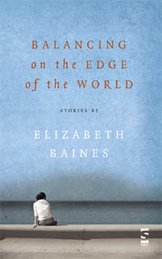
According to Lulu.com's Titlescorer, the title of my forthcoming collection of stories, Balancing on the Edge of the World, gives it a 79.6% chance of bestsellerdom. Hm. I might be excited if the scorer included the meanings, associations or connotations of the words in a title, and not simply the parts of speech.
Thanks to Debi for the link.
Thanks to Debi for the link.
Saturday, February 17, 2007
Learning to adapt
Giles Foden writes in today's Guardian about the dangers of having one's fiction adapted for the screen. It's a funny business, as I've said on my other blog. As a reader I would say I don't like screen adaptations: I usually try never to see one before reading a book, yet if I watch one afterwards I'm always frustrated by the gap between the director's vision and my own. I haven't read Foden's novel The Last King of Scotland, but on this occasion I was dragged along, reluctantly, to see the film. I was bowled over - rarely has a film made such a lasting impact on me - but I know now that I'll never be able to read the book without its images and those actors in my head.
As a writer, though, it's a different story. Someone comes along and offers you a big bag of money to turn your novel into something which will make it a hell of a lot more famous than it ever was before - or in, my case, famous in a way it never was. I had had bad luck with my second novel, Body Cuts. Halfway through the editing process my editor at the small publishing house left to pursue her own novel career, and the publisher failed to tell me, or to make clear to her replacement where we were in the editing process, and as a result the book went to press without my final editing. The reason for such mix-ups suddenly became evident. Weeks before the book was due out the publisher was bought up by another, and although my book had been announced in the trade press, it failed to appear. When it was eventually published, no new announcements were made in the trade press by the new publisher, and not long after that the original publisher's fiction list was remaindered.
In the meantime, however, during the short time that book was in the bookshops, the TV director John Glenister happened to pick it up, got hooked and immediately decided that he wanted to adapt it for TV. How cool was that? How could I refuse such a chance of resurrection? My usual reservations about screen adaptations went shooting off into the ether.
In fact, in the end that adaptation didn't happen - people at the BBC had moved on, artistic and funding policies had changed - but as I had been working on the adaptation with John, I took it to a Channel 4/arts-board screenwriting scheme, and here my reservations dropped back down from the sky. My God: the changes I was expected to make!! My main male character should be a different sort of person, my female character's mother ought to die!!! Needless to say I soon dropped the whole idea, and contented myself with salvaging from this last experience insights for my satirical (and entirely fictional) story, 'The Shooting Script', which may be included in my forthcoming collection from Salt, Balancing on the Edge of the World.
We haven't yet decided which stories will go in this collection, but one which probably will is 'Power', which looks at the stresses on children of quarrelling parents through their contrasting voices (previously published in Power [Honno]), a story I adapted as a radio drama. It was the second time I had adapted my own fiction for radio: earlier I worked on my first novel, The Birth Machine. Both times I worked with the director Michael Fox and both times I was given free rein to adapt my work in ways which allowed me to stay as true to the original as I wished. I have to say that adaptation for the verbal, non-visual medium of radio is a different thing altogether: I don't feel in any way that the transformations stole the souls of the original fictions in the way screen adaptations so often seem to do.
As a writer, though, it's a different story. Someone comes along and offers you a big bag of money to turn your novel into something which will make it a hell of a lot more famous than it ever was before - or in, my case, famous in a way it never was. I had had bad luck with my second novel, Body Cuts. Halfway through the editing process my editor at the small publishing house left to pursue her own novel career, and the publisher failed to tell me, or to make clear to her replacement where we were in the editing process, and as a result the book went to press without my final editing. The reason for such mix-ups suddenly became evident. Weeks before the book was due out the publisher was bought up by another, and although my book had been announced in the trade press, it failed to appear. When it was eventually published, no new announcements were made in the trade press by the new publisher, and not long after that the original publisher's fiction list was remaindered.
In the meantime, however, during the short time that book was in the bookshops, the TV director John Glenister happened to pick it up, got hooked and immediately decided that he wanted to adapt it for TV. How cool was that? How could I refuse such a chance of resurrection? My usual reservations about screen adaptations went shooting off into the ether.
In fact, in the end that adaptation didn't happen - people at the BBC had moved on, artistic and funding policies had changed - but as I had been working on the adaptation with John, I took it to a Channel 4/arts-board screenwriting scheme, and here my reservations dropped back down from the sky. My God: the changes I was expected to make!! My main male character should be a different sort of person, my female character's mother ought to die!!! Needless to say I soon dropped the whole idea, and contented myself with salvaging from this last experience insights for my satirical (and entirely fictional) story, 'The Shooting Script', which may be included in my forthcoming collection from Salt, Balancing on the Edge of the World.
We haven't yet decided which stories will go in this collection, but one which probably will is 'Power', which looks at the stresses on children of quarrelling parents through their contrasting voices (previously published in Power [Honno]), a story I adapted as a radio drama. It was the second time I had adapted my own fiction for radio: earlier I worked on my first novel, The Birth Machine. Both times I worked with the director Michael Fox and both times I was given free rein to adapt my work in ways which allowed me to stay as true to the original as I wished. I have to say that adaptation for the verbal, non-visual medium of radio is a different thing altogether: I don't feel in any way that the transformations stole the souls of the original fictions in the way screen adaptations so often seem to do.
Friday, February 16, 2007
Out in Manc
To Manchester Metropolitan University's Writing School last night for a great reading by tutor Simon Armitage, and on to the Kro2 Bar afterwards. There Steve Waling and I sat and patted each other on the back for getting on Salt's publishing list, and, with silly grins on our faces, compared notes about how great they seem to be, and how much effort they seem to put into marketing their books. Steve's poetry collection comes out in April and he told me that Publishing Director Jen Hamilton-Emery had been up to make a podcast of him reading a poem and talking about his book for the website.
I haven't been out much recently, and I should go out more often: as we sat there shamelessly congratulating ourselves, a film company for whom I worked as an actor last summer walked in. The film we made has been really well received, apparently, and they're doing another, and would I be free? Yippee. Acting is one of the things I love best in the world (much easier than writing!!). I'm not telling you the name of the company or the film, because I play a pretty uncool character (it is a surreal comedy, I hasten to add), and that's not the kind of image you need for marketing fiction, now, is it?
I haven't been out much recently, and I should go out more often: as we sat there shamelessly congratulating ourselves, a film company for whom I worked as an actor last summer walked in. The film we made has been really well received, apparently, and they're doing another, and would I be free? Yippee. Acting is one of the things I love best in the world (much easier than writing!!). I'm not telling you the name of the company or the film, because I play a pretty uncool character (it is a surreal comedy, I hasten to add), and that's not the kind of image you need for marketing fiction, now, is it?
Sunday, February 11, 2007
That photo thing...
So Salt asked me to provide some recent publicity photos PDQ. Oh, help. That dreadful process again. And my last photographer has moved away. Where would I get another one? Fellow bloggers Manchizzle and Adrian Slatcher came to my aid with suggestions, but their contacts appeared not to be around. Then John reminded me how fantastic the photos had been last summer for the Manchester 24:7 Theatre Festival. Yes!! Dave Slack, the festival's organiser, put me right on to their photographer: Tom Wright. And there I was within a day or two meeting him in the city centre.
What sort of thing did I want? Tom wanted to know. I resisted the urge to say the thing which made my last photographer go white even though I was joking, ie Please try and make me look glamorous if you can; I didn't even say Just making me look not plain ugly would be great, and I gave him the publisher's specs: interesting urban shots.
I suggested the new white bridge over the Irwell, which is always appearing in telly dramas like Cold Feet, and as Tom checked the light I leaned on the side in the hope of looking writerishly thoughtful. A man walked past and stared. He kept staring, turning back. More people came, in both directions, all staring back over their shoulders. I cracked up. And the bridge turned out not to be the best suggestion: it shook as people passed, which was not so good for focus, and it was so huge that it was hard to get a shot of it except from a distance. At Tom's more sensible suggestion we moved off to the old arched bridge. A woman stopped. 'Oh don't forget your bag will you, dear?' she cried, scooping it up for me and spoiling the shot. More people endangered their lives by walking while looking backwards at us, and again I had to make the effort to straighten my face.
At the end I took a shot of Tom taking one of me, and if I hadn't still been laughing it wouldn't have been blurred.
What sort of thing did I want? Tom wanted to know. I resisted the urge to say the thing which made my last photographer go white even though I was joking, ie Please try and make me look glamorous if you can; I didn't even say Just making me look not plain ugly would be great, and I gave him the publisher's specs: interesting urban shots.
I suggested the new white bridge over the Irwell, which is always appearing in telly dramas like Cold Feet, and as Tom checked the light I leaned on the side in the hope of looking writerishly thoughtful. A man walked past and stared. He kept staring, turning back. More people came, in both directions, all staring back over their shoulders. I cracked up. And the bridge turned out not to be the best suggestion: it shook as people passed, which was not so good for focus, and it was so huge that it was hard to get a shot of it except from a distance. At Tom's more sensible suggestion we moved off to the old arched bridge. A woman stopped. 'Oh don't forget your bag will you, dear?' she cried, scooping it up for me and spoiling the shot. More people endangered their lives by walking while looking backwards at us, and again I had to make the effort to straighten my face.
At the end I took a shot of Tom taking one of me, and if I hadn't still been laughing it wouldn't have been blurred.

Saturday, February 10, 2007
Expectations unfulfilled
On Tuesday the reading group met at Clare's house to discuss Jack Maggs by Peter Carey. Carey's True History of the Kelly Gang is the only book ever which has had a universal thumbs-down from the group – no one had been able to engage with it - and when Clare (who had not been a member then) suggested this book everyone groaned. In the end, however, we decided not to be so prejudiced and to give Peter Carey another chance.
It was a freezing night, and the fire in Clare's Victorian terrace was roaring: a fitting setting for discussing this novel set in Victorian London and featuring an eponymous protagonist not a million miles removed from the character Magwitch in Dickens’ Great Expectations and antagonists with parallels in its hero Pip and in Dickens himself. Like Magwitch in Dickens’ novel, Jack Maggs, a convict deported to Australia, has made good there and now returns to find the young man (in this case Henry Phipps) who once as a boy took pity on him, and whose secret benefactor he has been all along. Unaware like Pip of his true relationship to Maggs, Phipps absconds on receiving news of Maggs’ imminent arrival, and Maggs becomes involved as a ‘patient’ with the Dickens-like novelist and mesmerist Tobias Oates.
Most of the others looked at us pretty suspiciously, and feeling therefore somewhat like the school swots Ann and I talked about how Carey switches the narrative/focal places of the Magwitch/Maggs and Pip/Phipps characters, taking Magwitch from the periphery of Dickens’ Victorian-colonial narrative to the centre of his own, and exiling Dickens’ hero to the periphery. Australia
Wednesday, February 07, 2007
Short stories on the up
In December I wrote about the state of the short story and the fact that there were signs of a resurgence, with several small publishers beginning to specialise in the form. Well, I am thrilled to be able to say that in October one of those publishers, Salt, is to publish a collection of my stories, Balancing on the Edge of the World.
Salt, based in Cambridge and run by Chris and Jen Hamilton-Emery, are turning out to be marvellous. The whole thing happened very quickly: a fortnight before Christmas I sent them a sample three stories, and by mid January they had offered to publish a collection. No messing about: straight through came an author questionnaire which made it very clear that Salt empower their authors by involving them in publicity and marketing at every stage.
Take a look at their site, and you'll see how classy they are, both in terms of literary standard and marketing flair. It's no wonder that they've gained such prominence and respect in such a short time, and I feel just honoured to be published by them - alongside several other Manchester writers, as it happens, including Steve Waling, David Gaffney and Neil Campbell.
Salt, based in Cambridge and run by Chris and Jen Hamilton-Emery, are turning out to be marvellous. The whole thing happened very quickly: a fortnight before Christmas I sent them a sample three stories, and by mid January they had offered to publish a collection. No messing about: straight through came an author questionnaire which made it very clear that Salt empower their authors by involving them in publicity and marketing at every stage.
Take a look at their site, and you'll see how classy they are, both in terms of literary standard and marketing flair. It's no wonder that they've gained such prominence and respect in such a short time, and I feel just honoured to be published by them - alongside several other Manchester writers, as it happens, including Steve Waling, David Gaffney and Neil Campbell.
Tuesday, February 06, 2007
How to read plays
Not long after I wrote in November about the frustrating business of submitting my fringe-produced play O'Leary's Daughters to mainstream theatres last February, I received a response from one of the theatres I had given up on.
They enjoyed reading it, they said, and admired both my 'confidently fluid writing style' and the 'economy of my stagecraft'. For once they did not take the schematic structure and my 'other devices' as mistakes, but unfortuntely they found them 'alienating'. Oh.
Mm. Why, I wonder? None of the audiences in the three fringe shows found them alienating in the least. Those audiences laughed and cried (some coming out with wet faces), and in the 24:7 production they stood at the end of some performances and whistled.
I read on to the end of the sentence: '...and they didn't allow the drama space to breathe.'
Ah! That breathing kind of drama! Not the tight stuff then, not the stuff where you're pulled on an emotional rack, breathless with all your senses attuned... But the breathing stuff, the stuff where you can lie back, relax.... They couldn't be meaning naturalistic drama, could they?
Of course they could. Here's the next sentence: 'It was also felt that the piece might benefit from a deeper exploration of the causes of abuse and a more balanced approach to the nature-nurture debate.' What?!!!! Lordy-lor, this NOT a play about abuse! Yes, all three characters have been abused, and use their childhood abuse as their defining experiences, but this is a play about IDENTITY, not abuse per se!
Gotcha. You didn't want me to write anything so abstract or surreal, in fact even though I'd said in my letter what the theme of the play was, such an idea was so far from your concept of what a play should be, that you couldn't even see when you read it that that's what it was.
You wanted me to write a different play.
They enjoyed reading it, they said, and admired both my 'confidently fluid writing style' and the 'economy of my stagecraft'. For once they did not take the schematic structure and my 'other devices' as mistakes, but unfortuntely they found them 'alienating'. Oh.
Mm. Why, I wonder? None of the audiences in the three fringe shows found them alienating in the least. Those audiences laughed and cried (some coming out with wet faces), and in the 24:7 production they stood at the end of some performances and whistled.
I read on to the end of the sentence: '...and they didn't allow the drama space to breathe.'
Ah! That breathing kind of drama! Not the tight stuff then, not the stuff where you're pulled on an emotional rack, breathless with all your senses attuned... But the breathing stuff, the stuff where you can lie back, relax.... They couldn't be meaning naturalistic drama, could they?
Of course they could. Here's the next sentence: 'It was also felt that the piece might benefit from a deeper exploration of the causes of abuse and a more balanced approach to the nature-nurture debate.' What?!!!! Lordy-lor, this NOT a play about abuse! Yes, all three characters have been abused, and use their childhood abuse as their defining experiences, but this is a play about IDENTITY, not abuse per se!
Gotcha. You didn't want me to write anything so abstract or surreal, in fact even though I'd said in my letter what the theme of the play was, such an idea was so far from your concept of what a play should be, that you couldn't even see when you read it that that's what it was.
You wanted me to write a different play.
Friday, February 02, 2007
That inspiration thing...
Who was I kidding? This is just a different, new (for me) way of writing a play, I told myself, as I sat at my desk all January, and the play seemed to ease its way out of the ether only slowly, and then to disintegrate on the page, only to begin easing its way out again from a slightly different angle.
But I had to face it, I wasn't making progress. I knew what the themes were, I thought I knew the characters and the story, but something was sticking: in the middle of the play there was a dark patch, a blank, a big chasm over which I had to get the characters, and which I never would until the damn thing disappeared, lit up, turned into some kind of solid ground. Oh, I could think of plenty of ways to do it in theory; I even drew myself a little picture/diagram, my two characters standing together at the tram stop at the opening of the play and curved lines showing the journeys they would make away from each other and back again to the conclusion. But would it actually happen? Would it resonate, buzz in my belly, take on that alchemical fizz which makes a play really happen? Would it heck. And I was getting so tired. And other things were piling up: the washing, the unanswered mail, the blogging!, some publicity work I was meant to be doing, the crucial matter of earning a living...
Really, sometimes writing is the hardest thing in the world....
I was writing this play for a deadline, the 31st of January. Last Saturday, 27th of January, I decided I would never do it now, not just for the deadline, but anyhow, anyway. The play was a dead duck. I was a dead duck. My recent much larger writing project had drained me, of imagination, of inspiration. Maybe I would never write again.... I gave up, gave in. I went downstairs and started sorting the piled-up washing, I went out to the shops and for once didn't rush to get back but wandered...
'I've given up,' I said to John. And guess what? As I said it, in a flash, in a single instant, the real play, the one I was meant to be writing after all, popped into my head fully-formed. I got up on Sunday morning and put my pen to paper and the play just flowed. I was in that ecstatic fired-up state, where you're not really thinking so much as tuning in, where it feels as if you're acting as a conduit, this buzzing thing - this play - simply coursing through you and out of the nib. I wrote all day - I was writing much longer hours now but no longer exhausted - and on Monday I did the same and completed the handwritten draft. Tuesday and Wednesday I rose at six to the laptop, and by 5.30 on Wednesday afternoon, the deadline, I had the typed draft in the post.
Really, sometimes writing is the most exhilarating thing in the world...
Looking at it now, I can see that this was the same play from a different angle, but a very different angle. I could say I wrote it in only four days, but the real truth is that I was gestating it for the whole of January. There's never really a simple answer to that question you're often asked at readings or when you give talks: How long did it take you to write it?
Fay Weldon once wrote: if you're blocked, go away. Write something else, or do something else altogether. She's right.
But I had to face it, I wasn't making progress. I knew what the themes were, I thought I knew the characters and the story, but something was sticking: in the middle of the play there was a dark patch, a blank, a big chasm over which I had to get the characters, and which I never would until the damn thing disappeared, lit up, turned into some kind of solid ground. Oh, I could think of plenty of ways to do it in theory; I even drew myself a little picture/diagram, my two characters standing together at the tram stop at the opening of the play and curved lines showing the journeys they would make away from each other and back again to the conclusion.
 But would it actually happen? Would it resonate, buzz in my belly, take on that alchemical fizz which makes a play really happen? Would it heck. And I was getting so tired. And other things were piling up: the washing, the unanswered mail, the blogging!, some publicity work I was meant to be doing, the crucial matter of earning a living...
Really, sometimes writing is the hardest thing in the world....
I was writing this play for a deadline, the 31st of January. Last Saturday, 27th of January, I decided I would never do it now, not just for the deadline, but anyhow, anyway. The play was a dead duck. I was a dead duck. My recent much larger writing project had drained me, of imagination, of inspiration. Maybe I would never write again.... I gave up, gave in. I went downstairs and started sorting the piled-up washing, I went out to the shops and for once didn't rush to get back but wandered...
'I've given up,' I said to John. And guess what? As I said it, in a flash, in a single instant, the real play, the one I was meant to be writing after all, popped into my head fully-formed. I got up on Sunday morning and put my pen to paper and the play just flowed. I was in that ecstatic fired-up state, where you're not really thinking so much as tuning in, where it feels as if you're acting as a conduit, this buzzing thing - this play - simply coursing through you and out of the nib. I wrote all day - I was writing much longer hours now but no longer exhausted - and on Monday I did the same and completed the handwritten draft. Tuesday and Wednesday I rose at six to the laptop, and by 5.30 on Wednesday afternoon, the deadline, I had the typed draft in the post.
Really, sometimes writing is the most exhilarating thing in the world...
Looking at it now, I can see that this was the same play from a different angle, but a very different angle. I could say I wrote it in only four days, but the real truth is that I was gestating it for the whole of January. There's never really a simple answer to that question you're often asked at readings or when you give talks: How long did it take you to write it?
Fay Weldon once wrote: if you're blocked, go away. Write something else, or do something else altogether. She's right.
Monday, January 22, 2007
Indigo at the Whitworth Gallery

An invitation from Ann French, textile conservator at the Whitworth Gallery (aka Ann of the reading group) to the opening last Friday of the show she has been working round the clock to prepare: Indigo. It's a fantastic array of historical and contemporary indigo-dyed fabrics and garments from around the world, from ancient ceremonial garments to modern workwear and designer denims. The exhibition thus traces the history of indigo dyeing which has become almost obsolete but which in some parts of the world is now being revived.
The place was packed, and there was a huge buzz, and it was impossible to study everything properly, which I'm looking forward to doing another time. Ann suggested that I went upstairs where it was quieter and look at the connected installations by two Japanese artists, and sure enough I was blown away. The installation pictured above is by Hiroyuki Shindo and 'references the ceremonial banners seen in picture scrolls of the Japanese Heian period'. The banners are indigo-dyed by the 'Shiboni' method, the fabric pleated around two tensioned cylinders. The balls scattered on the ground beneath the banners, which the artist doesn't mind being knocked around as people walk through the installation, are covered in indigo-dyed fabric.
The reading group were there in force, getting too drunk as usual to look properly at the show, and Clare took the picture. Needless to say, afterwards there was a reading group dinner in the curry mile just down the road.
Indigo will continue at the Whitworth until 15th April, after which it will tour to Plymouth and Brighton.
Monday, January 15, 2007
The Royal Court
In the wake of the recent debate about the failure of British theatres to value and nurture the individual visions of playwrights (in a culture of non-text-based theatre and the 'development' of writers by other theatre professionals), Michael Billington writes in today's Guardian supporting the argument - generally considered, he says, 'faintly derriere garde' - that 'while collaboration is a vital rehearsal tool, it rarely produces dynamic words on the page' and 'theatre achieves its greatest resonance when it expresses a solo writer's vision.'
As the directorship of the Royal Court passes from Ian Rickson to Dominic Cooke, Billington muses that Rickson's tenure has been characterised by a rare and 'obstinate belief in the solo writer'. Rickson nurtured writers in another way too, he says: encouraging their second and third plays in a 'culture where people are always frantically seeking the next new thing rather than admiring maturing talent.' He hopes that Cooke will continue in the same vein.
He hopes too that Cooke will fulfil his promise to restore the RC's reputation for experiment and move away from social realism - as indeed do I, a lover (and also writer) of theatre which offers different realities from those which to we are accustomed through television and film. And as we might expect from Billington, his final and biggest hope is that Cooke will produce a more socially-political theatre than did Rickson.
As the directorship of the Royal Court passes from Ian Rickson to Dominic Cooke, Billington muses that Rickson's tenure has been characterised by a rare and 'obstinate belief in the solo writer'. Rickson nurtured writers in another way too, he says: encouraging their second and third plays in a 'culture where people are always frantically seeking the next new thing rather than admiring maturing talent.' He hopes that Cooke will continue in the same vein.
He hopes too that Cooke will fulfil his promise to restore the RC's reputation for experiment and move away from social realism - as indeed do I, a lover (and also writer) of theatre which offers different realities from those which to we are accustomed through television and film. And as we might expect from Billington, his final and biggest hope is that Cooke will produce a more socially-political theatre than did Rickson.
Wednesday, January 10, 2007
Out again
Reading group come round again and in all that while there has been nothing writerly to blog about. After the Christmas distractions I have been just getting down to the actual writing (and involved in one or two negotiations which may or may not come to anything). The only things that have been happening have been happening inside my head, and in a very strange way, for me: I'm writing a play, and usually I write plays very quickly, in a rush of excited inspiration, but this play is coming slowly, revealing itself in slow accretions as I sit at my desk each day in an odd waiting mode. For the first time ever for me writing is a question of patience rather than simply of enormous energy. As a result, the play feels less like something pulled from my brain or psyche, and, as I say, more like something already out there being revealed to me in stages.
Reading group last night was a welcome foray back into the outside world. Several members couldn't make it, so it was a small group which gathered at Jenny's to discuss John Banville's Booker-winning novel The Sea. This takes the form of a diary-cum-memoir written by an art historian who has retired, after the death of his wife, to the seaside town where he once holidayed as a child, one year becoming fascinated and entangled with another holidaying family: Connie and Carlo Grace and their twins Chloe and mute Myles, and an older girl Rose. It is in the house once occupied by the Graces, now a boarding house, that he has decided to settle.
Doug had chosen the book because, he said, he thought it might provoke some interesting controversy. For his own part, he had mixed feelings about the book. There was much he admired about it, in particular the prose with its poetic flow and vivid descriptions, although he felt there were moments when the prose went over the top and wasn't so good after all, and the book was in fact flawed.
Jenny then said with great contempt that she thought it a 'typical Booker type novel'. What did she mean by that? Well, she said she had found the prose really pretentious and there were at least fifteen words she had never come across before in her life, the meaning of which she couldn't tell from the context. I said yes, I had had to look in the dictionary several times, often to discover that the unfamilar words referred to obscure trades or professions, eg 'deckle' (papermaking) and 'anabasis' (military). Usually these words were being used metaphorically to describe something else. I said, to strong agreement from John, that the point of a metaphor is to make things more vivid, but on these occasions the opposite effect was created. Not only that, there were several occasions when I came across words I thought I had known the meaning of, only to be thrown into doubt by the context, then to discover in the dictionary that they had been used in the book in an archaic sense. More generally we found the language over-formal or inflated (eg fingernails described as 'sanguineous red' rather than 'blood-red', 'refection' for 'meal', and the somewhat laughable 'At times the image of her would spring up in me unbidden, an interior succubus, and a surge of yearning would engorge the very root of my being'). While we accepted in theory that these linguistic characteristics are those of a narrator who has consciously and defensively created for himself a formal persona, we nevertheless found them alienating, and some people said that as a result they found it very difficult to care about the characters. Ann, who had been nodding away but had been quiet up till now, said that she had given up on the book without finishing it.
Doug now grinned and said he knew that I in particular would have this reaction to the language, and this was why he'd chosen the book. As he'd said, he agreed, but there were also wonderfully vivid passages, and the book was brilliantly crafted and the story was stunning.
The rest of us agreed that the observations were often vivid and acute - Clare had been pulled up in amazement by the accuracy of a description of 'the way women used to smoke', and I by one of a woman leaning on a till, among others. Jenny said that the portrayal of the narrator's childhood yearning to better himself (and be like the Graces) reminded her of her own similar childhood feelings. We all thought the memories of the illness and death of the narrator's wife moving and the aspect of the book which rang most true. However, there was disagreement with Doug about the way the book was shaped.
Ann said that she found really irritating and confusing, and lacking in true connections, the shifts between the various time levels. There were situations and characters - the narrator's relationship with his daughter, a visit with her to a local farm, the shocking hospital photos taken by the dying wife - which were made to seem significant, but their precise nature or significance either never became clear to us or indeed fizzled away. As for the story, John said, there is none for most of the book, but then the story is packed in towards the end in a way which he found contrived. Most of us were dissatisfied by the revelation of the identity of the narrator's present-day landlady. Looking back through this at the earlier representation of their relationship, we found that earlier representation both tricksy and psychologically unconvincing. None of us (apart from Doug) was convinced, in the final analysis, by the denouement, the tragedy at the novel's heart, although it is most emotively described, and, as Jenny and Ann said, although we were clearly meant to accept that this was the narrator's formative experience, there was no real sense of how it had made him what he was or informed his other relationships.
And Jenny said that she found the narrator's sexual attraction as a boy to the mother of the Grace family 'disgusting', which made us all hoot with laughter.
Our archived discussions can be found here, and a list of all the books we have discussed here.
Reading group last night was a welcome foray back into the outside world. Several members couldn't make it, so it was a small group which gathered at Jenny's to discuss John Banville's Booker-winning novel The Sea. This takes the form of a diary-cum-memoir written by an art historian who has retired, after the death of his wife, to the seaside town where he once holidayed as a child, one year becoming fascinated and entangled with another holidaying family: Connie and Carlo Grace and their twins Chloe and mute Myles, and an older girl Rose. It is in the house once occupied by the Graces, now a boarding house, that he has decided to settle.
Doug had chosen the book because, he said, he thought it might provoke some interesting controversy. For his own part, he had mixed feelings about the book. There was much he admired about it, in particular the prose with its poetic flow and vivid descriptions, although he felt there were moments when the prose went over the top and wasn't so good after all, and the book was in fact flawed.
Jenny then said with great contempt that she thought it a 'typical Booker type novel'. What did she mean by that? Well, she said she had found the prose really pretentious and there were at least fifteen words she had never come across before in her life, the meaning of which she couldn't tell from the context. I said yes, I had had to look in the dictionary several times, often to discover that the unfamilar words referred to obscure trades or professions, eg 'deckle' (papermaking) and 'anabasis' (military). Usually these words were being used metaphorically to describe something else. I said, to strong agreement from John, that the point of a metaphor is to make things more vivid, but on these occasions the opposite effect was created. Not only that, there were several occasions when I came across words I thought I had known the meaning of, only to be thrown into doubt by the context, then to discover in the dictionary that they had been used in the book in an archaic sense. More generally we found the language over-formal or inflated (eg fingernails described as 'sanguineous red' rather than 'blood-red', 'refection' for 'meal', and the somewhat laughable 'At times the image of her would spring up in me unbidden, an interior succubus, and a surge of yearning would engorge the very root of my being'). While we accepted in theory that these linguistic characteristics are those of a narrator who has consciously and defensively created for himself a formal persona, we nevertheless found them alienating, and some people said that as a result they found it very difficult to care about the characters. Ann, who had been nodding away but had been quiet up till now, said that she had given up on the book without finishing it.
Doug now grinned and said he knew that I in particular would have this reaction to the language, and this was why he'd chosen the book. As he'd said, he agreed, but there were also wonderfully vivid passages, and the book was brilliantly crafted and the story was stunning.
The rest of us agreed that the observations were often vivid and acute - Clare had been pulled up in amazement by the accuracy of a description of 'the way women used to smoke', and I by one of a woman leaning on a till, among others. Jenny said that the portrayal of the narrator's childhood yearning to better himself (and be like the Graces) reminded her of her own similar childhood feelings. We all thought the memories of the illness and death of the narrator's wife moving and the aspect of the book which rang most true. However, there was disagreement with Doug about the way the book was shaped.
Ann said that she found really irritating and confusing, and lacking in true connections, the shifts between the various time levels. There were situations and characters - the narrator's relationship with his daughter, a visit with her to a local farm, the shocking hospital photos taken by the dying wife - which were made to seem significant, but their precise nature or significance either never became clear to us or indeed fizzled away. As for the story, John said, there is none for most of the book, but then the story is packed in towards the end in a way which he found contrived. Most of us were dissatisfied by the revelation of the identity of the narrator's present-day landlady. Looking back through this at the earlier representation of their relationship, we found that earlier representation both tricksy and psychologically unconvincing. None of us (apart from Doug) was convinced, in the final analysis, by the denouement, the tragedy at the novel's heart, although it is most emotively described, and, as Jenny and Ann said, although we were clearly meant to accept that this was the narrator's formative experience, there was no real sense of how it had made him what he was or informed his other relationships.
And Jenny said that she found the narrator's sexual attraction as a boy to the mother of the Grace family 'disgusting', which made us all hoot with laughter.
Our archived discussions can be found here, and a list of all the books we have discussed here.
Thursday, December 21, 2006
Evelyn Waugh versus mince pies
Reading group on Tuesday night at Doug's. He had a beautiful huge Christmas tree, tastefully decorated with red baubles and tiny white lights, which made everyone exclaim as they entered, and people brought Christmas food, mince pies and chocolates, and Jenny had a bag of samosas left over from her other reading group at Didsbury library which had had a Christmas gathering earlier in the day. And no one was much inclined to get down to business and discuss the book.
In the middle of all the hilarity I asked everyone if they minded my writing about our meetings on my blog (previously my reports have appeared on my website), and everyone said it was fine. But then Doug said suddenly that that reminded him: he had a good mind to start a rival web report because my last one (on Hubert Selby Jr's Last Exit to Brooklyn) was totally biased (towards my own view of the book) and ended on a yah-boo-sucks note. (Trevor added that he's always shocked by how different my memories of the discussion are from his.) Quite right! I retorted, refusing to be chastened.
Anyway, this is my memory of the discussion we had on Tuesday:
Ann had chosen Evelyn Waugh's 1938 novel Scoop in which, in a classic case of mistaken identity, a naive aristocratic nature-features writer, Boot, gets sent as a war reporter to the fictional African Republic of Ishmaelia, and in which journalistic contempt for the truth is famously satirised. Having read other Waugh novels and enjoyed them, she said she had chosen it as a civilised and urbane antidote to the linguistic grimness of Selby Jr. However, having expected to enjoy it without reservation, she now wasn't so sure, finding it on the whole to be in fact more of a farce than a satire. Everyone readily and strongly agreed, although most had enjoyed it - though Sarah said she had given up after the first seventy pages, for the very reason that she hates farce.
John pointed out that, while the overriding trope of mistaken identity and that of the innocent abroad were in the realm of farce, there was true satire in the treatment of the activities of the journalists and their newspapers, and most people agreed that the telegrams passing between them were very funny. Most were agreed too that the book was in any case very clever, but John and Ann weren't so sure since it wavered between satire and farce. Trevor said that, having previously avoided Waugh because of his right-wing reputation, he had been amazed to find how even-handedly Waugh had poked fun, representing the aristocratic Boot family as dodderers mainly confined to their beds. At which point Jenny expressed her oft-stated opinion that aristocrats are anything but duffers, it just suits them to have people think they are, and Waugh (who was not in fact aristocratic) had fallen for that.
John also noted that Boot is something of a psychological blank, and he said that while this is part of the satirical or farcical point, he found that it created a sense of something incomplete. We discussed this - the fact that in a satire you don't really need psychological complexity but that somehow here it seemed like a flaw - without coming to much conclusion as to why this should be. I said it was particularly noticeable in the 'love' interest (Boot falls innocently in love with a young German woman who is quite cheerfully taking him for a ride), and Trevor, who'd had quite a bit to drink by then, explained to me their relationship. I said I understood what their relationship was, I was talking about the treatment of it, and he explained it to me again.
Ann wondered how much more impact the book might have had in its day, as we are now so much more used to the idea of not trusting the press, but Doug said, haven't there always been satirical cartoons?
And that was about it. A very short discussion (as far as I remember it), and by the time Mark arrived, late from putting his kids to bed, we'd long gone onto other topics which we stayed late discussing, even though Doug had to go to London next day...
Our archived discussions can be found here, and a list of all the books we have discussed here.
In the middle of all the hilarity I asked everyone if they minded my writing about our meetings on my blog (previously my reports have appeared on my website), and everyone said it was fine. But then Doug said suddenly that that reminded him: he had a good mind to start a rival web report because my last one (on Hubert Selby Jr's Last Exit to Brooklyn) was totally biased (towards my own view of the book) and ended on a yah-boo-sucks note. (Trevor added that he's always shocked by how different my memories of the discussion are from his.) Quite right! I retorted, refusing to be chastened.
Anyway, this is my memory of the discussion we had on Tuesday:
Ann had chosen Evelyn Waugh's 1938 novel Scoop in which, in a classic case of mistaken identity, a naive aristocratic nature-features writer, Boot, gets sent as a war reporter to the fictional African Republic of Ishmaelia, and in which journalistic contempt for the truth is famously satirised. Having read other Waugh novels and enjoyed them, she said she had chosen it as a civilised and urbane antidote to the linguistic grimness of Selby Jr. However, having expected to enjoy it without reservation, she now wasn't so sure, finding it on the whole to be in fact more of a farce than a satire. Everyone readily and strongly agreed, although most had enjoyed it - though Sarah said she had given up after the first seventy pages, for the very reason that she hates farce.
John pointed out that, while the overriding trope of mistaken identity and that of the innocent abroad were in the realm of farce, there was true satire in the treatment of the activities of the journalists and their newspapers, and most people agreed that the telegrams passing between them were very funny. Most were agreed too that the book was in any case very clever, but John and Ann weren't so sure since it wavered between satire and farce. Trevor said that, having previously avoided Waugh because of his right-wing reputation, he had been amazed to find how even-handedly Waugh had poked fun, representing the aristocratic Boot family as dodderers mainly confined to their beds. At which point Jenny expressed her oft-stated opinion that aristocrats are anything but duffers, it just suits them to have people think they are, and Waugh (who was not in fact aristocratic) had fallen for that.
John also noted that Boot is something of a psychological blank, and he said that while this is part of the satirical or farcical point, he found that it created a sense of something incomplete. We discussed this - the fact that in a satire you don't really need psychological complexity but that somehow here it seemed like a flaw - without coming to much conclusion as to why this should be. I said it was particularly noticeable in the 'love' interest (Boot falls innocently in love with a young German woman who is quite cheerfully taking him for a ride), and Trevor, who'd had quite a bit to drink by then, explained to me their relationship. I said I understood what their relationship was, I was talking about the treatment of it, and he explained it to me again.
Ann wondered how much more impact the book might have had in its day, as we are now so much more used to the idea of not trusting the press, but Doug said, haven't there always been satirical cartoons?
And that was about it. A very short discussion (as far as I remember it), and by the time Mark arrived, late from putting his kids to bed, we'd long gone onto other topics which we stayed late discussing, even though Doug had to go to London next day...
Our archived discussions can be found here, and a list of all the books we have discussed here.
Thursday, December 14, 2006
North West Playwrights at Christmas
Christmas Party at North West Playwrights last night. Nice red wine, a lovely Christmas tree with silver baubles and a room full of playwrights gabbing about playwriting and the eternal obsession: HOW TO GET PLAYS PUT ON.
NWP was originally started by a bunch of playwrights including Dave Simpson and John Chambers (both veterans of Coronation Street and Emmerdale), as a yearly showcase of work by north-west writers, presented as script-in-hand readings at Contact Theatre. My first-ever try at writing for stage - a one-act play, Cakes - appeared in the showcase, and later I was privileged to be invited onto the judging panel. More recently, NWP has evolved into a somewhat different organisation, with a different emphasis. Headed now by a Director, Chris Bridgeman, and Deputy Director and playwright Sheila McNulty, it is geared towards nurturing and developing the careers of playwrights in a more ongoing way via not only script-in-hand performances but also workshops, training sessions and links with several theatres.
There was much talk of course amongst us playwrights of the recent debate, prompted by the Guardian's Lynn Gardner, about the frustrating aspects, for writers, of theatre 'development' schemes (which I wrote about in an earlier post). Everyone was agreed however that North West Playwrights is very different, its aim being not only to help writers develop their skills and scripts but also to find homes for their plays.
One guest was Dave Slack, co-founder of 24:7, the yearly Manchester theatre festival with an increasing profile, and a question on everyone's lips was: 'Are you putting something in for it?'. As I said to someone, 24:7 is one place where you can come from nowhere with a play, put it on unchanged by anyone else or for any theatre's philosophy, style or mission statement about 'development,' and then by virtue of having put it on, can be regarded as a professional playwright (rather than someone 'in need of development' by theatre professionals other than writers). Many theatre professionals might presume that this would make for inferior plays, but for two years running now plays from 24:7 have won prestigious Manchester Evening News Awards.
Closing date for 24:7 is 31st January.
And then it was time to go, and guess what, I'd been vain and worn my high heels, and when I went to meet John it turned out he'd had to park the car at the other side of town...
NWP was originally started by a bunch of playwrights including Dave Simpson and John Chambers (both veterans of Coronation Street and Emmerdale), as a yearly showcase of work by north-west writers, presented as script-in-hand readings at Contact Theatre. My first-ever try at writing for stage - a one-act play, Cakes - appeared in the showcase, and later I was privileged to be invited onto the judging panel. More recently, NWP has evolved into a somewhat different organisation, with a different emphasis. Headed now by a Director, Chris Bridgeman, and Deputy Director and playwright Sheila McNulty, it is geared towards nurturing and developing the careers of playwrights in a more ongoing way via not only script-in-hand performances but also workshops, training sessions and links with several theatres.
There was much talk of course amongst us playwrights of the recent debate, prompted by the Guardian's Lynn Gardner, about the frustrating aspects, for writers, of theatre 'development' schemes (which I wrote about in an earlier post). Everyone was agreed however that North West Playwrights is very different, its aim being not only to help writers develop their skills and scripts but also to find homes for their plays.
One guest was Dave Slack, co-founder of 24:7, the yearly Manchester theatre festival with an increasing profile, and a question on everyone's lips was: 'Are you putting something in for it?'. As I said to someone, 24:7 is one place where you can come from nowhere with a play, put it on unchanged by anyone else or for any theatre's philosophy, style or mission statement about 'development,' and then by virtue of having put it on, can be regarded as a professional playwright (rather than someone 'in need of development' by theatre professionals other than writers). Many theatre professionals might presume that this would make for inferior plays, but for two years running now plays from 24:7 have won prestigious Manchester Evening News Awards.
Closing date for 24:7 is 31st January.
And then it was time to go, and guess what, I'd been vain and worn my high heels, and when I went to meet John it turned out he'd had to park the car at the other side of town...
Tuesday, December 12, 2006
Normblog Writer's Choice
Famous blogger Norman Geras has invited me to contribute to his Writer's Choice series, where writers discuss books which have been important to them. I write about Wuthering Heights as perhaps the most influential on my own writing, and the shock I had when I re-read it for the purpose. The piece appears today.
Friday, December 08, 2006
Lost Literature
You can't help wondering what literature, both written and potential, is lost through lack of outlets. Commenting recently on my other blog, nmj relates how she started out as a short-story writer and got an agent on the strength of her short-story writing. However, she discovered, it wasn't the stories themselves the agent was interested in, and she was immediately persuaded to write a novel, and her short-story writing went by the board.
My own experience was the same, and I'm sure we are not the only two. It seems to me that the AL Kennedys and Ali Smiths are only the exceptions that prove the rule: Ali Smith, indeed, has stated in an interview that she feels she was helped towards publication of her first collection by things extraneous to her (marvellous) prose: the fact that she was Scottish, and the fact that she was lesbian.
Once upon a time short stories were all I ever really wanted to write. I loved the form with its special poetic yet muscular compression. Once I had published several stories in literary magazines, I began hoping to publish a collection. I went on an Arvon course and to my delight and gratitude my tutor Martin Booth sent my stories off to his agent, who immediately rang me. (And there are people in the blogosphere insisting that you don't need assistance and contacts to get taken up!) But this agent said the same to me as nmj's did to her: we have to have a novel, it's impossible to sell short stories. So I wrote a novel (The Birth Machine) - not a very long one that first time, more of a novella really; it took me a while to ease out of the short form - and then another (Body Cuts).
I didn't stop writing stories; I just went on publishing them in magazines. But then the magazines began to die away, and there didn't seem any point in writing them any more... And my novel publishers got bought up, the usual story, and the list I was on was remaindered. And, just as I found myself out in the cold, the commercialisation of publishing accelerated, and, after a beginning when all doors had opened before me, getting fiction published seemed no longer the easiest thing in the world. And since the doors in radio were flung wide open - I had written a play on the off-chance and it had been broadcast and won a prize - I became a radio dramatist instead.
Of course you don't stop altogether, you can't keep the urge down. And this week a collection of short stories won the Guardian first book award. Small presses like Comma, Salt, Elastic and Leaf are springing up to specialise in short stories. There are doors swinging open again.
My own experience was the same, and I'm sure we are not the only two. It seems to me that the AL Kennedys and Ali Smiths are only the exceptions that prove the rule: Ali Smith, indeed, has stated in an interview that she feels she was helped towards publication of her first collection by things extraneous to her (marvellous) prose: the fact that she was Scottish, and the fact that she was lesbian.
Once upon a time short stories were all I ever really wanted to write. I loved the form with its special poetic yet muscular compression. Once I had published several stories in literary magazines, I began hoping to publish a collection. I went on an Arvon course and to my delight and gratitude my tutor Martin Booth sent my stories off to his agent, who immediately rang me. (And there are people in the blogosphere insisting that you don't need assistance and contacts to get taken up!) But this agent said the same to me as nmj's did to her: we have to have a novel, it's impossible to sell short stories. So I wrote a novel (The Birth Machine) - not a very long one that first time, more of a novella really; it took me a while to ease out of the short form - and then another (Body Cuts).
I didn't stop writing stories; I just went on publishing them in magazines. But then the magazines began to die away, and there didn't seem any point in writing them any more... And my novel publishers got bought up, the usual story, and the list I was on was remaindered. And, just as I found myself out in the cold, the commercialisation of publishing accelerated, and, after a beginning when all doors had opened before me, getting fiction published seemed no longer the easiest thing in the world. And since the doors in radio were flung wide open - I had written a play on the off-chance and it had been broadcast and won a prize - I became a radio dramatist instead.
Of course you don't stop altogether, you can't keep the urge down. And this week a collection of short stories won the Guardian first book award. Small presses like Comma, Salt, Elastic and Leaf are springing up to specialise in short stories. There are doors swinging open again.
Sunday, December 03, 2006
Sundar Kanta Walker - exhibition of paintings

Yesterday I went to the opening of an exhibition of paintings by Sundar Kanta Walker, 'This Precious Place', at the new Waterside Arts Centre in Sale in South Manchester. Kanta's paintings are vibrant with pure colour, as can be seen above, brimming with a seething yet patterned life, and also often with humour. That's Kanta above, standing next to one of my favourite paintings in the show: 'Ethnic Chick'. If you can't afford one of the oils, there are limited prints available, and I persuaded John to buy me one for Cristmas!
Kanta is of course also a writer, which was how I met her, when she and I once did a reading together, along with novelist Jane Rogers. So it was no suprise that there was another writer at the show, and to my delight Kanta introduced me to her: poet Judy Kendall, who has two books due out, a collection of poems from Cinnamon Press, and the edited letters of Edward Thomas from Carcanet.
I haven't been to Sale for a long time and was amazed to find how gentrified it's become. The Waterside Arts Centre is in a splendid new complex looking out over a paved and lamplit area next to the canal. There were other things going on in the centre besides the opening, and towards the end a group of people drifted past the gallery entrance, coming downstairs from a North-West Playwrights training day. And who from among them should come rushing in to the gallery but my actress friend Mary-Ann Coburn. You could see the pub across the canal through the glass wall of the gallery, so no prizes for guessing where we ended up then...
Kanta's exhibition runs until the 20th January.
Thursday, November 30, 2006
Whose writing is it anyway?
In yesterday's Guardian Maddy Costa writes about an 'extraordinary' collaboration betweeen five women playwrights at the Royal Court Theatre this week, instigated by outgoing artistic director Ian Rickson and echoing a similar experiment in 1971 with seven young men including Howard Brenton, David Hare and Stephen Poliakoff. Well, the play does sound exciting, so maybe it's extraordinary in that sense, but it's a little amusing that the concept of collaboration should be considered so innovative once it's applied to mainstream theatre, when it was of course a commonplace with alternative theatre in the seventies and eighties, and often still is to this day.
It puts me in mind of the time I took part in a similar exercise. Two other playwrights, Sue Ashby and Janet Mantle, invited me to join them in writing a play for Theatre in Education on the subject of child abuse, It's OK to Say No. I was interested and excited to find out how such a process would work, and what it would be like writing someone else's concept rather than my own, and something so very research-based.
First off, we did the research by talking to professionals. Next, we mapped out a story and a structure for the play. This was easier than I'd imagined, sitting swapping suggestions and coming to a consensus - partly, I suppose, because our aim, teaching children how to deal with abuse, very much dictated a structure. Then, like the Royal Court group, we divided up the scenes between us and went away to write them. It was a good experience - I liked the learning process, I loved the companionship and sharing, but I have to be honest and say that it felt more workmanlike than writing usually does for me, without that thrill of inspiration that comes from somewhere deep.
Halfway through the writing period I dropped out. After we had talked to one of the professionals I began to have doubts about the professional methods and ideology for dealing with child abuse which she was describing and which our play was endorsing, and I left Sue and Janet to it.
At least one of my scenes remained, however, a pretty crucial one, and it was a very strange experience to attend the first performance of a play over which I no longer had any claim and no longer felt any ownership, and to witness that scene being acted out. I'd written it, but it was no longer mine; I didn't even feel the need to claim it. Weird.
It's OK to Say No has toured schools all over since, mainly with Action Transport Theatre Company, who probably know nothing of my early involvement with the play. Maybe my scene has long gone anyway, but whenever I hear of another production I get that strange mixed feeling of disconnection and ever-so-vague connection.
It puts me in mind of the time I took part in a similar exercise. Two other playwrights, Sue Ashby and Janet Mantle, invited me to join them in writing a play for Theatre in Education on the subject of child abuse, It's OK to Say No. I was interested and excited to find out how such a process would work, and what it would be like writing someone else's concept rather than my own, and something so very research-based.
First off, we did the research by talking to professionals. Next, we mapped out a story and a structure for the play. This was easier than I'd imagined, sitting swapping suggestions and coming to a consensus - partly, I suppose, because our aim, teaching children how to deal with abuse, very much dictated a structure. Then, like the Royal Court group, we divided up the scenes between us and went away to write them. It was a good experience - I liked the learning process, I loved the companionship and sharing, but I have to be honest and say that it felt more workmanlike than writing usually does for me, without that thrill of inspiration that comes from somewhere deep.
Halfway through the writing period I dropped out. After we had talked to one of the professionals I began to have doubts about the professional methods and ideology for dealing with child abuse which she was describing and which our play was endorsing, and I left Sue and Janet to it.
At least one of my scenes remained, however, a pretty crucial one, and it was a very strange experience to attend the first performance of a play over which I no longer had any claim and no longer felt any ownership, and to witness that scene being acted out. I'd written it, but it was no longer mine; I didn't even feel the need to claim it. Weird.
It's OK to Say No has toured schools all over since, mainly with Action Transport Theatre Company, who probably know nothing of my early involvement with the play. Maybe my scene has long gone anyway, but whenever I hear of another production I get that strange mixed feeling of disconnection and ever-so-vague connection.
Tuesday, November 28, 2006
The Frontlist
Times in an author's life, there's no point in having any pride. The Frontlist seems like a good idea, says Fessing Author. That's what I thought too.
Like Fessing Author, I wasn't a new writer, but I emailed Tom Lodge, who runs the scheme, and got the go-ahead to put something up.
First the synopsis. This is really important, the site tells you, so important that they provide you with guidelines. I look at the guidelines. A synopsis should be all about plot and story, they tell me. It should be written in the style of the novel and should include a flavour of the dialogue. I scratch my head. This doesn't quite sound like the kind of summing-up paragraph I know most publishers and agents prefer (and anyone else, surely). I email Tom again. Is he looking for something longer or something shorter? Tom says it's all early stages yet, and it's really up to me but he thinks something that an agent would like sounds best. But he also says that on the other hand it might be a good idea to write something my peers would like, and some people have been marked down for not making their synopses long or detailed enough.
I scratch my head again. I compromise. I write as short a synopsis as I can while trying to outline a ridiculously complex and psychological story and include a sense of the (fluctuating) voices of the novel.
I post up my submission, synopsis included.
Straightaway I get five pieces to critique. Each piece has to be given a mark out of 5 on each of several criteria. Firstly Syntax, which to my surprise is explained as spelling, punctuation, grammar etc, and which - although I know that writers who can't do the basics mostly can't come up with the bigger stuff - seems a rather nit-picking and superficial approach to establish in beginning to look at a novel. Next Concept which we are told we should judge via the synopsis. Well now, I can see that a synopsis might indicate that a novel has a good shape, etc, but just because it fails to do that doesn't mean a novel hasn't: as anyone in the business knows, a synopsis is one of the most difficult things to write, and the person it's most difficult for is the author, so necessarily close to the subtleties (why would you write a novel if you could sum it up in a paragraph - or a page or two, as some of these synopses run to?). So I'm not so sure about the idea of at least one fifth of the marks being based on the synopsis, about which there seemed to be some confusion in the first place...
Then the last three: Originality, Intelligence, Readability. Nothing about narrative thrust or characterisation (though later characterisation was introduced), nothing about voice. And the explanations of some of these categories seem confusingly to cut across each other...
Now to look at the work I must critique. Well, I've done a lot of critiqueing of work at all sorts of levels, and I am sorry to say that some of the pieces were not, shall we say, of the best I have ever seen. I am pretty used as a teacher to commenting constructively on people's less-than-good work (I am being euphemistic here), but on this occasion my heart sinks, because what I am doing with my comments - and the marks which I must in all honesty give them - is denying them their goal in entering this scheme, being passed to a publisher. No way can I bring myself to use the word which comes to mind about one of them: 'semi-literate'. But there is one good one, thank goodness, pretty brilliant actually, and with relief I can say so and give the author practically full marks.
It all seems a bit embarrassing, I think. Professionals pitted against would-bes, and let's face it, never-will-bes...
Ha! Here's my come-uppance, my own critiques. Sparse dismissive comments, eg 'Waffelly' (sic); I am told that there is nothing original, complex or insightful about my novel, several times I am told that my 'syntax' is poor, I am pulled up for my 'improper' sentences (by which the reviewer doesn't mean indecent), and my narrator's use of the word 'caff' (for cafe) is marked down as a spelling mistake of my own. I'm even told that at one point my novel is 'a bit illiterate'. And it's the synopsis they really have it in for: some tell me it's too long, others that it's not detailed enough (and all the time its 'syntax' is faulty). Not all of my reviewers are negative, there's one who gives me almost full marks, but even he/she feels obliged to take marks off for my synopsis.
Crumbs. (No doubt they'd tick me off for that verbless sentence.)
And the overall results? Well, some of the ones I didn't rate did a whole lot better than me...
Like Fessing Author, I wasn't a new writer, but I emailed Tom Lodge, who runs the scheme, and got the go-ahead to put something up.
First the synopsis. This is really important, the site tells you, so important that they provide you with guidelines. I look at the guidelines. A synopsis should be all about plot and story, they tell me. It should be written in the style of the novel and should include a flavour of the dialogue. I scratch my head. This doesn't quite sound like the kind of summing-up paragraph I know most publishers and agents prefer (and anyone else, surely). I email Tom again. Is he looking for something longer or something shorter? Tom says it's all early stages yet, and it's really up to me but he thinks something that an agent would like sounds best. But he also says that on the other hand it might be a good idea to write something my peers would like, and some people have been marked down for not making their synopses long or detailed enough.
I scratch my head again. I compromise. I write as short a synopsis as I can while trying to outline a ridiculously complex and psychological story and include a sense of the (fluctuating) voices of the novel.
I post up my submission, synopsis included.
Straightaway I get five pieces to critique. Each piece has to be given a mark out of 5 on each of several criteria. Firstly Syntax, which to my surprise is explained as spelling, punctuation, grammar etc, and which - although I know that writers who can't do the basics mostly can't come up with the bigger stuff - seems a rather nit-picking and superficial approach to establish in beginning to look at a novel. Next Concept which we are told we should judge via the synopsis. Well now, I can see that a synopsis might indicate that a novel has a good shape, etc, but just because it fails to do that doesn't mean a novel hasn't: as anyone in the business knows, a synopsis is one of the most difficult things to write, and the person it's most difficult for is the author, so necessarily close to the subtleties (why would you write a novel if you could sum it up in a paragraph - or a page or two, as some of these synopses run to?). So I'm not so sure about the idea of at least one fifth of the marks being based on the synopsis, about which there seemed to be some confusion in the first place...
Then the last three: Originality, Intelligence, Readability. Nothing about narrative thrust or characterisation (though later characterisation was introduced), nothing about voice. And the explanations of some of these categories seem confusingly to cut across each other...
Now to look at the work I must critique. Well, I've done a lot of critiqueing of work at all sorts of levels, and I am sorry to say that some of the pieces were not, shall we say, of the best I have ever seen. I am pretty used as a teacher to commenting constructively on people's less-than-good work (I am being euphemistic here), but on this occasion my heart sinks, because what I am doing with my comments - and the marks which I must in all honesty give them - is denying them their goal in entering this scheme, being passed to a publisher. No way can I bring myself to use the word which comes to mind about one of them: 'semi-literate'. But there is one good one, thank goodness, pretty brilliant actually, and with relief I can say so and give the author practically full marks.
It all seems a bit embarrassing, I think. Professionals pitted against would-bes, and let's face it, never-will-bes...
Ha! Here's my come-uppance, my own critiques. Sparse dismissive comments, eg 'Waffelly' (sic); I am told that there is nothing original, complex or insightful about my novel, several times I am told that my 'syntax' is poor, I am pulled up for my 'improper' sentences (by which the reviewer doesn't mean indecent), and my narrator's use of the word 'caff' (for cafe) is marked down as a spelling mistake of my own. I'm even told that at one point my novel is 'a bit illiterate'. And it's the synopsis they really have it in for: some tell me it's too long, others that it's not detailed enough (and all the time its 'syntax' is faulty). Not all of my reviewers are negative, there's one who gives me almost full marks, but even he/she feels obliged to take marks off for my synopsis.
Crumbs. (No doubt they'd tick me off for that verbless sentence.)
And the overall results? Well, some of the ones I didn't rate did a whole lot better than me...
Saturday, November 25, 2006
Taken over...
Oh dear, I have not been blogging. Why? Because I have an idea for a play simmering, and I'm one of those writers who, once this happens, can't think about much else. The play takes up all of my attention, I stop halfway through the washing up and find myself leaning on the windowsill thinking about those characters, wondering how the heck I am going to get them from A to B; halfway through cleaning my teeth I find I have wandered downstairs, toothbrush in hand, listening to the conversation they are having which has sprouted unbidden into my head...
And we writers wonder why people sometimes look at us askance...
And we writers wonder why people sometimes look at us askance...
Friday, November 17, 2006
Driven to drink?
Reading group on Wednesday night. Only six of us drinking, and when I got up next morning there were eight bottles to clear away! I don't think I drank much of it, but if I did, this is why.
Wednesday, November 15, 2006
What are playwriting schemes for?
Today on my other blog I ask What is Theatre FOR? but you could ask the same question about playwriting schemes, and when I came back from holiday I was alerted to the fact that Lyn Gardner has.
Wondering where all the good new playwrights are nowadays, Gardner speculates that they are clogged up in burgeoning playwriting development schemes, which she suspects exist for their own sakes, and to keep personnel in jobs, rather than actually to bring plays to the stage.
Some of the comments on her post endorse my own about theatre script readers in an earlier post here about my attempts to place 'O'Leary's Daughters' with New Writing mainstream theatres. (I hesitate to betray the arrogance of placing myself among the 'good playwrights', but the play has been fringe-produced, twice, and has won prizes, and I'm a pretty established, you might even say veteran radio dramatist). Gardner might have added that the playwrights are stuck in never-to-be-touched slush piles: it was February when I sent the play off, and I'm still waiting to hear back from several of those theatres and know now that I never will. But of the responses I did get back, more than one betrayed the tendency I described earlier to apply naturalistic measures to a non-naturalistic play (and thus to find it lacking), and the rest appear to fulfill Gardner's suspicions. I have been repeatedly told that my 'well-written and engaging script' can't however be put on by a theatre, since the theatre only puts on the plays it 'develops'. Once or twice this has extended to putting my name down on a list for 'the next development programme' (ie to write another, different play, which will, as Gardner says, be molded to the theatre's mission statement).
The most encouraging response was from Suzanne Bell, the Liverpool Everyman's Literary Manager, who I have to say quickly is a great person, but her hands are tied by this system. Again she said that the theatre only puts on the plays it develops, but she said she wanted to keep links with me and invited me to a workshop with Paines Plough and Graeae Theatre Company. But what was this workshop? Oh dear, yes, the Paines Plough and Graeae people were lovely, but it was one of those workshops which I used to do all the time with schoolkids, and then later with WEA adults, you know: get into pairs, each think up a character, swap characters, then write a dialogue using the two characters. Oh... Groan. For godssake, I just want to get my play on a mainstream theatre; it's already wowed audiences, I'm a radio writer going long in the tooth... what am I doing BEING TAUGHT HOW TO WRITE FROM SCRATCH????
A few weeks later I get an email from Paines Plough. Would I send them what I wrote at the workshop? A bit later another: if I've developed this piece since, or written anything else, would I send it, as they are looking for writers for their Wild Lunch series of rehearsed readings. What they are looking for is 30-minute plays. Oh! Well, sounds like an opportunity you can't miss. I sit down and develop my piece into a 30-minute play.
A couple of months later I am informed that unfortunately I am not one of the fourteen writers they have selected to develop their 30-minute plays into 45-minute pieces. Fair enough, but what was I doing being diverted through hoops to no avail, WHEN I JUST WANTED TO GET MY ALREADY WRITTEN PLAY STAGED? This week I am sent the Wild Lunch programme of rehearsed readings. Eight plays, eight writers. Which means that SIX of the fourteen CHOSEN TO DEVELOP THEIR 30-MINUTE PLAYS have been dropped!
Oh please! These lovely, committed and hard-working people aren't to blame, it's the system, but this is playing with writers. This is not taking seriously any concept of writers' individuality or professionalism, just as Gardner laments.
Wondering where all the good new playwrights are nowadays, Gardner speculates that they are clogged up in burgeoning playwriting development schemes, which she suspects exist for their own sakes, and to keep personnel in jobs, rather than actually to bring plays to the stage.
Some of the comments on her post endorse my own about theatre script readers in an earlier post here about my attempts to place 'O'Leary's Daughters' with New Writing mainstream theatres. (I hesitate to betray the arrogance of placing myself among the 'good playwrights', but the play has been fringe-produced, twice, and has won prizes, and I'm a pretty established, you might even say veteran radio dramatist). Gardner might have added that the playwrights are stuck in never-to-be-touched slush piles: it was February when I sent the play off, and I'm still waiting to hear back from several of those theatres and know now that I never will. But of the responses I did get back, more than one betrayed the tendency I described earlier to apply naturalistic measures to a non-naturalistic play (and thus to find it lacking), and the rest appear to fulfill Gardner's suspicions. I have been repeatedly told that my 'well-written and engaging script' can't however be put on by a theatre, since the theatre only puts on the plays it 'develops'. Once or twice this has extended to putting my name down on a list for 'the next development programme' (ie to write another, different play, which will, as Gardner says, be molded to the theatre's mission statement).
The most encouraging response was from Suzanne Bell, the Liverpool Everyman's Literary Manager, who I have to say quickly is a great person, but her hands are tied by this system. Again she said that the theatre only puts on the plays it develops, but she said she wanted to keep links with me and invited me to a workshop with Paines Plough and Graeae Theatre Company. But what was this workshop? Oh dear, yes, the Paines Plough and Graeae people were lovely, but it was one of those workshops which I used to do all the time with schoolkids, and then later with WEA adults, you know: get into pairs, each think up a character, swap characters, then write a dialogue using the two characters. Oh... Groan. For godssake, I just want to get my play on a mainstream theatre; it's already wowed audiences, I'm a radio writer going long in the tooth... what am I doing BEING TAUGHT HOW TO WRITE FROM SCRATCH????
A few weeks later I get an email from Paines Plough. Would I send them what I wrote at the workshop? A bit later another: if I've developed this piece since, or written anything else, would I send it, as they are looking for writers for their Wild Lunch series of rehearsed readings. What they are looking for is 30-minute plays. Oh! Well, sounds like an opportunity you can't miss. I sit down and develop my piece into a 30-minute play.
A couple of months later I am informed that unfortunately I am not one of the fourteen writers they have selected to develop their 30-minute plays into 45-minute pieces. Fair enough, but what was I doing being diverted through hoops to no avail, WHEN I JUST WANTED TO GET MY ALREADY WRITTEN PLAY STAGED? This week I am sent the Wild Lunch programme of rehearsed readings. Eight plays, eight writers. Which means that SIX of the fourteen CHOSEN TO DEVELOP THEIR 30-MINUTE PLAYS have been dropped!
Oh please! These lovely, committed and hard-working people aren't to blame, it's the system, but this is playing with writers. This is not taking seriously any concept of writers' individuality or professionalism, just as Gardner laments.
Monday, October 30, 2006
Artists and Power
Power. It's nothing, but it's everything.
You're a writer. You don't have a publisher/producer. You petition everybody. Everybody turns you down. You feel like the lowest of the low.
You go to a 24:7 Theatre Festival meeting (as I did tonight) . People come up to you. You say you're an actor (as I did half the time). They look at you with matey commiseration. You say you're a writer (as I did the rest of the time). They hand you their CV, they tell you (with a wild , longing look in their eyes) that they'd love you to get in touch if you ever have a play produced. You feel like Herod or something.
Sometimes I think it's hell being a writer, but, honestly, there are worse things to be...
But I'm off out of it, from tomorrow I'm neither, I'm just a holidaymaker...
You're a writer. You don't have a publisher/producer. You petition everybody. Everybody turns you down. You feel like the lowest of the low.
You go to a 24:7 Theatre Festival meeting (as I did tonight) . People come up to you. You say you're an actor (as I did half the time). They look at you with matey commiseration. You say you're a writer (as I did the rest of the time). They hand you their CV, they tell you (with a wild , longing look in their eyes) that they'd love you to get in touch if you ever have a play produced. You feel like Herod or something.
Sometimes I think it's hell being a writer, but, honestly, there are worse things to be...
But I'm off out of it, from tomorrow I'm neither, I'm just a holidaymaker...
Friday, October 27, 2006
Spooked by a cough
It's great to support your writer friends, isn't it? Hm...
I've had a stinking fluey cold, which is why I haven't even been writing my blog, but last night I felt better, which meant, Great: having missed Nick Royle's launch during the Literature Festival, I could go to his reading with Conrad Williams in Didsbury Library. I kind of knew Conrad, too: I'd met him once, though I couldn't remember where, London, I think, and now, it turned out when I got there, he had come to live round the corner from me.
Nick and Conrad both write stories 'on the dark side' - stories which touch on the surreal and on alternative realities - so this reading, the brainchild, I gathered, of the Manchester Libraries fiction buyer, was intended as a Halloween event. It was intended also as a test of the viability of a series of readings, though as a one-off receiving consequently minimal advertising, it was not expected to be full. Huh. It was packed! They had to bring extra chairs and people had to sit just outside the reading area...
Lucky me, I got there early, making it through the chilly wind and revelling in the fact that I was no longer sneezing and coughing, and got a seat slap-bang in the middle. Nick began, a chilling story about strange events in a lonely pub. Then Conrad: another short spooky story, followed by a longer, seemingly realistic story about a wedding. It was just as you realised that there was something ghostly happening - just when the tension racheted - when, oh no, my throat began to tickle, and the uncontrollable coughing began. Oh no, I'd have to leave, stand up right in the centre, distracting people just when the story was at its most tense, and I did, I walked out, and fled off down the library towards the foyer, whooping and spluttering in a way which the library ceiling seemed to hollow and exaggerate. And, oh no, here came a kind librarian with a cup of water - what a fuss I was causing! - and at last the coughing stopped, but only just in time for the break, and I'd missed the end of Conrad's story.
Worse - in the second half I sat near the edge in case it happened again, and it did, and those lovely librarians chased me with more water, and when that didn't work a sticky toffee, and when that didn't a Strepsil tablet.
How to ruin your friends' readings without even trying...
I don't really think I did, though: the audience seemed thrilled by the readings, and the fiction buyer said that the success of the evening meant that a series was definitely on the cards.
I've had a stinking fluey cold, which is why I haven't even been writing my blog, but last night I felt better, which meant, Great: having missed Nick Royle's launch during the Literature Festival, I could go to his reading with Conrad Williams in Didsbury Library. I kind of knew Conrad, too: I'd met him once, though I couldn't remember where, London, I think, and now, it turned out when I got there, he had come to live round the corner from me.
Nick and Conrad both write stories 'on the dark side' - stories which touch on the surreal and on alternative realities - so this reading, the brainchild, I gathered, of the Manchester Libraries fiction buyer, was intended as a Halloween event. It was intended also as a test of the viability of a series of readings, though as a one-off receiving consequently minimal advertising, it was not expected to be full. Huh. It was packed! They had to bring extra chairs and people had to sit just outside the reading area...
Lucky me, I got there early, making it through the chilly wind and revelling in the fact that I was no longer sneezing and coughing, and got a seat slap-bang in the middle. Nick began, a chilling story about strange events in a lonely pub. Then Conrad: another short spooky story, followed by a longer, seemingly realistic story about a wedding. It was just as you realised that there was something ghostly happening - just when the tension racheted - when, oh no, my throat began to tickle, and the uncontrollable coughing began. Oh no, I'd have to leave, stand up right in the centre, distracting people just when the story was at its most tense, and I did, I walked out, and fled off down the library towards the foyer, whooping and spluttering in a way which the library ceiling seemed to hollow and exaggerate. And, oh no, here came a kind librarian with a cup of water - what a fuss I was causing! - and at last the coughing stopped, but only just in time for the break, and I'd missed the end of Conrad's story.
Worse - in the second half I sat near the edge in case it happened again, and it did, and those lovely librarians chased me with more water, and when that didn't work a sticky toffee, and when that didn't a Strepsil tablet.
How to ruin your friends' readings without even trying...
I don't really think I did, though: the audience seemed thrilled by the readings, and the fiction buyer said that the success of the evening meant that a series was definitely on the cards.
Monday, October 23, 2006
Rhyme or Reason
Yesterday I wrote on my other, critical blog about an article in the Observer by Jason Cowley on our current era of winners-past-the post cultural prizes. Afterwards I fell to thinking about the time I didn't actually win a glitzy prize but may as well have done, and got to experience how it felt.
The occasion was the Sony Radio awards. I had just had my first radio play, Rhyme or Reason, produced. One morning Robert Cooper, my producer, rang up and said that something wonderful had happened: my play had been nominated for the Best Production category, and Harriet Walter, who had played my protagonist, for Best Actress. I was invited to the dinner and ceremony at the Grosvenor Hotel, and since Harriet was in LA and wouldn't make it, would I collect her award if she won?
Crikey. Help. But yes!!! Yes!!
So off I went on the train, worrying about what I was wearing, worrying about getting up on that stage, rehearsing the speech I might have to make, almost shaking with nerves the whole way in fact, in through the doors of the hotel, down the stairs (behind Ned Sherrin, in fact) and into that vast ballroom filled with glittering tables. I'm not sure why I didn't actually faint.
And I couldn't sit with Robert, the only person there I knew; as a nominee (nominated for Best Production for two plays) he'd been placed at a table near the front, and I was stuck right at the back with a table of unnominated BBC employees. They had no idea of course who I was, and I was so small and black in my dress and my nervousness, so removed and silent in my agony (what if Harriet won?) that they clearly decided to leave me alone. I listened a little, understood that some of them were producers whose names I knew, but most of the time I blanked out. Needless to say, I hardly ate a thing.
Then the ceremony. I followed the programme, my heart going like a goose in a bag. 'Best Production.' Robert Cooper! 'Best Actress.' My heart flapped up my throat. 'Harriet Walter. Unfortunately, Harriet can't be here this afternoon, but the writer of the play, Elizabeth Baines, is here to collect her award for her.'
Funny things happen at moments like this. Not for nothing are they done in slow motion in films. That's exactly how they seem to happen. I stood, and in the space of what must have been only seconds - I had to get across that vast floor, between all those staggered tables - I saw in minute and leisurely detail the way the people at my table turned and looked at me in astonishment, the changing of their expressions to realisation and then delight.
In his article, Jason Cowley writes of how winning a prize can change someone's life as a writer, and it's true: even though I hadn't actually won a prize - it was Robert and Harriet who had won - in that moment I went like Alice through a hole into another dimension, out of literary anonymity into recognition, out from 'struggling' into 'established' and 'successful.'
That whole vast room clapping and cheering as somehow, remembering my performance skills, I got quickly across it. Jane Asher kissing me (she was presenting the prizes), then down off the stage to a barrage of flash bulbs. And back to the table and everyone there waiting to hug and kiss me. 'Congratulations!' they kept saying. 'But it's not me who's won!' I said. 'Rubbish!' said the woman with the long hair who had turned out to be the producer Enyd Williams. 'No one gets nominated for a play that isn't great!' 'It's your win too,' they kept telling me. 'Make sure you put it on your CV!'
And then they called me to go with them in their taxi for a celebration at the BBC.
And afterwards? Well, as a radio writer I was made. One unfortunate result was that Robert - Sony-award-winning radio producer - quickly moved off to TV and Dublin, but the prize made it easy for me to get another radio producer. 'Anything you write, I'll produce it!' said Sue Hogg, who did indeed produce my next play. (Though there came a time of course when BBC Radio embraced Marketing, and no producer could say such a thing.)
But you can't help thinking how much luck is involved. What if that play hadn't fallen into Robert's hands? I had entered it in a Radio Times competition, and it hadn't won that - wasn't even a runner-up - and it could have fallen into oblivion if someone running the competition hadn't made the decision to pass it to Robert. I could have taken it as a message that I couldn't do radio plays and abandoned the whole idea... What if Robert had been less ambitious, and hadn't bothered getting a well-known and respected actress to play the part (bound to get more serious attention then)? What if he'd been less good at marketing and hadn't created a series of linked plays of which my play was one (an innovation at the time, that got a lot of attention)? What if, what if... As various people have commented, not least Grumpy Old Bookman, people take prizes as serious measures, but there's much about them that's random and not a lot of rhyme or reason.
The occasion was the Sony Radio awards. I had just had my first radio play, Rhyme or Reason, produced. One morning Robert Cooper, my producer, rang up and said that something wonderful had happened: my play had been nominated for the Best Production category, and Harriet Walter, who had played my protagonist, for Best Actress. I was invited to the dinner and ceremony at the Grosvenor Hotel, and since Harriet was in LA and wouldn't make it, would I collect her award if she won?
Crikey. Help. But yes!!! Yes!!
So off I went on the train, worrying about what I was wearing, worrying about getting up on that stage, rehearsing the speech I might have to make, almost shaking with nerves the whole way in fact, in through the doors of the hotel, down the stairs (behind Ned Sherrin, in fact) and into that vast ballroom filled with glittering tables. I'm not sure why I didn't actually faint.
And I couldn't sit with Robert, the only person there I knew; as a nominee (nominated for Best Production for two plays) he'd been placed at a table near the front, and I was stuck right at the back with a table of unnominated BBC employees. They had no idea of course who I was, and I was so small and black in my dress and my nervousness, so removed and silent in my agony (what if Harriet won?) that they clearly decided to leave me alone. I listened a little, understood that some of them were producers whose names I knew, but most of the time I blanked out. Needless to say, I hardly ate a thing.
Then the ceremony. I followed the programme, my heart going like a goose in a bag. 'Best Production.' Robert Cooper! 'Best Actress.' My heart flapped up my throat. 'Harriet Walter. Unfortunately, Harriet can't be here this afternoon, but the writer of the play, Elizabeth Baines, is here to collect her award for her.'
Funny things happen at moments like this. Not for nothing are they done in slow motion in films. That's exactly how they seem to happen. I stood, and in the space of what must have been only seconds - I had to get across that vast floor, between all those staggered tables - I saw in minute and leisurely detail the way the people at my table turned and looked at me in astonishment, the changing of their expressions to realisation and then delight.
In his article, Jason Cowley writes of how winning a prize can change someone's life as a writer, and it's true: even though I hadn't actually won a prize - it was Robert and Harriet who had won - in that moment I went like Alice through a hole into another dimension, out of literary anonymity into recognition, out from 'struggling' into 'established' and 'successful.'
That whole vast room clapping and cheering as somehow, remembering my performance skills, I got quickly across it. Jane Asher kissing me (she was presenting the prizes), then down off the stage to a barrage of flash bulbs. And back to the table and everyone there waiting to hug and kiss me. 'Congratulations!' they kept saying. 'But it's not me who's won!' I said. 'Rubbish!' said the woman with the long hair who had turned out to be the producer Enyd Williams. 'No one gets nominated for a play that isn't great!' 'It's your win too,' they kept telling me. 'Make sure you put it on your CV!'
And then they called me to go with them in their taxi for a celebration at the BBC.
And afterwards? Well, as a radio writer I was made. One unfortunate result was that Robert - Sony-award-winning radio producer - quickly moved off to TV and Dublin, but the prize made it easy for me to get another radio producer. 'Anything you write, I'll produce it!' said Sue Hogg, who did indeed produce my next play. (Though there came a time of course when BBC Radio embraced Marketing, and no producer could say such a thing.)
But you can't help thinking how much luck is involved. What if that play hadn't fallen into Robert's hands? I had entered it in a Radio Times competition, and it hadn't won that - wasn't even a runner-up - and it could have fallen into oblivion if someone running the competition hadn't made the decision to pass it to Robert. I could have taken it as a message that I couldn't do radio plays and abandoned the whole idea... What if Robert had been less ambitious, and hadn't bothered getting a well-known and respected actress to play the part (bound to get more serious attention then)? What if he'd been less good at marketing and hadn't created a series of linked plays of which my play was one (an innovation at the time, that got a lot of attention)? What if, what if... As various people have commented, not least Grumpy Old Bookman, people take prizes as serious measures, but there's much about them that's random and not a lot of rhyme or reason.
Friday, October 20, 2006
Bitches and Chicks
Manchester Bitch-Lit event last night and Waterstone's packed out for it. This time I wasn't performing, but could sit back and enjoy: delicious performances from Rosie Lugosi, Chris Scholes and Sherry Ashworth.
The tour is over for me now, though there will yet be events in Newcastle, Leeds, York and London. It's been interesting to compare the different events and the different audiences and audience discussions. The 'Bitch-Lit' idea really seems to have struck a chord: events have sold out, with people placed on reserve lists or turned away. (If you still want to go but find it sold out, then reserve a place, because at Manchester some people who had booked failed to turn up - though you might need to turn up on the off-chance.)
In the book and at the readings editors Mary Sharratt and Maya Chowdhry have pointed out that generally in literature female protagonists are allowed to be less trangressive than male ones, or if they are transgressive they must be punished and/or realise the error of their ways. A condition for submissions to this book was that protagonists must not be punished for their behaviour, but must triumph in their transgression. The idea was to counter the censorship on women writers - that sense that you'd better make sure that, in some way at least, your female protagonist can be seen in a good light. The female heroes would be autonomous, answerable to no one, and thus an antidote to Chick-Lit, where your heroine is usually pathetically desperate to get her man (well, that's what they say - I've never read any Chick-Lit myself).
At Sheffield, and especially at Ilkley, you could see that the audiences, mainly female - there were only three men at Sheffield - were really taken by this. 'We're celebrating female badness!' said Mary at Ilkley, and many in the audience grinned and nodded. I have to say that I didn't feel entirely comfortable with this sentiment, though of course it was not completely serious, rather a provocation. I wouldn't exactly celebrate or condone my protagonist's behaviour, I'm simply inviting the reader to understand the extremes of behaviour to which her situation has driven her. At another point (in the book's introduction) Maya says that the women characters in the book are not victims 'lashing out in self-defence'. 'I don't intend to be a victim,' my protagonist says at one point, but it depends what you mean by a victim, and you could say that her act of revenge makes her one, a slave to her vengeful emotions, and as desperate, in a different way, as any Chick-Lit heroine, to get her man. As Suzanne Elvidge, another reader at Sheffield, said to me in the bar afterwards, several of our protagonists are indeed, in this sense, victims lashing out.
As I said, though, in the Q & A at Ilkley, the real difference with this book is that it blows a breath of fresh air over the taboo subject of female badness, and does this largely by reclaiming the word Bitch. As I said then, if we can't say a word then we can't begin to discuss the issues around it, but once you reclaim the word you can break the taboo, and begin to discuss the concept of female badness more rationally.
Most of us were agreed that there has been a real taboo. At Sheffield we were asked if we felt liberated by the book into censoring ourselves less when we write, and even Sophie Hannah said that she did. Sophie is one of the most straight-speaking and independent-minded women I know, and one of the most balloon-pricking of satirical writers, yet she said that it has made her more determined to resist editors' pleas to 'make her protagonists nicer' (and thus, in Sophie's opinion, less lifelike).
Interestingly, however, when I asked Rosie the same question in the Q & A last night, she said that she had been developing in that direction anyway in her writing, and Sherry said that she had never felt censored, even though she writes books for teenagers, an area in which language is inevitably strongly policed by editors. I suppose, however, it depends how far you are already censoring yourself, and Sherry did indeed admit that although she had never been troubled by the b-word, she still found herself shocked by the use of what she called the c-word, a fact which many of the Manchester audience may have found shocking in itself.
It was a different kind of audience last night in Manchester, much more mixed in age and gender. A nineteen-year-old student in a red bakerboy hat said that she felt we were perhaps making too much of it all, and it was the same on the English degree course she had just started, as soon as you get to a woman writer people start on about the feminism thing, it really didn't mean a lot to people of her age and it irritated her, and furthermore she read Chick-Lit and enjoyed it and didn't see anything wrong in it. She clearly felt that there wasn't an issue, as the editors were making out.
The fact remains, however, that when Mary went on Women's Hour to talk about the book, Jenny Murray avoided using that word, as did many of the writers who rang up to inquire about submitting...
The tour is over for me now, though there will yet be events in Newcastle, Leeds, York and London. It's been interesting to compare the different events and the different audiences and audience discussions. The 'Bitch-Lit' idea really seems to have struck a chord: events have sold out, with people placed on reserve lists or turned away. (If you still want to go but find it sold out, then reserve a place, because at Manchester some people who had booked failed to turn up - though you might need to turn up on the off-chance.)
In the book and at the readings editors Mary Sharratt and Maya Chowdhry have pointed out that generally in literature female protagonists are allowed to be less trangressive than male ones, or if they are transgressive they must be punished and/or realise the error of their ways. A condition for submissions to this book was that protagonists must not be punished for their behaviour, but must triumph in their transgression. The idea was to counter the censorship on women writers - that sense that you'd better make sure that, in some way at least, your female protagonist can be seen in a good light. The female heroes would be autonomous, answerable to no one, and thus an antidote to Chick-Lit, where your heroine is usually pathetically desperate to get her man (well, that's what they say - I've never read any Chick-Lit myself).
At Sheffield, and especially at Ilkley, you could see that the audiences, mainly female - there were only three men at Sheffield - were really taken by this. 'We're celebrating female badness!' said Mary at Ilkley, and many in the audience grinned and nodded. I have to say that I didn't feel entirely comfortable with this sentiment, though of course it was not completely serious, rather a provocation. I wouldn't exactly celebrate or condone my protagonist's behaviour, I'm simply inviting the reader to understand the extremes of behaviour to which her situation has driven her. At another point (in the book's introduction) Maya says that the women characters in the book are not victims 'lashing out in self-defence'. 'I don't intend to be a victim,' my protagonist says at one point, but it depends what you mean by a victim, and you could say that her act of revenge makes her one, a slave to her vengeful emotions, and as desperate, in a different way, as any Chick-Lit heroine, to get her man. As Suzanne Elvidge, another reader at Sheffield, said to me in the bar afterwards, several of our protagonists are indeed, in this sense, victims lashing out.
As I said, though, in the Q & A at Ilkley, the real difference with this book is that it blows a breath of fresh air over the taboo subject of female badness, and does this largely by reclaiming the word Bitch. As I said then, if we can't say a word then we can't begin to discuss the issues around it, but once you reclaim the word you can break the taboo, and begin to discuss the concept of female badness more rationally.
Most of us were agreed that there has been a real taboo. At Sheffield we were asked if we felt liberated by the book into censoring ourselves less when we write, and even Sophie Hannah said that she did. Sophie is one of the most straight-speaking and independent-minded women I know, and one of the most balloon-pricking of satirical writers, yet she said that it has made her more determined to resist editors' pleas to 'make her protagonists nicer' (and thus, in Sophie's opinion, less lifelike).
Interestingly, however, when I asked Rosie the same question in the Q & A last night, she said that she had been developing in that direction anyway in her writing, and Sherry said that she had never felt censored, even though she writes books for teenagers, an area in which language is inevitably strongly policed by editors. I suppose, however, it depends how far you are already censoring yourself, and Sherry did indeed admit that although she had never been troubled by the b-word, she still found herself shocked by the use of what she called the c-word, a fact which many of the Manchester audience may have found shocking in itself.
It was a different kind of audience last night in Manchester, much more mixed in age and gender. A nineteen-year-old student in a red bakerboy hat said that she felt we were perhaps making too much of it all, and it was the same on the English degree course she had just started, as soon as you get to a woman writer people start on about the feminism thing, it really didn't mean a lot to people of her age and it irritated her, and furthermore she read Chick-Lit and enjoyed it and didn't see anything wrong in it. She clearly felt that there wasn't an issue, as the editors were making out.
The fact remains, however, that when Mary went on Women's Hour to talk about the book, Jenny Murray avoided using that word, as did many of the writers who rang up to inquire about submitting...
Wednesday, October 18, 2006
Bollards, fences and boxes
When you're doing a reading, always turn up early.
Yeah, right.
Bitch-Lit reading in Sheffield yesterday evening. 7.30 start, plan to get there an hour beforehand to change into costume and check out the venue, so leave at five for the one-and-a-half hour drive. Oh-oh. Traffic blocked at Glossop. At 6.30, when I'm meant to be there, we're still scooping round those scary bends between darkening misty hills, not a city light in sight. 6.40, we hit the outskirts, zoom downwards to the centre only to find what no one has warned us about: the roads around it are completely dug up, it's all bollards and diversions, hardly any lights or signs, and no one around - why not? - it's like the surface of the moon, the dark side. We're going round in circles, and now we seem to be driving away from the centre again... One lone man walking. I wind down the window. 'We're looking for the station!' He scratches his head, not sure how we'd get there with all these altered directions... Another: with all these altered directions, he's not even sure any more in which direction it actually is. It's seven o' clock now. John's driving, so I rummage in my bag, thinking I should change in the car, but then find I don't have the room. Two young girls, about twelve and ten. 'Know where the station is?' 'Oh yes! Well... erm... MUM!' they scream up to a window above the shops. The window opens. 'Mum, where's the station?' The woman starts yelling down instructions we can't hear.
It's 7.10 when we get to the back of the station which we know is opposite the venue, the Showroom Cinema. 'Stop! I'll run from here!' I grab my bags and costume and jump from the car, my skirt dropping from the hanger onto the pot-holed ground. Snatch it up, run through the dark round the side of the station car park, stumbling over potholes, only to come to a high workman's fence and be diverted a very long way round. It's 7.15, when I finally reach the steps of the Cinema Showroom. I fling myself, breathless, onto the box-office desk. 'To the stairs and then left,' I am told. I race down the stairs. There's no left turn... I race back up. 'Where's showroom 5?' I call to an usher. Oh, he meant past the stairs and turn left!
Everyone else is ready and waiting. So where can I change? Not in an office as they'd vaguely suggested we might, but in the loo... Great. Race to the loo. Can't paint my bitch lips on, must have dropped my makeup bag when I rummaged in the car...
I emerge with my arms full of bags, coat, clothes and a coathanger to find the audience already being seated. Where can I put them? Under that table there, I'm told, which I must squash past the legs of the audience to get to. So much for making an impact as your character...
And the setup, which I'd come too late to have a say in? A lectern with a mic we didn't really need, and which would hide our carefully planned costumes. And each side of it and a little behind it, two chairs for the readers, which meant that in the long room where the seating was arranged horizontally, each pair of readers was hidden from half of the audience. And as for the Q & A session: well, I tell you, it's amazing the rapport we achieved with our sell-out audience from behind a big blue box!
Here Maya Chowdhry and I are trying to converse around the lectern with the other two readers:
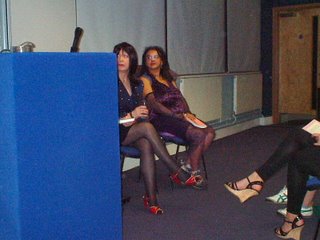
And here we are at last released from the box [From left to right: me in my wig and dressed as my avenging wife character, Sophie Hannah as herself (because, as she told the audience, she is her character), Suzanne Elvidge as her avenging cook, and Maya Chowdhry as a fairy punk]
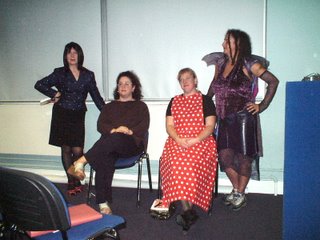
Yeah, right.
Bitch-Lit reading in Sheffield yesterday evening. 7.30 start, plan to get there an hour beforehand to change into costume and check out the venue, so leave at five for the one-and-a-half hour drive. Oh-oh. Traffic blocked at Glossop. At 6.30, when I'm meant to be there, we're still scooping round those scary bends between darkening misty hills, not a city light in sight. 6.40, we hit the outskirts, zoom downwards to the centre only to find what no one has warned us about: the roads around it are completely dug up, it's all bollards and diversions, hardly any lights or signs, and no one around - why not? - it's like the surface of the moon, the dark side. We're going round in circles, and now we seem to be driving away from the centre again... One lone man walking. I wind down the window. 'We're looking for the station!' He scratches his head, not sure how we'd get there with all these altered directions... Another: with all these altered directions, he's not even sure any more in which direction it actually is. It's seven o' clock now. John's driving, so I rummage in my bag, thinking I should change in the car, but then find I don't have the room. Two young girls, about twelve and ten. 'Know where the station is?' 'Oh yes! Well... erm... MUM!' they scream up to a window above the shops. The window opens. 'Mum, where's the station?' The woman starts yelling down instructions we can't hear.
It's 7.10 when we get to the back of the station which we know is opposite the venue, the Showroom Cinema. 'Stop! I'll run from here!' I grab my bags and costume and jump from the car, my skirt dropping from the hanger onto the pot-holed ground. Snatch it up, run through the dark round the side of the station car park, stumbling over potholes, only to come to a high workman's fence and be diverted a very long way round. It's 7.15, when I finally reach the steps of the Cinema Showroom. I fling myself, breathless, onto the box-office desk. 'To the stairs and then left,' I am told. I race down the stairs. There's no left turn... I race back up. 'Where's showroom 5?' I call to an usher. Oh, he meant past the stairs and turn left!
Everyone else is ready and waiting. So where can I change? Not in an office as they'd vaguely suggested we might, but in the loo... Great. Race to the loo. Can't paint my bitch lips on, must have dropped my makeup bag when I rummaged in the car...
I emerge with my arms full of bags, coat, clothes and a coathanger to find the audience already being seated. Where can I put them? Under that table there, I'm told, which I must squash past the legs of the audience to get to. So much for making an impact as your character...
And the setup, which I'd come too late to have a say in? A lectern with a mic we didn't really need, and which would hide our carefully planned costumes. And each side of it and a little behind it, two chairs for the readers, which meant that in the long room where the seating was arranged horizontally, each pair of readers was hidden from half of the audience. And as for the Q & A session: well, I tell you, it's amazing the rapport we achieved with our sell-out audience from behind a big blue box!
Here Maya Chowdhry and I are trying to converse around the lectern with the other two readers:
And here we are at last released from the box [From left to right: me in my wig and dressed as my avenging wife character, Sophie Hannah as herself (because, as she told the audience, she is her character), Suzanne Elvidge as her avenging cook, and Maya Chowdhry as a fairy punk]
Sunday, October 15, 2006
From the sublime to the wicked
Yesterday I went to the talk by Murat Belge in St Ann's Church - an event I found quite mind-blowing, and which I've written about on my other blog where I try to tackle the more serious matters.
Afterwards I wandered a bit gloomily, musing how in Britain we just don't value serious literature any more, when we damn well ought to: after all, the issues Belge was talking about, and in the novels he publishes by Nobel-Prize winning Orhan Pamuk, are even now being played out in Britain, not least in the current comments by British politicians about the veil.
And then I went into Waterstone's and found something to cheer me right up: there in the anthology section was Bitch-Lit, our light-hearted anthology with nevertheless a pretty serious point, turned out in all its bright-pink glory. Not only that, someone was reaching up to look at a copy! I tip-toed away, thinking, Good Old Waterstones, and Three Cheers for our lovely publisher Cathy Bolton at Commonword!!
Afterwards I wandered a bit gloomily, musing how in Britain we just don't value serious literature any more, when we damn well ought to: after all, the issues Belge was talking about, and in the novels he publishes by Nobel-Prize winning Orhan Pamuk, are even now being played out in Britain, not least in the current comments by British politicians about the veil.
And then I went into Waterstone's and found something to cheer me right up: there in the anthology section was Bitch-Lit, our light-hearted anthology with nevertheless a pretty serious point, turned out in all its bright-pink glory. Not only that, someone was reaching up to look at a copy! I tip-toed away, thinking, Good Old Waterstones, and Three Cheers for our lovely publisher Cathy Bolton at Commonword!!
Saturday, October 14, 2006
Salt added
Yesterday afternoon I'm waiting to cross the road to get to the fish shop and over the other side, waiting to cross in the opposite direction, is Steve Waling, poet and editor of poetry magazine Brando's Hat. He waits for me, looking somehow calm, beatific yet excited... What's cooking, I wonder? When I get there he gives me this exciting news: he has a poetry collection coming from Salt. No wonder he looks like the cat that got the salmon! There is nothing so wonderful, so heart-warming as the joy of a writer who, after years of working away, has achieved success (just look at Marie Phillips' blog recently)! And this small press, Salt, seems to have come from nowhere to become a hugely respected force in publishing in a very short time. Another reason for writers not to give up in the face of the more commercial trends in publishing...
Friday, October 13, 2006
One reason to turn to drink
Reading group last night, and another useful illustration for the writer of how differently people read and the different criteria they apply. 'Brilliant,' said Mark about our choice for discussion, Truman Capote's In Cold Blood. 'Really clever marriage between journalistic and novelistic forms. The objectivity means there's a lack of sensationalism, prurience or moralising, yet it's a compulsive read, you just can't put it down.' Others differed. 'Afraid I struggled with it,' said Doug. Doug and others felt that the marriage didn't work, and that the book did in fact at times induce a prurient reaction on the reader.
See? You hone your prose, you think carefully about your structure and its effect on the reader, and then a load of crisp-chewing, wine-guzzling punters casually bring to your book their own preconceptions and taste and experience...
Ah well.
See? You hone your prose, you think carefully about your structure and its effect on the reader, and then a load of crisp-chewing, wine-guzzling punters casually bring to your book their own preconceptions and taste and experience...
Ah well.
Wednesday, October 11, 2006
Manchester Literature Festival
The Manchester Literature Festival, conceived by outgoing director Chris Gribble and built on the foundations of the Manchester Poetry Festival, kicks off on Thursday, and it looks pretty exciting. I'll be sorry to miss William Boyd that day, as I'm already committed to my reading group, but I'm looking forward to the Amnesty International event on Freedom of Expression in St Ann's Church on Saturday afternoon and to Sebastian Barry at the University of Manchester at six on Monday. Sometimes as a writer you JUST DON'T GET OUT, but I've got an embarrassment of choices later on Monday evening: free tickets to a rarely-performed Tennessee Williams play at the Library Theatre, cult artist and musician Ed Barton reading his poetry at Matt and Phred's, or the Manchester Blog Awards at Urbis. How on earth can I choose? Maybe I'll get a migraine trying...
I'm extremely sorry to be missing the launch of novelist Nick Royle's first short story collection at Matt and Phred's on Tuesday, not least because we published him in metropolitan, but that night I'll be doing the Sheffield Bitch-Lit event. Apparently, to our great delight, the Manchester Bitch-Lit event at Waterstone's on Thursday has long been booked out. Sharon Olds at Manchester Museum on Wednesday is a must-see, I'd say, as well as the 'Celebrating Burgess' event at the Whitworth Gallery on Friday, and the exciting festival-within-a-festival of Palestinian literature and the Decapolis European short story events.
I'm extremely sorry to be missing the launch of novelist Nick Royle's first short story collection at Matt and Phred's on Tuesday, not least because we published him in metropolitan, but that night I'll be doing the Sheffield Bitch-Lit event. Apparently, to our great delight, the Manchester Bitch-Lit event at Waterstone's on Thursday has long been booked out. Sharon Olds at Manchester Museum on Wednesday is a must-see, I'd say, as well as the 'Celebrating Burgess' event at the Whitworth Gallery on Friday, and the exciting festival-within-a-festival of Palestinian literature and the Decapolis European short story events.
Saturday, October 07, 2006
A schizoid moment
What do you do when your relatives decide to come to one of your readings? Bite the bullet, I guess: thank the lord they support you in your mad life's endeavour and hold no grudges about the way you've unfairly portrayed them, decide not to care about the clash between your carefully honed writer's persona and the real embarrassing you they could let slip in flash, and when the night comes shut your mind to the fact that they know precisely which bits of the piece you're reading are autobiographical, and can transmit this to the rest of the audience with their knowing, readier laughs.
My mum rings me: 'We're coming to the Sheffield Bitch-Lit reading.' Eek. 'But we've got this problem. We tried to book, but they told us because we're relatives we'd get complimentary tickets.'
They told them they were my relatives? (Like proud parents or something?!!)
'And they said you'd know all about it and would sort it out.'
Ohmigod. I know nothing. I want to know nothing... 'OK.'
I ring the festival box office, apologetic, foolish. 'Oh, that's fine!' they tell me. 'Yes, your mother and your sister: we've already put two comps aside!'
I feel just like when I was in the school play...
My mum rings me: 'We're coming to the Sheffield Bitch-Lit reading.' Eek. 'But we've got this problem. We tried to book, but they told us because we're relatives we'd get complimentary tickets.'
They told them they were my relatives? (Like proud parents or something?!!)
'And they said you'd know all about it and would sort it out.'
Ohmigod. I know nothing. I want to know nothing... 'OK.'
I ring the festival box office, apologetic, foolish. 'Oh, that's fine!' they tell me. 'Yes, your mother and your sister: we've already put two comps aside!'
I feel just like when I was in the school play...
Sunday, October 01, 2006
There's never not a hitch...
Forget your posh pens or your slick laptops: a writer's best equipment is a damned good sense of humour.
Yesterday we kicked off the Bitch-Lit tour. Drive from Manchester to Ilkley, leave in plenty of time, but the traffic is dire, backed up for miles, and I know others are cutting it finer. Will they make it? Will the folk of Ilkley miss out on the revelation of a row of bitches bitching? And what about the parking? Lucky for me, there's a space right outside the Ilkley Playhouse where we're performing. Grab costume and bags, rush in to find Mary Sharrat our editor there already, and I no longer need my sense of humour: lovely ladies ply us with cups of tea and a bottle of wine (before a performance?) and lead us up to a plush green-room with glorious mirrors and a big plate of fruit and enough hairspray, as Mary said, for Margaret Thatcher if she lived another forty years.
We're already changed when the others arrive in a breathless dash. 'Hi Mary,' they cry and fling their arms around her, but they don't speak to me, just glance at me uneasily. 'You bitches,' I say, and at last they see it's me beneath my wig and in my vamp's jacket and killer heels...
But there's no time for laughing, and in a very short while a sound engineeer who looks all of sixteen has excessively politely spoilt the line of our costumes by sticking mics up our jackets, and we're being led downstairs to the stage. The show begins, it's going well, and Cath Staincliffe is two minutes into her reading, the first. The door opens at the back and a tiny elderly woman in a sharp grey trouser suit bursts in. The usher jumps up to direct her to a seat near the back, but she booms that she has to sit at the front 'because I'm deaf', and, still booming over Cath, is led all the way to the front row.
Hitch over, the show seems to go well. The audience is a gift, laughing at all the right moments and very appreciative in the Q & A session afterwards. We're walking out to the foyer for the signing when I realise the hard-of-hearing lady is right in front of me. She turns and snaps at me: 'You want to invest in a microphone.' 'We had microphones, actually,' I tell her kindly and sympathetically, and then realise I might not be speaking up enough. She heard all right, though: 'Well, they didn't work.' She turns, scowling, to Mary who chaired the event: 'I didn't hear a thing and I'm demanding my money back.'
Hm. Everyone else seemed to enjoy it, however, and we sold a fair few books, the main point of the exercise, after all....
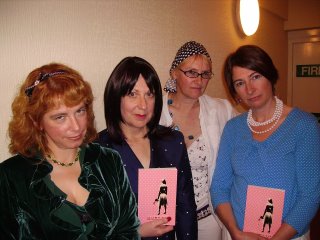 Four bitches, from left to right: Mary Sharratt, me in my wig, Char March and Cath Staincliffe
Yesterday we kicked off the Bitch-Lit tour. Drive from Manchester to Ilkley, leave in plenty of time, but the traffic is dire, backed up for miles, and I know others are cutting it finer. Will they make it? Will the folk of Ilkley miss out on the revelation of a row of bitches bitching? And what about the parking? Lucky for me, there's a space right outside the Ilkley Playhouse where we're performing. Grab costume and bags, rush in to find Mary Sharrat our editor there already, and I no longer need my sense of humour: lovely ladies ply us with cups of tea and a bottle of wine (before a performance?) and lead us up to a plush green-room with glorious mirrors and a big plate of fruit and enough hairspray, as Mary said, for Margaret Thatcher if she lived another forty years.
We're already changed when the others arrive in a breathless dash. 'Hi Mary,' they cry and fling their arms around her, but they don't speak to me, just glance at me uneasily. 'You bitches,' I say, and at last they see it's me beneath my wig and in my vamp's jacket and killer heels...
But there's no time for laughing, and in a very short while a sound engineeer who looks all of sixteen has excessively politely spoilt the line of our costumes by sticking mics up our jackets, and we're being led downstairs to the stage. The show begins, it's going well, and Cath Staincliffe is two minutes into her reading, the first. The door opens at the back and a tiny elderly woman in a sharp grey trouser suit bursts in. The usher jumps up to direct her to a seat near the back, but she booms that she has to sit at the front 'because I'm deaf', and, still booming over Cath, is led all the way to the front row.
Hitch over, the show seems to go well. The audience is a gift, laughing at all the right moments and very appreciative in the Q & A session afterwards. We're walking out to the foyer for the signing when I realise the hard-of-hearing lady is right in front of me. She turns and snaps at me: 'You want to invest in a microphone.' 'We had microphones, actually,' I tell her kindly and sympathetically, and then realise I might not be speaking up enough. She heard all right, though: 'Well, they didn't work.' She turns, scowling, to Mary who chaired the event: 'I didn't hear a thing and I'm demanding my money back.'
Hm. Everyone else seemed to enjoy it, however, and we sold a fair few books, the main point of the exercise, after all....
Four bitches, from left to right: Mary Sharratt, me in my wig, Char March and Cath Staincliffe
Subscribe to:
Posts (Atom)