Saturday, April 16, 2016

Reading group: Hangover Square by Patrick Hamilton

Warning: plot spoil.

This 1941 novel, Trevor's suggestion, features thirty-four-year-old George Harvey Bone who is in the grip of an infatuation with Netta Longdon, an out-of-work minor actress at the centre of a group of idlers who hang around London's Earl's Court all day drinking, or indeed, blagging drinks from others, chiefly from George. The novel opens, however, when George, staying with his aunt on the Norfolk coast for Christmas, suffers one of the mental lapses to which he is increasingly prone, in which he momentarily forgets where he is and is then overtaken by a purpose which at other times he entirely forgets: to kill Netta. Netta and her cohorts treat George cruelly, blatantly and even tauntingly using his infatuation with her to exploit him and going so far as to trick him, but so great is his obsession with her that in his 'sane' moments, he entirely forgets his desire to kill her and once more simply longs to be admitted into her affections.

Introducing the book, Trevor said he had found it hard to get to grips with these mental shifts, by which I think he meant he couldn't understand them on a psychological level. Although there is some implication that they are fuelled, or at least exacerbated, by excessive drinking, the book is epigraphed with a now outdated definition of schizophrenia: SCHIZOPHRENIA: A cleavage of the mental functions, associated with assumption by the affected person of a second
personality. However, George's lapses are in fact more akin to what we might now call a fugue state, a state of forgetting, dissociation and escape. It also seemed to some so very alien to George's somewhat passive and put-upon character that he should have such an impulse in even a dissociated state.

I said however that I didn't think this was meant to be a psychologically realist novel, and Ann agreed, saying that the mental shifts were more of a device, used in my view for a political rather than a psychological purpose. The novel begins very explicitly and indeed self-consciously at the start of 1939 and the run-up to war. As he walks the Norfolk cliff, George wonders when he should kill Netta: 'January the first? That seemed a good idea - starting the New Year - 1939.' Netta and the group around her approve of the Munich appeasement which troubles George; Netta is attracted to fascism for all the most decadent reasons:
She was supposed to dislike fascism, to laugh at it, but actually she liked it enormously. In secret she liked pictures of marching, regimented men, in secret she was physically attracted by Hitler. She did not really think that Mussolini looked like a funny burglar. She liked the uniform, the guns, the breeches, the boots, the swastikas, the shirts. She was, probably, sexually stimulated by these things in the same way as she might have been sexually stimulated by a bull-fight
and the unpleasant Peter, with whom George is devastated to find Netta is sexually involved, and who has been in jail, once for what he calls 'a minor spot of homicide with a motor-car', (and whose brutality is another source of attraction for Netta) is a Nazi sympathiser, if not an out-and-out Moseleyite.

In my view George's obsession with Netta, mired in the unthinking alcohol-soaked stasis of an idle life, is intended to stand for the dreamlike British psyche in the run-up to the war; it is George's fugue-like states which are the true sanity: the moments in which he sees evil for what it is and recognises that it must be destroyed, however contrary that runs to his nature.

Ann said she felt there was also a class theme operating. Netta and Peter and co are social climbers and they tolerate George not simply for what they can get out of him materially, but for the association with the kind of social background including a minor public school education that is George's. Indeed, in discussing Netta's attraction to fascism, the narration comments: 'And somehow she was dimly aware of the class content of all this: she connected it with her own secret social aspirations'. John noted the similarity in atmosphere and situation to that of Jean Rhys's Voyage in the Dark, published seven years earlier and which we discussed previously: a book set in a similar alcohol-soaked social milieu in the run up to the earlier war, with a similar sense of social breakdown and uncertain future - though, as we all noted, Rhys's book is much more psychologically internal (and thus to my mind more modern).

Jenny said she had read this book more simply as a depiction of a man manipulated by cruel people and unable to withstand them due to his amenable nature, and had found it very moving indeed. Everyone agreed that the book did work powerfully on that level, but whether this mix of modes works is perhaps questionable. Because George's character and emotional state are so richly portrayed, I found it difficult to believe that he would ever kill Netta. Others reported being very engaged by the question of whether he would, and the tension created as the narration led towards the possibility. John had said he thought the 'schizophrenia' device was a clever way of engaging your sympathies with him when he finally does so, but people experienced surprise, even shock, while some, including me, rather lost sympathy with George at this point - or rather, I found myself jerked out of the emotional engagement induced by the psychological realism and forced back to the detachment created by a more political allegory.

On the whole, I think people found the book thus slightly problematic, but everyone was agreed that it is a striking book, steeped in atmosphere and social-historical details that everyone relished, and rendered in acute prose beautifully exemplified in this description of Peter from George's point of view: 'And he laughed in his nasty, moustachy way.'

Our archive discussions can be found here and a list of the books we have discussed, with links to the discussions, here

Friday, April 08, 2016

Wales Arts Review reviews Used to BE

Here's a great new review of Used to Be in the Wales Arts Review - very insightful in terms of my basic themes and preoccupations. I didn't see it for a while, as I've not been on social media much - coming to the end of a big writing project means spending any spare time catching up in the garden, cleaning the sadly neglected house and spending hours and hours fiddling about with the manuscript - I've edited it twice now, but every time I look at the damn thing I see something that needs changing, and then I have to redo it and print out the changed pages again for my beta readers, who prefer hard copy.

The review, by Frances Spurrier, comments on the way some of the stories touch on technology, which I hadn't thought of myself - I tend to think I've left behind my obsession with technology, as worked out in The Birth Machine and some of my earlier stories, having become more interested in storytelling and memory, but I guess those things are intertwined, all feeding into my underlying theme of power which I made most explicit in Balancing on the Edge of the World.

I'm pretty chuffed by Frances Spurrier's comment:
 'While it may be easy enough to have existential anxieties, to ask what is real and what is not, to question the reliability of memory – it is not at all easy to ask big questions in this most difficult of writing forms, the short story, and using such lucid and poetic prose as the author here uses.'
Off to London today, to the launch of Isobel Dixon's new poetry collection Bearings - can't wait, I love her poetry!

Sunday, March 13, 2016

Edge Hill Prize long list


It's that time of year again - the longlist is announced for the Edge Hill prize for a single-author collection of stories. This year my own book Used to Be, is on the list - a massive list, and there's huge competition, with some big hitters in the short-story world there, including Colum McCann and Kate Clanchy, two of my favourite writers. And a good proportion of Irish and Scottish writers.

Crossposted to Fictionbitch

Saturday, February 27, 2016

Reading group: The Butcher Boy by Patrick McCabe

John suggested this novel set in an Irish border town in the early 60s, which begins, 'When I was a young lad twenty or thirty or forty years ago...' Thus Francie Brady establishes himself as a severely unreliable narrator before embarking on a tale of the small-town ostracisation of his family for the drunkenness of his father Benny and the unstable mental state of his mother and the resulting squalor of their life, and his own reaction and resistance to the ostracisation, which ends in horrific violence and incarceration.

John said there were various questions that could be asked about this book. Is it a depiction of how to create a psychopath, or is it more simply a portrayal of the brutal lives that some people still led in Ireland in the early 60s? Or is it an exploration of the effects of English colonisation of Ireland and of Anglo-American culture on Irish small-town life? Francie's main enemies, the Nugents, are strongly anglicised: they have lived in England and their son Phillip once attended an English private school, turning up at first in his pristine uniform which marks him out as different, superior and privileged. Along with the Purcells, the parents of Francie's friend Joe, they aspire to an English middle-class lifestyle, with over-neat houses and dinner parties. The trouble between Francie and the Nugents begins when Mrs Nugent calls Francie's family pigs, a historic English insult for the Irish.

I said that I thought the book was about Irish identity and the ambivalence and confusion of realities created by the imposition of English culture on an older, more rural Ireland, and I thought it therefore significant that the novel is set in a southern Irish town near the border with Northern Ireland. Francie permanently longs for a lost past located in old-fashioned romantic love and family and preserved in his mother's romanticised tales of his parents' honeymoon - tales which will turn out to contrast starkly with the reality - and struggles always, in spite of the reality, to regard himself and his parents in this light. Yet he is deeply colonised by Anglo-American culture. His mental landscape is peopled by characters from English comics and American films, and his acts of transgression and violence do indeed have a horrifically comic-book character. It is significant that the anglicised Phillip Nugent is the possessor of a large collection of such comics, all of them preserved in a pristine state, which Francie envies and tricks out of him, the act which precipitates all the trouble between himself and the Nugents. His aggression towards the Nugents is clearly based in part in envy: he has unbidden and ambivalent fantasies in which they tell him they know he wants to belong to them and in which, to his disgust, Mrs Nugent breastfeeds him. He shares in the small-town admiration of his Uncle Alo, who has left for England and is supposed to have done so well there, and the unmasking of Alo is one of the precipitating factors in Francie's downward spiral. He has his own snobbery about traditional country people. He notes that 'a tractor went farting off home to the mountains with a trailer of muck', a derisory image contrasting sharply with a similar but romanticised image of 'an ass and cart going off into the green mountains', by which Francie is seduced, on the cover of Phillip Nugent's music book, nostalgically titled Emerald Gems of Ireland. It is significant too that it is Phillip, identified with appropriating colonisers, who, while possessing a library of Anglo-American comic culture, is also the possessor of this repository of Irish traditional ballads, including the one that Francie poignantly identifies with his mother. Francie holds particular scorn for Mrs Nugent's country-living brother, 'carrot-head Buttsy ... in a cottage that stank of turfsmoke and horsedung'. Buttsy's violent and uncouth pursuit of Francie gives the lie to the civilisation of the Nugents, the ambiguity of which is already established in their having to have returned to Ireland - a failure paralleling that of Francie's Uncle Alo. Yet the hypocrisies of the new society are more than matched by those of the older Ireland, so widely romanticised yet a seat of devastating damage: the damage to Francie's family is rooted in the trauma of his father's childhood in a Catholic Belfast orphanage, a pattern that will be repeated when Francie is sent in turn to a children's home and is interfered with by a priest.

All of this ambiguity is carried by the fact that Francie constantly slips into immature fantasies which in the end he turns into horrific reality. It is a shock to the reader to realise, when he returns from the reform school wanting to take up again his childish games with Joe, that Joe has gone on to secondary school and has outgrown such things, and to register Francie's arrested development  - signalled in the opening 'When I was a lad twenty or thirty or forty years ago' (which also prefigures the book's theme of confused history). I saw Francie's immaturity as representing the infantilisation of a people by both colonisation and religion, and it was noted in the group that Francie's name for his abuser in the reform school is 'Tiddly', neatly encapsulating the immaturity of a (historically all-powerful) Catholic priesthood.

After John's first question, Jenny had jumped in and said strongly that she didn't think that Francie is a psychopath - she thought that his behaviour is induced by circumstances and the way he is treated - and indeed his nostalgic longings and attachment to natural beauty, such as the single snowdrop that grows in the alleyway, militate against such an interpretation. However it was clear that Jenny had read the book as a psychological study. Others, in particular Clare, subscribed to this reading, and I agreed that the book did work beautifully on a psychological level as well as the political. Everyone agreed that the voice was exceptionally acute, that the book was in fact a tour de force of voice and prose style.

One question of John's that we didn't perhaps explore in enough depth was that of Francie's verbal charm, which he uses to manipulate people. Group members felt that the idea that he charms them is just another of Francie's fantasies, and that in reality they patronise or are frightened of him. I feel it's more complicated than that, but was unable to articulate why in the meeting. Francie's verbal wit is indeed quaint and acute. He comes upon some gossipy housewives in the grocery store: 'What's this? I says, the woman with three heads? When I said that they weren't so bad. Flick - back come the smiles.' I thought there was an implication that people were indeed momentarily disarmed by him, creating a cognitive dissonance (for both the characters and the reader) which in itself induces fear in others. In other words, Francie uses quaint Irish charm as a threatening weapon against his oppressors. John said that when he first read the book, several years ago, he was indeed charmed and saw Francie's actions as schoolboy pranks until they turn horrifically violent, a view that is reflected in reviews of the time. This time, he said, knowing the ending, he found all of it much more horrific.

Trevor noted that, unusually for Irish Catholics, none of the families, even the Bradys, has more than one child, and it was agreed that this is because this is not a social-realist novel, but one in which each character is some kind of representation.

Doug said that he was very impressed by the novel, but he could hardly say he enjoyed it as he found it so horrific, a view that was shared - interestingly enough, particularly among the men.

Our archive discussions can be found here and a list of the books we have discussed, with links to the discussions, here

Monday, February 22, 2016

Reading Group: Martin Dressler: The Tale of an American Dreamer by Steven Millhauser.

It's a long time since we held the discussion of this book, Jenny's choice, and in the meantime my head has been stuffed with my WIP (I've been a long way away, psychologically), so my memory of it is rather hazy.

The book, first published in 1997, winner of a Pullitzer prize, and more recently brought back to attention, is a kind of fable set in New York at the end of the 19th century, when a frenzy of building development was spreading upwards and outwards to create the metropolis we know. It concerns the son of a tobacconist who from humble beginnings as a hotel clerk becomes an entrepreneur, developing first a series of coffee bars and then moving into the business of building hotels, each successive one larger, more luxurious, and finally more fantastical than the last.

We all liked the book, I think, though as far as I remember Hans wasn't so sure about the unusual tension in the book between realism and non-realism. The book begins in the mode of a fairytale, using fairytale idiom and summing up the whole story to follow: 'There once lived a man named Martin Dressler, a shopkeeper's son, who rose from modest beginnings to a height of dreamlike good fortune.' There's also a surreal episode near the beginning in which, before he becomes a clerk, Martin is taken to the top floor of the hotel and witnesses strange scenes amongst a troupe of actors staying there. However, the novel then quickly moves into a realist mode, with a measured, slightly old-fashioned prose very suited to the era portrayed, and a plethora of fascinating (and clearly deeply researched) historical details (which everyone loved). However, embedded within this realism is the motor of the novel: Martin Dressler's own psychic development from inspired but realist business sense to ambition, dreams, and finally fantasies that overreach themselves. As a result the novel ends in surreality, with Martin's final hotel a place that could not possibly exist in reality, with whole replicated worlds encompassed on its endless floors, including features such as real boating lakes.

Personally, I like this narrative tension a lot as a statement of the disastrous lack of realism at the heart of so many real-life capitalist projects, and indeed of our capitalist mentality and society, and Trevor in particular wholeheartedly agreed. There was some discussion as to how far in any case the ending of the book was a fantasy, those who had been to LA saying that projects there equal Martin's in their reliance on fantasy if not in impossible physicality.

Everyone was very taken with the ending, in which, recalling the early surreal scene involving actors, once Martin's final dream hotel is failing he employs actors to act as guests. In order to do so, they (for a time) become real-life inhabitants, the fantasy thus melding into reality. Finally, Martin walks by the river 'woken from his dream of stone', but unbowed, because it wasn't the particular dream that was important, but the dream impulse itself. In other words, realism can't win: the capitalist fantasy won't die.

Introducing the book, Jenny found central Martin's relationship with the two sisters he meets in a hotel where he lives before starting his own: he marries the dreamy but cool and ungiving Caroline, but takes into his confidence and business the lively and practical and less good-looking Emmeline. Jenny saw this as a depiction of the cultural (sexist) paradox in which women are required to fulfil incompatible male fantasies and be both beautifully fey and yet practical. I saw the two women (and his relations with them) rather as personifications of Martin's own psychic paradox - his initial practicality, and the dreaminess that overtakes it and leads to his downfall.

There was comment on the fact that there is a lot of repetition - especially in the depiction of these two women and their chaperoning mother. One early description of Caroline -  '...her pale hair pulled tightly back, so that it seemed to pull painfully against the skin of her temples' - is repeated several times. This is another rhetorical and rhythmic fairytale technique, and Ann pointed to the similarity with Homer's repetition of 'the wine-dark sea', noting also that it was a kind of labelling or signalling (of themes, tropes etc). A labelling technique seems indeed apt for the Victorian setting. However the repetitions here weren't exactly snappy, yet were repeated verbatim and so didn't work for several members of our group. Some people indeed found the book on the whole very wordy, though I hadn't found it unaptly so myself, and they did concede that the prose style was very suited to the era of the story.

Finally, Jenny and Clare both expressed appreciation of the fact that, in spite of this, the novel is composed of (more modernist) short sections, which made it easier to read in the short bursts occasioned by modern life. All in all, we thought it an excellent and engaging allegory of the capitalist urge, and thus indeed of present-day society.

Our archive discussions can be found here and a list of the books we have discussed, with links to the discussions, here

Sunday, February 21, 2016

End of a draft


At last I reached the end of the latest draft of my wip - the typing up of it, that is. (I now have to read through the typescript and edit it). Here was my desk on the 2nd January when I started: five and a bit hand-written A4 Pukka pads, and beneath them two earlier typed-up drafts put ready for reference. And last Friday, after six weeks of sitting there at my window with the rain slashing down outside, and the sun, when it did come out, slowly creeping around so that towards the end I had to draw down the blind to see the screen, I typed the last word. Since then I have been immersed in the horror of cleaning a neglected house, the pleasanter and more therapeutic work of pruning a neglected garden, frantically catching up with my overdue reading, and basically re-learning to engage with the world around me!


Wednesday, February 10, 2016

The WIP trap

WIP progress report: I have been sitting still for so long now that I have a sore knee - argh! And because of that, and because I'm so near the end and tying things up, I hardly slept a wink last night. Other consequences are: a filthy house, an absolutely messy garden, my social life in utter abeyance and my awareness of the cultural events around me - theatre, film etc - at a minimum.

I do NOT recommend this working method, but I just can't help it myself: if I try to stop, I just sit there thinking about it but not doing it, and unable to put my mind to a single other thing, apart from Killer Soduko (numbers are such a great relief from words!).

Tuesday, February 09, 2016

Helen Walters reviews Used to Be

Another review of Used to Be to bring me back to my blog in spite of the demands of the WIP. Helen Walters writes a lovely response to the book on her blog, Fiction is Stranger than Fact.

She says:
One of the most appealing things about this collection is that, although all the individual stories are very different and cover different subjects, there is a real unity of theme to the book,

goes on to explain that
All the stories look at alternative explanations and viewpoints on things that have happened or are happening. They examine the nature of memory, the complexities of interpretation and the possibilities of alternate reality. The y also put the microscope on the art of storytelling itself,

picks out her three favourite stories, and concludes:
All in all, an enjoyable collection of well-chosen stories with a fascinating linking theme. Recommended.

WIP bulletin (for those the slightest bit interested): woke at 3.35 and couldn't get back to sleep for thinking about it, so overslept and lost an hour's working time this morning. Stopped for lunch, a walk in the park and a coffee in Nero's and then rushed back to it. Have just finished at 7 pm, and this page keeps blurring!

Monday, February 08, 2016

Review of Used to Be on Our Book Reviews Online

Still stuck like glue to my manuscript, so still not blogging properly, but in the meantime here's another nice review for Used to Be, this time by The Mole on Our Book Reviews Online. He concludes:

A really great collection that you will enjoy, identify with, wish that worm hadn't got into your head - and each of these in equal measure.

Whole review here.

You may or may not be interested to know that I am typing and rewriting so hard and for such long hours that my back aches and my sight keeps getting blurred, which is about all the other writing news I have at the moment. The thrills of the writer's life, eh?

Monday, February 01, 2016

Bookmuse reviews Used to Be

Pretty thrilled with this review of Used to Be on Book Muse. It's short, but then it's not how much you say but what you say:
Baines reminds me of a scratch DJ, taking a conventional format and messing with it, expertly, to give the audience a whole new experience... 
...Highly readable, thought-provoking and with beautiful use of language, this collection is a rich and unexpected delight.

Read the whole review here.

I haven't managed to blog much since the New Year, in spite of my hopes. As I said, I'm typing up a draft of something long, and I thought that this would give me more headspace than I had during the actual writing, but I'm so obsessed with it that I just type and type (and edit) all day, right into the evening when I'm too whacked to do anything else. Soon be finished, I hope!

Sunday, January 24, 2016

Tim Love reviews Used to Be

Tim Love's review of Used to Be, based on his previous blog notes, is on Everybody's Reviewing.

He begins:
The Mandaeans of southern Iraq had a demon called Dinanukht, half man and half book, who "sits by the waters between the worlds, reading himself". This demon could be the patron saint of Bainesland, where characters interpret symbols that seem to belong to the external world, but turn out being part of the character's past.

I'm gratified by his grasp of what I'm trying to do in these stories. 'Explicitly or otherwise,' he says, 'the characters are story-makers, reassembling their life-arc from stirred memories.'  He discusses three of the stories in particular, and lists as his favourites three stories earlier versions of which happen to be online: the title story 'Used to Be', 'Falling' and 'Tides, or How Stories Do or Don't get Told'.

Tuesday, January 05, 2016

An interview in the Didsbury Community Index

Before Christmas, on the publication of Used to Be, Deborah Grace came to interview me for the Didsbury Community Index magazine. She asked me about the themes of the book, which include memory, and got me spilling some very early memories of my own. Read the interview here.

Monday, January 04, 2016

Review of Used to Be on A Life in Books

The New Year (well, the working New Year) kicks off for me with a great review of Used to Be on the A Life in Books blog. The poet Gillian Allnutt once said to me, 'It's so wonderful when people understand what you're trying to do', and that's just my reaction this review by Susan Osborne, in which she says that the collection 'niftily overturn[s] apparent certainties, often in a series of small revelations and delivering the occasional killer punch.' After considering several of the stories, she concludes:
There are several quotations I could have picked in which Baines neatly sums up her theme but here’s my favourite:  ‘your life might go one way, or a completely different other’. Most of us like the idea of certainty – it makes us feel safe – but as this thoughtful collection reminds us there’s precious little of it in life, although sometimes – as in fiction – that makes it more interesting.

Saturday, January 02, 2016

New chapbooks from Nightjar


It's a while now since I was delighted to receive from Nicholas Royle the latest production of his Nightjar short story imprint, and at long last I have the time to write about it here. Two beautifully produced chapbooks, as ever, smartly typeset and printed on lovely silky paper, in limited signed editions, this latest pair sporting jackets in differing tones of lush purple. Nightjar is of course dedicated to the weird or strange, and neither of these stories disappoints on that score, although they each, in their individual ways, differ in tone from most of the books in the series which tend toward the spooky. John Rutter's 'Last Christmas' has indeed something of a Punch-and-Judy feel: set at an eye-opening family Christmas dinner, it's a metaphoric treatment of ageism and the notion that the younger we are the bigger the space and attention we take up, and the older the less. Leone Ross's 'The Woman Who Lived in a Restaurant' is a kind of fairytale that is also a love story, and has a lushly haunting quality.

If you collect these editions - and I know many people do - then better rush and order these two before they sell out, as several in the series already have.

Friday, January 01, 2016


I'm thrilled to be involved with this project, a collaboration between Galley Beggar Press and Salt, intended to provide refuge for those in need. It's a collection of short stories on the subject of Refuge by such wonderful writers as Marina Warner, Toby Litt, Stella Duffy, Nicholas Royle and others, and I'm proud that my little piece 'Home' (which previously appeared in Fragments from the Dark, a book produced by Hafan, the Swansea Asylum seekers support group) rounds off the collection. Do please download it: you'll get a wonderful read as well as be supporting those so sadly in need.

Thursday, December 31, 2015

Reading group: The Crying of Lot 49 by Thomas Pynchon

I'm afraid this 1965 book didn't manage to compete with Christmas for our group. We met to discuss it in the pub just before our Christmas dinner, and it turned out that only three of us had read all of it. Ann, Clare, Mark and John had found that it just didn't engage them enough to encourage them to put aside for it the myriad of seasonal things they had to do, and Jenny hadn't even tried. I was one of those who read it to the end, but I found it a struggle, and had a singular experience: when Doug first suggested the book I said I had read it previously - and I believe I had even written about it at some time - but when I came to read it again for the group I recognised nothing whatever about it, which has never ever happened to me before on a reread. I was convinced I had been mistaken about having read it until I started to come across pencilled notes in the margin in my own handwriting. Further, I moaned to John that I still had to finish it, before remembering that I had actually finished it the evening before as we sat in a cafe. That was just how unmemorable the book was for me.

Hans and Doug, however, were more positive, Doug announcing that this was perhaps the seventh time he had read it, that he still wasn't entirely sure what it was about, but that he really loved and admired it. It's the story of a young woman, Oedipa Maas, who one afternoon returns to her California home from a Tupperware party to find she has been made the unlikely executor of the will of a past lover, real estate mogul Pierce Inverarity. If indeed story is a word that can be applied to the off-beat and sometimes seemingly disconnected events that follow as she drives south to carry out this duty, becoming involved with ex-child-actor lawyers, a larky pop group recalling the Beatles or the Monkees, and the mystery of a medieval postal system with the sign of a muted horn, still apparently existing in an underground form and somehow implicated in Inverarity's vast and complicated estate. Or is it? Inverarity (note the echoes of verity/truth in the name) has left behind a postage stamp collection which at the end of the book will become an item in an auction (Lot 49), and appears to hold clues to this, but how can Oedipa be sure that it isn't all a huge practical joke on Inverarity's part?

There are comic disconnected dialogues and madcap scenes reminiscent of a certain kind of film popular at the time, the sixties, and characteristic of that era's popular larky view of itself. It's clear that these are intended, paradoxically, to illustrate the serious theme of the book, that of the difficulties of communication and the impossibility of ever knowing the true significance of things in a culture in which the social and moral barriers are breaking down. Unfortunately, however, I think it was this fragmented nature that made the book unmemorable for me, and some in the group found the events silly rather than funny, in particular John, and Mark who was the most critical of all. The serious purpose is evident in the language, the satirical naming and magnificent long, convoluted sentences which Doug in particular admired. He said that if he himself had managed to write something as good as the riff early in the book on the former car-sales career of Oedipa's husband Mucho, then he would die happy:
Yet at least he had believed in the cars. Maybe to excess: how could he not, seeing people poorer than him come in, Negro, Mexican, cracker, parade seven days a week, bringing the most godawful trade-ins: motorized, mechanical extensions of themselves, of their families and what their whole lives must be like, out there for anybody, a stranger like himself, to look at, frame cockeyed, rusty underneath, fender repainted in a shade just off enough to depress the value, if not Mucho himself, inside smelling hopelessly of children, supermarket booze, two, sometimes three generations of cigarette smokers, or only of dust - [This single sentence continues for another half-page.]
Everyone agreed that the passage was extremely well written, but some pointed out that its subject was never picked up on again, was just left dangling and seemed to be there just for its own clever sake - which may have been the thematic point, but was unsatisfying. There are other sentences that are less easy to read and people expressed irritation at having constantly to go back and read them over and over again, and that on the whole they had lacked the necessary patience - and I have to say that I found, particularly in the latter half of the book, that some of the sentences overreached themselves and resulted in clumsiness. (There is in fact a certain imprecision in the middle of the sentence quoted above, although, as John has said to me, that is perhaps acceptable for the laid-back, 'psychedelic' literary style of the time.)

Which is all that I can remember was said before we dropped the subject of the book, left it dangling, and larkily went off to our Christmas dinner in Aladdin's over the road.

Our archive discussions can be found here and a list of the books we have discussed, with links to the discussions, here

Wednesday, December 30, 2015

Season's greetings, recap of the year and a nice bit of news


Happy festive season! 

Well, it's been a very busy year for me, and as a result I haven't blogged much, in spite of periodic resolutions to get back to it. Since January I've radically redrafted two novels I've had on the stocks, and struggled with a commission for a contribution to a book on writing - one of the most difficult things I've ever had to write, and it's not right yet! - and of course there's been the publication of Used to Be. (Plus we had our house re-roofed, which was naturally very disruptive.) When I went to get the Christmas decorations out, it seemed to me that I'd only just put them away after Christmas 2014!

When you're that short of time it's so much easier to post your news and share your thoughts about writing on Facebook or Twitter, but I have missed the chance to mull things over in the more contemplative way that blogs allow, and I hope that in the next year I'll have more time for that. Come the New Year, I'll be working on typing up and revising the longer of the two novels I worked on last year (I rewrote it in longhand, which for me, is the best way to feel the rhythms of the story and get into the dream-like state I need to imagine it: as I reported earlier, the reason I had to rewrite the other, shorter novel was that I had tried to write it directly onto the laptop, and it just didn't have those rhythms and juice) and of course I'll be trying to finish the ruddy commission. But both of these will be basically polishing jobs, so I'm hoping I'll have more headspace from now on.

That headspace thing is so important - I've constantly felt that I've had nothing to blog about, but of course it's not true, I've had loads of thoughts about writing, but it's all gone into the other things, the commission and the novels. It is also true, however, that being so cocooned inside the creative process, I've done less in the outside world, so have had fewer events to report. (That's the see-saw of writing, particularly with novels: you need the time shut away in order to do it, but then you need to be in the outside world to gather the material!)

As it happens, this morning does bring me some nice writing news to report: Scott Pack highlights a story from Used to Be on his 'Me and My Short Stories' page and gives it four stars. The story he picks out is 'The Choice Chamber' (which Katy Lumsden previously picked out as a favourite in her review), in which a woman thinks back to her younger self and the alternative possible futures she had then. Scott likes the fact that although this might seem to be a familiar situation, there's a 'killer last line' that turns it all on its head. Which, needless to say, leaves me feeling pretty chuffed!

Sunday, November 22, 2015

Chrissie Gittins and Tessa Hadley


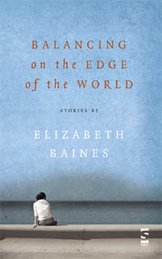
On Friday evening Chrissie Gittins launched her wonderful new collection of stories, Between Here and Knitwear (Unthank), a lovely event upstairs in the cosy central-London Rugby Tavern. I first met Chrissie when she came to read at Manchester Central Library with her then newly published first collection, Family Connections, and when my own first collection, Balancing on the Edge of the World, was forthcoming from the same publisher, so of course we got chatting and have kept in touch ever since. And so of course on Friday I jumped on the train for the launch of the new book.


It's a series of linked stories that chart the life of one woman, Christine, from early childhood to middle age, and the shifts in her relationship with her parents as she grows and then as her parents become vulnerable and aged. The stories are steeped in the kind of physical detail and psychologically acute observations that will have readers exclaiming with recognition, and Chrissie has a beautifully subtle and dry wit.
I loved Mrs Marshall. We all did. We wanted to be her. We wanted to be married to her husband and donate our wedding trousseaus to the school play. We wanted a weekend cottage in Troutbeck, and to start our teaching careers in Wales.
Chrissie read beautifully, and we were all entranced. I read the book all the way back on the train, looking up only once, at Stoke-on-Trent, to see that, without my noticing, it had been snowing. It's a book you'll want to read in one sitting.


Two days earlier I was at Edge Hill University, hearing Tessa Hadley read and talk. She read an early short story and an extract from her latest novel, The Past, and talked very interestingly about the difference between novels and short stories, and the different strategies and mindsets needed for each. She didn't think there was any point in getting indignant about the way short stories don't sell, she said: the fact is that short stories are a 'strenuous' read, requiring a particular kind of focus of attention, and people prefer the immersive experience that novels can provide. Nevertheless, she said, stories are a joy to read and write, and for the writer a wonderful medium in which to hone your linguistic skills. Afterwards I reminded Tessa that we had met in Cardiff at the launch of Power, an anthology published by Honno, in which we both had stories, and she told me that that had been her very first short story - she's come a long way since!

Friday, November 13, 2015

Used to Be reviewed on Everybody's Reviewing.


A lovely review of Used to Be by Hannah Stevens on the Everybody's Reviewing blog, which opens thus:

'A collection packed with bursts of intense short stories, written in clean, sharp prose. The stories are immersive and gripping. I read this book in one sitting.'


Wednesday, November 11, 2015

Goodreads giveaway books ready to go


Here are the copies of Used to Be packed up and addressed to the winners of the Goodreads giveaway. Congratulations to the 10 winners, and thanks so much for the interest of the other 1,382 people who went in for it.