Monday, March 18, 2013

Reading group: Ian McEwan's Saturday

Warning: plot spoiler.

Mark suggested this book which he said he really admired, considering it a truly great book:  a novel set, like James Joyce's Ulysses and Virginia Woolf's Mrs Dalloway, in the course of a single day, the day here being the momentous one of Saturday February 15th, 2003, when hundreds of thousands of protestors converged on London to demonstrate against the Iraq invasion. It concerns minutely the experiences and thoughts of neurosurgeon Henry Perowne, from the moment he wakes before dawn in his beautiful and beautifully appointed several-storey town house on Fitzroy Square - when he sees from the tall window a plane on fire and hurtling down towards Heathrow - to the moment he falls asleep at the end of the day. In between, he watches the news for information about the plane he saw (by lunchtime it turns out it was a cargo plane that landed safely and its fire was put out; it was after all no terrorist event), and makes his way through the rituals of his own private day (comfortable chat in the kitchen with his amenable blues-guitarist son Theo, lovemaking with his beautiful lawyer wife Rosalind before setting off into demonstration-clogged London in his top-of-the-range Mercedes for a squash game nearby, shopping for, and later cooking, a fish stew for an evening family get-together, a routine visit to his mother suffering from dementia in a nursing home, and a visit to a rehearsal of Theo's band), rituals punctuated and threatened, along with the whole of Perowne's extremely comfortable life, by two dramatic events concerning a thug, Baxter, and his henchmen, and indirectly caused in the first place by the peace march. All of these events are filtered through Perowne's highly introspective and visually observant consciousness, his thoughts about the state of the world and his appreciation of his own material comfort and relish for the modern technology that facilitates it.                                                                                                                        

Mark began his introduction by reiterating his admiration for the book. He said it was full of wonderful set pieces: the lengthy descriptions of brain surgery, and most especially the 16-page description of the squash game. The writing was superb, the sentences brilliant. Mark said he found stunning the brilliant and accurate way the squash game was conjured up, and thought it just an amazing feat of writing. He thought the book was exceptional in capturing the atmosphere and preoccupations of our times. Finally, though, he said that he did have to concede that the denouement is ridiculous, in which Baxter - having invaded Perowne's home, threatened the family with a knife, forced Perowne's daughter Daisy to strip and demanded that she read a poem from her own newly-published book of poems - is put off his guard by being overcome by the poem she does actually recite, Matthew Arnold's Dover Beach.

There was now a huge chorus of derisive agreement about this last, and expressions of strong dislike for the book. Everyone else had found it tedious, the squash game in particular, which some said they had skipped; many had found the descriptions of brain surgery ridiculously preening and self-congratulatory as well as tedious, Ann saying she had skipped all but the first (Mark said that McEwan had done two years' research so of course he had to use it! and was met with howls of protest that Of course he didn't!), and someone, I think Jenny, roundly said that the book was smug.

John expressed a certain doubt about this last: was the book really smug, or was the author McEwan, a famously controlled writer, perfectly aware of Perowne's potential smugness and distanced from it? McEwan has insisted that, in spite of the novel being set in a house identical to his own Fitzroy Square townhouse, he isn't to be confused with Perowne and his views, as some critics have assumed. John noted that at times McEwan points to Perowne's potential failings: the fact, for instance, that he can't relate to literature in spite of his rising-star poet daughter and his very famous poet father-in-law John Grammaticus, and the fact that his son Theo needs to point out to his ridiculously un-streetwise and possibly patronising father  that he may have made a mistake in humiliating Baxter (in his first, morning encounter with him). While Perowne presents his daughter with arguments for the invasion of Iraq, his daughter's opposing view is also carefully presented, and elsewhere, towards the end of the novel, Perowne expresses doubt about the pro-war position he has espoused in the argument. But John said he simply couldn't decide while reading precisely what was the attitude of the author to the character. I said, In fact, Perowne expresses a fair amount of doubt about his own actions and perceptions, he's constantly turning them over and questioning them, but I too felt there was a certain air of smugness, a self-congratulatory satisfaction about that very self-questioning characteristic.

I thought that the clue lay in the fact that I found the viewpoint of the novel hard to grasp. In a long 2009 interview with Daniel Zalewski for The New Yorker which I have read since (culled over months of meetings with McEwan and running to 14 pages), McEwan talks of using a 'free indirect style' to stay close to the thoughts of a character but also to be able to comment on that character. He is referring in the interview to his novel Solar (then in progress) but I presume the comment also relates to Saturday. Although I had agreed with Mark that the novel was good on the level of the sentence - the sentences sound beautiful, elegant, and their meanings ring with clarity - I don't think McEwan employs this mode as cleverly as his reputation as a master manipulator of prose would indicate. Perowne, the only character whose perspective is presented throughout, is established early on as introspective, a 'habitual observer of his own moods', and the use of the intimate third person leads us into his introspections. Very early on, he thinks back over the previous day and the surgical procedures he performed. But as I read I found myself instantly wondering, What neurosurgeon describes to himself the procedures he conducted in quite this wide-eyed, detailed and instructive way? The overall perspective, however, seems very intimately Perowne's: going over one patient's medical history, he remembers, 'The tumour was remote from the frontal lobes. It was deep in the cerebellar vermis' which seems to me accurate doctor-speak. But then the next sentence follows thus: 'She'd already suffered early-morning headaches, blind spots and ataxia - unsteadiness,' and one is tempted to ask: what neurosurgeon needs to explain to himself what ataxia is? In other words, rather than the free-flowing effect of a double viewpoint (of both author and character) for which McEwan is aiming, we get one (unconvincing) viewpoint disrupted by a clumsy authorial intervention, a direct address to the reader. Throughout I often found myself wondering, Whose viewpoint is this supposed to be? Whose musings, at any moment, are these really, Perowne's or the author's? I also found a clumsy clash of fiction and fact, and a consequent disruption of suspension of disbelief, in the way that John Grammaticus, a fictional character, is meant to have publicly competed with our real-life well-known poets for their prizes and professorships. This section, in which real-life poets such as Heaney are name-checked, and which seemed while I was reading it to be Perowne's introspective memories of  Grammaticus' career, ends with a statement that none of the names mean anything to Perowne - which of course makes it unlikely that he would remember them in such detail, and once again there's a skewing of perspective, and a suggestion that we had not been quite as intimate with Perownes' consciousness as had seemed. And what about this use of the protagonist's surname, Perowne? Who ever thinks of himself by his surname? (Or indeed thinks of his father-in-law by his surname, as Perowne does?) It's a distancing which signals the viewpoint of the author rather than the character. But then what novelist getting inside the mind of a character thinks of that character by his surname? Perhaps McEwan moves in a different world from mine, where people do still think of themselves and their close friends and colleagues by their surnames, but to me it struck a psychologically false and possibly pretentious note.

Now other group members exclaimed that they found smugness in the fact that everything about Perowne is so perfect: his house, his car, his perfect marriage - his wife so beautiful and dynamic that he has never once had a moment's thought of being unfaithful and with whom he still has such an active love life that they make love twice in the day - the second time after Baxter's traumatic intrusion! - his so, so talented children and of course his famous father-in-law. People said they couldn't stand any of the characters, John (to cries of agreement) said that in any case the women were just fragrant objects - Rosalind, Perowne's wife, is freqently referred to as 'childlike' - and Trevor said he couldn't stand the unrealistically benign Theo. I said that Theo was a character I liked (I didn't find him unrealistic, but then I know some really nice young men!), but I did find that the novel carried a certain self-congratulatory note about the fact of his benignity. People found a lot of things - beside the risible denouement - highly unbelievable. Why, John said, would you bother to get out your car just to go a few streets in London to play a squash game (it's a crunch in the car that begins the trouble with Baxter)? Ann, who had actually been on the demonstration, said, And especially on that day: all the roads were closed and no one would have tried to drive! And what about Perowne managing to play a really hard game of squash after the thumping and immensely bruised chest he's received from Baxter? And as for the fact that in the end, after throwing Baxter down a stone stair, from which Baxter incurs a broken skull, Perowne (full of wine!) would have either wanted to or been allowed to operate on the man who had just broken into his house, threatened his daughter with rape and held a knife to his wife's throat...!

Mark said, Come on, you're all being far too pedantic - it's fiction! And Trevor joined in and said Yes, you can do anything in fiction! Ann said, Yes, you can as long as you make it believable, but none of the rest of us had found these things believable. I said, it's particularly problematic because of all the very minute realistic details: it's a novel that seems dedicated to realism, so you need to have psychological realism too. Mark said, But these aren't mistakes, McEwan knows what he's doing, he's very controlled. Doug and I replied, Yes, he's very controlled, but that's the problem: everything is manipulated (for the sake of both ideas and plot), over-controlled; it's not organic and it doesn't work. I said that I had felt that the hold-up scene was particularly manipulated: the dialogue seemed ridiculously, even embarrassingly unrealistic and I could feel McEwan straining to decide who would do or say what next in this scene that he had decided (intellectually) to set up. As a result, I found obscene the moment when Baxter makes Daisy take off her clothes, manipulated as I felt this moment was by the author. Doug referred back to the stair-throwing scene, and the unrealistic fact - in view of recent real-life events - that there was no question of Perowne and Theo being in any trouble with the police for their actions in so seriously injuring their intruder: the hat-tipping air of 'Don't worry, guv, there'll be no problem' which, in spite Perowne's self-questioning, adds to the general air of unquestioned privilege hanging over the novel. I also noted that while Baxter is actually tumbling down the stairs Perowne takes the leisure not only to compare the man's bad fortune with his own privileged life, but to actually itemise his own blessings: 'the work, money, status, the home, above all, the family - the handsome healthy son with the strong guitarist's hands come to rescue him, the beautiful poet for a daughter, unattainable even in her nakedness, the famous father-in-law, the gifted, loving wife'. Early on in the novel McEwan tries to prepare for this by saying that 'a second is a long time in introspection' and in the New Yorker article Martin Amis is quoted as commenting on McEwan's brilliance in slowing the action down in moments of crisis and noticing things that others wouldn't. This is a classic technique, but it needs to be the author's viewpoint slowing things down. This is one passage that strongly primes us to believe we are firmly in the mind of Perowne - as Baxter first tumbles away 'Henry thinks he sees in the wide brown eyes a sorrowful accusation' - and as Doug and I said, it's psychologically unconvincing that the character would be so introspective in a moment of such crisis.

John and I were also made uncomfortable by the fact that, although Perowne struggles with his own prejudice against the thuggish Baxter and displays a certain sympathy with him for the fact that he's suffering from Huntington's disease, the prose refers to Baxter twice, without any apparent authorial irony, as 'simian' and once as 'monkeyish'. One of the biggest flaws, people noted, was the fact that Perowne could be so very introspective and yet care so little for and have so little understanding of literature - and someone noted that, since Daisy had spent her childhood learning poetry by heart, including the Arnold poem, it was unlikely that Perowne should fail to recognise it, and indeed not even have heard of Arnold - unless, that is, he had been a pretty distant and/or absent dad, which would rather give the lie to his supposed loving relationship with her, and maybe explain its air of somewhat sentimental artificiality. Someone now said that it was pretty unlikely anyway that a surgeon should be so introspective, that in fact they tend as a profession towards the opposite, and indeed although some of us in the room had known many doctors we had never yet come across an introspective one, leave alone one of such depth of introspection, which leads one to suspect the conflation of author and character that McEwan so strongly denies. Even Mark agreed with this, and by the end of the discussion, although he still thought the book good, I think he had shifted a little in his view.

Jenny said, to general agreement, that the one bit of the novel she liked was Perowne's afternoon visit to his mother in the nursing home, in particular her dementia-induced speech with its fragmentation and blurring of past and present. Her speech contrasts sharply with the dogged realism of the rest of the prose, and in fact has the unexpected and poetic associations and perceptual disruptions which are very often the chief pleasures of fiction.

Clare, who had been unable to attend the meeting, and was later told that many of the group had hated the book, responded that she certainly hadn't hated it, but 'on the whole enjoyed reading it and wanted to finish it'. She said though that she had liked others of McEwan's novels better and thought this one was uneven. She hadn't really had time to formulate her thoughts, but off the top of her head she said she thought that in many places McEwan was working very hard to fill in enough detail to conform to the structure he’d given himself, ie all action in a single day, and that the detail was at times tediously obsessive, for example in the squash game.

EDITED IN (and developed from comments below): John has wondered since the meeting if the book is intended as more concretely symbolic than it has been taken. I remember now that he did start to try to say this in the meeting, but it's interesting that no one seemed to get what he was saying or took it up. Baxter, John suggests, stands for Iraq, which/who must be taken in line however much immediate damage this causes, but must be healed up afterwards by the agent doing so. Perowne stands for the liberal, cushioned West which is forced into an act of aggression for the sake of a greater safety. In this scenario, John suggests, the squash game between medical colleagues, conducted under the banner of friendship but expressing some real antagonism and aggression, is symbolic of the pre-war position-jostling between Bush and Blair. This interpretation also gives a symbolic meaning to the fact that the crunch in the car is caused indirectly by the peace march and its traffic-flow alterations: a symbol of the notion that peace moves would only facilitate the violence in Iraq. Contrasted with this is the plane Perowne sees on fire from his window: a counterpointing symbol of the notion that those arguing for the war are overestimating the terrorist threat to the West.
This does seem like the kind of thing the highly intellectual McEwan would do, but as John says, It's not very good if it isn't clear (or people find scenes too tedious to bother to read), and the whole message is undermined if on the human/character level the novel isn't psychologically convincing.

Our archive discussions can be found here and a list of the books we have discussed, with links to the discussions, here

Saturday, March 09, 2013

Reading group: A Jew Must Die by Jacques Chessex

Once again other commitments have kept me from writing up the reading group report, and once again, I'm afraid, I have to rack my brains to remember the discussion.

The book was John's suggestion, a very short novella - perhaps really more of a long short story - set in April 1942 in the author's home town, the Swiss cattle-market town of Payerne, and recounting a true incident in which, as a 'birthday present' to Hitler, a group of Nazi locals (known to Chessex who in school sat next to the children of their leader, the thuggish Ischi) lure a Jewish cattle merchant into a stable and kill him with an iron bar.

My first memory is of John opening the discussion by saying that, short as the book was, it was certainly value for money, a statement with which I fully agreed, sensing others agreeing around me. He then went on to say what made it so: the spare prose, the calm, indeed stark way in which the author recounts the horrifying events, including the detailed process of the murder of Arthur Bloch which throws into ironic relief the town's previously homely tradition of butchery, a sobriety of narration which, as Jenny would say later, made the events somehow even more horrifying; the way the beauty of the surrounding countryside is contrasted with the moral ugliness at the heart of the town, and the way, especially, that the book anatomises the evil of idealism: the fact that the perpetrators saw their crime as an act of glory and wanted to be found out - Ischi walking towards the arresting policemen as if towards triumph and believing that once the Nazis took over Switzerland their action would make them heroes.

My next and main memory is of being most surprised, even shocked, to discover that Mark didn't think much of the book at all, and that to some extent he was backed up by Doug. Mark said it had left him absolutely cold, and he couldn't understand why it has had such a great critical reception. One thing he strongly felt was that it was banal and unoriginal. The book makes vividly clear that the main 'justification' for the murder - apart from the perpetrators' personal desire for political advancement - is the historic European resentment of the success of Jews in the professions and in business (Arthur Bloch being a supreme bourgeois example), now given impetus by Hitler's anti-Jewish campaign taking place beyond the Swiss mountains. Mark said, but we know that this is why there was general resentment of Jews, and he compared the book to the film Conspiracy in which the Nazi party plot their extermination campaign without ever referring to the imagined Jewish Conspiracy to dominate, but simply taking it for granted, which Mark found much more chilling. I was too stunned to gather my thoughts and say what I have thought since: that throughout history anti-Semitic propaganda set out precisely to deny the Jews any right to bourgeois or professional success by presenting them as dirty and subhuman, and inevitably (surely) in the process erasing or at least diminishing in many non-Jewish minds concepts of the Jew as bourgeois and professional. In addition, it seems to me that the shock I often still hear expressed about the middle-class and professional status of so many of those sent to the death camps implies that not everyone has an understanding that the notion of a Jewish Conspiracy fuelled European anti-Semitism and Hitler's Final Solution. Indeed, Trevor proved this by wondering suddenly during the discussion why, out of all the racism there is and has been in the world, Jews should have been so subject to such a sustained concerted campaign, and had to be reminded by Mark of the historical roots, the occupation of money handling falling to Jews in a time when such an activity was forbidden to Christians.

The book's revisiting of this historic and wartime prejudice is therefore to me salutary:
 A Jew has a bank account and a big belly - nothing surprising in that... The Jew grown fat from robbing us with his banks, pawnbroking and dealing in the cattle and horses he sells to our army. Our army!
and I find moving the contrasting depiction of Arthur Bloch as a typical yet exemplary and very human Swiss cattle trader:
With the point of his stick he presses on the flank of one of the animals from Villaz-Saint-Pierre, reaches out a hand, moves back to feel its haunch and gently strokes its neck... Arthur Bloch is deliberate, never peremptory or imperious. Unruffled and perspicacious, he displays the same wise caution as the local farmers. Rubbing shoulders with them, despite his difference he has long felt at one with them, that they esteem and respect him.
All I could think to say to Mark at the time was that just because we know things doesn't mean that they can't be anatomised in novels, but Mark retorted that in any case, and above all, the book didn't move him. Here Doug came in and said that for most of the book he found the same. I now remembered, and John reminded me, that while I was reading the book I had also commented that it wasn't moving - until, that is, I got to the end, to a years-later chance encounter between the author and the unrepentant pastor whose Nazi agitation was central to the plot, which I found devastating, and finally to Arthur Bloch's funeral: by then I was in floods of tears. Doug conceded that he too found the end moving, but he said it was hard to see why, with which I couldn't help but agree, as the prose at the end is rather declamatory.

There is probably a clue in the manipulation of viewpoint in the novel, which John commented on, saying he thought it brilliantly done. While adopting to begin with an omniscient third person and looking down on the town from an omniscient visual perspective, the book segues subtly into the viewpoint of the Nazi thugs, as in the first quotation above. Finally, we get the angry, grieving years-later viewpoint of the author confronted by the pastor's continuing hatred, and looking back on the whole affair. It is the contrast between the earlier cool anatomisation of the situation and the author's final outpouring that is so devastating. As John pointed out, far from being unoriginal, the book is special in being written by someone who was at the time embedded in anti-Semitic Swiss society. At one point Jenny commented that the book is about shame.

In response to Mark's objection, Ann also pointed out that the book is about far more than the single incident of the Nazi murder of one man by a handful of thugs in a single rural Swiss town, but (I think she said) wider issues of racism and prejudice and the way that the poison of seemingly distant events can filter into the smallest communities and make all of us culpable.

People commented on the title of the translation, A Jew Must Die. Jenny said she had been reading the book on the bus and it had suddenly occurred to her how it might look, and had felt the need to cover it up. It was generally agreed that the original French title Un Juif pour l'example (A Jew as an Example) was a more apt title for the book, although I can't help thinking that the English title is a clever way of endorsing, indeed enacting, the book's message of our culpability.

[EDITED IN: Ann has reminded me that one comment we made at the end of the evening was that the shortest book we have ever discussed had given rise to one of our longest discussions.]

Our archive discussions can be found here and a list of the books we have discussed, with links to the discussions, here

Tuesday, March 05, 2013

Guest post: Report on reading group discussion of Oranges are not the Only Fruit


I wasn't at the last meeting when the reading group discussed Oranges Are Not the Only Fruit, the well-known and acclaimed autobiographical first novel by Jeanette Winterson, in which a protagonist with the same name as the author is brought up to be a preacher by an adoptive and fanatically evangelical Christian mother who burns her books, but, discovering her lesbian sexuality, finally rebels and escapes to university.

Here is the report of the discussion written by John:


Jenny chose this book. Or rather she suggested two other books and was met by a number of people very obviously not keen to choose either of them. She then mentioned she’d seen a programme with Jeanette Winterson talking about her memoir, recently published, which she found interesting. There was then the suggestion that we read Oranges and general agreement.
Jenny, whose initials, like JW’s, are JW, said she felt very close to the book, being adopted herself in rather similar circumstances – she was adopted into a “working class” home and became a university lecturer. Jenny said her mother was not like JW's – but that she was nonetheless a mother with a mission.
Jenny said she had enjoyed the book, and that it is very funny. She (hailing from Stoke), Mark (Moston), John (Skem and New Mills) and Trevor (Bolton) all agreed about the interesting and vivid picture of life in Northern towns it presented. There was general agreement that the women were particularly well portrayed. Trevor said he could exactly imagine the cafĂ© – and at this moment Mark phoned to apologise for being late for the meeting. He was, he said, in the chippy with his kids and would be along soon (typical northern life!).
Jenny said she liked the book because it is short and sharp with no long words. I pointed out “marmalade” and “Factory Bottoms”, but she still insisted there are not many long words. Ann also admired what she called the matter-of-fact tone, “No violins”, no in-depth analysis of personality. Clare said the characters are great, and Ann added, Particularly the women, in general strong women, in an environment where the men are absent or weak. Ann and Clare agreed the mother was mad, gloriously mad.
Two particular incidents were mentioned: the father’s carefully wrapped birthday present to his wife, a catapult, I think to get rid of squirrels or some such, and another incident, typical perhaps of northern life, or perhaps of the non-rich everywhere: the pressing of a glass against a thin partition wall to hear what’s going on next door. Surprisingly, this was not the mother’s glass for her false teeth, but a wine glass! This led to a discussion of the mother’s background. She is not typical of the working classes in small northern towns, but has at least one wine glass, knows some French and has had a French lover, a relationship that seems ended for her with some regret. She is also a fan of the Brontes. However she tells JW her own versions: Jane Eyre ends early, with Jane marrying the preacher man, St John!
The mother’s husband is introduced early, but takes very little part in the book. JW refers to him early on not as her father, but as “her mother’s husband”. He oozes supressed aggression. The first paragraph of the book was discussed, in which the mother wrestles with God.  This is highly significant in terms of what we are told about the father. A man who says nothing and has such a wife, and spends much time watching wrestling must surely be someone who is suppressing aggression? The mother says nothing to him, and very little about him, one of her main statements being “He’s not one to push himself”.
Jenny said she wondered if she hadn’t previously read the book after all as she had thought, because she couldn’t find it in her house and wondered if she knew the story well because she knew it from the television series. It was agreed that the TV adaptation presented a more dramatic storyline. Ann wondered if the book is a memoir rather than a novel. Most agreed and it was stated that there is no central drama, but an attrition of information. The book drifted rather than focusing on the story. It was agreed there are non-memoir elements, that is the Arthur and the Knights stuff and the cod philosophy. It was felt that these last were “showing off”, though they had not particularly bothered any one – most people had skirted over them.
The symbolism of the title was discussed, and the large number of references to oranges in the text. The title [a favourite saying of the mother's] suggests that there are alternatives, and ironically the mother did not believe in alternatives but in good/evil, friend/enemy dichotomies.  Two possibilities for the meaning of the title were discussed: that there is the religious view of life and the non-religious, and  that there is not just one type of sex. The mother is well aware of lesbianism, having stopped the young JW going to a particular newsagent's shop, run by two women she “suspected”. The link between oranges and Nell Gwyn was mentioned, and after the group meeting a Google search of  “Jeannette Winterson” and “lesbian” brought up something like a million references. However “Nell Gwyn and lesbianism” brought up more.
I mentioned that in spite of any faults the book is a great achievement for an author who was so young when she wrote it, having been able to absorb much painful material.
It was agreed that JW was given a remarkable degree of self-confidence by being moulded by her mother – Ann mentioned the Jesuits, give me a child until he is 7... The groups’ attitude was that JW was both to be admired and pitied. Her famous entry for book of the year for a newspaper was mentioned, and the fact that most people put forward their friends, whereas she put forward only herself.
It was said that she seems in a way like Mrs Thatcher, but more vulnerable than was usually evident. Various members of the group seemed to think she’d had a hard time about 15 years ago, and had tried suicide.
This was one of the more popular books recently discussed by the group.
It was generally agreed that the last paragraph of the book is brilliant. “This is Kindly Light calling, come in Manchester, this is Kindly Light.”

The group went on to discuss its own possible claim to fame. Nicholas Royle’s recent novel, First Novel, set in our area and referring to real-life characters, mentions a reading group. There is the implication that this is a mainstream group, with possible negative connotations. I read out some passages from the book, which had been sent to one group member, directing them at Mark. It gradually dawned on him that he and his wife bore some remarkable similarities to a couple in the book, the wife having 'meringue-like breasts', which seemed to be intended as a compliment. Clare suggested that the group should choose to read and discuss the book. This was met with howls of horror and laughter. One member of the group is Elizabeth Baines whose blog this is. She wasn’t present however. She appears named in this book, with some physical description and apparent life details – and to no precise purpose it seems. All the group were shocked by this. They asked me, as a friend of hers, what she thought. * I said I didn’t really know. Three group members were enraged on her behalf.

* Elizabeth Baines: You can read what I did think about it towards the end of this post on my Fictionbitch blog.

Our archive discussions can be found here and a list of the books we have discussed, with links to the discussions, here

Monday, February 25, 2013

Film writing workshop

My good friend the writer Vicky Grut has asked me to tell you about an exciting-looking course (details  below) which I'd attend myself if I weren't overwhelmed by the commitments that have also been keeping me from this blog. I met Vicky when I was editing, with Ailsa Cox, the short story magazine Metropolitan, and Vicky, a contributor, read from one of her great short stories at one of our London readings.

Here are the details:


SCREENWRITING WORKSHOP MAY/JUNE 2013
This is a unique opportunity for UK writers to work with an inspirational writer and practitioner. Gill Dennis is Master Filmmaker in Residence at the American Film Institute in Los Angeles, and co-writer of the Johnny Cash biopic Walk the Line (2005).  He will be running a two-part workshop for eight writers (working in two smaller groups).

This course is suitable for screenwriters working on a feature or short film script, as well as novelists and/or short story writers who want to adapt their own work for the screen. 

There will be two workshop meetings for each group of four writers, plus a one-hour individual meeting with Gill for each writer.
·   Gill will read all the scripts in advance. Participants will be asked to read and discuss the work of three other writers.
·   The first meeting will be on Saturday 18 May. Group 1: 10.30am -1.30pm, Group 2: 2.30 – 5.30.
·   On Sunday 19th and Monday 20th Gill will meet each writer for a one-to-one meeting to set objectives for rewrites.
·   The two groups will meet with Gill again on Saturday 1 June (same times) to discuss the resulting revisions and changes.

BIO: GILL DENNIS's screenwriting credits include the Oscar-nominated film WALK THE LINE (2005); RETURN TO OZ (with Walter Murch, 1985); RIDERS OF THE PURPLE SAGE (TNT, 1996); and an original mini-series, HOME FIRES, named as one of the top ten television events of 1987 by Time Magazine. He also worked on scripts such as THE BLACK STALLION, APOCALYPSE NOW and POLLOCK.
 
His current projects include FOREVER  with director Tatia Pilieva, now in post-production; SPANISH BLOOD with Aza Jacob, starring Jennifer Lopez and John Hawkes, which will be shot in the Spring; and an adaptation of Joe Sacco's FOOTNOTES FROM GAZA for the director Denis Villeneuve (INCENDIES).

As Master Filmmaker in Residence at the American Film Institute, Gill has mentored many of the new generation of American filmmakers, including Jonathan Levine (THE WACKNESS), Jacob Estes (MEAN CREEK), Goran Dukic (WRISTCUTTERS), and Aza Jacobs, whose feature TERRI screened at last year’s London Film Festival.

Gill Dennis won the L.A. Drama Critics Circle Award for Distinguished Direction in Theatre, and has taught screenwriting workshops in Ireland, Portugal, Scotland, and Australia.


APPLICATION PROCESS: If you’d like to take part in this workshop please send a short writing sample together with a covering letter telling us something about you and your writing and the screenplay you are developing. Email to:  londonwritingworkshops@gmail.com 


DEADLINES:  applications before 31st March. Places will be allocated on a rolling basis. If you are accepted, you will be asked to pay a deposit to secure the place, and to send in a full draft of your screenplay by mid to late April 2013. The balance of the course fee will be payable before the start of the course.

WORKSHOP FEE:  £350


" Gill Dennis is a man who ‘knows that the way to learn is to listen, and to ask the questions that will find the heart of the subject.  He’s an expert communicator, which serves him both as a teacher and writer." – from the publicity for Gill Dennis’s master-class at the 2011 Galway Film Fleadh

Tuesday, January 29, 2013

Stand Magazine


Lovely surprise this weekend: a copy of the latest issue of Stand Magazine plopped through my letterbox, containing a new story of mine, 'The Relentless Pull of Gravity' - a story, based around the idea of black holes, about the difficulty or ease of escaping the weight of the problems of past generations. I'm thrilled to be in great company in the issue, as you can see from the cover above.
Buy the issue here, or subscribe, which I urge you to do: Stand is one of the longest-running lit mags and has been responsible for supporting countless well-known writers in the early days of their careers - Angela Carter to name but one - and on: writers go on feeling that it's a privilege to be published there.

Monday, January 28, 2013

Review: The Gospel According to Cane by Courttia Newland

The Gospel According to Cane by Courttia Newland (Telegram)

Beverley Cottrell lives alone in a tiny flat, once a week teaching an evening class in Creative Writing to local troubled and disadvantaged teenagers. It's a kind of equilibrium after her previous life - a full-time teaching job, a lawyer husband and weeks-old son Malaky - was blown apart when Malaky was stolen from her husband's parked car, never to be found again. But while desperate to make connection with her students and seeming to do so - calling them 'my kids' - Beverley is troubled by their seething, chiefly suppressed violence. In addition, she has disturbing dreams in which her family (light-skinned and 'wealthy for generations') are displaced to their ancestral Caribbean past. In these dreams her real-life parents are freed slaves involved in the slave trade and hated by the other Africans; fleeing the vengeance of the latter, Beverley is trapped in a forest of sugar canes. Then one day in her hum-drum real life she realises she's being stalked by a youth who eventually breaches the security door in her block of flats and comes knocking and claiming to be her long-lost son.

Is he really her son? Beverley is sure of it, knows it even before he comes knocking and saying who he is - though when she first notices him, not only does the thought not occur to her, she is afraid of him. Others, including her family, are dubious or sure he can't be. The novel is a study in ambiguity, an ambiguity brought into stark relief by a shocking conclusion. The book takes the form of Beverley's journal, written to 'make sense of the pain', and the events and memories are strikingly interspersed with text-book definitions of physical pain. There's an energy to the prose, though at times I found the language, in particular the dialogue, coy, and consequently Beverley's psychology and emotions as a mother faced with her regained but stranger son seemed incompletely realised. But there is no doubt that the novel keeps you guessing, gripped to know the outcome, and it's a striking exploration of the ambiguities of loss and love and of the ancestral legacies of betrayal, schism and belonging: the gospel according to cane.

Monday, January 07, 2013

Reading group: Roger Fishbite by Emily Prager

This is a book, the Lolita story updated to the nineties and recast from the viewpoint of the 'nymphet', which Trevor has kept mentioning as brilliant ever since I strongly recommended it to him some time ago, so finally, to his delight, and to that of Jenny who had also read it and admired it, I suggested it for our November group discussion.

Whereas Lolita is a fictional memoir narrated by the paedophile Humbert Humbert, awaiting trial for the murder of the man who turned out to have corrupted the child Lolita before him, this book is the fictional memoir of the 'nymphet', Lucky Linderhof, awaiting trial for the murder of the Humbert figure, the man she calls Roger Fishbite - a reversal which can be seen as a literary redress. Whereas in Lolita Humbert's desire is fulfilled by the convenient accidental death of the mother he married in order to gain sexual access to her twelve-year-old daughter, Roger Fishbite is the purposeful murderous agent of his wife's death - a comment, as I see it, on the authorial 'killing off' of the women in Lolita, and thus the complicity of the author. Such literary stratagems have led some critics to deride Prager's book as an over-simplistic, if not crude recasting of Lolita, which, as we noted in our discussion of the earlier book, subtly portrays the duality of both characters and Humbert in particular. However, it seems to me that the story seen from the viewpoint of the molested child would inevitably be more black and white: the moral complexities of a perpetrator caught in romantic obsession with unsullied youth would be unavailable or only dimly available to the child and indeed irrelevant to the trauma of her experience. In this case, as our group agreed, the book is making an important point especially relevant in our current culture where widespread sexual abuse of young girls, and the voices of the victims, are for the first time being acknowledged. The point is that we need to see abuse from the viewpoint of the child.

In fact, Lucky is a complex character and her feelings for Fishbite are complicated: even when she is drearily trapped with him, moving from deserted hotel to deserted hotel, she has moments of seeing him as the father figure for whom she always longed (one reason she paid him attention in the first place), and she is fiercely jealous of the girl she calls 'Evie Naif', the child beauty queen with whom, it turns out, Fishbite is also sexually involved.
Was I in love with Fishbite? Sometimes, when the light hit his shoulder in a certain way, or he made a game of chasing me down one of the empty corridors, or at a mall when he was paying at the register, I could forget the iniquity and a wave of warmth would rush over me and I'd have to kiss him. I did like him, after all. I always liked him or none of this would have happened.
What the book thus conveys is the way that the needy impulses of children, both sexual and non-sexual, can make them open to abuse, and the moral imperative of adults not to abuse those impulses.

Having read the book again in a hurry just before the meeting, I hadn't quite formulated these thoughts when I came to introduce the book. What I did say was that I was most impressed with the narrative voice (which beautifully conveys the complexity of a sassy and precocious girl caught in a searingly painful situation). I said also that the book is concerned not just with sexual abuse, seeing it as one aspect of a wider abuse of children (including the child slave labour which Lucky and her friend Eg try to expose in a street theatre and the foot binding of Chinese girls, recalled in the little shoes collected by Lucky's mother), and everyone agreed.

Jenny then said that once again she had really enjoyed the book, but that, actually, this time around, she hadn't been quite convinced by the voice, which seemed to her too adult, conscious and knowledgeable for a thirteen-year-old. Ann said that that had occurred to her too, although she had very much enjoyed the book nevertheless. I didn't agree: it's made quite clear from the start that Lucky has always been intellectually as well as sexually precocious and is particularly good with words (she's also had the benefit of an exclusive private academic education), and her early experience of attracting sexual attention has given her a wisdom and cynicism beyond her years. Clare, however, said that the very sassy wise-cracking tone of the voice had put her right off at the start of the novel, and although she eventually got used to it, she found herself as a result less in sympathy with the prose than the rest of us. For instance, she found unconvincing and erroneous the fact that in dialogue characters refer to each other by the nicknames Lucky has bestowed on them, and didn't find it acceptable as a stratagem of Lucky's memoir.  She also questioned Lucky's old-fashioned convention of constantly addressing 'Readers and Watchers' (Lucky has a dream to get her own Oprah-style television show to expose stories of child abuse). Personally I very much like it: by taking overt narrative control in this way Lucky has triumphed over a situation created through her childish lack of control over her life. Jenny had said that although she had found Lolita a very upsetting book, she hadn't been upset by this at all, even though it was told from the girl's viewpoint, and I suggested that this was precisely because the girl is given power by being given narrative control. This led someone to wonder about the ending, in which Lucky's dream has come true: it is a kind of epilogue narrated not by Lucky, but the Executive Producer of the show which Lucky presents from the facility where she is now incarcerated, having been found guilty. Does this mean that Lucky really has been not a victim but some kind of clever manipulator all along? The section addresses this very question:
...people have asked me, 'Warma, is she for real or is she just a clever killer?

And what I say to them and to you is this: the jury found her guilty of second degree murder, which makes her a killer. During the trial, her news conference on the plight of children raised ten million dollars for global children's charities including her own ... and completely bankrupted the Pike's Peak sneaker company, which makes her very clever. And she carries in her purse a little ragged piece of her infant blanket which she calls 'Peco' and which, when I see her with it, makes me feel she is very real.'
thus movingly portraying the mix of preociousness, intelligence and childishness which made Lucky - and can make adolescents generally - vulnerable to abuse yet unfairly held culpable.

Before this, there had been some discussion of characters' motives, led by Trevor, who kept saying how brilliant the book was - it 'had everything'. We also discussed the covers of our different editions, which we found generally inappropriately titillating and thus unfortunately proving the book's portrayal of our culture as paedophilic. We were particularly shocked by one featuring the back view of a young girl with a plait wearing a pale bathing suit and her feet tucked under her: from any distance she looks as though she's in a vest with her knickers pulled down exposing her buttocks, and we did not think that that was accidental (as far as I can remember, at no point does Lucky go swimming). Everyone thought the book was very prescient - the scene where Fishbite gets a crowd of child beauty queens to surround and stroke him when he falls down in an asthma attack is horribly reminiscent of footage of Jimmy Saville surrounded by young girls - and the discussion soon moved on in a spirited way to the recent scandal and the issue at large.


Our archive discussions can be found here and a list of the books we have discussed, with links to the discussions, here

Wednesday, January 02, 2013

Two launches


It's a while since I managed to keep up with reporting things right away or even at all, and here are belated photos of a launch I attended at the end of November, that of Jane Rogers' Hitting Trees with Sticks (Comma), her first short story collection after a string of award-winning novels. The moving title story here was shortlisted for the BBC National Short Story Award; others in the collection were first commissioned by Comma's Ra Page for the science-based anthologies he has published, and previously, at a Manchester Science Festival event, I had heard Jane read her stunning story, 'Morphogenesis', about Alan Turing. Twice now I have heard Jane say that she isn't instinctively a short-story writer and only began writing stories on the urging of Ra, which, since this is the result, goes to show what a great promoter of short stories Ra is. Jane has also been writing for radio - when I was decorating in Wales, a wonderful play by her came on the radio - and 'Where Are You, Stevie?' is a story in four parts with four different narrators, written with radio in mind. At the November evening, Jane read an engaging and finally off-the-wall ghost story from the collection.

She was supported by Annie Clarkson, another contributor to Comma anthologies, who read a beautifully wry and ultimately searing story of two young girls and their elderly male neighbour.


 A week later I popped down the road to Didsbury Oxfam to hear my very good friend Livi Michael talk about and read from her new novel for young adults, Malkin Child, about the Pendle Witches, which was commissioned by the Lancaster Literature Festival. Livi talked most intriguingly about the subject of the Pendle Witches, and her book's original take on the story - the viewpoint of the young girl Jennet on whose testimony her relatives were convicted. And of course when Livi read I was entranced by the gutsy prose. Apparently the book has been as popular with adults as with teenagers, and it certainly went down well with the adult audience that evening.

Wednesday, December 26, 2012

Living with books


Funny how a domestic upheaval can make you reassess your relationship to your physical books - both one's personal relationship with them, and their place in our newly digital book world. My relationship with my physical books had been - well, you know how it is after years without change: you get too comfortable, you start taking it all for granted, you hardly notice the accretion of the years or your habits, you even lose sight of some of the things about it all that matter, so it's not actually so comfortable, really, it's all sort of running away with you...

We have books all over the house - in the back room downstairs we have poetry, short-story anthologies and non-fiction; the room I write in is crammed with lit crit, feminist books and lit mags. John's a psychologist by profession and writes on linguistics so, naturally, the room he writes in houses his psychology and linguistics books as well as his particular poetry collection; there's a shelf of cookery books in the kitchen, of course, and I have a line of books published by Salt at my bedside. Our biggest collection, fiction, we have always kept on these shelves in the front room downstairs, and when we came to strip the room in the summer for fairly major building work and decorating, it took me a fortnight of afternoons to shift the books elsewhere. Painting the shelves was a pretty time-consuming job and took up gallons of paint, but spacious as they are I had begun to realise that they were no longer adequate for the books they'd been carrying: the books been double- and even triple- stacked, with others piled horizontal on top of the rows (you can see something of how it was in the sidebar in the videos of me reading from The Birth Machine). We hadn't been able even to see more than half of them and had forgotten we owned some of them, and the difficulty of getting to some of them had meant that they'd got more and more muddled as the years went by.

So what to do when I finally finished painting a couple of weeks ago and it was time to fill the shelves again? John suggested we limit them to classics and hardbacks. I wanted to know if he was mad: we wouldn't even fill the shelves and then we'd have nowhere for the modern paperbacks of which we have far, far, more. But I was wrong. We have far more of everything than I'd realised. Here below are the shelves filled as John suggested, and we still have boxes and boxes of paperbacks lining the landing, and we're going to have to go to Ikea for more shelving for the landing.


It makes me wonder: when, how did I acquire quite so many books? And what does it mean? Am I some old-fashioned fogey clinging on to an outdated way of life - because it is a way of life, the keeping of physical books: all that effort and time carting them around, all that thought, time and expense in creating places to put them... And they just disintegrate, don't they? The spines, I found, had started to come off the little leather-backed classics I was so thrilled to snap up from a secondhand-book shop when I was a student, some of the paperbacks had fallen apart, and those on the very top shelves, packed too tightly in a room inadequately heated before we set it to rights, were even going mouldy.

But I tell you what: I only found one plastic bag's worth that I was prepared to take down to the charity shop...

Thursday, December 06, 2012

Review: 1930s Fashion: The Definitive Sourcebook, Edited by Charlotte Fiell and Emanuelle Dirix


What do I do when I'm setting a novel or a story in the past, and I want to refer to characters' clothing? I look at old photos, of course. What do I do when I'm producing or acting in a play set in the past? Ditto, of course. And what do I do when I have a spare afternoon? Scour the charity shops for vintage to wear NOW, of course.

So imagine my delight when the publishers sent me this book: over 600 original photographs and illustrations of the fashions of the thirties - drawings taken from fashion periodicals and mail order catalogues of the time and Hollywood studio press shots - and with an introduction by leading fashion historian Emmanuelle Dirix which sets the developing style of the era in the context of the two shattering world events that framed it: the Wall Street Crash and World War Two.

One thing that struck me immediately was the difference between my own impression of the way people dressed in the early thirties, as illustrated in our family photos - with a distinct overhang of twenties flapper style on the younger women (straight up-and-down dresses, dropped waists) and the older women still in Edwardian-style dresses - and the more forward-looking style presented here, figure-hugging and fluid and developing fairly early on in the decade into the styles I don't see on my family until war time - big shoulders and blouson waists. The introduction neatly addresses this issue, pointing out that fashion is about fantasy and ideals, and at the start of the decade the privilege of an elite able to patronise the couture houses. However, Dirix traces the way that the Depression broke down this divide and led to a democratisation of fashion, with Paris fashion houses offering ready to wear and even 'sew up your own to fit' ready-tailored garment pieces, and the rise of department stores and mail order catalogues. The Hollywood talkies also brought glamorous fashion and its escapism into the purview of ordinary women, explaining the apparent contradiction of this era, associated as it is with both glamour and economic recession.

Maybe it's the book nerd in me, but I'd have liked some information about the publications from which the illustrations were taken, and maybe it's the history nerd in me, but I badly wished that the illustrations had been presented more chronologically, in order to show the development Dirix describes. As the decade wore on, and 'the rumbles of warmongering grew louder', she tells us, more functional, military-style garments began to appear, so it seemed odd to me that the first section, 'Daywear' should open, rather than end, with a colour photo spread of two such dresses from 1936, and that there was no chronological pattern to the presentation of images that I could detect. Also, I was fascinated by the distinction made in the captions between 'day dresses' and 'afternoon dresses' - I'm no fashion history expert after all - a distinction I could not always detect in the dresses themselves, but I'll have to go elsewhere to investigate that little socio-historical matter: the book doesn't address it.

However, this book is a veritable feast for theatre and film wardrobe departments, fashion historians, fashion enthusiasts, and vintage wearers everywhere. If it hadn't been sent to me by the publisher, I would definitely be asking for it for Christmas. At the bottom of this post you'll find the details of how to buy it, and in the meantime, here are some of the hundreds of gorgeous images:

First, two evening dresses from Tres Chic - Selection Reunis, 1932:


 Three images from Tres Parisien, 1933:


and actress Madeleine Carroll in 'It's All Yours', 1938:


1930s Fashion: The Definitive Sourcebook is published by Goodman Fiell, has an RRP of £30 and is available from www.carltonbooks.co.uk as well as Amazon and all good book stores.

Wednesday, December 05, 2012

A J Ashworth's dark secret


One of the five writers I tagged in The Next Best Thing is A (Andrea) J Ashworth (above), and today her post is up. Bravely, she writes about a work in progress - something I can never bring myself to do: I don't mind talking about the writing process as I experience it, but I have a superstitious fear of giving away anything of the subject matter or story before a thing is finished. Well, Andrea isn't giving too much away but she whets our appetite: the book, a novel, is about a dark secret, and who can resist that?


I also recommend Andrea's collection of short stories, which won the Salt-run Scott prize and was shortlisted for the 2012 Edge Hill Prize, and which I nominated when asked by the Guardian to make suggestions for the reader's choice slot on the 2011 Guardian First Book Award shortlist.

Wednesday, November 28, 2012

The Next Big Thing

Well, I've been tagged by the one and only Maya Chowdhry in something called The Next Big Thing by which I'm required to answer questions about a recent or forthcoming book. Ever the proactive author (though my actual writing has kept me from attending to this blog over-much lately!) I have chosen a book that, should you not have read it but like the sound of it, you can get hold of without waiting, and which anyway may be quite new to my more recent readers: my short novel Too Many Magpies. Plus, I've never answered some of these questions about it before.

But first, a word about Maya. She's an innovative and gloriously subversive writer whom I first met properly when she co-edited Bitch Lit (Crocus), an anthology of stories about bad women for which my story, 'The Way to Behave', was commissioned. Bitch Lit was great fun: we did a reading tour, each dressed as our protagonist, and Maya, who also contributed to the book, was dressed most exotically as a fairy goth. I won't ever forget the sight of my mum, who came to the Sheffield reading, sitting chatting to a fairy with wings as if she did that every day of the year. (You can read my posts about the Bitch Lit anthology and tour here.) The book Maya answered TNBT questions about is her poetry collection, The Seamstress and the Global Garment.

So, the questions about Too Many Magpies:

What genre does your book fall under?
It's not a genre book, though it definitely has elements of the psychological thriller: the female protagonist meets a charismatic man who seems like her saviour, but becomes ever more scary... As for the form, I tend to call it a novella but I once read that a novella is 32,000 words or less and actually Too Many Magpies is 38,000. Goodness only knows (or cares!). Suffice it to say that according to the Reading Matters blog, it's 'smartly plotted and with not a word wasted... an appealing, bewitching read, one that feels slightly dangerous and a little bit thrilling.'

What actors would you choose to play the part of your characters in a movie rendition?

That's a difficult one: Maxine Peake or Shirley Henderson could capture wonderfully the neurotic vulnerability the situation produces in my (nameless) protagonist - a state akin to madness, though you never really know how sane or otherwise she is - but Kate Winslet has the kind of looks that fit my picture of her - wholesome nice-girl looks that attract her sinister suitor and belie the chaos in her psyche that she's suppressing with her tidy bourgeois life. And of course, Kate Winslet could do that brilliantly, too, as she did in the film of Revolutionary Road. Kevin Spacey would be great as the charming, even cheeky, yet sinister older stranger...

What is the one sentence synopsis of your book?
A young mother married to a scientist fears for her children’s safety as the natural world around her becomes ever more uncertain - until, that is, she meets a charismatic stranger who seems to offer a different kind of power…

Who publishes your book?
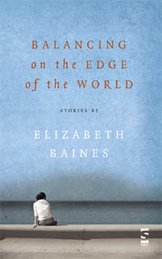
Who but the wonderful Salt, who have also published two others of my books, the short story collection Balancing on the Edge of the World, and another short novel, The Birth Machine.

How long did it take you to write the first draft of the manuscript?
Not long at all. I wrote the whole thing in eight weeks, first and second drafts included. This is why I think of it as a novella rather than a novel - it has a kind of holistic shape that I associate with short stories, as opposed to the more rambling feel of novels, and as a result somehow it needed to be written quickly, just to get it all down while it was in my head.

Who or what inspired you to write this book?
I've always been interested in the divide between science and art, and between rational and magical thinking. My father was an engineer and my mother was literary and artistic, and as I was growing up I felt caught between different world views. Both were fascinating, and attractive, to me, but what was fascinating to me also was the way those supposedly different ways of thinking could become blurred - my artistic mother was by far the more rational of the two, and my 'scientific' father was a great believer in ghosts and magic. Then I married a doctor and came up against some real 'magical' and non-rational thinking on the part of some medical so-called scientists, and I began badly to want to write a story based around these ideas. (So I suppose you could say that one of the reasons the book tumbled out so quickly was that it had been gestating for some time.) The autobiographical bit of the book concerns the protagonist's small son, who falls ill with a life-threatening condition: that happened to my own small son, and the uncertainty of it fed into the novel and fitted the themes.

What else about your book might pique the reader's interest?
There are spells and sinister nursery rhymes, there are spooky birds, there's a day when the protagonist wakes and just knows there's someone out there watching in the hissing rain...
The five writers I've tagged are Charles Lambert, A J Ashworth, Zoe Lambert, Ailsa Cox and Sarah Salway - all writers I very much admire.

You can buy Too Many Magpies direct from Salt or from Amazon or The Book Depository.

Sunday, November 11, 2012

Sweet Journey from Home


To Southport on Friday evening for the launch of Cary Bray's Scott-Prize-winning story collection Sweet Home. It was dreadful weather - sheets of water on the motorway, and when we got there waterfalls coming off the elegant glass arcade-type roofs that cover the pavements in Southport's centre - which last I'd never expected, never having set foot in Southport before. But Broadhurst's Bookshop was a wonderful haven, with a real and homely coal fire, and when we got there, on time, a crowd had already gathered, undaunted by the weather, and Carys was already signing copy after copy of her exciting-looking book. And there were cakes (!) which Carys had made herself, themed with the book, and very much in keeping with the great story she read us, a twist on the Hansel and Gretel tale with its gingerbread house, beautifully told with an original flair for language. If that story is anything to go by, there's an edge to Carys's writing which is anything but homely and sickly-sweet!


Broadhursts is an amazing bookshop - selling antiquarian, secondhand and new books and tiering up three storeys, it reminds me rather of Shakespeare and Company in Paris. They wrap your books in brown paper and string, pulling the string down from an antique dispenser high on the wall, and I was very torn between letting them wrap my copy of Sweet Home and leaving it available to peep into.


It was a lovely evening, and congratulations to Carys, for winning the prize and on her publication.