Sunday, July 17, 2011
Dusting etc
Everything's done and dusted for me at the moment, writing-wise, and I'm actually getting back to my life! Yesterday I did a waist-high pile of ironing, and discovered clothes I'd forgotten I had but hadn't actually missed as I've hardly been out since January. This afternoon I'm going to tackle a huge pile of mending - I know, it's archaic, but when you're on the income (what income?) of a writer... And then I may have to turn my attention to some cleaning: now that I have started to look around me again I have noticed that the spiders have been as busy as me... And joy of joys, I'm back to reading...


Sunday, July 10, 2011
Edge Hill short story prize
Well, I expected that when I got to the end of my big writing stint I'd get back to blogging more frequently, but it hasn't happened... I've had so many practical things to catch up on (including a week spent decorating!), I've been away twice, and other, more journalistic work has been piling in. One of my trips was to London and included the Edge Hill award ceremony on Thursday, at which Graham Mort won the prize for his collection Touch (Seren) and Salt author Tom Vowler won the Reader's Choice prize (chosen by sixth formers) for a story from his debut collection, The Method and Other Stories. The other shortlisted authors were Polly Samson for Perfect Lives (Virago), Helen Simpson with In-Flight Entertainment (Cape), and Michele Roberts with Mud: Stories of Sex and Love (Virago).
 As Graham (left) was in Africa, Seren fiction editor Penny Thomas received his prize instead and read from the message he'd sent (below).

I've been to so few events in the past few months and am consequently so out of touch with taking photos at them that I failed to get a photo of Tom receiving his prize, but this was also partly because he was so surprised to get it, it seemed, that he had no speech prepared and didn't hang around at the front! Here he is, though, in the audience beforehand (centre) and looking as though a prize was the last thing on earth he expected:

On the left of him is Adam Marek, author of the short-story collection Instruction Manual for Swallowing (Comma) and just behind on the right Robert Shearman, who won the Reader's Choice prize last year and was short-listed in 2008 with his collection Tiny Deaths (Comma).
I really can't believe, either, that I didn't get photos of the other shortlisted authors, who were all there. It's all just too exciting, you see, after being incarcerated at my desk for so long...
As for my own project: I've now had feedback from my early readers: mostly typos, but one reader thought I should excise a (small) section which she didn't think added to the whole, and I have decided she's right. Also, an inconsistency occurred to me out of the blue one day (and when I mentioned it to that reader she said that she'd also noticed it), so that's another thing to see to, and I'm hoping to get down to finalising the ms in the next few days. And funnily enough, when I went outside to the garden this morning, I noticed the jackdaws flying back in to their previously emptied nest. Brooding again, perhaps, just as I'm about to start brooding the novel once more...
Wednesday, June 29, 2011
The Good of the Novel

There's a discussion on the topic on the Faber blog, to which I was very kindly asked to contribute. In Part 1 Richard T Kelly, editor of Faber Finds and agent Clare Alexander contribute their views, and in Part 2 I have my say along with two other bloggers, Paperback Reader and Juxtabook. Do go on over and contribute your own views.
Cross-posted with Fictionbitch
Sunday, June 26, 2011
Reading group: Ingenious Pain by Andrew Miller
I suggested this book as one of my favourites, one that I said had made a lasting impression on me and which I have always recommended to anyone and everyone. It concerns the fictional eighteenth-century James Dyer, born unable to feel pain and becoming, via a series of picaresque adventures, a skilled and sought-after surgeon, before the ability to feel is finally unlocked in him.
The number present to discuss it was our smallest: just four. One of those, Mark, hadn't managed to read the book, and this necessitated my recounting Dyer's convoluted adventures, which underlined the eighteenth-century-type picaresque aspect of the narrative. However, as I explained, the book is not ultimately linear: it begins after Dyer's death when the (real-life) Burke and Hare are dissecting his body to look for clues as to his unusual condition, then moves backwards a year to the point in Dyer's life when, now able to feel pain, he has lost his surgeon's nerve. After this it switches further back thirty-eight years to the night of his conception, the half-rape of his mother by an unknown stranger on a frozen lake, conditions (according to traditional lore) determining his life of frozen feeling. It is after this that the novel takes on a linear mode, charting Dyer's life to his death (and taking in on the way the eighteenth-century epistolary mode). This structure is I think both clever and essential, as it allows us as readers to become involved with Dyer's fate when we might otherwise be unable to do so, ie while he is dispassionate and unempathic.
I said that the things that had attached me to the book were its themes of empathy and of magic versus science, these being among my own themes as a writer. James becomes a freak of nature and a wonder of science and is first shown in fairs and used by Gummer, a snakeoil saleman (who is probably his biological father) to 'prove' the efficacy of his medicine, and then 'saved'/abducted by an aristocrat who keeps a stately home full of such 'freaks' - including Siamese twins, a librarian with six fingers and a creature who seems to be a mermaid - to be exhibited to a royal scientific society. All of this conveys beautifully the Enlightenment tension between superstition and scientific reason, and the lack of empathy often involved in scientific inquiry, issues strongly relevant today. Press-ganged with Gummer (who has 'saved' him from the aristocrat), Dyer becomes mate to a ship's surgeon before taking on the role himself and then, with his utterly clinical and cool-headed approach, a famed surgeon.
The trouble is, I said to the others, although once again I found the book engrossing, I had not in fact remembered any of this plot, and I usually remember novels very well. I had only remembered that Dyer 'had a series of picaresque adventures' before the next stage of the story, which I did strongly remember. Here Dyer takes part in a race - which did in historical reality take place - to be the first doctor to reach the Russian court and inoculate the Empress against smallpox. It is on this trip that Dyer's unfeeling is breached, that he first begins to feel, and the scene in which the agent of this change appears was imprinted on my brain. She is a woman, a kind of witch, and we first see her pursued by men and dogs in the snowy woods, through the eyes of the Reverend whose party has been holed up by the weather in a monastery along with the disappointed Dyer who will not now make it first to the court. The English party rescue the woman, and from that moment on she works her 'magic' on James Dyer and he begins to feel, at first emotion and then the physical pain his body should have suffered through all its previous traumas. At last, as a consequence, he learns the empathy we have seen in him at the start of the book.
I wondered why I should have so vividly remembered that particular scene and been so vague about the rest. When I thought about it, I similarly couldn't remember the precise adventures of the heroes of picaresque eighteenth century novels either, such as Joseph Andrews or Roderick Random, and I decided that it was because of something inherent in the picaresque mode: its deliberate reliance on ups and downs of fortune (suited to an age, the eighteenth century, when life indeed was precarious and one's fortunes could turn in a second), and consequent disconnection between episodes. The encounter in the woods with Mary, however, operates in a much more organic and pivotal way: unlike Dyer's other experiences, it's not just a random illustration of the theme which could have been replaced by another, but is absolutely essential to the plot, the moment that will change the course of Dyer's life in a more fundamental way than any other, where the theme is most dynamically realised through the drama of character in action. After this there can be no more hostage-to-fortune moments: it contains within it the seeds of the end, and as such it's the stuff of modern drama and fiction, and not of the eighteenth-century novel which for much of the time Ingenious Pain pastiches. I found the episode extremely moving on both readings, and the narrative following it (and read in the light of it) very moving, too.
I also said that, actually, I had been surprised to find that I couldn't think of anything more to say about the novel (beyond admiring the concept and theme and the fact that I'd forgotten most of the story) and it now struck me that this novel was a supreme example of so-called 'high concept' (so beloved of present-day marketers). It's based on a very striking, unusual yet graspable idea - that of the man who feels no pain and so can't empathise - but that idea is established right from the beginning of the novel and the rest of the book is largely an illustration rather than a development of it. The book is thus less deep than it seems or than I had remembered.
Ann and John agreed. They too had found the book an engrossing read but had been left with similar thoughts. We three also agreed that the book's eighteenth-century world feels stunningly authentic, and we particularly admired the authentic feel of the language. We also thought it a supreme achievement to have engaged readers with such a potentially unappealing character as the icy Dyer.
John, a child psychologist, pointed out that James's condition was an exaggerated version of some aspects of autism: apparently some of those with autism do have a high pain threshold and many have an obsession with circular mechanisms - James is indeed obsessed with the orrery, the moving model of the planets, which he is given as a child; that, significantly, is his first memory - and the book is thus a comment on the 'autistic' tendencies - the overlooking of emotion - in medicine.
Mark said that he was just really dubious about books written in the present day and set in the past: he didn't see the point (especially when they adopted past modes of fiction as this novel seems to). We said that a character with James Dyer's condition in the present day would have been immediately picked up by the system and prevented from the kind of adventures James has that carry the theme so vividly - apart from the fact that his condition is unusual enough to be mythical and thus better placed at a historical distance. Mark said he could see that that was true, although he remained generally suspicious of historical novels.
Ann and I puzzled about the Epilogue which I won't describe here in order not to plot-spoil, but although its meaning was not altogether clear to us, once again we found it very vivid, evocative and moving. And in spite of our doubts about the whole novel on analysis, there was no denying that it remains an engrossing, striking and moving read, remarkable above all for its humanity.
Our archive discussions can be found here and a list of the books we have discussed, with links to the discussions, here
Tuesday, June 21, 2011
New novelist from new publisher: Emma Jane Unsworth and Hidden Gem

About sixteen months ago I attended a meeting of women writers in Manchester, called in response to the difficulties that the increasing commercialisation of the bigger publishing houses is presenting writers, and with a view to discussing possibilities of setting up an alternative publishing house. One of the main movers behind the meeting was writer and teacher Sherry Ashworth, and it is indeed Sherry who has now, with her husband Brian, established the brand-new Manchester-based publishing house Hidden Gem. Their aim, they say, is to 'publish top quality novels by the best emerging talent'. Their very first publication, launched last week, is Hungry, the Stars and Everything, a striking debut novel from former journalist Emma Jane Unsworth, and last Thursday The Portico Library was packed for the book launch.

It's a high-concept novel in which the elaborate taster menu of a Michelin-starred restaurant triggers memories of the somewhat fraught life of the narrator-protagonist, twenty-nine-year-old food critic Helen Burns, and in which the devil takes a prominent role. A memorable first sentence, 'I was eleven years old when I realised what I wanted most out of life: more' sets the scene for a story of a dysfunctional family background with a dieting mother, anorexia and alcohol addiction, and tension between, on the one hand, the rigid codes of church and grammar school and an unexciting but safe relationship and on the other rebellion and submission to passion. The devil, representing that last, and 'the ultimate bad lad', as Emma described him at the launch, makes vivid appearances throughout. Carried along by the story and the fluent and zippy prose, I read it in a single day. The themes are explored through astronomy as well as food (Helen falls for an astronomer), and there's plenty of tension to keep you wondering about Helen's fate. What's really neat is that in spite of her emotional troubles, sharp turns of phrase make her a feisty protagonist.
Congratulations to Emma, and to Sherry and Brian.
Monday, June 20, 2011
How to let go...?
Oh dear. I have printed out copies of the ms for my three early readers, I have punched holes in two of them. And every time I glance at it I see something that needs changing. I know I can't really tell piecemeal, but it's so very, very hard to hand something over unless you're feeling for the moment (however wrongly) you've got it right. However, I know I need more distance before I can work on it again, and this is the only window two of my readers have. I'm going to find this really difficult...
Saturday, June 18, 2011
Flying the nest
An amazing cacophony this morning: the baby jackdaws in the nest nearby hadn't flown before I got back from Wales after all, and they flew this morning. For about five minutes there was a huge squawking as the parents shoved the fledglings around, chasing them up the pitched roof opposite, up to the ridge tiles where they had no choice but to take off, swooping down and practically knocking them off the TV aerial, and generally yelling. And now they've gone and all is silent.
And yesterday I spent the day working on the changes to my novel suggested by John, being tough enough with it (I hope) to make it fly, and now it's ready to go to my early readers and all is going quiet at last in my head. Actually, just like the parent jackdaws I've had enough of it now: I kept glancing at pages where I'd made the changes and thinking that the changes had spoilt the rhythm, but the only way I could be sure of that is with a proper read-through and some distance, so I'm leaving it to others for the present: my fabulous, eagle-eyed, mince-no-words, I-just-like-a-good-story early readers.
I rang Printing.com in Didsbury yesterday to cost getting copies made and bound for them, which I have done in the past, and it turned out that it would now cost almost forty quid for one copy! 12p a page with no discount for volume! And when it costs so much less to properly print a book! It was never that expensive before the shop was taken over by Printing.com and was a little local service. So I won't be doing that, that's for sure: I'll be standing at my printer running off my own and wielding the old punch and bunging the pages together with treasury tags.
Wednesday, June 15, 2011
Culture shifts and novel adjustments
Back in Manc this evening and about to work some on the novel again. John said in retrospect that he felt I needed a different emphasis in one section of the novel, and after a LONG talk (I was a bit resistant to begin with) in the pub (The Anglesey in Caernarfon), while the sea came in and the harbour we could see through the pub window went from half-full to full, I decided he was right, so I'm about to work on that bit, as well as see to the typos etc he found. (Is a book ever finished?)
Feels odd to be back in town again. Only ten days or so away and Didsbury feels like a foreign country. Which is one good reason for going away: you see the place with new eyes when you come back. However, I'm very glad to say that my grip on the novel survived the culture shock of both shifts.
Feels odd to be back in town again. Only ten days or so away and Didsbury feels like a foreign country. Which is one good reason for going away: you see the place with new eyes when you come back. However, I'm very glad to say that my grip on the novel survived the culture shock of both shifts.
Tuesday, June 14, 2011
Bookshops I love: Palas Print in Caernarfon

Here's the latest stunning shop window display in Palas Print in Caernarfon - that's a real model boat in which those books are stacked. The display includes books on Patagonia where a Welsh community was established in the last part of the nineteenth century, and notice there in the front A Place of Meadows and Tall Trees by my writing colleague Clare Dudman, her beautifully researched and engrossing novel focusing on one of the settlers and his family. The book was published last summer, and I attended a very memorable launch which I wrote about here. The book's memorable too: the strong characters of the settlers, the scenes of hardship and fortitude and innovation and betrayal, the personality of the native American who watches and then befriends them, and are all still vividly with me.
Interesting to read back on that post in which I describe the launch. I also talk in it about finding a characterising word for one of my characters. Yet after my break to promote The Birth Machine, I went back in January and excised the section done in the voice of that character! Novel-writing, eh? Two steps forward and one back, quite often.
Palas Print is a really great community bookshop: John and I recently bought bikes and we've brought them to Wales with us this time. The other day I went into the shop looking for cycling maps, and the owner spent ages with me searching for the right one and discussing the whole subject. It's that really uniquely personalised sort of help you can get from an independent bookshop.
Both A Place of Meadows and Tall Trees and my novel Too Many Magpies can be bought online from Palas Print here and here.
Sunday, June 12, 2011
Editing, resting, reading (and whitewashing)
I have come to North Wales to edit the novel and have a bit of a rest and change of scene after my long slog. The weather's weird: you wouldn't know it was supposed to be summer: although it's been sunny it's been cold, especially here up on this mountain. Yesterday people nearby woke to a blanket of hail on the ground, and there was snow on the top of Snowdon. Today we've got winds and rain that are apparently sweeping the whole of the country, but the winds are very fierce here, as they so often are (and I'm unable to download pics off the internet before I get too tired of waiting for them). The crows who have a nest in the trees nearby are going quite mad, cawing and flinging themselves around: I'd go and investigate if it wouldn't mean getting utterly drenched.
It took me five days to edit the novel and print it off, and after that I passed it to John, my first reader who's here with me. I'm happy to say he sat laughing and weeping and read it with great greed and speed, and although he seemed to my pessimistic mind to be making a lot of scribbles, he didn't make all that many after all: just some typos, one or two sentences needing clarifying, and some notes about needing greater clarity in one or two places near the end of the novel.
Just as I'd finished, we had a problem with the wood-burning stove and the whole house was filled with smoke, with the result that the limewashed walls all went brown. Yesterday we re-whitewashed the whole of the downstairs room and up the stairs, and today we gave most of it a second coat, and what struck us was the thing that always strikes me whenever I do anything practical after writing: how quickly one can get practical jobs over and done with, compared to writing! It's especially true of course of long pieces, but it applies to short written pieces, too: sometimes they need so much mulling over, and quite often you go back to them again and again as you think of improvements or ways to develop them.
Meanwhile, I've been reading Hungry, the Stars and Everything by Emma Unsworth, the first novel published by the new Manchester press The Hidden Gem, run by Sherry and Brian Ashworth. Well, actually, I read it in a single day: it's an extremely readable and enjoyable novel hinged on a striking idea - more when I have time to write in more detail. I'm hoping to be back in Manc for the launch at 6.30 at the Portico Library on Thursday, which I believe is open to all (and free), but, as the Facebook page says, 'if you would like to come it would be helpful to send an email to Sherry and Brian Ashworth at hiddengempress@gmail.com or Katie at K.Slade@hotmail.co.uk'
Monday, June 06, 2011
Out of the novel into life

I discovered the other day what kind of crows are nesting in the eaves nearby, just along from where I've been writing my novel. No longer too obsessed with my novel to do more than glance up at them whizzing past my window, I was able to hang about and stare and take photos and identify them. And would you believe it, they are jackdaws, real-life counterparts of the jackdaw and jackdaw's nest with young that feature in the novel I've been writing. I should have known what they were, really: of the crows, jackdaws most often nest in holes, and through my fug of concentration, I realised in retrospect, I was hearing the characteristic jack of their call even as I was writing it into the novel.
When I went out to take these photos, I could hear the cries of the babies in the nest, which were already taking on that mature sound. I'm in Wales now - editing the novel - and I guess that by the time I get back they'll have flown.


Sunday, May 29, 2011
A review missed and found
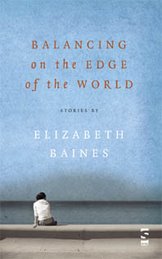
The internet is really amazing. The story 'Leaf Memory' is one of the very oldest in Balancing on the Edge of the World. It first appeared in an anthology published by Penguin, and I had no idea that the anthology had been reviewed in Punch until, years later, indeed this week, I came across the fact on the internet. Imagine how I felt when I read these words:
'[A short story] must emulate the swift, swallow or martlet. Most impressive in this respect is Elizabeth Baines' "Leaf Memory" which charts the fortunes of three generations in as many pages without any sense of strain or thinness.'I guess nowadays, thanks to the internet, you wouldn't miss a review in that way!
Friday, May 27, 2011
Work/pleasure


Wednesday, May 25, 2011
Finishing a draft

On Monday I came to the end of the current draft of the wip (I've written on Fictionbitch about the all-consuming nature of the process), and this is the state my room was in after I printed the last page and walked away from it all. That's my old writing table to which I'm crazily, psychologically attached - I got it from a junk shop when I was a hard-up single parent and sat down then and wrote The Birth Machine on it. Everything I've written since - apart from what I've written in Wales - has been written on that, so it feels really important to the writing process for me.
Scattered on the floor is the previous draft which I tore apart so radically, which is why it's all over the place, and the new draft - 40,000 words shorter! - is sitting on top of the printer. Under the table are the Pukka pads in which I hand wrote each day before typing up: I found I had to do that, cut right away from the previous printed draft, even when I kept the scenes, because I had a new overall perspective affecting the language, however subtly. So it was very much a rewrite...
On the desk are the notes I made last April, when I first started on it all, and the charts and timelines I drew for the characters and scenes, since I was changing the structure so radically (making it much more linear, in fact) with all their page references. In January, after a long break to promote The Birth Machine reissue, I abandoned that scheme and started again, having seen that I could make the book even simpler, but the charts with their page refs were still useful, and I used them right up to the end.
Notice the bits on the floor. But I won't be doing any cleaning in that room until I've done the editing...
It's never been decorated, either, and I'm not sure it ever will be...
Wednesday, May 18, 2011
Reading group: Blood Meridian by Cormac McCarthy.

In fact, it's a novel that sets out to subvert the conventions of the Western. It's based on real-life events that took place on the Texas-Mexico border in the 1850s and follows the fortunes of 'the kid', a fourteen-year-old boy who joins the infamous Glanton gang charged with running down Indians for their scalps but ultimately killing all in their way and turning in the end on each other.
Doug said he loved the novel, most especially for its stunning descriptions of the landscape, conveyed in a lyrical prose involving evocative verbal innovations/archaisms which we had already appreciated when we read McCarthy's The Road. He felt odd about this, however, loving the beauty of these descriptions, when at the same time the violence enacted by the gang and others was so graphically depicted and in such a sustained way. As for McCormac's message about the violence, he thought that, unlike that of conventional Westerns, it was that all parties were guilty of it, indigenous peoples and Europeans. (The book also subverts more recent views of the Indians as innocent and peaceful victims.) He was bowled over by McCormac's invention of the character of the white-gang member called the judge, a kind of superhuman being, huge and hairless and cultivated among illiterates yet the personification of violence. Doug reiterated that he felt odd about loving the lyrical aspect of the book, yet added only half-ironically that he'd have joined the Glanton gang, indicating, I think, that for him the book did not after all entirely succeed in subverting the boys'-wishfulfiment of traditional Westerns.
I said that while I'd had problems with the disjunction between the psyches of the characters and the descriptions of the landscape in Annie Proulx's Postcards (which we discussed last time), I felt that here the disjunction was authorially intentional and very interesting. I thought that what McCormac was consciously doing was placing the human figures and their violence as part of that landscape, no less a part of it than the animals and the geographic elements. Ann strongly agreed. Human violence, as a result, is an elemental force against which human morality and cultivation are impotent, and the judge is a kind of totem of this. He is supremely accomplished in all the human arts and civilised systems: he knows the law and legalese (hence his moniker) and several languages. He can play musical instruments and dance and draw beautifully; he knows Darwinian theory. But every natural thing he draws he must afterwards mutilate or erase. Nothing exists, he explains at one point, unless he owns it. Once he possesses them by drawing them, he can obliterate natural objects or the artefacts of ancient civiliations. Through the figure of the judge, even the human systems of cultivation are exposed as immoral and violent. The kid, as the motherless and illiterate son of a schoolmaster descended into drunkenness, is himself an icon of the precariousness of civilisation, and John said it was interesting that the novel began with echoes of David Copperfield, and then totally subverted that novel's theme of the making of a moral conscience. The kid is indeed the one member of the Glanton gang who tries, on several occasions, to act morally and to save others, but as the judge points out to him at the end of the novel, his apparently moral choices end in disaster, with death. The most moving and symbolic instance is when, years after the Glanton gang has dispersed, or rather imploded, and he is travelling alone, the kid comes upon a massacred wagon train with just one old woman remaining, sitting upright in the sand. He kneels in front of her and delivers a long speech about how she must come with him, he will take her to safety, before she keels over, revealed as a mummified husk. Ann, Doug and Trevor agreed that this was a very moving moment. Ann said it had occurred to her that the judge represented all the seemingly cultivated dictators of our contemporary world who nevertheless indulge in barbarous practices, and I thought that was a very interesting point.
Trevor then spoke about some of the moments he'd found particularly vivid, such as when the Glanton gang are first invited as conquering heroes by the governor of a town to an elegant dinner, and end up trashing everything. Meanwhile, at some time during the discussion, Clare had said that she hadn't liked the novel at all, had hated the violence and had been unable to continue with it. Up to this point Jenny, a criminologist, hadn't spoken at all, and now she said that she too hated the book. She said that what she really objected to was the utter lack of engagement with the subjective experience of violence from the victims' point of view: the fear, and the loss, the psychological damage which is far, far worse than the physical violence.
I said that that was a feeling that I'd had too as I read the book. In fact, I had found the book a very difficult read, and the only way I'd managed to get it read was to set myself a certain number of pages to read each day and stick to it. But when I got to the end I decided that that perspective - the emotional experience of the victim - was one that the author had deliberately eschewed, along with all interiority, in order to make his political point about the elemental nature of violence. Ann agreed: she said that she had found it difficult to read too; she had had to skip over the violence, and had wanted to dwell on the landscape descriptions but had found herself pushed on by the next (violent) episode, but when she got to the end, she'd had the same experience as me: she found the book an interesting political and artistic experiment.
For Jenny, though, this just didn't justify the omission. In any case, she said, historically at the time there were authorities sending people out to these frontiers to colonise the West, authorities who thus had a moral responsibility but were turning a blind eye, and this was a dimension totally overlooked by the book. I think she felt that fundamentally the book had abdicated a moral responsibility of literature, and in the end I and, I think, others were unsure...
Our archive discussions can be found here and a list of the books we have discussed, with links to the discussions, here
Saturday, May 14, 2011
Family likeness
Recently, the online bookstore Printsasia asked me to write a guest post about my recent books for their blog (you can read it here). It's funny, the insights you get into your own work when you're asked to do such a thing, given just a short number of words to sum it up. While I had always been clear that there are broad issues running through both The Birth Machine and Too Many Magpies - magic versus science, intuition versus logic etc - I'd always thought of them as two very separate sides of the thematic coin. And indeed they are (as I said at the Didsbury Arts Festival last year): The Birth Machine opposes intuition and true logic on the one hand and bad science on the other by locating them in separate characters, but Too Many Magpies places the two opposing forces - the longing for miracles and the need for rationality - in the one character, the narrator.
For this reason I have always seen the two books as two very separate creatures, but the blog post pushed me to sum up thus:
I guess your books are like your children. From the inside you see the differences, and not the family likenesses, but I have the feeling I've said this here before...
For this reason I have always seen the two books as two very separate creatures, but the blog post pushed me to sum up thus:
...the message of both novels is the same: we need to be rational, but we ignore at our peril the possibility of things we would never have guessed…and all of a sudden a saw them as a pair!
I guess your books are like your children. From the inside you see the differences, and not the family likenesses, but I have the feeling I've said this here before...
Wednesday, May 11, 2011
Distraction

I'm too immersed in my wip at the moment to cope with anything much else besides - I keep forgetting to pay bills and buy food, even. Just about the only thing I seem to be able to manage is taking the odd photo, and here are some from my garden, the iris above, cornflowers and some of the many and varied self-seeding columbines:


Thursday, May 05, 2011
Competition: chance to tour Faber archives
I've only just found out about this, and there's only until midnight on Sunday to do it, but I thought I'd draw your attention to this great Museums at Night competition - a draw in which the prize is a night being taken round the amazing archive of publisher Faber. Really, some of my favourite writing has been published by Faber, and I think this would be just a wonderful thing to do. Here are some of the details from the website:
Cross-posted with FictionBitch
Archivist Robert Brown will take five lucky winners on a journey through 80 years of treasures held in the publishing giant's London office at Bloomsbury House, which is not normally open to the public.
Faber and Faber's unique publishing archive ranges from its famous early twentieth century poetry collection including manuscripts of TS Eliot and WH Auden to books on farming, gardening, art and architecture.
The evening will conclude with an intimate poetry reading by one of Faber's most acclaimed poets, Jo Shapcott [recent winner of the Costa with her collection Of Mutability].
Jo Shapcott

The event will take place between 6.30pm and 7.30 pm on Friday May 13 at the Faber Archive in London.
To enter, click here.
The competition closes at midnight on Sunday May 8 2011.
Cross-posted with FictionBitch
Saturday, April 30, 2011
Too much waist
Writing, you might think, is a pretty safe occupation. After all, you are at your desk most of the day and so more unlikely than most to a) catch infectious diseases from others b) walk under a bus or get knocked down by a car c) sprain your ankle on an uneven pavement etc, and it's always seemed pretty damn silly to me that I'm charged a huge whack on car insurance because technically I'm in 'the entertainment business', as if most of the time I'm driving round in fast cars after showbiz parties rather than cooped up in my room for a greater proportion of the day than most normal human beings.
But there are hazards. DVT, if you get too damn involved in your imaginary world and forget to move, and, as Margaret Atwood has pointed out, backache and long-term problems with posture. But, dear readers, the thing that is truly taxing your vain writer at the moment is LACK OF WAIST. Think about it: if you do housework or stretch to fill supermarket shelves or to write on a whiteboard, you are stretching your waist. If you walk for at least a portion of the day the movement of your legs pulls on the muscles around your waist. But if you SIT COMPLETELY STILL for at least five hours of the day you are not going to exercise your waist muscles, and so, even if you forget to eat, which is happening to me more and more at the moment, YOUR WAIST DISAPPEARS.
Next time you see me, dear readers, I shall mostly be wearing a burka...
Thursday, April 21, 2011
Paring and realigning

After blogging so little recently (because I'm so immersed in my writing) I'm going to make you groan. You'll know if you've been following this blog for the past year that this time a year ago I began a new draft of my novel in progress, and, in the obsessive way of us writers, I kept seeing symbols of the redrafting process in nature all around me. Well, I'm doing it again.
After working on the novel from April to the end of August, and getting about half-way through, I stopped writing altogether to promote the reissue of The Birth Machine. As I've previously described, when I finally got back to the wip after Christmas and looked at it with fresh eyes, I realised that I could in fact be going a lot further with the redrafting, and so I went right back to the beginning again. (I'm about halfway through once more.) As I've said before, this is the piece of work I've had to work on harder than any other so far: it's been a question of paring (over and over) as well as some radical realigning, and I can't help but see symbols of this in the bird life in our garden:
Firstly, paring. In our garden we have the bird house above, and for some years running it was used by great tits for nesting. But last year, although we watched a pair investigating, to our disappointment none nested there. In the winter we looked inside: no wonder, there wasn't any room, the whole thing was choked with nests from the previous years! So we cleared it out (just as I've been clearing the dross from my novel) and this spring there are tits nesting there again.
Secondly, realigning. This January three huge trees at the end of our road and close by were felled, just as my latest draft came in for the chop. And the crows that used to nest there? Well, they've found themselves a new structure: under the eaves of the next door house...

Subscribe to:
Posts (Atom)