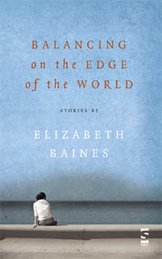
Writing, you might think, is a pretty safe occupation. After all, you are at your desk most of the day and so more unlikely than most to a) catch infectious diseases from others b) walk under a bus or get knocked down by a car c) sprain your ankle on an uneven pavement etc, and it's always seemed pretty damn silly to me that I'm charged a huge whack on car insurance because technically I'm in 'the entertainment business', as if most of the time I'm driving round in fast cars after showbiz parties rather than cooped up in my room for a greater proportion of the day than most normal human beings.
But there are hazards. DVT, if you get too damn involved in your imaginary world and forget to move, and, as Margaret Atwood has pointed out, backache and long-term problems with posture. But, dear readers, the thing that is truly taxing your vain writer at the moment is LACK OF WAIST. Think about it: if you do housework or stretch to fill supermarket shelves or to write on a whiteboard, you are stretching your waist. If you walk for at least a portion of the day the movement of your legs pulls on the muscles around your waist. But if you SIT COMPLETELY STILL for at least five hours of the day you are not going to exercise your waist muscles, and so, even if you forget to eat, which is happening to me more and more at the moment, YOUR WAIST DISAPPEARS.
Next time you see me, dear readers, I shall mostly be wearing a burka...
Saturday, April 30, 2011


Thursday, April 21, 2011
Paring and realigning

After blogging so little recently (because I'm so immersed in my writing) I'm going to make you groan. You'll know if you've been following this blog for the past year that this time a year ago I began a new draft of my novel in progress, and, in the obsessive way of us writers, I kept seeing symbols of the redrafting process in nature all around me. Well, I'm doing it again.
After working on the novel from April to the end of August, and getting about half-way through, I stopped writing altogether to promote the reissue of The Birth Machine. As I've previously described, when I finally got back to the wip after Christmas and looked at it with fresh eyes, I realised that I could in fact be going a lot further with the redrafting, and so I went right back to the beginning again. (I'm about halfway through once more.) As I've said before, this is the piece of work I've had to work on harder than any other so far: it's been a question of paring (over and over) as well as some radical realigning, and I can't help but see symbols of this in the bird life in our garden:
Firstly, paring. In our garden we have the bird house above, and for some years running it was used by great tits for nesting. But last year, although we watched a pair investigating, to our disappointment none nested there. In the winter we looked inside: no wonder, there wasn't any room, the whole thing was choked with nests from the previous years! So we cleared it out (just as I've been clearing the dross from my novel) and this spring there are tits nesting there again.
Secondly, realigning. This January three huge trees at the end of our road and close by were felled, just as my latest draft came in for the chop. And the crows that used to nest there? Well, they've found themselves a new structure: under the eaves of the next door house...

Wednesday, April 20, 2011
Flash Mob Competition
I've been asked by blogger Fat Roland to let you know about the the Flash Mob Competition he's helping to run and judge for the Chorlton Arts Festival:
Stories of 500 words or less, theme and style completely open, entry free. Deadline for entries April 29th. A shortlist will be announced on May 13th, then the whole thing will be topped off with a reading night and awards ceremony on May 26th. 12 shortlisted entrants will get to read their story, and the winner gets their story illustrated and framed. Further details on the website here.
Stories of 500 words or less, theme and style completely open, entry free. Deadline for entries April 29th. A shortlist will be announced on May 13th, then the whole thing will be topped off with a reading night and awards ceremony on May 26th. 12 shortlisted entrants will get to read their story, and the winner gets their story illustrated and framed. Further details on the website here.
Wednesday, April 13, 2011
Jane Rogers and Rachel Genn

I haven't been going out much at all lately - for the first time in my life I don't particularly want to: when I finish actually writing for the day all I want to do is sit around tinkering with it in my mind and thinking about next day's episode: just waiting for bed, really, so I can wake up and start again...
But I couldn't miss the launch last night of a new book by Jane Rogers and a debate on the value of teaching creative writing with her ex MA student Rachel Genn, whose debut, The Cure, will come from Constable and Robinson in May.

It was a Central Library event, and took place in Eliot House on Deansgate (where the library has relocated during the refurbishments) with its elaborate ceilings and stained-glass windows. The debate that followed the readings was interesting, Jane (who is Professor of Creative Writing at Sheffield Hallam) expressing the view, which I share, that you can teach grammar and structure and plot and character-building, but you can't teach a basic, and essential, feel for language.


Friday, April 08, 2011
Edge Hill short story prize

On Wednesday I had a great evening at Edge Hill University, when the winner of last year's Edge Hill Short Story Prize, Jeremy Dyson, read from his winning collection, The Canes That Build the Cranes.
Just beforehand, the long list for this year had been announced, as follows below. It includes a full seven collections from my own publisher Salt Publishing, as well as collections by several other internet friends. Congratulations to all. (Thanks to The Short Review for the list; links are to reviews on The Short Review.)
- Martin Bax - Memoirs of a Gone World (Salt Publishing).
- Alan Beard - You Don't Have to Say (Tindal Street Press).
- Peter Bromley - Sky Light and Other Stories (Biscuit).
- Jo Cannon - Insignificant Gestures (Pewter Rose Press).
- Roshi Fernando - Homesick (Impress Books).
- David Gaffney - The Half-life of Songs (Salt Publishing).
- Vanessa Gebbie - Storm Warning, Echoes of Conflict (Salt Publishing). review coming soon
- James Kelman - If it is Your Life (Penguin).
- Andre Mangeot - True North (Salt Publishing). review coming soon
- Jay Merill - God of the Pigeons (Salt Publishing).
- Magnus Mills - Screwtop Thompson (Bloomsbury).
- Graham Mort - Touch (Seren).
- Nik Perring - Not So Perfect (Roast Books).
- Susannah Rickards - Hot Kitchen Snow (Salt Publishing). review coming soon
- Michele Roberts - Mud, Stories and Sex and Love (Virago).
- Polly Samson - Perfect Lives (Virago). review coming soon
- Helen Simpson - Inflight Entertainment (Random House).
- Fiona Thackeray - The Secret's in the Folding (Pewter Rose Press).
- Tom Vowler - The Method and Other Stories (Salt Publishing).
- Susie Wild - The Art of Contraception (Parthian).
Friday, April 01, 2011
Reading group: Postcards by E Annie Proulx

Unfortunately Clare was unwell and unable to attend the meeting but sent a message that she had found the novel very atmospheric but also hard-going. Introducing the book in her place, Trevor said he had really enjoyed it as a depiction of the flipside of the American Dream and outlined the downfall of the family and most of the characters, since it turned out that four of the members present had however failed to finish the novel. John had given up after about thirty pages as he had found it dull and didn't feel it promised to go anywhere. Ann and Jenny had given up about halfway through, Ann because she had been very busy and Jenny because she said she just hadn't been in the mood for serious literature, but both suspected that if the novel had had the potential to grab them they'd have finished it anyway. Mark hadn't even tried, because he'd hated Proulx's second novel The Shipping News.
Jo said she'd disliked The Shipping News too, but she had absolutely loved this book. I said that my problem with the novel was that it was perhaps the first book I had ever read that left me feeling depressed rather than cathartically uplifted. One of my favourite books is The Whereabouts of Eneas McNulty by Sebastian Barry, which similarly deals with the exile and gradual degradation of a main character, who meets a similar tragic end, but I don't find that book depressing at all in the way I found this. There was something about the treatment of the situation in this novel, of the way that all of the characters end up dying with wasted lives behind them and forgotten.
Trevor and Jenny objected that that was just realistic: in real life everyone does end up dead! I said, but we don't all die with a sense of our lives wasted! Jenny said that she thought that a lot of people did reach the ends of their lives with a sense of waste, and she and Trevor said, and most people end up being forgotten. I said, But surely the point of the novel (as an art form) is to transcend that, to give significance to lives. Trevor said it's one point, but I said no, actually, it's the point. Even in life, we see significance in the lives of others even if they die not seeing it themselves, and the point of the novel surely is to focus significance and meaning. But somehow, to me, this novel fails to do that. In fact, as Jo pointed out, not all of the characters in this book feel that their lives were wasted. Daughter Mernelle and her husband Ray are saved by their marriage, and mother Jewell is basically emancipated by the events, yet there is something about the perspective of the novel which makes their lives seem wasted.
Jo said, but didn't I find the writing absolutely beautiful? Those wonderful descriptions of the landscape? I said, yes, they were stupendous, but I thought that this was perhaps the key to the problem: although the narrative is purportedly a shifting intimate third rather than omniscient, on the whole I felt those descriptions were made from an authorial viewpoint rather than that of the characters. I wouldn't say that the descriptions were exactly touristic, but the sense of appreciation of the beauty and grandeur was often at odds with the situations and psychic journeys of the characters. Jenny said, Yes, the farming characters would probably find the landscape pretty grim, wouldn't they? As well as that basic matter of the attitude to the landscape, there's also the question of the metaphorical language in which it's described. I did think it worked brilliantly for the psyche of the skin doctor who buys up Loyal's fields to build himself an outback retreat, and whose emotional focus is indeed the landscape to which he looks for succour but which overwhelms him:
There was too much to look at. Knotted branches. The urgent but senseless angular pointing of the tree limbs. Grass the colour of wafers. Trees lifting soundless explosions of chrome and saffron. Mountains scribbled maroon...However, I felt that such language was inapt for the farming characters who are revealed by the framing handwritten postcards as semi-literate. At one point, just after the murder, Loyal's heightened perception of the landscape was psychologically acceptable - He saw and heard everything with brutal clarity - but the terms in which he sees it didn't seem so: Evening haze rose off the hardwood slopes and blurred a sky discoloured like a stained silk shirt. (As John said: would he ever have even seen a silk shirt, leave alone readily think of one?) I felt, as a result, the chief subjects of the novel were the landscape and the author's appreciation of it, rather than the characters, who simply floated towards their inconsequential fates amongst the fine descriptions.
This is reinforced by the focus in terms of event. Of course everyone (in real life) dies, but the novel is so plotted that every character is propelled towards nothing more than their own death, which always ends on a note of waste, as in the description of the death of Mernelle's husband Ray. At the end he fails to recognize Mernelle (after their seemingly loving marriage) and in his mind's eye sees instead a figure from his childhood: her slender back to him, her bare arms, the square of sunlight on the floor enclosing his own shadow. / 'Too bad we never did,' he said, and died.
John said that this novel had changed his previously firm view that the most important thing about a book is prose style, and Doug, arriving late and having missed the discussion up to this point, said independently that he thought the book was brilliantly written but basically tedious.
Mark (who hadn't read the book) asked, But surely it must be saying something about America, and people said what they thought it was saying: that technological progress had destroyed people like the Bloods. Unfortunately, though, most people felt that the book did a disservice to that message by being too tedious, and I felt it did a disservice to those characters by subsuming them to the landscape.
I said I found the framework of the handwritten postcards rather forced and artificial, not much more than a linking device for the episodic structure: it's not as if all of the postcards were in the bundle grabbed by Loyal when he's first on the run, and in reality many of those communications would not have been made on postcards but in letters. Most people, including even Jo, agreed. Jenny said the postcards had really irritated her, as she found them extremely difficult to read, which meant that she often lost their significance to the chapters they headed, and there were murmurs of agreement. Ann said, with reference to both the episodic structure and the linguistic style, that she wondered if Proulx's narrative mode was better suited to short stories than novels: she had read two volumes of her short stories and had found them wonderful.
Finally, I asked people what they had made of the sections appearing every so often and titled 'What I See' and set apart from the rest of the narrative by being printed in bold (which last Mark said he hates in novels, along with sections in italics). Most people were blank, and even Jo said that she hadn't known what to make of them. It seemed to me now on reflection that that they were intended as authorial intervention, but I hadn't previously been sure, probably because, as I said, there was such an authorial feel to the main, purportedly intimate-third narration.
Our archive discussions can be found here and a list of the books we have discussed, with links to the discussions, here.
Thursday, March 24, 2011
Bookshops I Love: Waterstone's Gower Street

When I was in London last week I happened to be passing Gower Street Waterstone's and popped in, and lookey-here! So there's one place you can get The Birth Machine, if you happen to be passing too...
Thank you, Gower St W!
Sunday, March 20, 2011
Wisewords reading - how it went

And The Luxe in Spitalfields, where we were doing the reading, turned out to be just that: a really plush space. And what a great evening it turned out to be - a great audience and superb readings from the talented bunch of women writers I was lucky to be joining. Jay Merill, who organized and presented the whole event, kicked off by reading 'Little Elva' from her great Salt story collection, God of the Pigeons:

She was followed by Catherine Smith who read us a striking story about an unusual house-hunter, from her new collection , The Biting Point, published by Speech Bubble. After a short break, Sarah Salway read from her wonderfully wry story collection 'Leading the Dance':

and then Tania Hershman read us a series of her amazing science-inspired flashes, some from The White Road and Other Stories (Salt) and some new and unpublished:

In the final third, Susannah Rickards read beautifully from her Scott Prize-winning collection Hot Kitchen Snow (Salt):

and, since the event was part of a women's arts festival, I read my story about two sisters, 'Holding Hands', from Balancing on the Edge of the World:
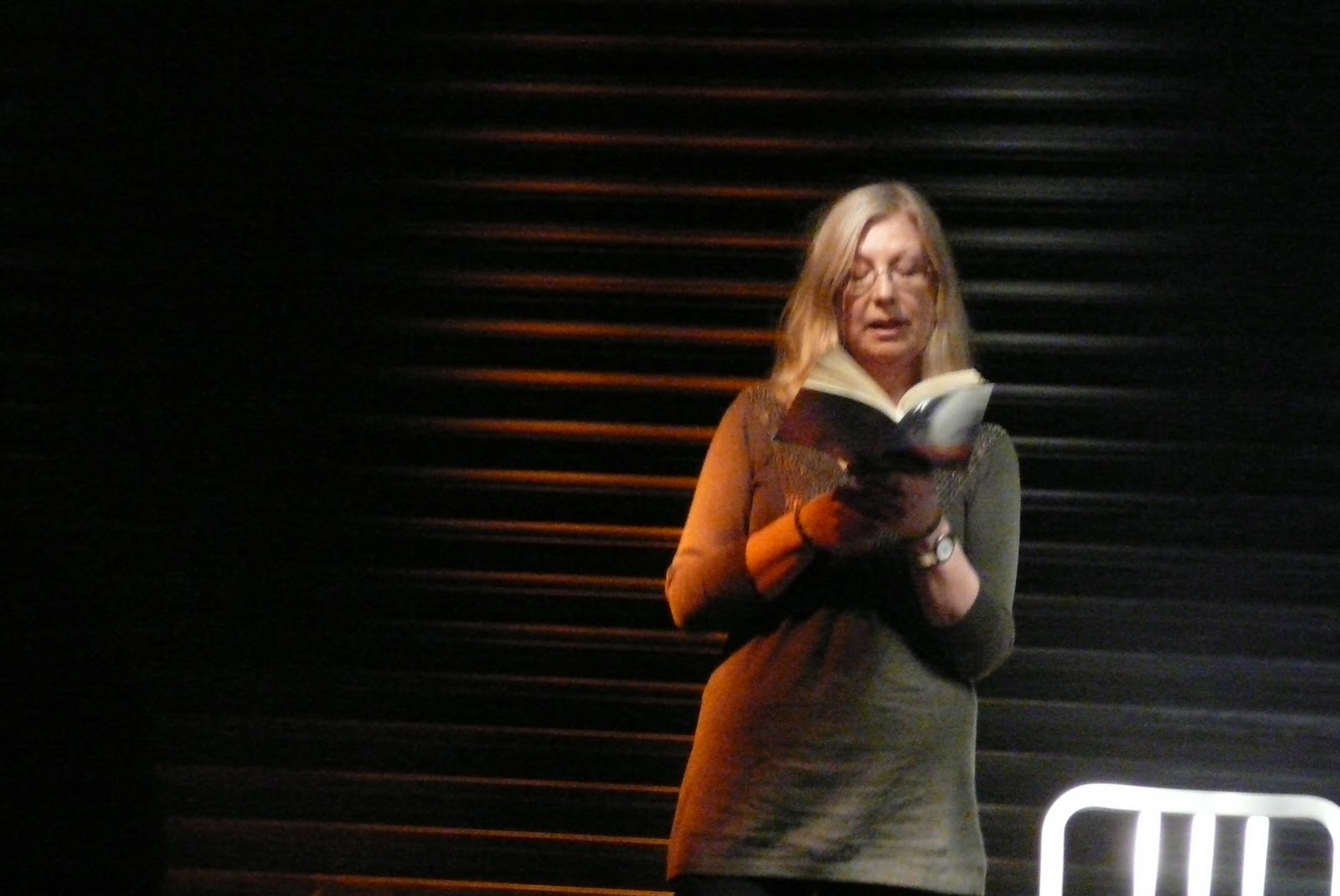
And then I had a fabulous chat to the others and all the lovely audience members who included writers Debi Alper, Emma Darwin and Judith Amanthis.
Thank you to the others for their great readings, to all who came and made a great audience, to Jay especially for organizing and inviting us, and to the Wisewords Festival.
Next day I actually had a DAY OFF (in London)!!
Weird. (But fabulous.)
Monday, March 14, 2011
Wisewords reading
Sorry not to be blogging much at the moment: I'm very immersed in my WIP and hardly able to hear what people are saying to me, leave alone finding enough mental and creative space to do any other kind of writing!
This week I'll be having a break, though, as I'm off to London to read at an event organised by Salt author Jay Merill, which I'm really looking forward to: five exciting other short-story authors are also reading: Jay herself, Susannah Rickards (recent winner of Salt's Scott Prize), Tania Hershman, Sarah Salway and Catherine Smith.
JayLive
Wednesday 16 March 2011, 6.30pm FREE
The Luxe Spitalfields 020 7101 1751
109 Commercial Street, E1 6BG Liverpool St tube
One of the Wisewords Bookclub series of events and part of the Wisewords Festival
This week I'll be having a break, though, as I'm off to London to read at an event organised by Salt author Jay Merill, which I'm really looking forward to: five exciting other short-story authors are also reading: Jay herself, Susannah Rickards (recent winner of Salt's Scott Prize), Tania Hershman, Sarah Salway and Catherine Smith.
JayLive
Wednesday 16 March 2011, 6.30pm FREE
The Luxe Spitalfields 020 7101 1751
109 Commercial Street, E1 6BG Liverpool St tube
One of the Wisewords Bookclub series of events and part of the Wisewords Festival
Friday, March 04, 2011
World Book Day and Save Our Libraries at Crystal Peaks

I was delighted to be invited by Claire Molinari, Chair of Sheffield's Local & Live Community Theatre, to read and talk yesterday, World Book Day, at Crystal Peaks Library. I felt a bit agoraphobic about leaving my novel (I'm in that stage now where it's like a cocoon) but it was lovely to have a change and drive out with John in beautiful sunshine and over the frosty Pennines. When we arrived at the library, retired policeman Martyn Johnson, author of 'What's Tha Up To - Memoirs Of An Attercliffe Bobby' was holding his audience spellbound, and he told how, after its huge local success, the book has now been picked up by a bigger publisher.
The day-long series of events was also part of the Save Our Libraries campaign, so I talked about what libraries had meant to me as a child and the part they had played in the making of my books. As I've said before, I find libraries very inspiring for writing - often when I've got a general idea for a story but can't find the starting point I'll wander down to the library, and sure enough a first line will come to me - it's as though they're there waiting for me, somehow nurtured by the library! This is what happened very startlingly with Too Many Magpies: the first line just seemed to drop down to me from the domed ceiling of Didsbury Library (photo below by Gene Hunt).

The Birth Machine couldn't have been written without the help of the library in Chorlton, where I was living at the time: there was a big Obstetrics book in the reference section which I constantly referred to for the sections set in a maternity ward.

(Thanks to Paul Ashwin for this photo of Chorlton Library)
And my story 'Glossary of Bread' (included in Balancing on the Edge of the World), which is structured around dictionary definitions of bread (and the changes over time of those definitions) was written using the 1933 volumes of the Oxford English Dictionary ranged at the time around the reference shelf walls in Didsbury Library.
Anyway, I had a lovely time yesterday, and thanks so much to those who came and to Claire for inviting me to join in the day.
Tuesday, March 01, 2011
The other World Book Night
If you don't already know about it, do go on over to Nicola Morgan's blog to read about her great idea for contributing to World Book Night. Essentially, having had some doubts about the wisdom of the WBN project to give away 40,000 copies of each of 25 books (doubts I share), she has thought up the notion of buying a book between now and Saturday (5th March) and giving it away with an inscription marking WBN and stating where the book was bought. I'm definitely in, for one!
Since the official WBN is concentrating on books already well known, I suggest too buying from a small publisher and a less hyped author - and you couldn't go wrong with my own publisher, Salt!
EDITED IN: Here's a great suggestion from the comments on Fictionbitch, made by Nicola Morgan herself:
Since the official WBN is concentrating on books already well known, I suggest too buying from a small publisher and a less hyped author - and you couldn't go wrong with my own publisher, Salt!
EDITED IN: Here's a great suggestion from the comments on Fictionbitch, made by Nicola Morgan herself:
I'd love if people who did go for my Buy-and-give-a-book idea would add a comment here: http://helpineedapublisher.blogspot.com/2011/03/what-did-you-do-for-books-this-week.html to say what they bought and who they gave it too.Crossposted with Fictionbitch.
Sunday, February 27, 2011
Bookshops I love: Waterstone's Deansgate (yet again!)

Not sure I can convey quite how chuffed that made me! Thank you so much, the fiction staff at Deansgate!
Saturday, February 26, 2011
An article and two readings
 Here's a laugh: last week I had an article on The View from Here in which I said that when I'm really immersed in my writing I can forget even to talk to my children. And then, although I'd intended to mention it on here, because I am currently so immersed in my writing, I forgot.
Another thing I meant to mention and forgot is the event I'm taking part in next Thursday at Crystal Peaks Library in Sheffield for World Book Day and the Save Our Libraries campaign. There are events all day, and I'm on at 2 pm, reading from my work and talking about the role libraries have played in my life as a reader and a writer.
2 pm Thursday 3rd March 2011
Crystal Peaks Library
1-3 Peak Square, Sheffield, South Yorkshire S20 7PH
I'm also excited to be reading later in the month at the Spitalfields Wisewords Festival with some really great writers :
Jay Merill presents Jay LIVE (Salt Publishing) with authors Elizabeth Baines, Tania Hershman, Susannah Rickards, Sarah Salway and Catherine Smith Wednesday 16 March 2011, 6.30pm FREE
The Luxe Spitalfields 020 7101 1751
109 Commercial Street, E1 6BG Liverpool St tube
One of the Wisewords Bookclub series of events and part of the Wisewords Festival
Monday, February 21, 2011
Reading group: Waterland by Graham Swift

Ann was attracted by the book's reputation as an evocative depiction of the Fens landscape which she often travels through, and the moment she suggested it, Doug, who grew up in Lincolnshire, immediately said that he knew the book and had loved it for that reason.
Everyone in the group agreed that it was indeed a vivid evocation of that flat, fluid landscape, and its mournful, uncertain atmosphere. However, Ann said that she found it hard to take the long and detailed historical digressions, those dealing with actual history - the French Revolution which Crick is supposed to be teaching (rather than telling stories), and the history of the drainage of the fens and its brewing industry - as well as the fictional history of Crick's brewing ancestors. (They are couched self-consciously in the mode of essays or lectures in a way that slows down the pace of the novel, making it leisurely, indeed ponderous, and are titled as such: 'About the Rise of the Atkinsons', 'About the Ouse'.) Jo and John and Jenny agreed that the brewing and drainage bits were boring (though later Doug - who arrived very late - insisted that, to someone brought up in Lincolnshire, drainage was fascinating!). Ann said that after a while, however, she began to see a reason in the novel's style and structure, and then found it easier to accept: ie, with its digressions and the constant loopings back in the action, it was specifically structured like a river (the fictional river, indeed, the Leem, on which the story takes place). I agreed with this, and I said that I thought that likewise the prose, with its constant subordinate clauses, its often ponderous sentences interrupting themselves and looping back to earlier clauses, was intended to mimic the looping of a river over flat land and indeed the constant draining and silting of the land itself to which the novel refers early on. The novel deals in uncertainty, the uncertainty of the landscape and indeed the uncertainty of history, and while Ann could see that this is why it's often not clear what exactly happened at various points in the story, or what the motives of the characters were precisely, she found that lack of clarity very unsatisfying. On the whole, she thought that at times the novel worked really well, but that at other times it didn't, and she didn't like or care about any of the characters.
Jenny then said that one thing she thinks is great about our reading group is that it forces her to persevere with books she would otherwise have given up on, only to find that she enjoys them after all, and so it was with this book: for the first 150 of its 350 pages she was very bored but after that began to be engaged. Trevor said that the first time he read the book he hadn't thought much of it, but that this time he'd rather enjoyed it: he felt that once you knew the story you had more patience with the digressions and could enjoy them for themselves. Clare said that, like Doug, she had very much liked the book.
John and Jo were perhaps the most negative. While the story-telling theme and the mode in which it's conveyed seemed to me very clever (and were fascinating enough to me to keep me reading in spite of some doubts), John thought the book clever in a cold, manipulative way, and Ann, I think, agreed with him that it was 'too clever'. He said he agreed with Ann that the characters and their relationships were unbelievable, and once he'd said it, there was general agreement about this, even from those who liked the book. There is a whole thirty years in the life of Crick and his wife Mary which is simply glossed over, and so you couldn't understand what had happened to their relationship, or therefore know on any deep psychological level the reasons for Mary's behaviour and madness which precipitate Tom Crick out of his teaching career. John thought the depiction itself of the sex etc was sordid - there is even a chapter titled, seemingly without irony, 'About Holes and Things' - and again everyone nodded.
As for the incest in the novel, Jenny, a sociologist, pointed out that incest happens more frequently than we tend to assume, especially in lonely and isolated places (and Ann said that a social worker had told her the same). I said that although I accepted this absolutely as sociological fact, I didn't think it was conveyed believably in the novel, especially from the point of the view of the daughter, and everyone agreed. Ann and I then discussed why this was so. This episode is self-consciously told in fairytale mode, and while we could see that this authorial choice would be based on the fact that fairytales can make the most grotesque seem matter-of-fact, we felt that it simply didn't work: we needed the depiction to be more psychological. At this point things got very confusing, as some people were muddled between the two couples in the story, indeed, just about everyone had been so at points during the reading. John thought that was ridiculous, that you should have to keep checking back to sort out the different couples in the reading, but Clare thought it was an authorial intention - the idea that all these people's lives flowed into each other like the river. John said, getting back to the lack of psychological portrayal, a whole problem with the book was that none of the women are portrayed in any depth whatever; he came away with the distinct notion that the author didn't understand women: what did the women in the group think? Jo and I agreed, but Jenny said none of the characters were portrayed in any psychological depth, and Clare said they weren't meant to be psychologically realistic, they were symbols.
I then said that my main problem with the book was the voice: quite frankly, as an ex-secondary school teacher I found that Crick's relationship with his pupils and the way he spoke to them made me uncomfortable. In real life he'd have been laughed out of the classroom. While there were aspects of the book I liked, it's so framed by and saturated in this voice, that I found it hard to get past. John too thought that the way the pupils accepted Crick's attitude and mode of address was psychologically unrealistic, and Ann agreed with me that the way the main troublesome pupil ended up as Crick's champion, smelled embarrassingly of authorial ex-schoolteacher's wishful thinking. Jenny and Trevor said they didn't have a problem with any of this. John said that while Crick makes clear that he doesn't actually call the class 'children' to their faces, and also while John understood that Crick's calling them that 'silently' throughout the text was something to do with Tom and Mary's own childlessness, the very fact that he does this last simply creates - along with his pompous diction - a sense of a history teacher dustily out of touch and thus impossible to empathise with.
John now quoted a sentence which he thought was ridiculously long, pompous and convoluted with its sub-sub clauses:
And while this determined policy on the part of the parents might have expressed the simple recognition that their first-born was, after all, irreclaimable, this did not account for the rigour with which it was pursued: for that moment, for example, when the younger son, thinking it only right to impart to his less fortunate brother some of his, albeit frugal, learning, embarked (the future teacher in the making) on a programme of secret tuition; and, being found out, was not only stopped short in his scheme of enlightenment but was roundly told by the provoked father (who was not a man, it was true, easily roused to great temper or severity, especially since the death of his sad wife): 'Don't educate him! Don't learn 'im to read!'But Doug said that prose was great, and Clare said, Lovely stuff!
People now talked about the things they hadn't understood or thought weren't clear in the novel. Was Tom's brother Dick really not mentally slow after all, but had simply been held back? Did Tom's father know the secret concerning Dick? (The above-quoted sentence seems to imply an affirmative to both questions, but people had doubts.) Who was really supposed to be the father of the teenage Mary's baby? Were we meant to believe what Mary said about it, or not? Was there a hint of incest between Mary and her father, or not? Why did Dick commit his final act? Was he drunk, or not? What was the point of the bottles of special beer in the trunk? (People generally agreed that they had the fairytale role of a magic potion, and the trunk was a kind of Pandora's box). What was the thematic point of Dick's being designated a saviour of the world by a grandfather descended into madness? Everyone shrugged, and nobody knew. (In retrospect, I'd say this last was an illustration of the madness of trying to take control of the ebb and flow of the world.)
Ann posed the question as to why the French Revolution had been chosen by the author as the historical moment constantly referred to. It's another instance of people trying to control the ebb and flow of history, and Clare pointed to Crick's speech in which he says that revolution does not necessarily mean change (as people tend to think of it), since a revolving wheel returns to its previous point - just as, I'd add, the Fens constantly return to water, and the rivers, like the Leem after the 1947 floods, silt up and return to land.
All however agreed that the chapter 'About the Eel', with its revelation that the life cycle of the eel is still unknown, was fascinating - even Jo, and a grudging John since it was so very symbolic of the theme of the book, though he said if he'd wanted that much detail he'd have gone to a bloody encyclopaedia. He said that if you took away all the pompous digressions which seemed to give the book dignity and boiled it down to the direct personal action, it would take up about twelve pages and make a pretty sordid little story.
Finally, he asked, 'What's the point of this book? What's it saying?' No one really answered - they laughed and groaned, taking his question as rhetorical - but I'd say that the book is an exploration of uncertainty, the uncertainty of history and of storytelling and the ultimately unfathomable nature of the motives of others. It's especially interesting because the novel borrows from, and thus ironises, the mode and language of the Victorian sensation novel which, while it similarly deals with secrets and corruption and breakdown of the social order, was underpinned by authorial certainty. Like Ann, I'm not sure that the deliberate uncertainties of this book make for an ultimately satisfying novel, but even John had to admit that it was a fascinating experiment.
Our archive discussions can be found here and a list of the books we have discussed, with links to the discussions, here
Sunday, February 13, 2011
The perils of writing an 'issue' book
When I set out to write The Birth Machine, was my chief aim to address the issue of hi-tech childbirth and to set the profession of Obstetrics to rights? Of course not. The Birth Machine was simply the next in a series of stories I wanted to tell simply because once they'd hatched in my brain they moved and obsessed me enough to want to explore them and get them down on paper. (Previously all my pieces had been short stories). My main impulse always is to explore and convey the feeling and ideas that any situation and story suggest to me.
But then of course certain situations inevitably carry with them specific issues, and in this particular case the issue - hi-tech childbirth - has been highly politicised. And naturally, in exploring the situation, while my chief concerns were the wider issues (and my constant themes) of power and language and story-telling, the novel was bound to make comment on the more specific issue. And personally, I did feel that there were issues about hi-tech childbirth that needed to be addressed, and that was bound to find expression in the novel. In fact, I'd go so far as to say that, yes, I'd have liked it if Obstetricians had read the book and it made them think... But it's those wider issues, and in particular the mode of telling, that were my chief concern, and while the book's first publisher (The Women's Press) was certainly political (and indeed edited the book for political purposes) they nevertheless pushed the book not simply as a polemic but as a literary work - for the writing.
Still, actually, nowadays you'd be crazy, wouldn't you, to ignore the marketing possibilities of an issue - the fact that an issue can widen your market beyond the usual literary one? So when the book was reissued recently, I and my publisher Salt set about contacting birth groups (which didn't in fact exist, even, when the book was first published) and, lo and behold, we had a fantastic interested response.
But. Today on Goodreads I discovered that a member involved in natural childbirth and drawn to the book for its 'issue', and whose usual fiction tastes clearly run to very different kinds of books such as Harry Potter, says that while she's sympathetic to the book's ideas, she found the story too chaotic and 'undone' to make any sense, and gives it one star only (which means 'I didn't like it') and says roundly that she will not be recommending it to her students (I presume they are childbirth students, but a casual glancer might assume otherwise). Clearly, the book was never meant for this reader and vice versa. But now that one star is out there to influence others (and it's also on Google!). Hm.
Would we have been better in our marketing to stick to a more 'literary' constituency, do you think?
But then of course certain situations inevitably carry with them specific issues, and in this particular case the issue - hi-tech childbirth - has been highly politicised. And naturally, in exploring the situation, while my chief concerns were the wider issues (and my constant themes) of power and language and story-telling, the novel was bound to make comment on the more specific issue. And personally, I did feel that there were issues about hi-tech childbirth that needed to be addressed, and that was bound to find expression in the novel. In fact, I'd go so far as to say that, yes, I'd have liked it if Obstetricians had read the book and it made them think... But it's those wider issues, and in particular the mode of telling, that were my chief concern, and while the book's first publisher (The Women's Press) was certainly political (and indeed edited the book for political purposes) they nevertheless pushed the book not simply as a polemic but as a literary work - for the writing.
Still, actually, nowadays you'd be crazy, wouldn't you, to ignore the marketing possibilities of an issue - the fact that an issue can widen your market beyond the usual literary one? So when the book was reissued recently, I and my publisher Salt set about contacting birth groups (which didn't in fact exist, even, when the book was first published) and, lo and behold, we had a fantastic interested response.
But. Today on Goodreads I discovered that a member involved in natural childbirth and drawn to the book for its 'issue', and whose usual fiction tastes clearly run to very different kinds of books such as Harry Potter, says that while she's sympathetic to the book's ideas, she found the story too chaotic and 'undone' to make any sense, and gives it one star only (which means 'I didn't like it') and says roundly that she will not be recommending it to her students (I presume they are childbirth students, but a casual glancer might assume otherwise). Clearly, the book was never meant for this reader and vice versa. But now that one star is out there to influence others (and it's also on Google!). Hm.
Would we have been better in our marketing to stick to a more 'literary' constituency, do you think?
Saturday, February 05, 2011
Save Our Libraries Day and a review
I know I don't need to enumerate here for my lovely blog readers the reasons we need to save our libraries from the government slashfest, but it I'd just like to mark Save Our Libraries Day here.
And if you will permit me a little wander down memory lane... Those Saturday mornings when I escaped from the house and entered those oases (we lived in several different places) smelling of wood and paper and, oh, centuries of wisdom and dreams which in turn could transport you to a possibility-filled future... In the library you were no longer the eleven-, thirteen-year-old daughter of, sister of, pupil of... You felt part, however novice, of a vast intellectual and creative community. It gave me a sense of my right to belong to that community which otherwise, in spite of my parents' encouragement, I may never have had...
To turn to writing news: Many thanks to Womagwriter for reviewing The Birth Machine. Interestingly, unlike others she feels that she may have preferred the earlier published edition, and feels that in any case the book still reads as 'a plea for natural childbirth, and minimum intervention' (I say in my Author's Note that people took the first edition as a plea for natural childbirth rather than as a plea for logical thinking). Well, I guess when it comes down to it the book does argue for minimum intervention (as minimum as possible in each case) as a result of logical thinking (though to me that's not the same thing at all as as an argument for natural childbirth), and it's interesting to see how one's work ends up striking other people, whatever one's intentions.
And if you will permit me a little wander down memory lane... Those Saturday mornings when I escaped from the house and entered those oases (we lived in several different places) smelling of wood and paper and, oh, centuries of wisdom and dreams which in turn could transport you to a possibility-filled future... In the library you were no longer the eleven-, thirteen-year-old daughter of, sister of, pupil of... You felt part, however novice, of a vast intellectual and creative community. It gave me a sense of my right to belong to that community which otherwise, in spite of my parents' encouragement, I may never have had...
To turn to writing news: Many thanks to Womagwriter for reviewing The Birth Machine. Interestingly, unlike others she feels that she may have preferred the earlier published edition, and feels that in any case the book still reads as 'a plea for natural childbirth, and minimum intervention' (I say in my Author's Note that people took the first edition as a plea for natural childbirth rather than as a plea for logical thinking). Well, I guess when it comes down to it the book does argue for minimum intervention (as minimum as possible in each case) as a result of logical thinking (though to me that's not the same thing at all as as an argument for natural childbirth), and it's interesting to see how one's work ends up striking other people, whatever one's intentions.
Monday, January 31, 2011
What's the point of Creative Writing?
 Prompted by the Faber Academy discussion about Creative Writing on
  Fictionbitch, here's my own (ambivalent) take on one particular aspect, the teaching of the subject. It's my first post as a contributor to the online version of the excellent literary magazine The View From Here.
Friday, January 28, 2011
Reading group: Player Piano by Kurt Vonnegut

Introducing the novel, Trevor spoke of the ways in which its predictions were accurate, chiefly the fact that technology has indeed taken over our lives while we have descended into mass unemployment. People immediately said however that, from a present-day perspective, the vision of the details of the predicted world seems naif, the so-called sophisticated machines being run by tape-recorders and valves, and the computers huge rather than tiny, filling whole underground caves. That's perhaps the danger with science fiction, they said, that it dates - especially, John pointed out, novels written in the realistic style of this one. He said, if you considered Vonnegut's Slaughterhouse 5, written eleven years later and which we discussed previously, there was just no comparison: that book is surreal and so doesn't suffer from the same problem.
I said, but also Slaughterhouse 5 is so much better written. (In fact of course Slaughterhouse 5 is about the past rather than the future and breaks the bounds of the science-fiction genre.) Didn't anyone else find this novel utterly plodding? I asked. (I found the prose airlessly pedestrian, lacking the demotic energy of the voice of Slaughterhouse 5, and there was a lot of telling and explaining rather than showing, so the book lacked vividness for me. Here, for instance, is Paul reacting to his wife during a crucial, indeed relationship-changing episode: 'Paul had expected that reaction, and remained patient in the face of it' - note that formal 'remained'.) Hadn't anyone else found it a really tedious read? Jo and Ann immediately said yes they had, in fact neither of them had managed to finish it. All those long sections describing the machines and people's lives in such plodding detail... And, I added, the awkward dialogue. Jenny said that she hadn't engaged much with the book at the start, but the further she'd read the more she'd liked it. She and Doug said they hadn't found it badly written: surely, they said, to agreement from Trevor, it was nicely satirical? I couldn't agree: I found the attempts at satire rather self-conscious and forced, even a bit amateur; I thought this was really obviously a first novel. Well, said Jenny and Doug, what about the phone conversations between Paul and his wife Anita that always ended in the same way, with Anita saying 'I love you,' and Paul replying, 'I love you': Jenny and Doug had really enjoyed that - a pattern which Jenny pointed out was reversed once Anita started cheating on Paul. I must say I hadn't noticed this reversal, as I had found the repetition so overdone I had stopped paying attention to it by then. John said he hadn't found the novel as tedious as we three had, but even Trevor, the book's champion, said it certainly wasn't one of Vonnegut's best-written books. And he agreed with John that one thing the book had failed to envisage was the increasing status of women: its doctorate-qualified women work only as secretaries (and are being gradually replaced by machines), and even the rebels hope to return to a society where men do proper men's work and women do women's. The ambitious Anita is only ambitious for Paul's career and comes over as a kind of Lady Macbeth figure.
Then Jenny said, Ah yes, but one thing the book did accurately predict was the corporate wife! Jo and Ann and I said, But surely in 1952 the corporate wife already existed, though Jenny argued that after that there was a rise in the corporate wife as a significant social phenomenon. She and Doug and Trevor also very much appreciated the satirical portrayal of a corporate morale-boosting, male-bonding weekend, which Doug found amazingly accurate as an account of such events to this day. However, I found it tediously overdone, with nothing of the light touch you find in Slaughterhouse 5.
They also appreciated the device of the visiting Shah of Bratphur, who views the supposedly advanced society with an uncomprehending and usefully fresh eye, significantly unable to distinguish the Reeks and Wrecks workers from slaves, although Doug said he was disappointed that the Shah wasn't more radically worked into the development of the plot.
I said that to me the book didn't actually feel very original, even for 1952, but because I've read so little science fiction I couldn't support my case. Others agreed, but Trevor said I may as well accuse Orwell's Nineteen Eighty-Four of being derivative - which in fact it was, he said, being actually a rewrite of We, the novel by Yevgeny Zamyatin, which Orwell had actually previously reviewed. All of these books have similar predictions, anyway, he said. I answered that if a book is not particularly well written, which I didn't think this one was, and if it sets out merely to predict the future without much further theme or subtext or much deep insight into the human condition - another way in which I think this book fails - then it better be damned original in its predictions. However on reflection since, I have decided that the reason I felt that the book lacked originality was that its intent, like that of much science fiction, was not so much to make predictions as to satirise social trends already in motion at the time of writing, and I suppose whether you think the book succeeds depends on whether you think the satire is successful, which I don't.
This discussion didn't last very long, and we very soon ended up talking instead about the issues it had raised...
Our archive discussions can be found here and a list of the books we have discussed, with links to the discussions, here
Sunday, January 23, 2011
Bookshops I love: Waterstone's Deansgate (again)

Well, the top floor of Waterstone's Deansgate in Manchester may now be mainly a restaurant, and its ground floor half given over to Paperchase, but look at this lovely sight I came across in the first floor fiction section this afternoon - all of my books in a row! - and on the ground floor there's a section of local authors right next to the main door! Pretty good, eh: supporting local authors and small presses, with everything Waterstone's is facing?

Wednesday, January 19, 2011
Getting radical about the question Why Write?

Today on the Faber blog, Faber Academy's Ian Ellard takes up the debate - Why write? - at its most radical level, with an historical and extremely thoughtful exploration of why on earth we actually do it. I urge you to click on over and read.
Meanwhile, it's still possible to leave any questions you may have for previous posters on Fictionbitch, Sue Gee and Marcel Theroux. You can leave them on the comments thread here.
Also join in on Twitter #whywrite? #whynot
Subscribe to:
Posts (Atom)